
Dunning and Churn: How to Recover Failed SaaS Payments


Dunning is the structured recovery workflow that fixes failed subscription payments, and when built correctly it can cut involuntary churn by roughly half. Most SaaS teams treat a declined card as an accounting problem. It's actually a retention problem, and one you can solve faster than almost anything else on your churn roadmap. The fix starts with an optimized dunning sequence, not a support ticket.
TL;DR:
- Real-time detection of failed payments is crucial, as delays in identifying issues cost days in recovery potential.
- Skipping straight to an update request for expired cards increases recovery chances and avoids wasting retries on invalid payment sources.
- A well-structured 14-day dunning sequence, including retries, in-product banners, and multi-channel outreach, significantly improves recovery rates.
- Segmenting accounts based on value, history, and failure reason enables tailored escalation and reduces involuntary churn.
- Combining automated recovery efforts with churn prediction models allows for more effective, personalized retention interventions.
Table of Contents
- What Dunning Means for Subscription and SaaS Billing
- The Building Blocks: Detection, Retries, Channels, and Policy
- A Day-by-Day Dunning Sequence That Actually Recovers Revenue
- Automating Dunning Without Losing the Human Touch
- Metrics That Tell You If Dunning Is Working
- Where Dunning Sequences Go Wrong
- How Dunning Fits Into a Broader Churn Prediction Strategy
- What Actually Moves the Needle Here
- Put Recovery and Prediction in One Workflow
- Sources
What Dunning Means for Subscription and SaaS Billing
Dunning originally described the escalating letters collections agencies sent to delinquent debtors, and the core definition hasn't changed much: it's the structured, escalating sequence of communications used to recover overdue accounts while balancing persistence with respectful, compliant outreach. What changed is the mechanism. In SaaS, dunning runs through retry logic, automated emails, in-app banners, and one-click payment updates instead of a mailed notice.
It matters because failed payments are quietly one of the biggest churn sources in subscription business. Cards expire. Banks flag international charges as fraud. Balances run dry right before the renewal date hits. Failed payments can account for roughly 20 to 40% of SaaS churn, and almost none of that churn is voluntary. The customer didn't decide to leave. Their card just stopped working.
The ROI math is stark. Retention runs 5 to 20 times cheaper than new customer acquisition, and a recovered subscription costs a fraction of what it takes to close a replacement deal. If your product has $500,000 in monthly recurring revenue and 3% fails payment each cycle, that's $15,000 a month sitting in limbo. Optimized dunning recovers most of it without a single sales call.
The Building Blocks: Detection, Retries, Channels, and Policy
A dunning system is really five smaller systems working together. Skip one and recovery rates drop even if the others are solid.
Detection has to be instant. The moment a payment fails, your billing provider should fire a webhook that updates the account state in real time, before the customer even notices anything is wrong. Waiting for a nightly batch job to catch failures costs you days of runway on a cardholder who might fix it in minutes if asked.
Retry logic and the update path are two separate roads. A card declined for insufficient funds is worth retrying on a schedule. An expired card is not; retrying it just wastes attempts and irritates the payment processor's fraud systems. That one gets routed straight to a card-update request.
Channels need to work together, not alone. Pre-due reminders combined with email, SMS, and in-app messaging produce meaningfully higher recovery than email-only sequences, largely because inboxes get ignored but a red banner inside the product does not.
- Email carries the detail: what failed, why, and what to do
- In-product banners catch the user during an active session
- SMS works for high-value accounts where speed matters
- Phone outreach is reserved for enterprise accounts near cancellation
The update flow is where recovery is won or lost. A one-click magic link that drops a customer straight into a pre-filled card-update form, no login screen, no navigating account settings, typically lifts recovery by 15 to 25% compared to a generic "log in and update your billing" email.
Pro Tip: Build your grace period into the account status itself, not just the messaging. If a lapsed customer's account is set to "paused" instead of "canceled," reactivation later is a one-click resume instead of a full resignup, and you'll see meaningfully higher long-tail recovery.
A Day-by-Day Dunning Sequence That Actually Recovers Revenue
Here's a sequence built around a 14-day recovery window, which is long enough to catch slow-moving fixes without leaving an account in limbo for a full billing cycle.
- Day 0, immediate. Payment fails. Fire an automatic retry within the hour for insufficient-funds or generic decline codes. Simultaneously send a friendly, low-pressure email: "We couldn't process your payment. No action needed yet, we'll try again shortly." No urgency here. Panic language on day zero just annoys people whose bank flagged a routine charge.
- Day 1 to 3. Second retry attempt. Add an in-product banner that appears once the customer logs in, with a single clear CTA: update payment method. One button, no clutter.
- Day 5. Third retry, plus an SMS for higher-value accounts. Tone shifts slightly: mention that service continuity depends on resolving this.
- Day 7. This is the inflection point. Invoices contacted within the first week overdue are much more likely to be paid than ones first contacted after 30 days, so if you haven't converted by day 7, escalate the tone and, for enterprise accounts, loop in a human.
- Day 14, final retry. Last automated attempt, paired with a direct email stating the account will pause (not delete) if payment isn't resolved. This is the one message where urgency is appropriate.
Expired cards skip the retry queue entirely and go straight to an update request on day 0, since retrying a dead card wastes cycles and can trigger processor fraud flags. Every touchpoint should carry exactly one CTA and one magic link, since a card-update page fighting for attention against three other links is a page nobody finishes.
Automating Dunning Without Losing the Human Touch
Manual dunning works fine at small scale and falls apart fast past it. Automation becomes worth the setup investment once you're running roughly 50 or more active overdue accounts at a time, the point where hybrid automation starts beating manual follow-up on both consistency and hours saved.
Segmentation is what separates a good automated system from a blunt one. Not every failed payment deserves the same sequence.
- High-value or enterprise accounts get faster escalation and a human touchpoint sooner
- Long-tenured customers get more patience before a pause, since loyalty history predicts eventual recovery
- New customers on their first failed charge get gentler messaging, since first-cycle failures are often just a typo in the card number
- Failure reason drives routing: insufficient funds gets retried, expired cards go straight to update requests, fraud flags go to manual review
Provider-side smart retry systems, like Stripe's machine-learning-optimized retry timing, generally outperform fixed retry schedules because they time attempts against when a specific card is statistically likely to succeed, rather than retrying on a flat calendar. Use fixed schedules to fill the gaps your provider's smart retry doesn't cover, not as your primary logic. Account updater services that refresh expired or reissued card data in the background can quietly resolve a chunk of failures before a customer ever sees a dunning email.
Set a clear handoff trigger for when automation stops and a person steps in: usually the day 7 mark for anything above a defined MRR threshold, or any account showing a fraud flag.
Metrics That Tell You If Dunning Is Working
Four numbers matter more than the rest, and if you're only tracking one, make it recovery rate.
- Recovery rate: the percentage of failed payments successfully collected within your dunning window
- Involuntary churn as a percent of MRR: revenue lost specifically to payment failure, isolated from voluntary cancellations
- Days to recovery: the average time between failure and successful payment
- DSO (days sales outstanding): how long revenue sits uncollected across your billing cycle overall
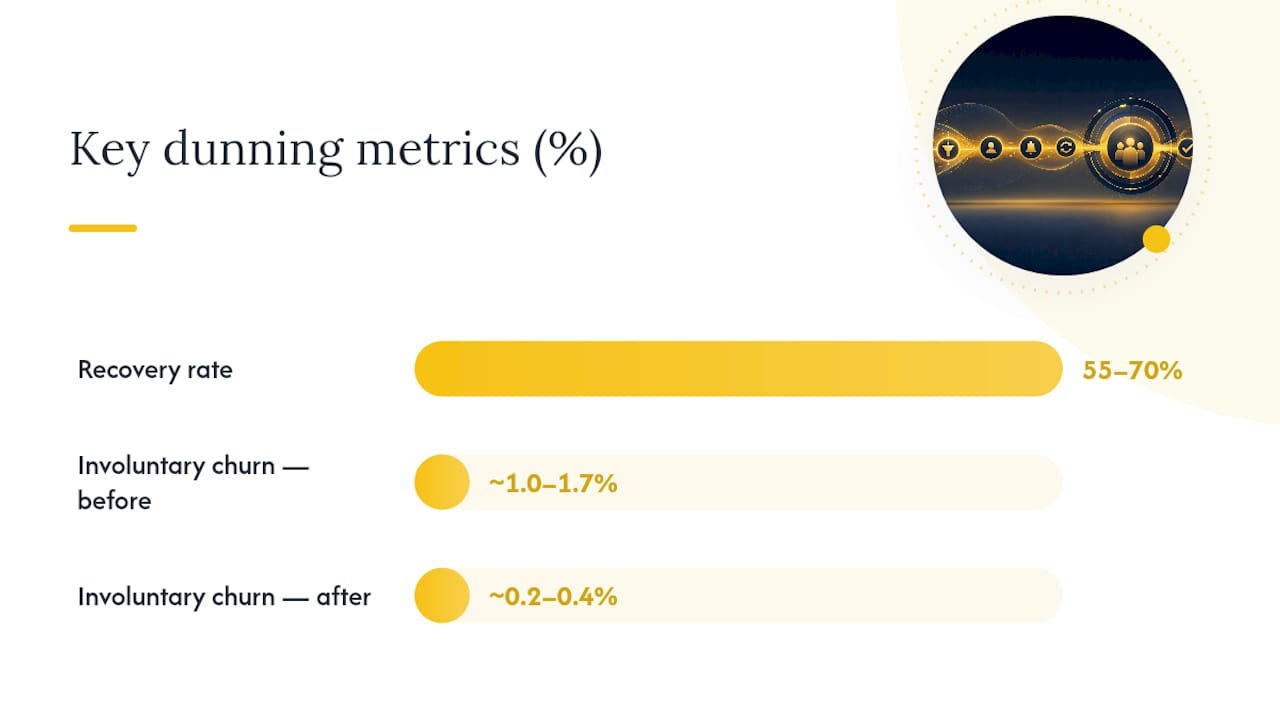
With proper dunning, meaning smart retries, layered email, and frictionless update UX, a large share of failed payments can be recovered and involuntary churn drops noticeably. Measure your own recovery rate before and after each change.
Review monthly at minimum. Watch dunning effectiveness alongside involuntary churn and retry success rather than in isolation, since a high recovery number achieved through aggressive, frequent contact can quietly push voluntary churn up even as involuntary churn drops.
Where Dunning Sequences Go Wrong
Most failed dunning programs share the same handful of mistakes.
- Retrying expired cards on a fixed schedule instead of redirecting straight to an update request
- Escalating tone too fast, turning a routine card update into a message that reads like a collections notice
- Running an inconsistent cadence where some customers get five touches and others get one, usually a sign the segmentation logic is broken
- Contacting customers outside reasonable hours or ignoring stated communication preferences, which risks both goodwill and compliance exposure around non-harassment and privacy expectations
- Canceling immediately on final failure instead of pausing, which kills reactivation odds
Tone should escalate gradually: informative on day 0, direct by day 7, and only urgent on the final attempt. Offer a concession, like a short extension or a discount, before you offer a phone call for high-value accounts nearing cancellation. Pause the subscription rather than deleting the account whenever your billing system allows it. A grace period of 14 to 21 days after the final retry attempt gives customers room to fix a card and come back without starting over, and that window alone tends to recover meaningfully more accounts long term than an immediate delete.
How Dunning Fits Into a Broader Churn Prediction Strategy
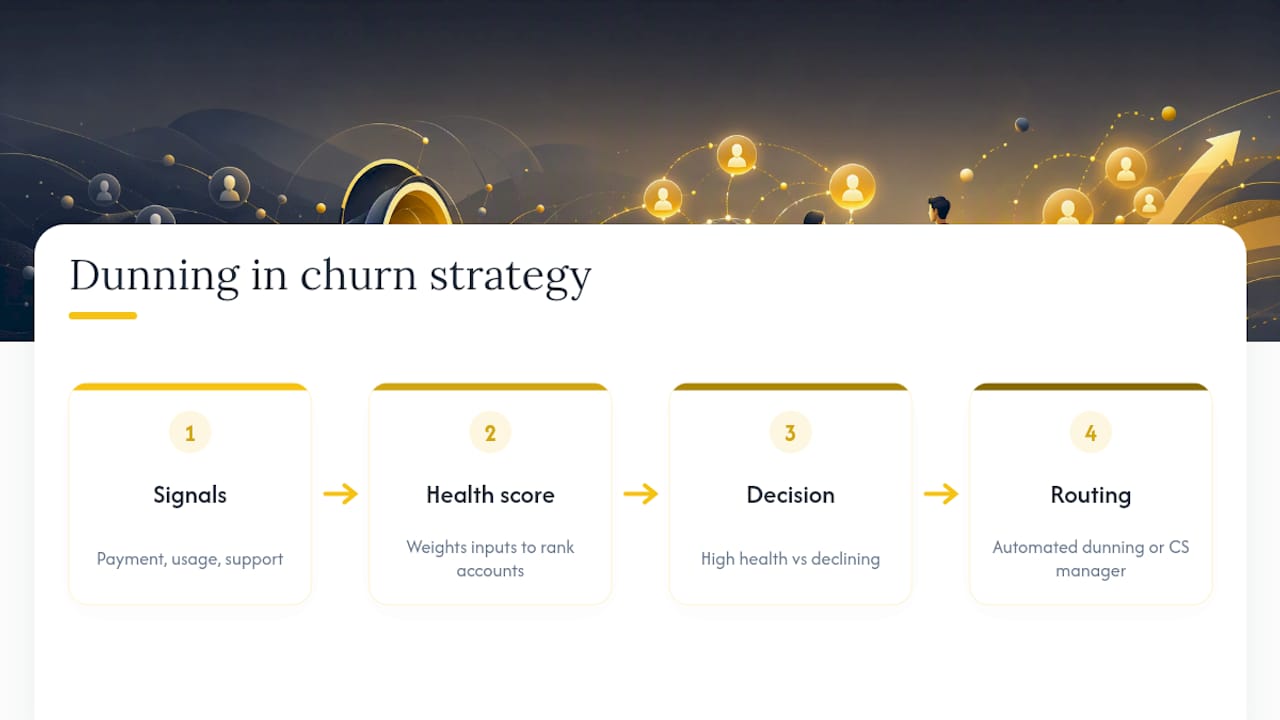
A failed payment isn't just a billing event. It's a signal, and one of the strongest ones you have. Feeding payment-failure data into a churn prediction model alongside product usage and support history gives a much sharper picture than billing data alone, since a lapsed card on a highly engaged account behaves very differently from the same failure on an account that already stopped logging in.
Health scoring treats a payment failure as one input among many, weighting it against usage trends and support activity to flag which accounts need a retention playbook, not just a payment reminder. The operational win is combining automated recovery with a CS workflow: when a high-health account fails payment, route it to an automated dunning sequence; when a declining-health account fails payment, route it to a customer success manager instead.
What Actually Moves the Needle Here
Most teams overinvest in email copywriting and underinvest in the update UX, and that's backwards. A perfectly worded email pointing to a clunky billing settings page will lose to a mediocre email with a working one-click link every time. This is one of the few retention projects where fixing a UX flaw pays back within a single billing cycle, which is rare in a discipline where most improvements take quarters to show up in the numbers. Start small this week.
The 7-day starter checklist:
- Day 1 to 2: turn on real-time payment-failure alerts and route expired cards to an immediate update request
- Day 3: add an in-product banner with a single CTA
- Day 4 to 5: ship your day-0 and day-3 emails
- Day 6 to 7: measure recovery rate on the cohort that just went through it
Bigger MRR accounts deserve the human escalation step first; smaller accounts can run fully automated from day one.
Patrik
Put Recovery and Prediction in One Workflow
Most dunning tools stop at the payment layer. They'll retry a card and send a reminder, but they have no idea whether the account behind that failed charge is thriving or already halfway out the door. The gap can be closed by combining automated churn prediction with explainable health scoring, so a failed payment gets treated differently depending on the account's actual risk level, not just its billing status.
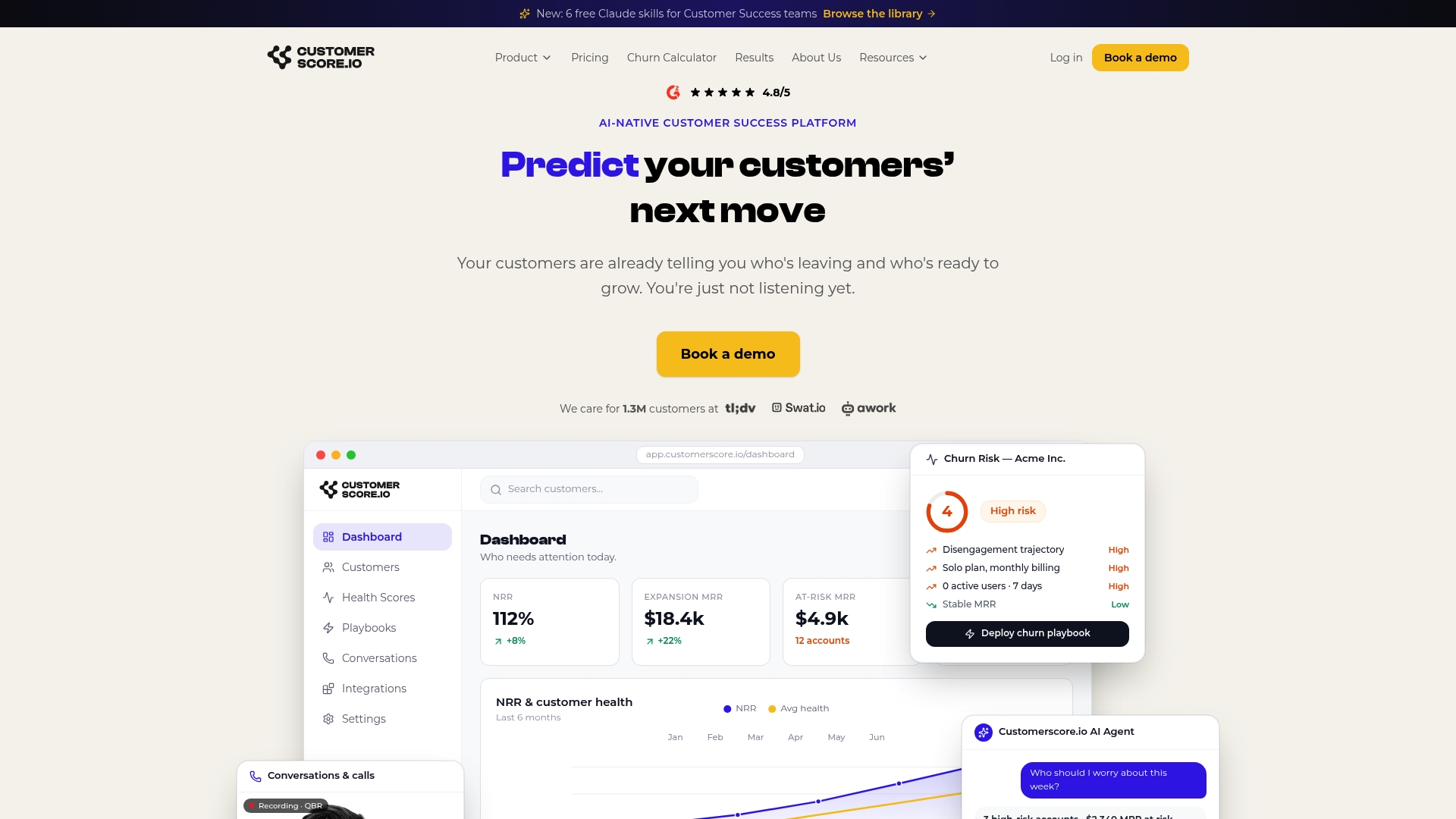
That distinction changes what you do next. A healthy, engaged account with a lapsed card gets routed through automated recovery. A declining account, one with a high Churn Risk Score, starts a playbook instead: the account's CS manager gets the tasks to reach out before the subscription lapses entirely. If you want to see what involuntary churn is actually costing you, run your numbers through the SaaS churn calculator first, then book a demo to see how prediction and recovery work together inside one platform.
Sources
For more on retry mechanics and recovery benchmarks, see the dunning recovery playbook and the dunning process breakdown. For broader retention tactics, Customerscore's guide to churn prevention strategies and this partner piece on customer retention strategies go deeper.
Recommended
Related articles
Best Customer Success Software for SaaS Teams in 2026
The 8 best customer success software platforms for SaaS in 2026, compared by company size and use case: health scoring, churn prediction, automation, pricing.
BlogMulti-Year Renewals in B2B SaaS: When to Offer Them and How
When a multi-year renewal pays off, what discount to expect, which clauses protect both sides, and how to time the offer.
BlogCustomer Success Org Design: Structure, Roles and CSM Capacity
How to structure a customer success team, size books by hours rather than ratios, and evolve the org as the company grows.
BlogSales to Customer Success Handoff: Template, Checklist and Other Handoffs
A one-page handoff brief, the fields it needs, timing targets, and how support to CS and product to CS handoffs work.