
120–90 Day SaaS Renewal Management Playbook for CS & RevOps, Ops First


SaaS renewal management is the operational system that moves a customer from signed to re-signed, replacing spreadsheet chasing with health-score triggers and a fixed timeline. The single highest-leverage move is starting a 120-day-to-90-day automated trigger sequence tied directly to account health, not calendar reminders. Renewal rate and Net Revenue Retention are the scorecards that tell you whether it's working.
TL;DR:
- Automated health score triggers and risk classification at 90 to 120 days before renewal significantly improve on-time renewal rates, reaching nearly 97 percent with all indicators green.
- Accurate renewal management relies on clean, integrated data fields like renewal date, contract value, and health score, typically integrated through reverse ETL into the CRM.
- Assign ownership based on account segment and gross revenue retention threshold, with owners embedded directly into CRM records to prevent handoff failures.
- Quick response protocols for cancellation signals include urgent calls within hours and formal save offers within 48 hours, with discounts reserved as a last resort.
- Running a SaaS churn calculator helps quantify revenue risk, enabling smarter budgeting and targeted pilot programs before full-scale automation deployment.
Table of Contents
- Why Renewal Management Matters for B2B SaaS
- Core Components and KPIs You Must Track
- The 90 to 120 Day Renewal Playbook: Timeline and Escalation Rules
- Segmentation and Ownership: Who Should Own Renewals
- Automation and Data Plumbing: What Renewal Automation Actually Requires
- Save Plays: What to Do When Cancellation Risk Appears
- Measure and Iterate: Running a Renewal Pilot That Proves Itself
- How Customerscore.io Operationalizes This Playbook
- Try the Playbook Without Building It From Scratch
- An Editorial Take on What Actually Predicts Renewal Success
- Sources
Why Renewal Management Matters for B2B SaaS
Renewals are the cheapest revenue a SaaS company generates. No sales cycle, no acquisition spends, just retained ARR compounding into Net Revenue Retention. A small lift in renewal rate, say two or three points, moves NRR enough to change how investors and boards read the business.
Most teams don't fail because renewals are hard. They fail because tracking breaks down quietly, then all at once.
- Spreadsheet-based tracking works fine at 15 accounts and falls apart around 30 to 40 customers, when nobody notices a renewal date until it's three weeks out.
- The result is the classic 30-day fire drill: a CSM scrambling for context on an account they haven't touched in months.
- Warning signs it's time to build a real system: manual renewal tracking eating a full day a week, forecast misses on "sure thing" accounts, or Gross Revenue Retention drifting down two quarters in a row.
If any of those sound familiar, the fix isn't more diligence. It's a renewal management process that runs on triggers instead of memory.
Core Components and KPIs You Must Track
Renewal management runs on two types of metrics, and confusing them is the most common measurement mistake in customer success.
Lagging indicators tell you what already happened: renewal rate (percentage of contracts that renew), churn rate (the inverse), Gross Revenue Retention (revenue kept, ignoring expansion), and Net Revenue Retention (revenue kept plus expansion, minus contraction and churn). NRR is the strategic scorecard because it captures the full picture, not just whether logos stuck around.
Leading indicators tell you what's about to happen, which is where the real work lives:
- Health score, built from usage depth, support sentiment, and champion stability
- Product adoption against the features tied to the customer's original use case
- NPS trajectory, not just the last score but the direction it's moving
- Champion turnover, since a departed sponsor is often the first real churn signal
Statistic to know: accounts showing all five leading indicators green roughly 90 days before renewal renew at close to 97% in cited industry guidance, while missing even one or two knocks that probability down sharply. That gap is why leading indicators, not last quarter's usage report, belong on the dashboard your CSMs check daily.
Different roles need different views: executives want portfolio health at a glance, CSMs need their own renewal pipeline sorted by risk, and RevOps needs discount rates and cycle time to spot process drag.
The 90 to 120 Day Renewal Playbook: Timeline and Escalation Rules
A renewal shouldn't be a surprise, and it shouldn't require a hero. Here's the sequence that keeps it boring, in the best way:
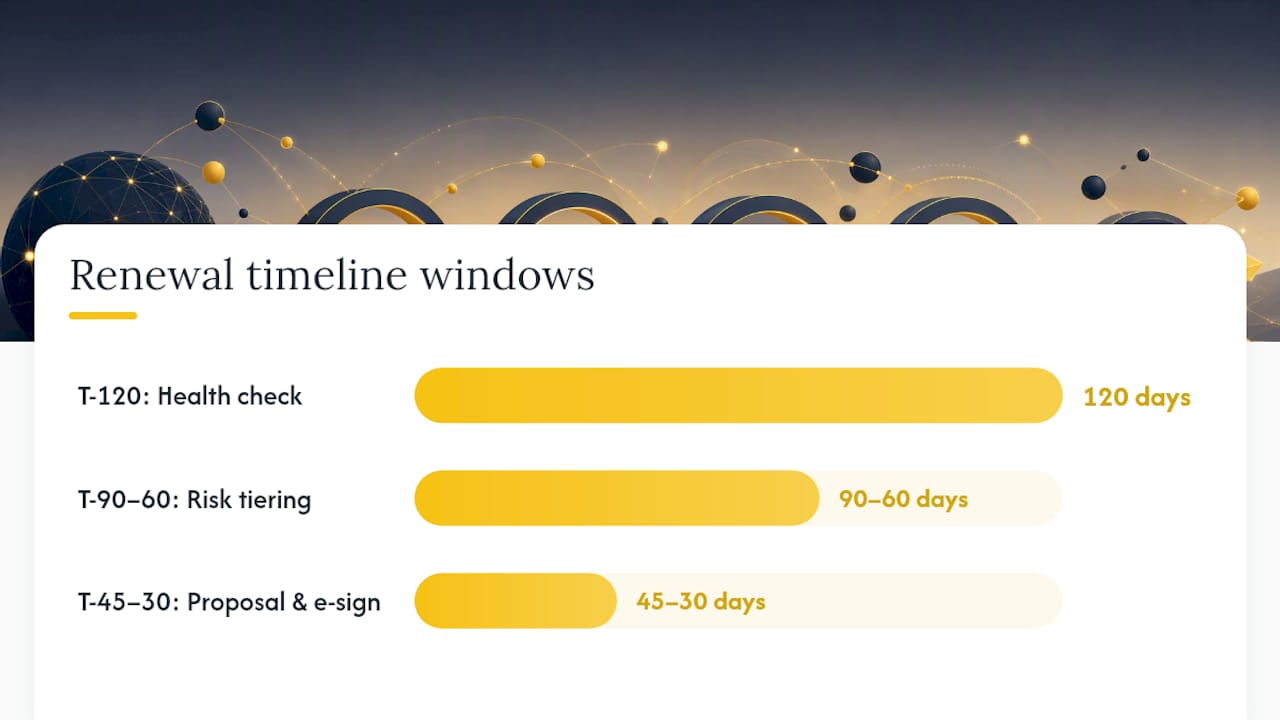
- T-120 days: Run an automated health assessment and validate that your stakeholder map is current. Generate a renewal brief covering usage trends, open tickets, and contract terms before anyone picks up the phone.
- T-90 to T-60 days: Classify the account into a risk tier: Green (healthy, low touch), Yellow (mixed signals, structured check-in), or Red (clear risk, executive involvement required). Each tier gets its own outreach cadence, not a generic template.
- T-45 to T-30 days: Trigger automated proposal generation and e-signature routing. Set reminder cycles that escalate in urgency by tier. If a contract sits unsigned past T-30 in a Yellow or Red account, that's an automatic flag, not a wait-and-see.
- Escalation authority: Give CSMs discount authority up to a fixed threshold, commonly 10 to 15%. Anything beyond that routes to a VP or the CRO, with the reason documented so pricing decisions don't become tribal knowledge.
This structure mirrors the tiered escalation approach that high-performing renewal teams use to avoid both under-attention on healthy accounts and under-reaction on risky ones.
Pro Tip: Send renewal outreach from the named CSM's email address, not a shared inbox. Renewal emails sent from an individual CSM see roughly 2.3 times higher response rates than generic company addresses, according to Gainsight-cited data. Automate the trigger, but keep the sender human.
Segmentation and Ownership: Who Should Own Renewals
Not every account needs the same owner, and forcing one model across your whole book creates friction exactly where you can least afford it.
A workable rule of thumb: if Gross Revenue Retention on a segment sits above 95%, let customer success own the renewal outright, low friction, relationship-driven. If GRR drops below 90%, bring in sales or a dedicated renewals specialist who has real negotiation authority.
Segment further by:
- Annual contract value, since a $200,000 account and a $12,000 account warrant different attention models
- Product stickiness, meaning how deeply the account has adopted core workflows versus a single feature
- Strategic status, whether the account is a reference customer or influences category perception
- Contract term length, since multi-year deals change the urgency curve entirely
Encode the owner directly as a CRM field tied to the account record, not a side note in Slack. Handoffs fail when ownership lives in someone's memory instead of the system.
Automation and Data Plumbing: What Renewal Automation Actually Requires
None of this works without clean data sitting in fields your automation can actually read. At minimum, every account record needs: renewal date, contract value, contract term, auto-renew flag, primary contact, CSM owner, current health score, and last NPS response.
The integration pattern that makes this reliable runs product telemetry into a data warehouse, then out through reverse ETL into the account record your CRM already uses. This keeps the CRM as the single source of truth instead of another disconnected dashboard nobody checks. Tools like n8n paired with AI can handle the outreach layer once the data is flowing.
Once the plumbing exists, prioritize automation in this order:
- The 90-day trigger workflow that kicks off risk classification and brief generation automatically
- Proposal generation tied to the contract terms already sitting in the CRM
- Escalation alerts for unsigned contracts past T-30, routed by risk tier
Teams with clean contract data and an existing CS platform can stand up this full system in 4 to 8 weeks; building from scratch with messy data takes closer to 8 to 12.
Save Plays: What to Do When Cancellation Risk Appears
When a customer signals they're leaving mid-renewal window, speed matters more than the perfect pitch.
- Within 4 hours: The assigned CSM calls, not emails. A phone call signals urgency an automated message can't.
- Within 24 hours: If the CSM can't get traction, an executive from your side reaches out directly to the customer's decision maker.
- Within 48 hours: Present a formal save offer, whether that's a discount, a contract restructure, or a service addition, with alternate contacts looped in if the champion has gone quiet.
- After resolution: Document what worked and what didn't. A save that isn't logged teaches the team nothing for next time.
Discounting should be the last lever pulled, not the first. Fixing an onboarding gap or adding a success plan often resolves the actual risk that a discount would only mask.
Measure and Iterate: Running a Renewal Pilot That Proves Itself
Don't roll this out company-wide on day one. Pick one segment, run it for a full quarter, and track four numbers: on-time renewal rate, discount rate, cycle time to signature, and at-risk ARR recovered.
Cohort analysis is what separates a real signal from noise. Compare pilot accounts against a matched control group and check whether NRR or renewal rate actually moved, not just whether the team felt busier.
Reporting cadence matters as much as the metrics themselves:
- Weekly: a simple CS card showing pipeline health per rep
- Monthly: an executive summary of renewal rate, NRR trend, and at-risk ARR
- Quarterly: a strategic review that decides whether to expand the playbook or adjust it
How Customerscore.io Operationalizes This Playbook
Building the system described above from scratch, health scoring, risk tiers, automated triggers, proposal workflows, is months of engineering work most CS teams don't have spare. Customerscore was built to skip that build phase entirely.
The platform generates explainable health scores from usage data, billing signals, and support history pulled through integrations with tools like Salesforce, HubSpot, Stripe, Chargebee, and Intercom, then feeds those scores directly into renewal workflows and real-time alerts. When an account's health score drops into Yellow or Red territory, the trigger fires automatically instead of waiting for a CSM to notice during a manual check.
Before building a business case internally, two resources are worth pulling up. Customerscore's 44,000-user retention study breaks down what actually predicts renewal risk across a large B2B SaaS dataset, and the renewal rate guide walks through how to define and track the metric correctly before you set targets.
For a lower-touch model, the self-serve churn reduction guide covers what changes when there's no CSM in the loop at all.
Try the Playbook Without Building It From Scratch
Everything in this playbook, health scoring, risk tiers, automated 90-day triggers, is exactly what Customerscore runs for B2B SaaS teams without months of internal engineering. Instead of stitching together a warehouse, reverse ETL, and a homegrown scoring model, you plug in your billing and product data and the health scores start generating within weeks, not quarters.
If you want to see the size of the problem before committing to a build, run the SaaS churn calculator against your current book of business. It turns your renewal rate and ARR into a concrete revenue-at-risk number, the kind of figure that makes budget conversations easier. From there, the natural next step is to book a demo and pilot the health scoring model on one segment, the same approach this playbook recommends before rolling anything out company-wide.
An Editorial Take on What Actually Predicts Renewal Success
Most renewal advice focuses on the conversation: what to say on the call, how to frame the value story, when to bring up price. That's not wrong, but it's downstream of the real problem. Teams don't lose renewals because a CSM said the wrong thing on a call. They lose them because nobody saw the risk coming 90 days earlier, when there was still time to act.
If you do nothing else this quarter, do three things. Make renewal date a required CRM field on every account, not a nice-to-have. Turn on a single 90-day trigger for one pilot cohort instead of trying to automate everything at once. And run the churn calculator against your current book so you know the actual dollar exposure before you argue for budget. Each of those closes a gap between when risk appears and when someone notices it, and that gap is where most preventable churn actually lives.
Patrik
Sources
- SaaS Renewal Automation Checklist: The 90-Day Playbook 2026
- Renewal management: stop losing renewals you should win
- How To Improve Customer Renewals
Recommended
Related articles
Five Fields to Fix Playbook Trigger Design for B2B SaaS CS & RevOps
Five Fields to Fix Playbook Trigger Design for B2B SaaS CS & RevOps ! Isometric trigger routing system illustration The most reliable approach to playbook trigger design is to sort every alert into
BlogStop SaaS Downgrades: Save 31% of At Risk Accounts for CS & RevOps
Stop SaaS Downgrades: Save 31% of At Risk Accounts for CS & RevOps ! Isometric account protection title card The fastest way to prevent SaaS downgrades is to stop treating every at-risk account the
Blog24–48 Hour Handoffs: B2B SaaS Support to CS Checklist, Six Fields
24–48 Hour Handoffs: B2B SaaS Support to CS Checklist, Six Fields ! Isometric handoff cards crossing between platforms A reliable support to CS handoff transfers ownership and context so the new owner
Blog90–120 Day Explainable AI Playbook to Reduce Renewal Risk for SaaS CS
90–120 Day Explainable AI Playbook to Reduce Renewal Risk for SaaS CS ! Isometric illustration of explainable renewal risk decisions To reduce renewal risk, you prioritize accounts daily using