
Stop SaaS Downgrades: Save 31% of At Risk Accounts for CS & RevOps


The fastest way to prevent SaaS downgrades is to stop treating every at-risk account the same way. Prioritize accounts using cohort-driven signals, separate the savable from the unsavable, and run targeted plays on the ones worth saving. Some customer success platforms now build this workflow directly into daily account prioritization, so Customer Success and RevOps teams spend their limited hours where they actually move ARR.
TL;DR:
- Usage volatility, especially among high-value accounts, is the most reliable early indicator of potential downgrade risk within 30 to 90 days.
- Segmenting accounts by usage patterns and contract value helps prioritize efforts, with volatile, high-value accounts being the top focus for retention strategies.
- Short-term intervention involves diagnosing, validating with the customer, and realigning features or contracts to prevent downgrades effectively.
- Pricing models tied directly to usage and longer contract lengths significantly reduce downgrade pressure and improve retention rates.
- Centralizing all customer data in a platform like Customerscore.io enables proactive risk detection, prioritized actions, and automated renewal prep, boosting retention outcomes.
Table of Contents
- Signals that reliably predict downgrades
- A triage framework: savable vs. unsavable accounts
- Defensive plays to stop contractions and offensive plays to prevent repeats
- Pricing and contract levers that reduce downgrade pressure
- The Customer Success Platform as your instrumentation hub
- Metrics and dashboards that prove you're preventing downgrades
- A practitioner's take on fixing downgrades
- Customerscore.io: how the platform maps to this playbook
- FAQ
- Sources
Signals that reliably predict downgrades
Low usage gets most of the attention, but it's the wrong signal to chase alone. Usage volatility, meaning inconsistent engagement that swings up and down rather than steadily declining, predicts contraction earlier and more reliably than a flat low-usage reading. A customer logging in sporadically after months of steady use is often a stronger downgrade risk than one using the product lightly but consistently.
Track a combination of signals rather than any single metric:
- Product usage trends across core features, not just login frequency
- Support ticket volume and sentiment, especially sudden spikes or silence
- Billing anomalies like failed payments or seat reductions
- Feature or seat drop-off between billing cycles
- Engagement decline among champions or admin users
A 30 to 90 day lookback window balances responsiveness against noise. Shorter windows catch urgent signals but generate false positives from normal usage dips; longer windows smooth out noise but react too slowly. Cohort movement within 30 to 90 days is the strongest early predictor of long-term retention outcomes, according to research across more than 9,000 accounts, which makes that window the right default for most CS teams building their own monitoring.
A triage framework: savable vs. unsavable accounts
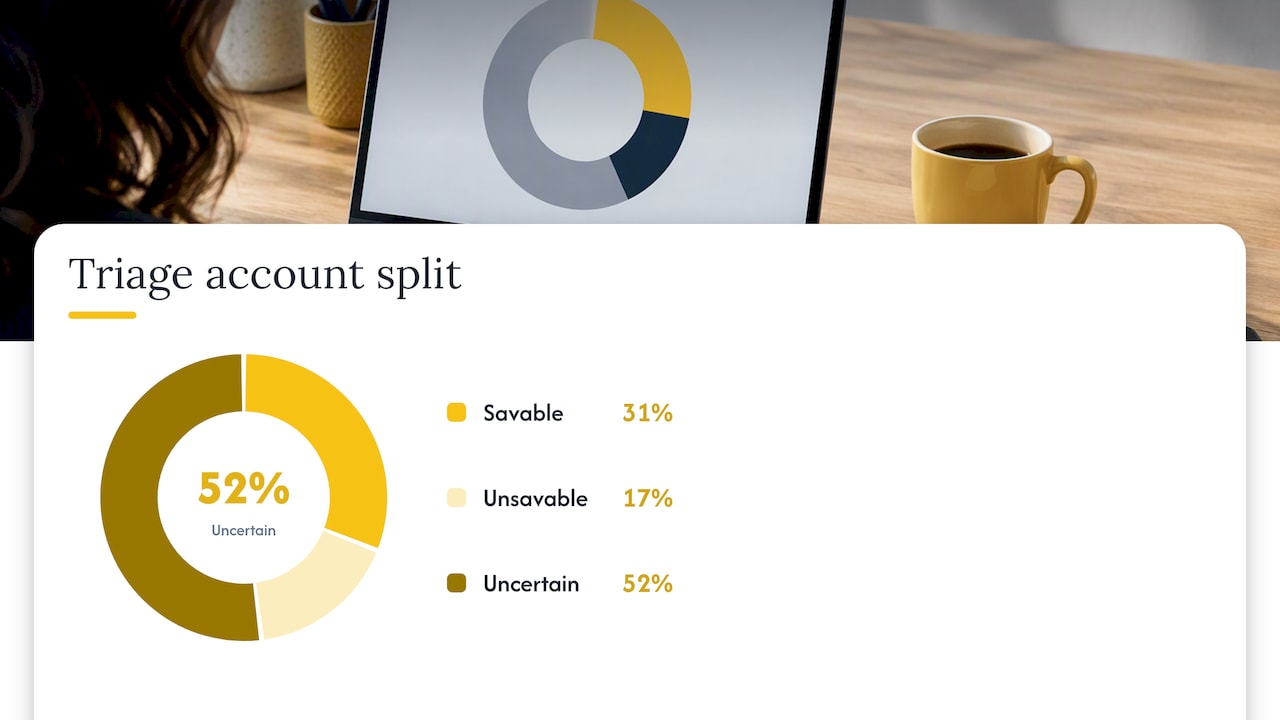
Not every at-risk account deserves equal effort. Among accounts below renewal thresholds, roughly 31% are savable with the right intervention while 17% will churn regardless of what you do. That split matters because it tells you where effort pays off and where it's wasted, and usage volatility is what helps separate the two groups before a renewal conversation ever happens.
A workable triage sequence looks like this:
- Segment accounts by usage level, usage consistency, and annual contract value.
- Flag accounts with volatile usage and high ACV as top priority for intervention.
- Deprioritize accounts with consistent, deep decline and low ACV, since these rarely respond to outreach.
- Assign daily focus using a blend of predictive risk score, account value, and renewal proximity.
Cohort-based account management, when applied this way, can predict renewal and expansion outcomes with roughly 90% accuracy up to twelve months in advance and has been linked to NRR gains of around 5% while cutting wasted interventions.
Pro Tip: Run your triage weekly, not just at renewal time; volatility signals shift faster than most renewal calendars do.
Defensive plays to stop contractions and offensive plays to prevent repeats
When an account shows downgrade signals, a three-step defensive sequence keeps the response disciplined instead of reactive:
- Diagnose: pull usage, billing, and support history into one view to confirm what's actually driving the risk, rather than guessing from a single data point.
- Confirm: validate the hypothesis directly with the customer through a targeted call or outcome-focused QBR rather than assuming intent.
- Realign: match the fix to the root cause. That might mean a short re-onboarding on unused features, a temporary credit to bridge a budget crunch, or a structural change to the contract if the mismatch is permanent.
Tactical options within that sequence include:
- Targeted re-onboarding focused on the two or three features tied to the account's original use case
- Feature activation pushes when adoption has stalled on paid capabilities
- Outcome-based QBRs that connect usage data to business results instead of listing metrics
- Temporary concessions reserved for genuine short-term hardship, not as a default retention lever
Offensive plays reduce the odds of ever reaching this point. Thirty to 90 day adoption sprints right after onboarding, deliberate champion development beyond the original buyer, and recurring feature adoption campaigns all build the usage depth that makes downgrade conversations rare. Escalate to leadership when ACV or strategic value is high; disengage gracefully from accounts already flagged unsavable rather than draining more hours there. Our churn prevention playbook covers more of these tactics in sequence.
Pricing and contract levers that reduce downgrade pressure
Commercial structure does as much work as any CSM outreach. Value-aligned pricing that ties cost to usage makes downgrades less attractive because price naturally tracks value instead of forcing an all-or-nothing contract exit.
Contract length matters too. Multi-year contracts show higher median net and gross retention than annual or monthly terms, since longer commitments reduce the frequency of renegotiation moments where downgrades get decided.
A short checklist for commercial response:
- Offer a temporary credit when the issue is a short-term budget constraint, not a value mismatch.
- Renegotiate the structure (seats, usage tier, committed volume) when the mismatch is likely to recur.
- Use committed usage minimums for high-volatility accounts to smooth revenue even if raw usage dips.
- Reserve discounting for accounts with high strategic value and confirmed savability.
The Customer Success Platform as your instrumentation hub
Downgrade signals live in too many disconnected systems to catch manually. The minimum consolidation most teams need pulls together:
- Billing data from Stripe or Chargebee
- CRM records from HubSpot or Salesforce
- Product usage from Mixpanel, PostHog, or Segment
- Support history from Intercom or Zendesk
- Call and meeting transcripts from tl;dv or Fireflies
- Communication threads from Gmail and Slack
Post-sales teams that centralize this data and run predictive models on top of it can shift from reactive renewal scrambles to proactive retention, which is the entire point of building a Customer Success Platform as the hub rather than leaving data scattered across tools. A capable platform needs a unified customer record, daily prioritization logic, explainable risk reasons attached to each score, and playbook automation that turns a flagged signal into an assigned task.
Pro Tip: Judge any CSP candidate by whether it explains why an account is at risk, not just that it is: explainability is what turns a score into an action.
The productivity payoff shows up fast: fewer false positives from noisy single-metric alerts, a clear daily priority list instead of a guessing game, and QBR or renewal prep that drafts itself from existing data instead of eating an afternoon.

Metrics and dashboards that prove you're preventing downgrades
Track a small set of metrics consistently rather than a sprawling dashboard nobody checks. The core numbers are net revenue retention (NRR), gross revenue retention (GRR), dollar-based contraction rate, raw downgrade count, and total ARR at risk. Median NRR across sampled B2B SaaS companies sits at 101%, with median GRR at 91%, and those benchmarks are a reasonable bar to measure your own cohorts against.
Operational views worth watching weekly:
- Cohort movement rates between usage tiers, not just net totals
- The ratio of savable to unsavable flagged accounts over time
- Aggregate usage volatility score across the active book
Cadence matters as much as the metrics themselves. CSMs need daily alerts tied to their own accounts, RevOps needs a weekly roll-up across cohorts, and leadership needs a quarterly summary tied back to NRR and contraction trends. Our renewal management guide breaks down how these views map to specific renewal timelines.
A practitioner's take on fixing downgrades
The core fix here is not complicated: instrument your cohorts, score them with a predictive model, and build a daily ritual around acting on the top risks first. Most teams already have the data to do this. What they lack is the discipline to triage instead of reacting to whichever account complains loudest. Start with one cohort, run a 30 to 90 day adoption sprint against it, and measure what moves before rolling the approach out further.
— Patrik Chalupa
Customerscore.io: how the platform maps to this playbook
We built Customerscore.io around exactly this workflow because most CS teams don't need more dashboards, they need one place that tells them who to call today and why. Every account's usage, billing, CRM history, support threads, and call notes live on a single record, and our predictive models score churn and expansion risk with the drivers explained in plain language instead of a mystery number.
Each morning, every CSM on your team sees a prioritized list built from that scoring, not from gut feel. Customer Rooms give you a shared workspace with the customer for onboarding or renewal work, and QBR and renewal prep draft themselves from the period's actual data and conversations.
What we offer:
- A flat platform fee tiered by your ARR, never per seat, with the full platform for every customer
- Expert-led setup that gets the platform live in 1 to 3 weeks, not months
- A dedicated churn prediction model built on your own account history
If this playbook sounds like what your team is missing, check pricing and plans to see where you'd fit.
FAQ
What percentage of at-risk SaaS accounts can actually be saved?
Research across more than 9,000 accounts found that roughly 31% of accounts below renewal thresholds are savable with the right intervention, while about 17% will churn regardless. Usage volatility is the signal that helps separate the two groups before a renewal conversation happens.
How early can you predict a SaaS downgrade?
Cohort-based account management can predict renewal and expansion outcomes with roughly 90% accuracy up to twelve months in advance. Consistent tracking of usage volatility, rather than a single usage snapshot, is what makes that lead time possible.
Does usage-based pricing actually reduce downgrades?
Value-aligned pricing that ties cost to usage makes downgrades less attractive because price tracks value instead of forcing a binary renew-or-cancel decision. Market leaders using platform plus usage fees are 6 to 13% more likely to meet growth targets than those on rigid flat tiers.
What's a healthy net revenue retention benchmark for B2B SaaS?
Median net revenue retention across sampled B2B SaaS companies was 101% in 2025, with median gross retention at 91%. Companies with higher ACV and multi-year contracts tend to post stronger numbers than those on monthly terms.
Can a Customer Success Platform like Customerscore.io actually prevent downgrades?
A platform built to centralize billing, usage, CRM, and support data can surface downgrade risk earlier than manual tracking and prioritize which accounts to act on first. Customerscore.io does this through explainable predictive scoring and daily prioritized account lists, with plans and pricing available here.
Sources
- New study reveals the post-sales B2B roles and tools that increase NRR
- RB32WS1-2025 B2B SaaS Retention Benchmarks (SaaS Capital)
- How Market Leaders Reverse Declining NRR
- Engineering SaaS Account Growth (SBIGrowth)
Recommended
Related articles
Five Fields to Fix Playbook Trigger Design for B2B SaaS CS & RevOps
Five Fields to Fix Playbook Trigger Design for B2B SaaS CS & RevOps ! Isometric trigger routing system illustration The most reliable approach to playbook trigger design is to sort every alert into
Blog24–48 Hour Handoffs: B2B SaaS Support to CS Checklist, Six Fields
24–48 Hour Handoffs: B2B SaaS Support to CS Checklist, Six Fields ! Isometric handoff cards crossing between platforms A reliable support to CS handoff transfers ownership and context so the new owner
Blog90–120 Day Explainable AI Playbook to Reduce Renewal Risk for SaaS CS
90–120 Day Explainable AI Playbook to Reduce Renewal Risk for SaaS CS ! Isometric illustration of explainable renewal risk decisions To reduce renewal risk, you prioritize accounts daily using
BlogFix Product to CS Alignment in 60 Days for B2B SaaS CS and Product Leaders
Fix Product to CS Alignment in 60 Days for B2B SaaS CS and Product Leaders ! Product and CS alignment loop illustration Product to CS alignment is an operating model that turns customer signal into