
90–120 Day Renewal System for CSMs: SaaS Renewal Playbook


Run renewals as a 90 to 120 day managed pipeline, not a calendar reminder. That means every account gets an owner, a risk tier, and a milestone workflow that fires automatically in your CRM long before the contract end date. The three levers that make this work are a fixed timeline, health scoring that sorts accounts into green, yellow, and red, and automation that removes the manual tracking. The templates, checklists, and workflow examples below show exactly how to build it.
TL;DR:
- Managing renewal timelines over 90 to 120 days with automated workflows ensures accountability and reduces missed deadlines, especially for enterprise and mid-market accounts.
- Customer health scoring should focus on usage trends, champion engagement, economic signals, and support sentiment, with the lowest score determining the overall risk tier.
- Clear ownership transfer at deal closure and automated deal creation prevent accountability gaps, while weekly pipeline reviews monitor red and yellow accounts proactively.
- Regular, personalized outreach structured around specific milestones, evidence of value, and channel-matched communication boosts renewal success rates.
- Automation of renewal deals and risk scoring via platforms like Customerscore minimizes manual tracking errors and provides explainable insights that support timely interventions.
Table of Contents
- What Is a SaaS Renewal Playbook, Exactly?
- How Do You Score Customer Health for Renewals?
- Who Owns the Renewal After Sales Closes the Deal?
- What Outreach Cadence Actually Drives Signed Renewals?
- How Do You Automate Renewals Inside Your CRM?
- How Do You Find Expansion Revenue During a Renewal?
- How Do You Save a Red-Tier Account Before It Churns?
- What Metrics Should Renewal Dashboards Track?
- Templates and Artifacts You Can Copy Today
- What Happens When a Renewal Requires a Contract Amendment?
- What Negotiation Tactics Actually Work at Renewal Time?
- How Should You Communicate With Customers to Improve Renewal Rates?
- Why Do Sales, CS, and Finance Need to Work Together on Renewals?
- Can You Win Back a Customer Who Already Churned?
- Making the Shift From Reactive to Managed
- Put This Playbook on Autopilot With Customerscore
- Sources
- FAQ
What Is a SaaS Renewal Playbook, Exactly?
A renewal playbook is the documented, repeatable process your team follows from the moment a deal closes to the moment it renews (and beyond). It replaces the "someone will remember to check in around month 11" approach with fixed triggers, named owners, and defined actions at each stage. The industry standard structures this around milestones at T-120, T-90, T-60, T-30, and the final two weeks before the contract ends, with tasks mapped to specific owners so nothing slips through a gap between sales and customer success.
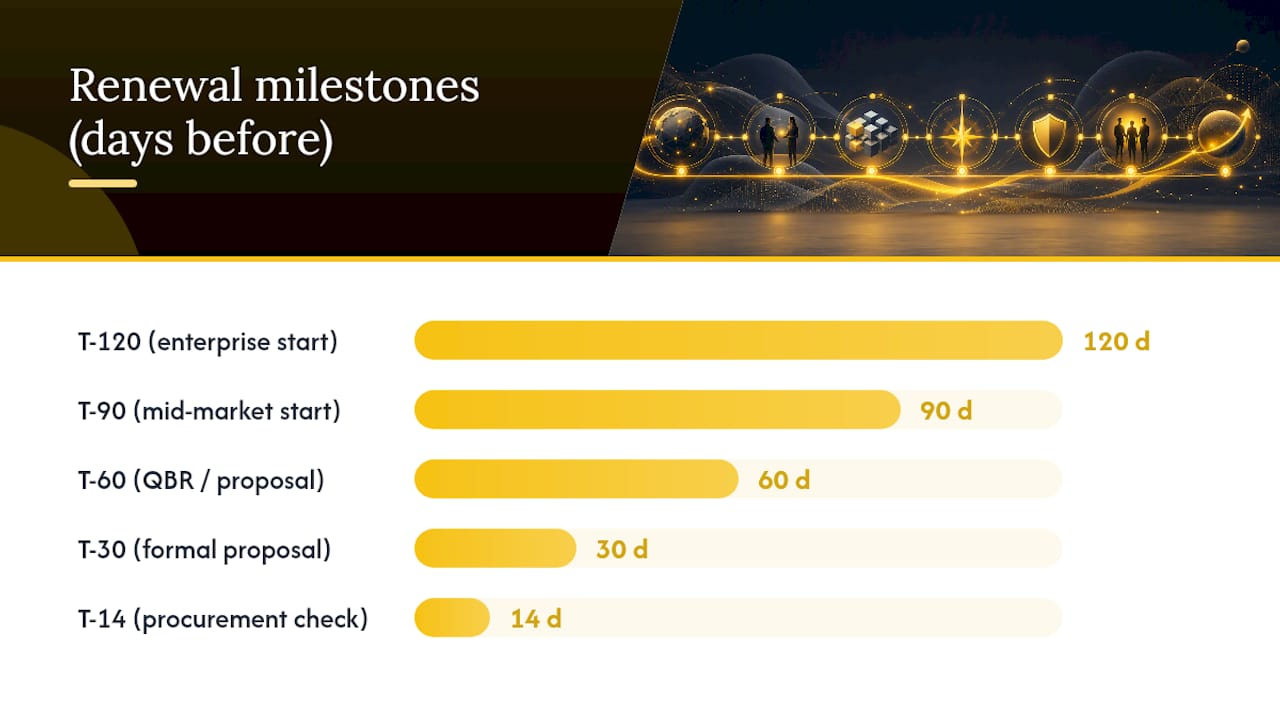
Segment size changes the starting gun. Enterprise accounts generally need more runway because procurement, legal review, and multi-stakeholder buy-in take time. Mid-market accounts often operate with a 120-day timeline. SMB accounts, which have simpler buying committees and lower contract values, can often work within a shorter timeframe without losing much ground.
Here's the milestone sequence and who owns each step:
- T-120 (enterprise) / T-90 (mid-market): CS reviews health score, confirms champion is still active, and flags any red-tier risk to the account team. Owner: CSM.
- T-90 / T-60: Deliver a usage and ROI recap to the customer's economic buyer. Owner: CSM, with sales support for enterprise.
- T-60 / T-45: Run the QBR or renewal conversation, surface expansion signals, and draft the renewal proposal. Owner: CSM + account executive.
- T-30: Send the formal proposal with pricing, term options, and any multi-year incentive. Owner: Sales/AE.
- T-14: Confirm procurement status, chase signatures, escalate stalled deals to management. Owner: CSM + Sales manager.
- T-7 to T-0: Final signature push; legal and finance confirm terms match billing. Owner: Deal desk or RevOps.
- Post-renewal: Update CRM, kick off next-cycle health tracking, log any expansion commitments. Owner: CSM.
Checklist items at each stop should include a current value document, an up-to-date stakeholder map, and a standing proposal template so no one starts from a blank page under deadline pressure. This 90-day renewal timeline framework is the closest thing the industry has to a shared standard, and it's worth adapting rather than reinventing.
How Do You Score Customer Health for Renewals?
A useful health score combines four signals: usage trend, champion health, economic signal, and support sentiment. Usage trend carries the most weight because flat or declining product adoption is one of the strongest early predictors that an account is drifting toward churn, often well before anyone says so out loud. Champion health tracks whether your internal advocate is still employed, still engaged, and still influential. Economic signal covers budget pressure, layoffs, or M&A activity at the account. Support sentiment picks up frustration building in ticket tone and volume.
The rule that matters most: the lowest-scoring dimension wins. An account with great usage but a champion who just left for a competitor isn't green, no matter how the other numbers look.
- Score each dimension 1 to 5, then let the floor value set the tier, not the average.
- Green (4 to 5 across the board): standard cadence, light-touch check-ins, expansion conversation on the table.
- Yellow (any dimension at 2 to 3): CSM schedules a proactive call within two weeks, documents the specific risk, and loops in a manager if no improvement by the next milestone.
- Red (any dimension at 1): immediate escalation, save-plan triggered, executive sponsor involved within 48 hours.
Pro Tip: Build the 1 to 5 grid into a weekly review, not a monthly one. A 1 to 5 scoring grid built on usage, champion, and economic signal is simple enough for a CSM to update in minutes, and simple beats sophisticated when it actually gets used.
Customerscore's explainable health scoring approach applies this same lowest-dimension logic automatically across billing, usage, and support data, which removes the spreadsheet guesswork from tier assignment.
Who Owns the Renewal After Sales Closes the Deal?
Renewal ownership has to transfer cleanly at Closed Won, or accounts drift for months without anyone accountable. The handoff meeting between the account executive and the CSM should happen within five business days of signature, and it isn't complete until specific fields are filled in the CRM record, not just discussed verbally.
Required fields at handoff:
- Value case: the specific business outcome the customer bought, in their own words if possible.
- Champion name and role: who signed off internally and who else influenced the decision.
- Contract term and renewal date: exact dates, not "sometime next year."
- Assigned renewal owner: the CSM name, entered as a CRM property, not a Slack mention.
The renewal deal itself should auto-create the moment the original deal closes, carrying over the account name, contract value, term length, and renewal date so the CSM inherits a pre-populated record instead of building one from scratch. A renewal playbook template built around this exact handoff structure is one of the more complete frameworks available for standardizing this step across a team.
What Outreach Cadence Actually Drives Signed Renewals?
The 90-60-30 cadence gives structure to what would otherwise be ad hoc check-ins, and it works because each stage has a distinct job rather than repeating the same "just checking in" message three times.
- T-90: Value review. Send a usage and ROI recap showing adoption trends against the goals set at onboarding. This is where you plant the seed for expansion, not close it.
- T-75: QBR. Run a structured quarterly business review with a fixed agenda covering wins, open issues, and roadmap alignment. Use this meeting to surface whether budget exists for a bigger footprint.
- T-60: Expansion discovery. If the QBR revealed appetite, this is the call to explore seats, modules, or tier upgrades. Keep negotiation separate from discovery.
- T-45 to T-30: Proposal. Send the renewal proposal with term options, including any multi-year pricing. This is where negotiation actually starts.
- T-14: Signature push. Confirm procurement and legal have what they need; escalate anything stuck.
- Post-renewal (T+7): Send a thank-you and confirmation, then immediately log next-cycle goals and any expansion commitments so they don't get lost between now and next year's T-90.
Skipping straight from a QBR to a proposal, without the separate expansion discovery step, is the most common reason renewal conversations feel transactional instead of strategic.
How Do You Automate Renewals Inside Your CRM?
Manual tracking is where renewal playbooks die. The highest-impact automation is triggering a renewal deal automatically the moment the original deal closes, rather than relying on a CSM to remember to create one.
- Auto-create the renewal deal on Closed Won, copying over contract value, term, close date minus term length as the new renewal date, and the assigned owner.
- Time-based stage progression should move the deal through Upcoming, 90-Day, 60-Day, 30-Day, and Overdue automatically based on days remaining, not manual updates.
- Line items need to copy correctly from the original deal, which is a common failure point; verify this before trusting the automation blindly.
- Build loop protection into any workflow that re-triggers on property changes, or you risk duplicate deals firing every time a field updates.
- Reconcile CRM and billing weekly. Mismatched renewal dates across your CRM, billing system, and any spreadsheet someone still keeps on the side are the single most common source of missed renewals.
Pro Tip: HubSpot has no native renewal object, so most teams build this through workflow automation that clones deals on Closed Won. Test the line-item copy behavior with a dummy deal first. This is exactly where automations quietly break without anyone noticing until a renewal is missed. A step-by-step renewal outreach automation template using n8n gives a workable pattern if you want to extend automation past the CRM itself.
How Do You Find Expansion Revenue During a Renewal?
Every renewal conversation is also an expansion opportunity if you ask the right questions at T-90, before the deal turns into a negotiation.
Run this five-question audit:
- Has actual usage grown beyond the contracted seats or usage tier?
- Are new departments or teams touching the product who weren't in the original deal?
- Has the customer's own headcount or revenue grown since signing?
- Are they using workarounds that a higher tier or add-on module would solve?
- Has a champion mentioned budget availability for next fiscal year?
Multi-year commitments are worth pushing when the account is green: a modest discount, typically single digits, paired with a price lock and a small co-investment like extra onboarding hours, tends to produce outsized retention gains for the concession involved. Structure pricing as Good, Better, Best rather than a single take-it-or-leave-it number, so the buyer is choosing a tier rather than deciding whether to renew at all.
How Do You Save a Red-Tier Account Before It Churns?
Red-tier accounts need a decision made within days, not weeks. Escalate immediately when any health dimension hits a 1, when a champion leaves without a documented successor, or when a customer misses two consecutive check-ins.
- Trigger escalation to a CS manager or VP within 48 hours of the red flag, no exceptions.
- Build a one-page save plan covering the specific reason for risk, the intervention (executive call, service credit, training refresh), the owner, and a hard timeline.
- Set a decision rule up front: discount only if the account has genuine expansion potential or strategic value; otherwise plan for a graceful exit rather than a costly rescue.
A documented save plan structure that names the reason, owner, and timeline forces accountability that a Slack thread never will.
What Metrics Should Renewal Dashboards Track?
Leaders will ask for the same five numbers every quarter, so build dashboards around them instead of scrambling to calculate them live in a meeting.
- Renewal rate (logo count and dollar-weighted, tracked separately).
- Net revenue retention (NRR) and gross revenue retention (GRR), the two numbers that reveal whether expansion is offsetting churn.
- Signed-before-end-date percentage, which exposes process leakage even when the final renewal rate looks fine.
- At-risk ARR, meaning the dollar value sitting in yellow and red tiers at any given moment.
- Discount rate on renewals, tracked over time to catch margin erosion before it becomes a pattern.
Run a 30-minute weekly renewal pipeline review with CS, sales leadership, and RevOps, focused specifically on red and yellow accounts. A weekly cross-functional review of at-risk accounts is one of the highest-leverage habits a renewal team can build, and it costs almost nothing to run.
Templates and Artifacts You Can Copy Today
Building this from scratch is slower than adapting what already exists. Start with a one-page handoff spec, a milestone checklist mapped to your own segment timelines, risk-tier play templates for green, yellow, and red, and a save-plan template with fixed fields for reason, owner, and timeline.
A public Notion renewal playbook template offers a ready structure worth adapting rather than building from a blank page. For HubSpot specifically, create custom properties for renewal owner, risk tier, and renewal stage before building any workflow, and test loop protection with a dummy record before trusting automation on live accounts.
| Artifact | Purpose | Where to start |
|---|---|---|
| Handoff spec | Transfers ownership cleanly at Closed Won | Copy the fields listed in the ownership section above |
| Milestone checklist | Keeps every account on the T-120 to T-0 schedule | Adapt the 90 to 120 day timeline to your segments |
| Risk-tier plays | Standardizes response by green/yellow/red | Build from the 1 to 5 scoring grid |
| Save-plan template | Forces accountability on red accounts | One page: reason, owner, intervention, timeline |
Customerscore's health score explainability guide walks through how scoring logic should be built so CSMs can see exactly why an account moved tiers, not just that it did.
What Happens When a Renewal Requires a Contract Amendment?
Contract amendments come up constantly during renewals, usually because pricing, seat counts, or terms need to change from the original agreement. The most common triggers are usage tier changes, added modules, updated data processing terms, or a shift from monthly to annual billing as part of a renewal incentive.
Route every amendment through the same review your legal or deal desk team uses for new contracts, even when the change looks minor. A seemingly small edit to a liability clause or a service level commitment can create exposure that a CSM isn't positioned to catch. Get legal or finance sign-off before the customer sees a redline, not after they've already agreed to terms informally over email.
Auto-renewal clauses deserve particular attention. Many SaaS contracts include automatic renewal language with a notice period, often 30 to 90 days, that obligates the customer to actively cancel or the contract rolls forward. If a customer is unaware of that clause and feels blindsided, it damages the relationship even when you're contractually in the right. Flag auto-renewal terms proactively at T-90 rather than letting a customer discover them at T-7.
Version control matters more than most CS teams treat it. Keep a single source of truth for the current contract terms, ideally synced between your CRM and your contract management or e-signature tool, so sales, CS, and finance are never negotiating off three different documents. Mismatched terms across systems are a direct cause of billing disputes after the ink dries.
When a customer requests a downgrade as part of renewal, treat it as a negotiation point, not an automatic approval. Understand why usage or budget dropped before agreeing to reduced terms. Sometimes a temporary discount or a paused module preserves more revenue long term than a permanent downgrade that's hard to reverse later.
Finally, document every amendment's effective date precisely. A change that takes effect mid-cycle creates proration questions that finance needs flagged before, not after, the next invoice goes out.
What Negotiation Tactics Actually Work at Renewal Time?
The strongest negotiating position comes from timing, not tactics. Starting the value conversation at T-90 gives you leverage that vanishes if the first serious discussion happens at T-14, when the customer knows you're desperate to close before the contract lapses.
Lead with value, not price. Open renewal conversations with the ROI recap and usage data before any number gets mentioned. Customers who see concrete proof of adoption are far less likely to open with a discount demand, because the conversation starts from "this is working" rather than "convince me it's worth renewing."
When a customer pushes back on price, resist the reflex to discount immediately. Ask what specifically triggered the objection: is it budget constraints, a competitor's pitch, or genuine underuse of the product? Each answer calls for a different response. Budget pressure might be solved with a payment schedule change rather than a lower price. A competitor comparison is an opening to reinforce differentiated value. Underuse is a signal to bring in a success plan, not a discount.
Hold firm on price and negotiate on terms instead when possible. Offering flexible payment timing, a temporary seat reduction, or bundled services often satisfies a budget objection without eroding your pricing structure for future renewals or other accounts watching how you handle it.
Never let a renewal negotiation drag past the contract end date without a clear interim agreement. A verbal "we'll figure it out" leaves both sides exposed and often signals to the customer that the relationship isn't a priority. If negotiation is genuinely stalled at T-7, put a short-term extension in writing rather than letting the contract lapse in ambiguity.
Bring your account executive back into the room for enterprise deals once pricing gets serious. CSMs own the relationship, but a joint CS and sales presence at the final negotiation stage signals organizational alignment and often closes faster than a CSM negotiating price alone.
How Should You Communicate With Customers to Improve Renewal Rates?
Communication frequency matters less than communication relevance. A customer who gets a generic "just checking in" email every month tunes out faster than one who hears from you three times a year with something specific to their account.
Personalize every renewal touchpoint with the customer's own usage data, not a generic template. Referencing their specific adoption trend, their named champion, or a feature they use heavily signals that someone is actually paying attention to their account, not running them through a mail merge.
Match the channel to the message. Save phone calls and video meetings for QBRs, expansion discussions, and anything involving risk. Use email for scheduled updates, proposal delivery, and documentation. Reserve Slack or in-app messaging for quick confirmations, not substantive renewal conversations that need a paper trail.
Set expectations early about what the renewal process looks like. A customer who knows in month one that they'll get a usage review at month nine and a proposal at month ten isn't surprised or defensive when those touchpoints arrive. Surprise is what erodes trust during renewal season.
Silence from the customer is a signal, not a green light. If a champion stops responding to renewal outreach, that's a yellow or red flag on its own, independent of whatever the usage data shows. Escalate to a different contact or a manager rather than sending a fourth unanswered follow-up.
Close every renewal, win or lose, with a specific thank-you that references what the coming year will focus on. This single habit does more for next year's renewal conversation than any amount of mid-cycle check-ins, because it sets the tone for the relationship going forward rather than ending the cycle on a transactional note.
Why Do Sales, CS, and Finance Need to Work Together on Renewals?
Renewals fail most often at the seams between departments, not within any single team's work. Sales owns the original relationship and pricing authority. CS owns the day-to-day account health and champion relationship. Finance owns billing accuracy, revenue recognition, and contract terms. When these three don't share a single source of truth, renewals slip through the gaps between them.

Finance needs visibility into upcoming renewals well before the contract date, not just when an invoice needs to go out. A finance team blindsided by a multi-year deal with a price lock, or a mid-cycle downgrade, ends up reconciling billing discrepancies after the fact instead of building them into forecasts ahead of time.
Sales and CS need a shared definition of "renewal ready" so a deal doesn't get pitched to the customer before CS has confirmed the account is actually healthy enough to support an upsell conversation. A joint pipeline review, even briefly, prevents sales from pushing expansion on an account that CS knows is quietly circling red.
Build a recurring, brief sync between the three functions, ideally the same weekly meeting where at-risk accounts get reviewed. Finance doesn't need to attend every week, but should see the at-risk ARR number and any pending multi-year or discount decisions that affect revenue forecasting. This is less about adding meetings and more about making sure the renewal pipeline number one team reports matches what the other two would say if asked separately.
Can You Win Back a Customer Who Already Churned?
Churn isn't always final, and treating a lost account as permanently gone wastes a real opportunity. Customers churn for specific, often time-bound reasons: a budget freeze, a champion departure, a bad implementation experience, or a competitor's aggressive pitch. Many of those reasons resolve within six to twelve months.
Segment churned accounts by reason, not just by date, before building any win-back outreach. An account that churned because of budget cuts needs a different message than one that left because of a poor onboarding experience or a champion who moved companies.
Wait for a natural re-engagement window rather than pitching immediately. A new champion joining the former customer's company, a funding announcement, or a product update that solves the specific gap that drove them away are all better triggers than a generic quarterly "we miss you" email.
Offer something concrete in win-back outreach, not just an apology. A revised onboarding approach, a different pricing structure, or a named point of contact who wasn't part of the original failed relationship all signal that something has genuinely changed since they left.
Track win-back attempts as their own pipeline with the same rigor as new sales, including owner, stage, and next action. Treating win-back as an occasional afterthought instead of a defined motion is why most companies recover far less churned revenue than they could.
Finally, mine churned accounts for pattern data even when you can't win them back individually. If the same reason keeps appearing across departed customers, that's a signal for product, pricing, or onboarding to fix before it churns the next cohort too.
Making the Shift From Reactive to Managed
The single hardest part of adopting this operating model isn't the timeline or the automation logic. It's convincing a CS team that's used to reactive check-ins to trust a system that flags risk weeks before it feels urgent. That discomfort is worth pushing through, because acting on a yellow flag at T-60 is a fraction of the effort of trying to save a red account at T-7.
The most common implementation pitfall isn't technical. Teams build the workflow correctly but skip the weekly review meeting, and the automation quietly stops mattering because no one's acting on what it surfaces. A pipeline only works when someone actually looks at it every week.
— Patrik
Put This Playbook on Autopilot With Customerscore
Building the timeline, scoring model, and workflows in this playbook by hand works, but it takes a spreadsheet, a lot of manual updates, and someone remembering to check it every week. Customerscore replaces that manual layer with automated churn prediction and explainable health scores pulled directly from your billing, product usage, and support data, so risk tiers update themselves instead of waiting for someone to notice a champion went quiet.
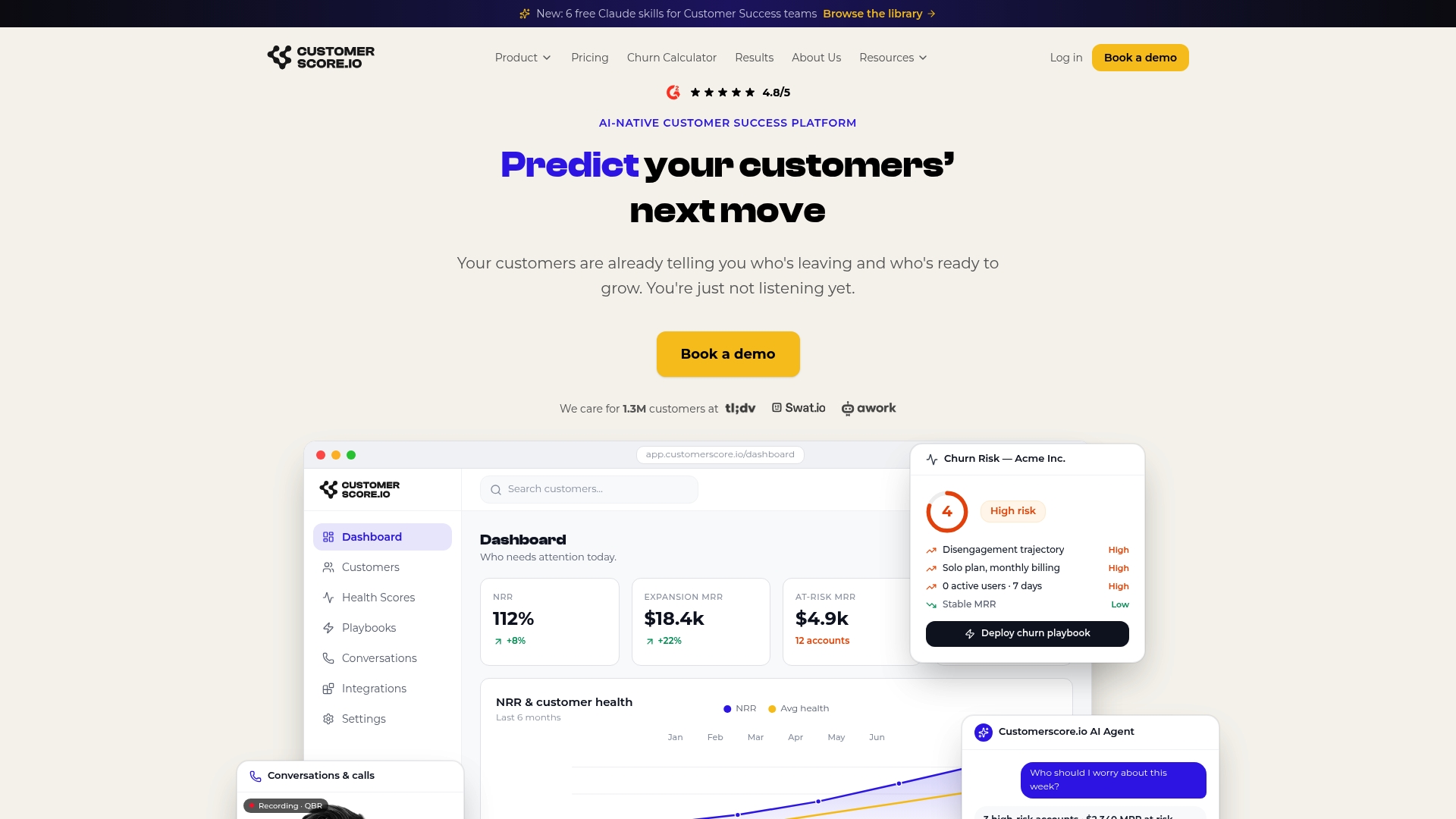
The platform maps directly onto the model covered here: AI-driven churn prediction flags red accounts before the renewal window even opens, while explainable health scoring shows the CSM exactly which dimension dropped and why, matching the lowest-dimension-wins rule instead of hiding behind a black-box number. Renewal and expansion workflows run on top of the same data, so there's no separate system to keep in sync with your CRM.
If you're currently piecing this together in HubSpot workflows and hoping the automation holds, book a demo and see how the scoring and workflow pieces fit around what you've already built.
Sources
- Renewal Timeline and Process: The 90-Day Renewal Playbook
- The Customer Success Renewal Playbook: A Complete Template | SWOTBee
FAQ
What Is a SaaS Renewal Playbook?
It's a documented, repeatable process for managing renewals from Closed Won through signature, built around a fixed timeline, risk-tiered health scoring, and CRM automation rather than ad hoc check-ins.
How Far in Advance Should Renewal Outreach Start?
Enterprise accounts generally need more runway because procurement, legal review, and multi-stakeholder buy-in take time. Mid-market accounts often operate with a 120-day timeline. SMB accounts, with simpler buying committees and lower contract values, can often work within a shorter timeframe without losing much ground.
What Signals Matter Most for Renewal Health Scoring?
Usage trend, champion health, economic signal, and support sentiment, scored on a 1 to 5 grid where the lowest-scoring dimension determines the account's overall tier.
Can CRM Automation Really Prevent Missed Renewals?
Yes, auto-creating a renewal deal at Closed Won and progressing it through time-based stages removes the manual tracking that causes most missed renewal dates, though line-item copying and loop protection need testing before you trust it fully.
Does Customerscore Help With This Specific Playbook?
An AI customer success platform automates the health scoring and churn prediction pieces of this model, feeding explainable risk tiers directly from usage, billing, and support data instead of requiring manual score updates.
Recommended
Related articles
Cut Response Time 60% with This Slack for Customer Success Playbook
Cut Response Time 60% with This Slack for Customer Success Playbook ! Customer success team routing a Slack conversation Slack works best for customer success when it functions as the conversation
BlogProduct Led Customer Success in 90 to 180 Days Without a Data Team
Product Led Customer Success in 90 to 180 Days Without a Data Team ! Customer success operator reviewing product signals Product-led customer success uses product usage data and in-product
BlogPredict Churn 60–90 Days: Five Phase Customer Risk Scoring for B2B SaaS
Predict Churn 60–90 Days: Five Phase Customer Risk Scoring for B2B SaaS ! Customer success manager reviewing account risk dashboard Customer risk scoring produces a predictive, explainable health
Blog30/90/180-Day Health Score Model for SaaS CS: AUC & Playbooks
30/90/180-Day Health Score Model for SaaS CS: AUC & Playbooks ! Analyst calibrating SaaS health score dashboard A health score model is a validated, segment-aware index (usually 0 to 100) that