
Product Led Customer Success in 90 to 180 Days Without a Data Team


Product-led customer success uses product usage data and in-product experiences, not calendar-based check-ins, as the primary way B2B SaaS teams drive adoption, retention, and expansion. The core outcome is scalable coverage: CS teams catch risk and expansion signals earlier, resolve more accounts without adding headcount, and free human attention for the customers who actually need it.
TL;DR:
- Product-led customer success can accelerate onboarding and expansion by using real-time usage signals instead of scheduled calls, reducing support load and increasing retention.
- Building a unified data layer before automating triggers is crucial, but perfect data is unnecessary at launch; signals should be tested early to inform automation and escalation.
- Automating responses with in-product guidance and trigger-based plays allows SMB accounts to be handled at scale, while high-value accounts receive personalized, high-touch support.
- Leading indicators like time to first value and feature adoption provide early warning signs, while lagging KPIs such as net revenue retention and churn validate overall health.
- A structured rollout over six months involves unifying data, setting success criteria, instrumenting early signals, scaling automation, and eventually implementing predictive modeling and regular reviews.
Table of Contents
- What Product-Led Customer Success Actually Means
- Why Product-Led CS Pays Off Faster Than Headcount
- The Tech Stack Behind Product-Led CS
- Building the Operational Playbook: Stages, Plays, and Owners
- Choosing High-Touch, Tech-Touch, or Hybrid Coverage
- Measuring What Matters: KPIs and Dashboards
- A 90-to-180-Day Rollout Plan
- Playbooks, Templates, and Where to Go Deeper
- Where Most Teams Get This Wrong
- See How Customerscore Fits Your Product-Led CS Stack
- Sources
- FAQ
What Product-Led Customer Success Actually Means
Product-led customer success flips the old model on its head. Instead of a customer success manager (CSM) calling every account on a quarterly schedule, the product itself becomes the communication channel. Usage events, feature adoption, and in-app behavior tell you who needs help before they ask for it.
Pendo's framing of this shift is useful: the product carries onboarding, guidance, and feedback collection, while CS engagement gets prioritized by what the data actually shows, not by who's loudest or next on the call list. A few operating rules make this work in practice.
- A shared data layer combining billing, usage, support tickets, and CRM records, so no team is working from a partial picture.
- Product as a channel, using tooltips, in-app banners, and contextual nudges to answer questions before a support ticket gets filed.
- Trigger-based plays that fire off a signal (a stalled setup, a spike in a key feature) instead of a date on the calendar.
- Segmentation by value and complexity, so a $200,000 account and a $12,000 account never get the same treatment.
- CS input into the product roadmap, because the team closest to churn reasons should have a say in what gets built next.
Pro Tip: Don't try to build a perfect data layer before you launch a single trigger. Perfection later; signal now.
Why Product-Led CS Pays Off Faster Than Headcount
The business case is straightforward: product signals shrink the time between signup and first real value, and that speed compounds into everything downstream. A customer who hits their "aha moment" in week one behaves very differently than one still fumbling with setup in week four.
Chameleon's research on product-led CS and PLG points to in-app guidance and micro-surveys as the mechanism. They let teams scale support and catch feature-adoption signals that would otherwise sit buried in a database no one checks daily.
The practical wins show up in three places:
- Faster activation — onboarding triggers close the gap between signup and habitual use.
- Lower support load — in-app guidance answers the questions that used to become tickets.
- Better expansion timing — usage spikes flag accounts ready for an upsell conversation before a renewal deadline forces it.
Retention math still rules the SaaS business model. A small improvement in net revenue retention compounds over several years far more than an equivalent gain in new logo growth, which is why investors track engagement metrics closely in public SaaS filings.
The Tech Stack Behind Product-Led CS
Five categories of tools have to talk to each other for this to work. Miss one and you get a health score that looks smart, but misses half the story.
- Product analytics (event tracking, cohort analysis, funnel breakdowns) tells you what people are actually doing inside the product, not what they say they do.
- In-app guidance (tooltips, guided tours, contextual banners) delivers onboarding and feature nudges at the exact moment someone needs them.
- Feedback and sentiment tools (in-product micro-surveys, NPS prompts) catch dissatisfaction before it turns into a cancellation email.
- A unified CRM/data layer merges billing, support history, and usage into one customer record instead of three disconnected ones.
- Automation and playbook engines turn a detected signal into an actual action: an email, an in-app message, or a task on a CSM's desk.
None of these tools matters much in isolation. A product analytics platform with no automation layer just produces dashboards nobody acts on. The value comes from wiring signal to action, which is exactly what trigger-based playbooks are built to do.
Building the Operational Playbook: Stages, Plays, and Owners
A framework is not the same thing as a strategy, and neither is the same thing as a success plan. The framework is the repeatable structure (stages, triggers, owners). The strategy is the set of choices about where to invest attention. The success plan is what you build for one specific customer inside that structure. Confusing the three is why a lot of "customer success programs" collapse into ad hoc firefighting within a year.
HubSpot's guidance on building a scalable framework is direct on this point: define stages, plays, owners, triggers, and shared metrics before you scale anything. A unified data layer is what prevents handoffs from becoming black holes.
A workable stage-by-stage structure looks like this:
- Onboarding. Trigger: signup or contract signature. Play: guided setup with milestone tracking. Owner: onboarding specialist or CSM, handing off to the account owner once activation criteria are met.
- Adoption. Trigger: onboarding completion or a defined usage threshold. Play: feature-adoption nudges and a check-in only if usage stalls. Owner: CSM, assisted by automated in-app messaging.
- Expansion. Trigger: usage nearing plan limits, new user seats added, or a headcount increase in the account's company. Play: proactive outreach with a tailored expansion pitch. Owner: CSM or account manager, informed by expansion scoring.
- Risk and retention. Trigger: usage drop, support ticket spike, or a health score decline. Play: escalation to a human, with root-cause diagnosis before any save attempt. Owner: senior CSM or CS leadership.
The most common failure point isn't any single stage. It's the handoff between them. HubSpot's research on sales-to-CS handoffs shows that when customer goals and stakeholder maps don't transfer at sale close, the CS team ends up re-discovering information the sales rep already had, and that delay costs real time-to-value.
Pro Tip: Require one thing at every sale close: a written record of the customer's stated success criteria. Not a summary, the customer's own words. It becomes your first health score input and your best defense against a "why did they churn" postmortem six months later.
The build order matters. Get the data connected first, then instrument the signals, then automate the plays, then reserve human escalation for exceptions. Building automation before you trust your data just automates noise.
Choosing High-Touch, Tech-Touch, or Hybrid Coverage
Not every account deserves the same amount of human time, and pretending otherwise is how CSMs end up with 300 accounts and no bandwidth for the ones that matter.
- High-touch usually works for accounts with high annual recurring revenue (ARR) or complex multi-team deployments. A dedicated CSM typically carries a modest portfolio of such accounts.
- Tech-touch fits smaller accounts, often those with lower ARR, where automated onboarding sequences and in-app guidance handle the entire lifecycle. One CSM can effectively oversee a large number of these accounts through dashboards and exception alerts.
- Hybrid covers the middle band, where automation handles routine milestones but a human steps in at renewal, at a detected risk signal, or when the account crosses an expansion threshold.
Set the thresholds by ARR band and complexity, not gut feel, and revisit them periodically as your customer base shifts. An account that changes in size or usage level should trigger an automatic reassignment, not wait for manual review.
Measuring What Matters: KPIs and Dashboards
The KPI mistake most teams make is tracking only lagging indicators, which tell you what already happened and nothing about what's coming. HubSpot's metrics guidance recommends pairing leading indicators with lagging ones so a dashboard can actually forecast risk instead of just reporting it.
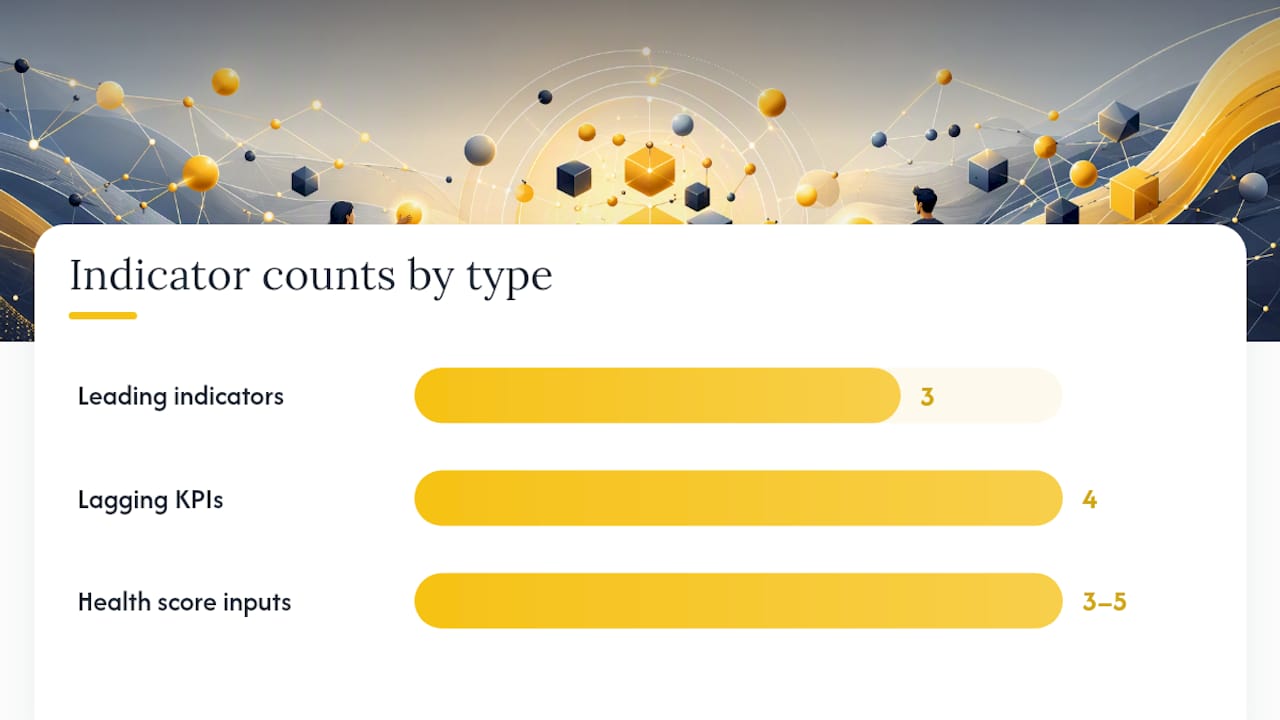
Leading indicators (predict what's coming):
- Time to first value
- Feature adoption rate
- Usage velocity (trend, not just a snapshot)
Lagging KPIs (confirm what already happened):
- Net revenue retention (NRR)
- Gross and logo churn
- Expansion MRR
- Customer lifetime value (CLTV)
Health scores sit between the two, and the strongest ones are built iteratively. Start with three to five signals with a proven correlation to churn, weight them by that historical correlation, and expand the model only as more data accumulates. Trying to build a 20-input health score on day one is how teams end up with a score nobody trusts.
A scorecard tells you where one account stands right now. A dashboard tells leadership where the whole portfolio is trending. You need both, and confusing their purpose is a common reason CS metrics reviews turn into confusing meetings. Teams that layer regular quarterly business reviews (QBRs) on top of this measurement cadence report meaningfully higher expansion revenue as a direct result.
A 90-to-180-Day Rollout Plan
Trying to launch predictive churn models before your data is even connected is the fastest way to lose leadership's confidence in the whole initiative. Sequence matters more than speed here.
- Phase 1 (days 1 to 60): Unify billing, usage, support, and CRM data into one layer. Build a baseline health score from three to five proven signals.
- Phase 2 (days 60 to 120): Instrument product analytics and set up the first tech-touch triggers, starting with onboarding and inactivity alerts.
- Phase 3 (days 120 to 180): Scale playbooks across segments and reassign freed-up CSM time to your highest-value, highest-risk accounts.
- 6 to 12 months out: Layer in predictive churn modeling, automate expansion detection, and establish a regular QBR cadence for your high-touch tier.
This sequence mirrors what practitioners consistently recommend: unify data first, define success criteria per segment, instrument early-value triggers, automate the tech-touch layer, then allocate human capacity where it earns the highest return, per CSMSummit's framework research.
Playbooks, Templates, and Where to Go Deeper
Some platforms provide resources that map directly onto this framework rather than treating it as an abstract exercise. The SaaS onboarding best practices guide covers the exact triggers referenced in Phase 1 and Phase 2 above. The customer success glossary is a fast reference for teams standardizing terminology across CS, product, and sales.
- Building customer success in a PLG SaaS walks through the stage-by-stage rollout for early-stage teams.
- Customer success metrics breaks down scorecard versus dashboard design in more depth.
- Customer success playbooks documents trigger-to-action automation patterns referenced throughout this piece.
None of this replaces judgment. A good health score model still needs a human to question it when the numbers and the customer relationship tell different stories.
Where Most Teams Get This Wrong
The single biggest mistake is treating the handoff from sales as a formality instead of a data transfer. If the customer's stated success criteria don't make it into a CS record at close, you're rebuilding trust and context from zero.
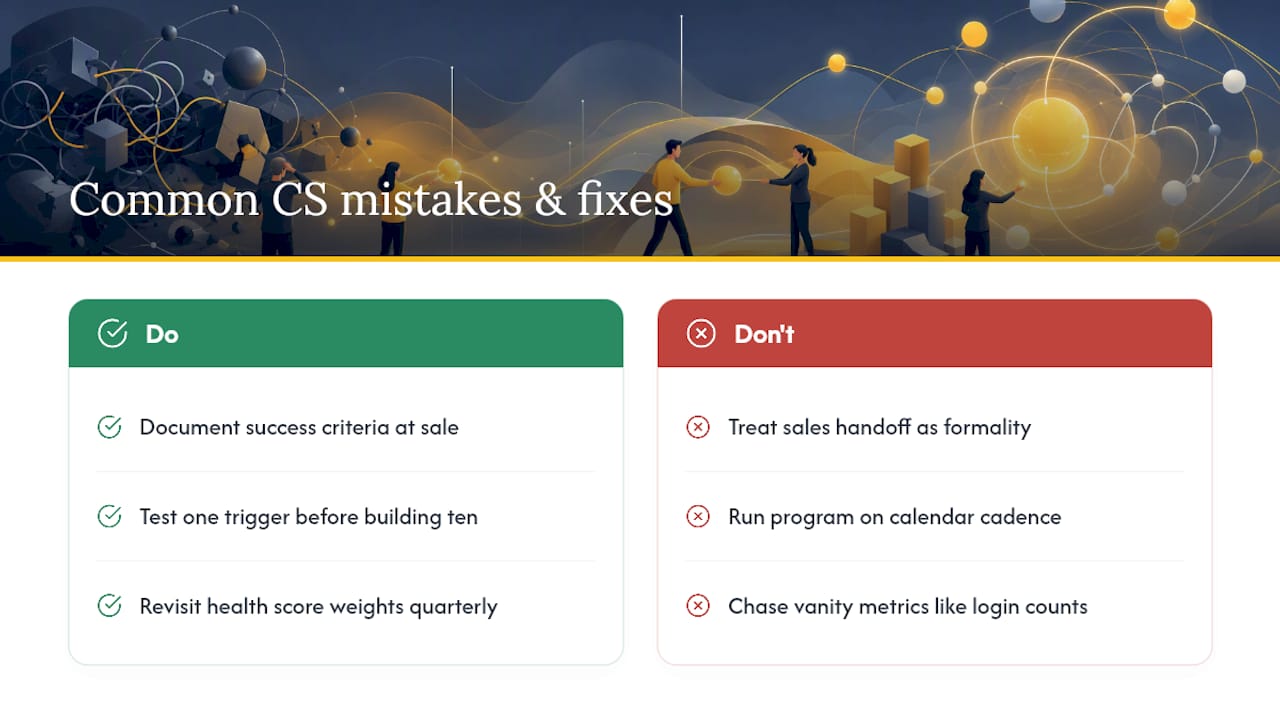
Do: document success criteria at sale, test one trigger before building ten, and revisit your health score weights every quarter as churn data accumulates. Don't: run your whole program on calendar cadence, or chase vanity metrics like login counts that don't correlate with renewal.
A six-point governance check: shared data layer in place, documented success criteria per segment, at least one live trigger, defined ARR thresholds for touch models, a dashboard leadership actually checks, and a quarterly review of health score accuracy against real churn.
— Patrik
See How Customerscore Fits Your Product-Led CS Stack
If you're building the framework above, the hardest part usually isn't the strategy. It's getting churn risk and health scoring live without hiring a data team first. Certain AI customer success platforms combine billing, product usage, CRM, and support data into one explainable health score, run automated churn prediction, and trigger playbooks that turn a risk signal into an actual customer success action.
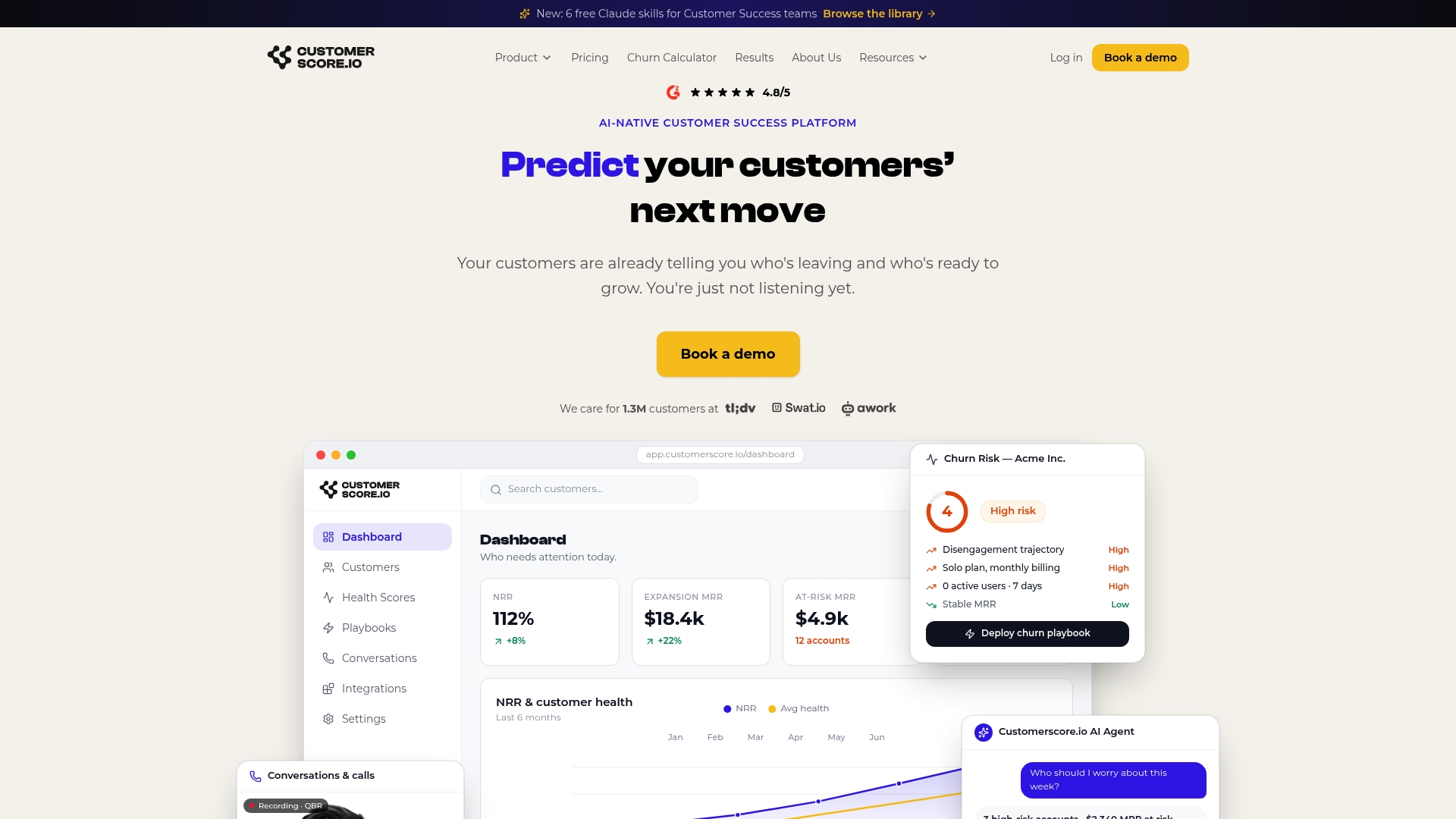
The AI-powered churn prediction engine flags at-risk accounts before renewal conversations get uncomfortable, and the customer health score software shows exactly which inputs are driving each score, so your team can trust it instead of guessing at a black box. Teams that also want to catch expansion opportunity earlier can put the expansion scoring module to work on the same underlying data. If you're ready to see how this maps to your own account base, book a demo and walk through your data with the team.
Sources
- What is product-led customer success? | Product-led Hub | Pendo
- Customer success framework: Build one that scales | HubSpot Blog
FAQ
What are the 5 pillars of customer success?
Most frameworks converge on customer onboarding, adoption, retention, expansion, and advocacy as the core pillars, though the exact labels vary by organization. Product-led CS applies data and automation to each pillar rather than treating them as separate manual workflows.
What companies use product-led growth (PLG)?
PLG and product-led CS approaches are common among B2B SaaS companies with self-serve or freemium models, where usage data naturally drives both the growth and retention motions. The specific companies vary widely by industry and aren't tracked in a single definitive list.
Will customer success managers be replaced by AI?
No. Automation and predictive tools handle repetitive, low-value tasks like onboarding nudges and routine check-ins, which frees CSMs for the strategic, high-touch work that actually requires human judgment. Pendo's research on product-led transformation frames this as a shift in focus, not a headcount reduction.
What does a customer success lead typically earn?
Compensation for customer success leadership varies significantly by company size, region, and whether the role carries revenue targets, so there's no single reliable figure to cite. Candidates and hiring managers should check current regional salary data from sources specific to their market.
How is a health score different from an NPS survey?
A health score combines multiple signals, usage, support tickets, billing status, and sometimes sentiment, into one weighted view of churn risk. An NPS survey captures a single point-in-time sentiment reading and works best as one input into that broader score, not a replacement for it.
Recommended
Related articles
Intercom Customer Success: A Practical B2B SaaS Playbook
Intercom Customer Success: A Practical B2B SaaS Playbook ! Close-up of workplace with headset and laptop Intercom is a practical platform for running customer success at scale.
Blog90–120 Day Renewal System for CSMs: SaaS Renewal Playbook
90–120 Day Renewal System for CSMs: SaaS Renewal Playbook ! Team planning a structured SaaS renewal Run renewals as a 90 to 120 day managed pipeline, not a calendar reminder.
BlogCut Response Time 60% with This Slack for Customer Success Playbook
Cut Response Time 60% with This Slack for Customer Success Playbook ! Customer success team routing a Slack conversation Slack works best for customer success when it functions as the conversation
BlogPredict Churn 60–90 Days: Five Phase Customer Risk Scoring for B2B SaaS
Predict Churn 60–90 Days: Five Phase Customer Risk Scoring for B2B SaaS ! Customer success manager reviewing account risk dashboard Customer risk scoring produces a predictive, explainable health