
Customer 360 Data Model for RevOps & CS: Design Guide


A customer 360 data model is the unified architecture that assembles a single golden record for every customer by pulling together CRM contacts, billing history, product telemetry, and support interactions into one queryable profile. That profile is what makes churn prediction accurate and lifecycle automation trustworthy. Your first concrete step: inventory your highest-signal sources (Salesforce or HubSpot for CRM, Stripe for billing, Mixpanel or Segment for product events) and schedule a matching-hierarchy workshop before you write a single pipeline.
Table of Contents
- Why a unified customer profile matters for RevOps and CS
- The five implementation stages you need to plan for
- Which architecture pattern fits your stack?
- Identity resolution: designing your matching hierarchy
- A reusable golden-record schema and event tables
- Implementation checklist, roles, and a 90-day starter plan
- How the Customer 360 feeds churn prediction and lifecycle playbooks
- Operational governance and compliance
- A concrete example flow from event to playbook
- Key Takeaways
- The gap between Customer 360 theory and what actually ships
- Customerscore cuts the time from data to churn alert
- Useful sources and documentation
Why a unified customer profile matters for RevOps and CS
A fragmented data stack forces your CS team to manually reconcile accounts before every renewal call. A 360-degree customer view eliminates that by creating a single profile that powers automated churn prediction, personalized lifecycle orchestration, faster renewals, cleaner CS-to-sales handoffs, and fewer hours lost to data wrangling.
For B2B SaaS specifically, the payoff shows up in four operational workflows:
- Health scoring: combine product usage velocity, billing anomalies, and support volume into one explainable score
- Renewal prioritization: surface at-risk accounts 60–90 days before renewal without manual spreadsheet work
- Expansion playbooks: trigger upsell sequences when usage crosses a threshold or a new team is onboarded
- AI agent actions: feed reconciled profiles to agentic AI that can draft renewal emails or flag escalations automatically
Customerscore integrates data from Salesforce, Stripe, Mixpanel, Fivetran pipelines, and Segment to build exactly this kind of profile. The platform's explainable health scores let CS leaders see why an account is flagged, not just that it is.
Pro Tip: Run a 30-day source-priority experiment: build two health models, one using CRM activity as the primary signal and one using product telemetry. Whichever produces fewer false positives becomes your anchor source in the matching hierarchy.
The five implementation stages you need to plan for
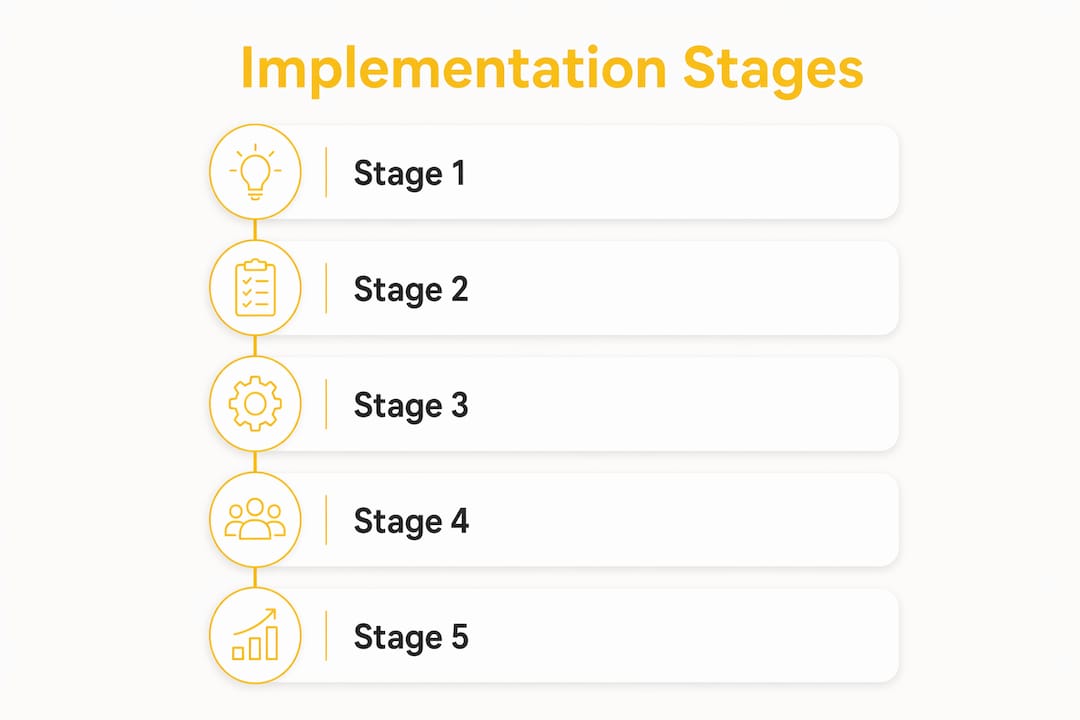
Customer data integration follows a consistent five-stage pattern. Skipping or rushing any stage creates technical debt that compounds fast.
- Data collection. Catalog every source: Salesforce or HubSpot for CRM, Stripe or Chargebee for billing, Mixpanel or PostHog for product analytics, Segment for event pipelines. Document field names, update frequencies, and owner teams before touching any code.
- Cleaning and standardization. Apply inline transforms at ingestion: proper case on names, trimmed whitespace, canonical phone and email formats, concatenated full-name fields. Preserving the original source object alongside the transformed version lets you audit discrepancies later.
- Identity resolution. Define your matching hierarchy before ingestion. Changing it afterward forces a full reprocessing run. Decide which source holds the authoritative value for each field (billing email beats CRM email for payment identity; CRM account name beats billing for display name).
- Load into a central repository. Choose your pattern: warehouse-first (Snowflake or BigQuery), CDP, or MDM. Load transformed records and preserve source lineage so every golden-record field traces back to its origin.
- Ongoing synchronization and monitoring. Set freshness SLAs per source. Batch sync works for CRM updates; streaming matters for product events that feed real-time health scores. Monitor pipeline lag and alert on schema drift.
Responsibility matrix: Data Engineering owns stages 1–4; RevOps owns the matching-hierarchy design; CS owns health-score definitions; an external integrator (Fivetran or a solutions partner) typically handles connector maintenance.
Common pitfalls: deciding the matching hierarchy after data is already flowing, missing product telemetry entirely, and skipping source-lineage storage.
Which architecture pattern fits your stack?
CDI is distinct from generic ETL: it focuses specifically on identity resolution and profile unification, not just moving tables. Three architecture patterns cover most B2B SaaS situations:
- Consolidation (warehouse-first): all source data lands in Snowflake or BigQuery; dbt handles transformations; Fivetran manages connectors. Best control, best transformation flexibility, slightly higher engineering lift. Most B2B SaaS teams with a substantial number of accounts land here.
- Propagation (CDP-first): a CDP like Segment syncs profiles back to operational tools in near-real-time. Lower engineering overhead, but transformation capability is limited and vendor lock-in is real.
- Federation (virtual queries): no central copy; queries hit source systems at runtime. Avoids data movement but query latency makes it unsuitable for real-time health scoring.
For most B2B SaaS RevOps teams, the recommended stack is: Fivetran (connectors) → Snowflake or BigQuery (storage) → dbt (transformations) → Customerscore (health scoring, churn prediction, playbooks). Connectors that adapt to source schema changes automatically reduce pipeline breakage and shorten recovery time when upstream tools update their APIs.
Identity resolution: designing your matching hierarchy
Identity resolution requires a predefined matching hierarchy; changing it post-ingestion forces expensive reprocessing. Design it in a workshop before your first pipeline runs.

| Priority | Source | Field | Match Type | Notes |
|---|---|---|---|---|
| 1 | Billing (Stripe) | Deterministic | Payment identity is most reliable | |
| 2 | CRM (Salesforce/HubSpot) | Account ID | Deterministic | Canonical account anchor |
| 3 | Product (Mixpanel/Segment) | User ID | Deterministic | Ties usage to account |
| 4 | Support (Intercom) | Probabilistic | May differ from billing email | |
| 5 | Manual override | CS-confirmed | Deterministic | Highest trust, lowest volume |
Deterministic matching (exact email, exact ID) is fast and auditable. Probabilistic matching (fuzzy name, domain inference) fills gaps but introduces false merges. Use a confidence score threshold (e.g., 0.85+) to auto-merge; route lower-confidence candidates to a human review queue.
Pro Tip: Store an audit link back to the source record for every merged field. When a CS rep questions why an account's ARR looks wrong, you can trace the value to its origin in under 30 seconds.
A reusable golden-record schema and event tables
Your golden record needs two layers: the unified account/contact profile and the event tables that feed your models.
Golden record fields (accounts):
account_id(canonical),crm_account_id,billing_customer_id,product_org_idaccount_name,domain,industry,employee_countlifecycle_stage(trial / active / at-risk / churned)arr,mrr,subscription_plan,renewal_date,contract_starthealth_score,health_score_updated_atlast_active_at,dau_30d,feature_adoption_scoreopen_support_tickets,csat_score,csm_owner_id
Event tables to build alongside it:
product_usage_events:account_id,user_id,event_name,timestamp,session_idbilling_events:account_id,event_type(upgrade/downgrade/churn),amount,timestampsupport_interactions:account_id,ticket_id,severity,created_at,resolved_atengagement_events:account_id,channel,content_id,action,timestamp
For multi-entity accounts (parent/child hierarchies), add parent_account_id and roll up ARR and usage metrics at both levels. In Snowflake or BigQuery, keep the golden record denormalized for query speed; normalize event tables and join at query time via dbt models.
Implementation checklist, roles, and a 90-day starter plan
| Week | Milestone | Owner |
|---|---|---|
| 1–2 | Source inventory and data audit | RevOps + Data Eng |
| 3–4 | Matching-hierarchy workshop and sign-off | RevOps + CS + Data Eng |
| 5–6 | Connect billing + product telemetry (quick wins) | Data Eng + Fivetran |
| 7–8 | Build golden-record schema in Snowflake/BigQuery | Data Eng + dbt |
| 10 | Baseline health score live in Customerscore | CS + RevOps |
| 12 | First churn model trained; playbooks activated | Data Science + CS |
Checklist by priority:
- Inventory all source systems and document field owners
- Run matching-hierarchy workshop; document trust order in writing
- Connect billing and product telemetry first (highest churn signal density)
- Build and validate the golden-record schema
- Activate a baseline health score with at least three signal types
- Train an initial churn model; set AUC target before launch
- Define playbook triggers and assign CSM owners
Primary cost drivers: Fivetran connector licensing scales with monthly active rows; Snowflake/BigQuery storage and compute scale with data volume; dbt Cloud licensing scales with developer seats; Segment event volume pricing scales with monthly tracked users.
How the Customer 360 feeds churn prediction and lifecycle playbooks
A unified profile powers churn models that are both accurate and explainable. The attributes that move model accuracy most in B2B SaaS:
- Usage velocity: declining DAU or feature adoption in the 30 days before renewal is the single strongest leading indicator
- Billing anomalies: failed payments, downgrades, or plan pauses signal financial stress before a cancellation request arrives
- Support volume and severity: a spike in P1 tickets in the 60 days before renewal correlates strongly with churn
- Engagement drop-off: reduced email open rates and login frequency compound the risk signal
For labeling, use reconciled profiles to build training sets: label accounts as churned if lifecycle_stage transitions to "churned" within 90 days of the observation window. Customerscore's churn prediction layer automates this labeling and surfaces explainable feature weights so CS leaders understand which signals drove the alert.
Map model outputs directly to playbooks: a high-risk score triggers a CSM check-in sequence; a billing anomaly triggers a finance-plus-CS alert; a usage drop triggers an in-app re-engagement flow. Track AUC and precision on the model side; track NRR, churn rate, and renewal conversion on the business side. For deeper churn analysis patterns, segment by cohort before building playbooks.
Operational governance and compliance
A Customer 360 is a continuous operational discipline, not a one-time project. Without quarterly audits, the single source of truth fragments as new SaaS tools appear.
- Data quality checks: monitor freshness (max lag per source), uniqueness (duplicate golden records), completeness (null rates on key fields like
arrandlast_active_at), and reconciliation reports weekly - Lineage: store source copies before transformation; maintain link tables mapping every golden-record field to its origin record and timestamp
- SOC2 controls: encrypt PII at rest and in transit; enforce role-based access (CS sees health scores, not raw billing data); log all queries against PII fields
- PII handling: apply minimal-necessary-access principles; mask or tokenize email and payment fields in non-production environments
- Schema change reviews: require a pull-request review before any source field rename or removal; test downstream dbt models before merging
- Quarterly matching-hierarchy audits: re-evaluate trust order as new sources are added; document every change with a rationale
A concrete example flow from event to playbook
- Collect (T+0): Mixpanel fires a
feature_unused_30devent; Segment routes it to Snowflake via Fivetran connector - Transform and match (T+5 min, batch): dbt model joins the event to the golden record using
product_org_id → account_idmapping - Update golden record (T+10 min):
feature_adoption_scorefield updates;health_score_updated_atrefreshes - Compute health score (T+15 min): Customerscore recalculates the account's health score; score drops below the at-risk threshold
- Trigger playbook (T+16 min): Customerscore fires a Slack alert to the CSM and queues a personalized re-engagement email via the renewal outreach workflow
Expected outcome metrics: time-to-alert under 20 minutes for batch pipelines; playbook conversion rate (at-risk accounts saved) tracked weekly; false positive rate monitored monthly and fed back into model retraining. For teams building automated renewal outreach, this flow is the backbone.
Key Takeaways
A customer 360 data model only delivers reliable churn prediction and lifecycle automation when the matching hierarchy is defined before ingestion, governance is continuous, and model outputs connect directly to playbooks.
| Point | Details |
|---|---|
| Define matching hierarchy first | Set trust order across billing, CRM, and product sources before any pipeline runs to avoid costly reprocessing. |
| Warehouse-first is the default | Fivetran + Snowflake/BigQuery + dbt gives B2B SaaS teams the best control and transformation flexibility. |
| 90-day plan works | A 12-week sprint from source inventory to live churn model is achievable with clear role assignments. |
| Governance is ongoing | Quarterly matching-hierarchy audits and schema-change reviews prevent the golden record from fragmenting over time. |
| Customerscore accelerates delivery | Customerscore integrates billing, CRM, and product telemetry to activate explainable health scores and churn playbooks without building the scoring layer from scratch. |
The gap between Customer 360 theory and what actually ships
Most teams I see stall not on the architecture decision but on the matching hierarchy. They spend weeks debating CDP vs. warehouse-first, then rush the trust-order design in a single afternoon meeting. Six months later, they're reprocessing 18 months of data because billing email and CRM email were merged incorrectly for 12% of accounts. That 12% is almost always the highest-ARR segment.
The other underestimated problem is stakeholder alignment. Data Engineering wants a clean schema. RevOps wants fast answers. CS wants explainable scores, not black-box outputs. Product wants event coverage. These goals conflict at the margin, and without a named owner for the matching-hierarchy artifact, each team optimizes for its own use case. The result is a golden record that is golden in name only.
What actually works: treat the matching-hierarchy document as a living contract, version-controlled and reviewed quarterly. Assign one person (usually a senior RevOps analyst) as the data steward who approves every new source addition. And connect your sales process handoffs to the same profile from day one, so the CS team inherits a complete account history rather than a blank slate.
The teams that get this right ship a working health score and a trained churn model in a few months. The teams that skip the governance setup ship faster initially and spend the next year firefighting data quality issues.
Customerscore cuts the time from data to churn alert
Churn prediction is only as good as the profile feeding it. Customerscore connects directly to Salesforce, HubSpot, Stripe, Mixpanel, PostHog, Segment, and Chargebee, assembling a reconciled golden record without requiring a custom data warehouse build first. The platform's explainable health scores show CS leaders exactly which signals drove an account's risk rating, and its playbook engine fires renewal sequences, Slack alerts, and expansion triggers automatically when thresholds are crossed.
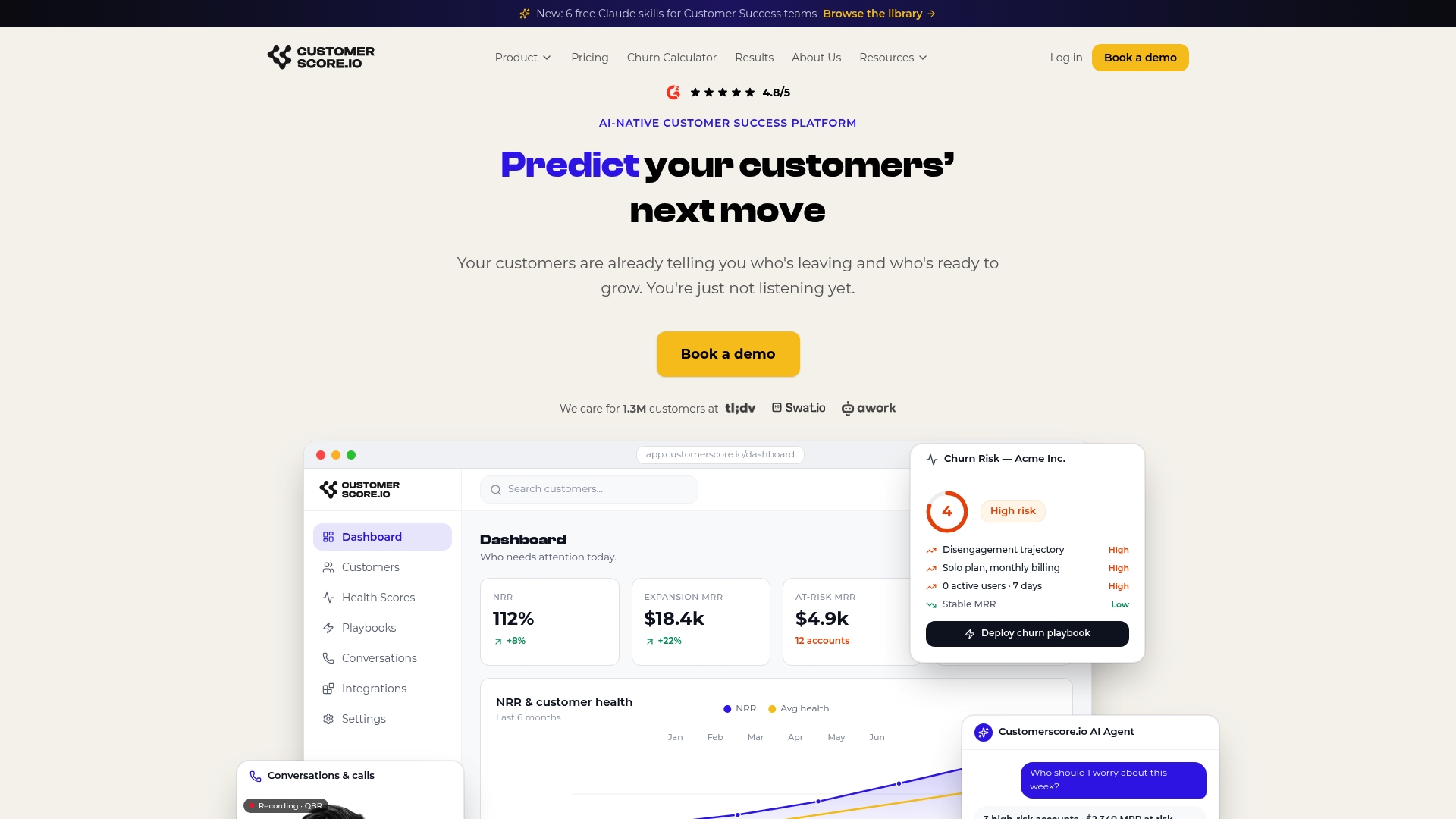
For teams already running Snowflake or BigQuery pipelines, Customerscore layers on top of the existing warehouse rather than replacing it. The result: a working churn model and live playbooks in weeks, not quarters. Explore the customer success platform or book a demo to see how the integration maps to your current stack.
Useful sources and documentation
- Salesforce Customer 360 Data Model (Trailhead): start here if you are building on Salesforce Data Cloud; covers DMOs, subject areas, and mapping guidance
- Salesforce Data 360 Architecture (Developer Docs): deep reference for inline transformations, DLO/DMO mapping, and identity resolution rules
- Fivetran CDI Guide: practical connector selection and schema-change handling guidance for warehouse-first builds
- TechTarget: CDI Definition and Architecture Patterns: concise comparison of consolidation, propagation, and federation patterns
- Denodo CDI Glossary: useful for federation architecture and virtual query tradeoffs
- Salesforce Data 360 DMO and Mapping Guide: reference for DLO-to-DMO mapping and data bundle configuration
- Customerscore Churn Prediction Blog: operational guide to connecting unified profiles to churn models in B2B SaaS
Recommended
Related articles
Recover 55–70% of Failed Payments: SaaS Dunning Meets Churn Prediction
Recover 55–70% of Failed Payments: SaaS Dunning Meets Churn Prediction ! Specialist reviewing a failed payment alert Dunning is the structured recovery workflow that fixes failed subscription
BlogCut Churn: Product Usage Analytics for SaaS, Backed by 44,000 Users
Cut Churn: Product Usage Analytics for SaaS, Backed by 44,000 Users ! Analyst reviewing SaaS usage analytics dashboard Product usage analytics tracks what individual users actually do inside your
BlogSix Step Escalation Playbook for B2B SaaS CSMs to Prevent Quiet Churn
Six Step Escalation Playbook for B2B SaaS CSMs to Prevent Quiet Churn ! CSM sending a daily escalation update An escalation playbook has one job: protect the relationship and resolve high-impact
Blog70 Point PQL Score for SaaS: Scoring Template, Routing SLAs
70 Point PQL Score for SaaS: Scoring Template, Routing SLAs ! Analyst reviewing SaaS account scoring signals A product qualified lead (PQL) is a user whose in-product behavior, not a marketing form