
CS & RevOps: 90–120 Day System to Protect Multi-Year Renewals


Multi year renewals pay off when two conditions hold at signing: the customer is operationally embedded enough that switching costs are real, and the contract includes price protection that caps mid-term escalation. Skip either one and the discount you handed out at signing quietly evaporates by year two. The trade-off is straightforward: you're buying revenue certainty and cash flow, but you're selling flexibility. Get the balance wrong and a "win" on paper becomes a margin problem within eighteen months.
TL;DR:
- Multi-year renewals are most beneficial when customers are deeply operationally embedded and contracts include price protection caps to prevent mid-term escalation increases.
- Longer contract terms, especially three or five years, significantly increase discounts and reduce churn, but only if price caps and true-up clauses are properly negotiated and included.
- Without price caps, multi-year deals can lead to higher costs than annual contracts due to unbounded annual uplifts, particularly in high-value, multi-department accounts.
- Implementing governance measures, such as tying discounts to compliance and designating contract owners, improves the success and protection of multi-year agreements.
- Using health scoring tools and timing renewal proposals within a 90 to 120 day window enhances conversion rates and allows for more strategic, protected multi-year commitments.
Table of Contents
- What Is a Multi Year Renewal in B2B SaaS?
- What Are the Real Benefits and Risks of Multi-Year Renewals?
- How Much Discount Should You Expect for a Multi-Year Deal?
- Which Contract Clauses Protect You in a Multi-Year Deal?
- Should You Choose a Multi-Year Term or Stay Annual?
- How Should CS and RevOps Run a Multi-Year Renewal Playbook?
- What Governance Actually Moves the Needle on Multi-Year Deals?
- How Customerscore Helps You Run Multi-Year Renewals Without the Guesswork
- Sources
- FAQ
What Is a Multi Year Renewal in B2B SaaS?
A multi year renewal is a contract renewal that locks in a term of two or more years instead of the standard twelve-month cycle. You'll also see it called a term commitment, a multi-year agreement, or simply a multiple year agreement in procurement paperwork. The mechanics vary more than most vendors admit upfront.
Term length is the first variable. Two-year deals are common as a "starter" multi-year commitment. Three-year terms are the sweet spot for mid-market and enterprise SaaS, and five-year terms show up mostly in large enterprise or regulated industries where budget cycles are long and switching vendors is genuinely painful.
Payment structure is the second variable, and it changes the economics more than most buyers realize:
- Prepaid multi-year: the customer pays the full term upfront, usually in exchange for the deepest discount.
- Annualized multi-year: the customer signs a multi-year term but pays annually, trading some discount for better cash flow control.
- Co-termed multi-year: multiple products or business units get aligned to a single renewal date, which simplifies procurement but can force awkward mid-term add-ons onto the master schedule.
Anniversary date locking matters more than it sounds. When a vendor co-terms a mid-term add-on purchase to the master anniversary, the buyer effectively pre-pays for unused months. Always ask whether a new module renews on its own cycle or gets absorbed into the existing date.
What Are the Real Benefits and Risks of Multi-Year Renewals?
The upside is measurable. Multi-year deals typically show materially lower churn than annual contracts, and vendors reward that stability with sharper pricing than a comparable annual commitment, according to multi-year discount benchmarks. For the vendor, that lower churn translates into a shorter CAC payback period, since revenue is contracted rather than re-earned every twelve months. For the customer, a multi-year term means fewer renewal negotiations eating up procurement bandwidth and more predictable budget lines.
Statistic callout: A 3-year enterprise SaaS commitment typically produces an 8 to 14 percentage-point wider discount than the equivalent annual deal, but that gap only survives the term if the contract includes a 3 to 5 percent price-protection cap.
The risk side is where deals go sideways:
- Escalation risk: without a capped uplift clause, year-two and year-three price increases can erase the original discount entirely.
- Overcommit risk: a merger, acquisition, or product substitution mid-term can leave a customer locked into software it no longer needs.
- True-up exposure: usage-based or seat-based products can generate surprise invoices if the true-up measurement window isn't clearly defined.
How much this matters depends on annual contract value and adoption depth. A $15,000 ACV account with one integrated workflow carries low overcommit risk and modest upside from locking a multi-year term. A $250,000 ACV account running the platform across five departments has far more to lose from a bad true-up clause, and far more to gain from locking in price protection early.
How Much Discount Should You Expect for a Multi-Year Deal?
Benchmark data gives you a reasonable starting point for negotiation, even though every vendor's floor is different. According to 2026 B2B SaaS discount benchmarks, the typical progression looks like this:
- Annual vs. monthly: median discount of 15 to 20 percent for committing to annual billing.
- 2-year term: adds roughly 5 to 8 percentage points beyond the annual rate.
- 3-year term: adds roughly 12 to 15 percentage points beyond annual, consistent with the 8 to 14 point lift documented by VendorBenchmark.
- 5-year term: adds roughly 18 to 25 percentage points beyond annual, though these deals are rarer and usually reserved for strategic accounts.
None of that matters if the uplift cap is missing or set too high. Most enterprise SaaS contracts either cap annual price increases at 3 to 5 percent or tie them to a CPI trigger that only fires above that cap. Run the math before you sign: a 3-year deal with a 10 percent headline discount and no price cap can cost more by year three than a rolling annual contract that never had a discount at all.
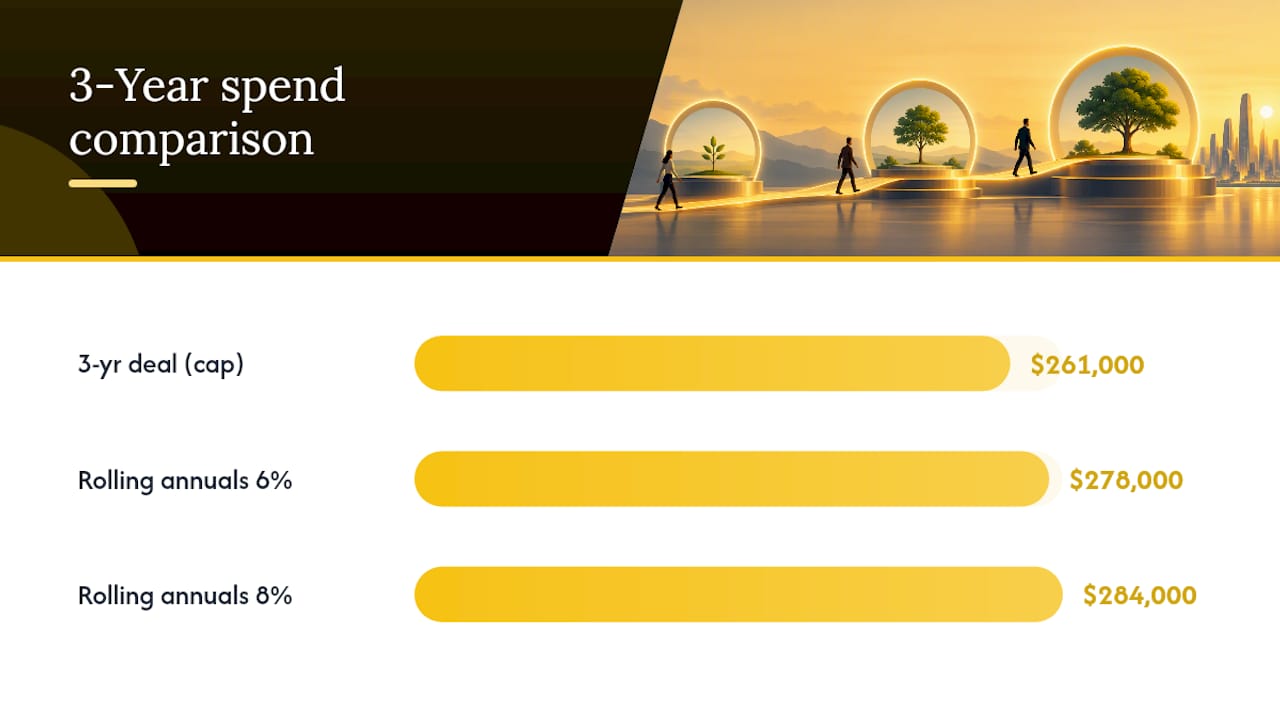
Here's a simplified worked example. Say your current annual list price is $100,000. A vendor offers a 3-year deal at a 13 percent discount with a 4 percent annual uplift cap starting in year two. Total three-year spend: roughly $261,000. Compare that to three rolling annual renewals at list price with a typical 6 to 8 percent annual increase (the market norm without a cap): roughly $278,000 to $284,000 over the same period. The multi-year deal wins, but only because the uplift cap held below the market's normal escalation rate. Remove the cap and the comparison flips.
Which Contract Clauses Protect You in a Multi-Year Deal?
Five clauses do most of the work in a multi-year contract. Negotiate all of them as a package, not one at a time, or you'll trade away leverage on the ones that matter most.
- Price protection / uplift cap. Cap annual increases at 3 to 5 percent, and make sure any CPI trigger only applies above that cap, not instead of it, per BizLeaseCheck's guidance on escalation clauses.
- True-up terms. Pin down the measurement date, the proration method, and the billing timeline in writing. Vague true-up language is where mid-term invoices go wrong.
- Termination for convenience. Insist on a cure period and a defined exit path rather than an all-or-nothing lock.
- True-down rights. Build in the right to reduce seats or usage tiers if a merger, divestiture, or product substitution changes your footprint.
- Audit limits and deemed-acceptance safeguards. Cap how often and how deeply a vendor can audit usage, and make sure silence on a renewal notice doesn't count as automatic agreement to a price increase, an interaction BizLeaseCheck flags as a common source of billing disputes.
Pro Tip: Package the discount with the protections in the same proposal. A vendor is far more willing to agree to a 4 percent uplift cap and true-down rights when it's bundled with the multi-year discount they already want to offer, rather than requested as a separate concession after the deal is verbally agreed.
Should You Choose a Multi-Year Term or Stay Annual?
Run through four checks before deciding, and weight them by how the account actually behaves, not how the sales rep pitches it.
Operational embedding. How many modules are in active use, how many integrations touch core systems, and how painful would switching actually be? A single-module account with light integration has low switching cost and low reason to lock in a long term.
Forecast stability. Usage-based accounts with volatile consumption are poor multi-year candidates unless the contract includes a true-down mechanism. Seat-based accounts with stable headcount are better fits.
Commercial protections. No deal should get a multi-year signature without a price cap, true-down rights, and a defined exit mechanism already negotiated.
Financial trade-offs. Weigh the cash-flow benefit of locking pricing against the NPV cost of losing the option to renegotiate or exit early.
| Signal | Favors multi-year | Favors annual |
|---|---|---|
| ACV | Mid-market to enterprise | Low ACV, early-stage usage |
| Adoption depth | Multiple integrated modules | Single module, low integration |
| Consumption pattern | Stable or growing | Volatile or seasonal |
| Contract protections | Price cap + true-down secured | Protections unavailable |
| Business context | Stable ownership, no pending M&A | Active M&A or pivot risk |
Pricing architecture itself shapes the answer. Usage-based pricing models show materially higher net revenue retention than seat-based models, per Aleph's NRR benchmarks, which means usage-based accounts often justify longer terms even without heavy seat growth. A churn calculator can help model the revenue impact of each path before you commit to a recommendation.
How Should CS and RevOps Run a Multi-Year Renewal Playbook?
Multi-year offers convert best when they're timed to a 90 to 120 day pre-renewal window, not dropped into a last-minute renewal email. Customerscore's 90 to 120 day renewal system breaks the window into three phases.
- Days 90 to 120: health and usage review. Pull adoption data, support ticket trends, and NPS scores to identify accounts with strong signal. NPS 9 to 10 customers are three to five times more likely to accept a multi-year offer than NPS 7 to 8 customers, according to GrowthSpree's conversion data, so this segment is where multi-year proposals should start.
- Days 60 to 89: executive value review. Present usage trends and ROI evidence to the economic buyer before any pricing conversation starts. This step separates a genuine multi-year fit from a discount-driven ask.
- Days 30 to 59: commercial proposal. Present the term options side by side, with the price-protection and true-down clauses already drafted, not promised for later.
Proactive multi-year offers convert 25 to 40 percent of eligible annual renewals when targeted this way, per the same benchmark data. That conversion rate depends on operational discipline behind the scenes: a defined approval gate for any discount above a set threshold, and a named contract lifecycle owner responsible for enforcing uplift caps at renewal time, echoing what one RevOps structure analysis found about why negotiated caps get violated in quoting without that ownership in place.
Pro Tip: Build the multi-year offer into your account health dashboard as a triggered alert, not a manual review. Waiting for a CSM to remember to check NPS scores is how high-propensity accounts slip past the 90-day window untouched.

What Governance Actually Moves the Needle on Multi-Year Deals?
The biggest mistake I see isn't in the negotiation. It's upstream, in how comp plans reward reps for signing multi-year deals without rewarding them for protecting the terms. A rep paid on booked ARR has no incentive to fight for a price cap that only pays off in year three.
Fixing that means two things: tying part of variable comp to renewal-term compliance, not just signature, and giving one person, a contract lifecycle owner, authority to block deals that skip the clause package. Take this to leadership as a three-item checklist: cap discount authority above a threshold, require the clause package before signing, and assign renewal-term ownership to a named role instead of leaving it to whoever closed the deal.
— Patrik
How Customerscore Helps You Run Multi-Year Renewals Without the Guesswork
Most of the multi-year playbook above depends on knowing which accounts are actually ready for a longer commitment, and that's the part spreadsheets handle badly. Customerscore is built to answer that question directly: it runs churn prediction and explainable health scoring off your connected billing, product usage, CRM, and support data, so you can see exactly which accounts hit the health and NPS thresholds that make a multi-year offer worth proposing.
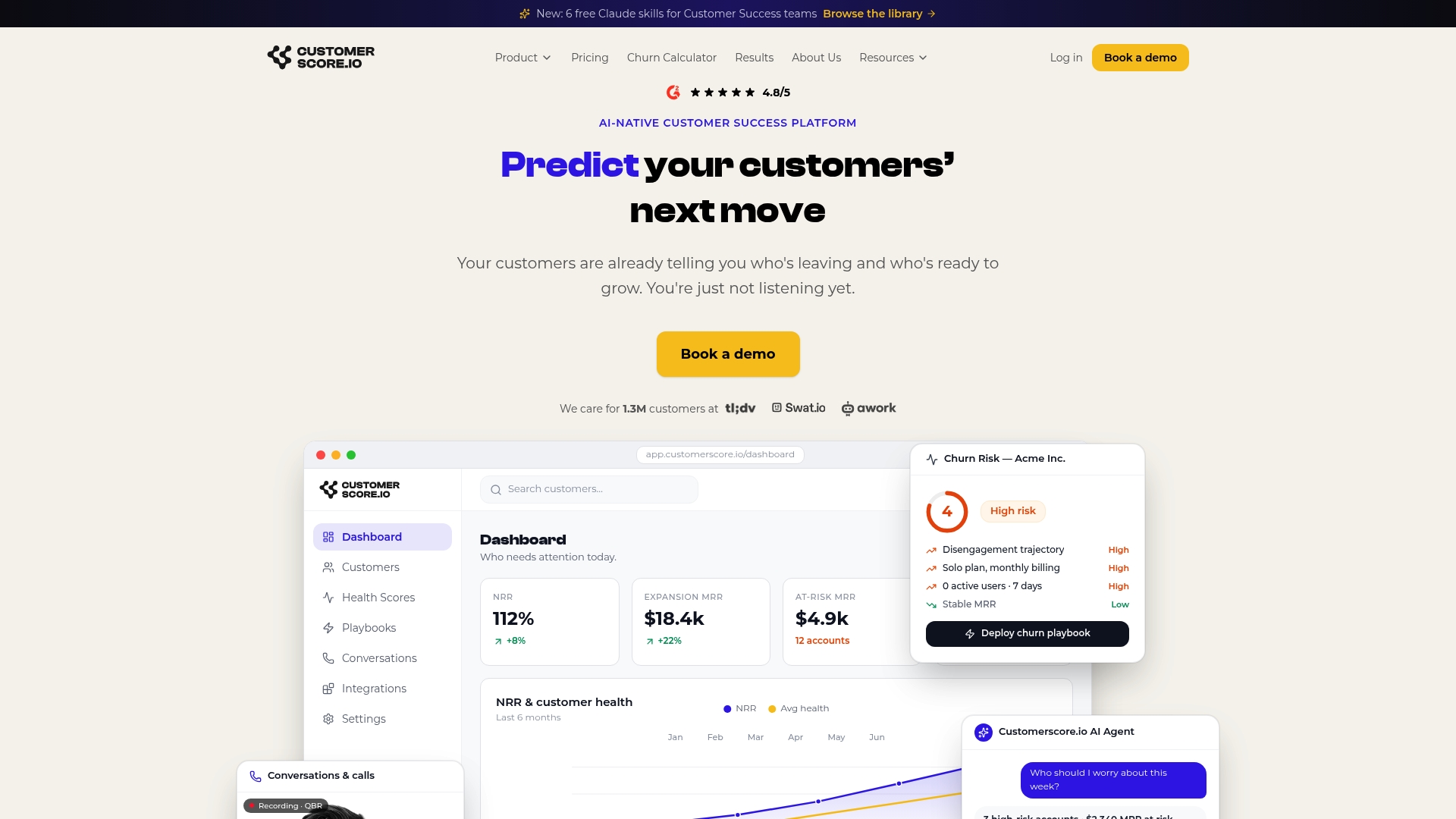
The platform ties directly into the renewal workflow itself, triggering alerts when an account enters its 90 to 120 day window and routing the offer through the approval gates your team sets, instead of relying on a CSM to remember the timing. It connects natively with tools like HubSpot, Salesforce, Stripe, and Chargebee, so the health score and the renewal proposal are working off the same data your finance team already trusts. Customerscore charges a flat platform fee tiered by your client ARR rather than per seat, quoted in one call from the pricing page. If you're managing renewals across more than a handful of enterprise accounts, book a demo and walk through how the health scoring would handle your multi-year candidates.
Sources
- Multi Year vs Annual Software Contract Benchmark
- B2B SaaS annual contract & multi-year discount benchmarks (2026)
- Price escalation and true-up clauses (2026)
FAQ
How Many Years Is a Multi-Year Contract?
Most multi-year SaaS contracts run two, three, or five years, with three-year terms the most common structure for mid-market and enterprise deals. Term length usually tracks with discount depth: longer terms unlock larger cumulative discounts, but only if price-protection clauses are in place to preserve them.
What Is the Difference Between a Multi-Year Contract and a Multiple Year Agreement?
There's no functional difference. "Multi-year contract," "multi-year renewal," and "multiple year agreement" all describe the same structure: a term commitment of two or more years instead of an annual cycle.
How Many Times Can You Renew a Contract?
There's no fixed limit on the number of renewals a contract can go through; that depends entirely on what the agreement's renewal clause allows. Some contracts auto-renew indefinitely under set terms, while others require a fresh negotiation at each term's end, which is why checking the deemed-acceptance and auto-renewal language matters before signing.
What Is Considered a Multi-Year Deal?
A multi-year deal is any B2B SaaS contract with an initial term of two years or longer, whether paid upfront, annualized, or co-termed with other products. The defining feature isn't the payment schedule; it's that the customer is locked into pricing and terms beyond a single twelve-month cycle.
Does Customerscore Help Identify Accounts Ready for Multi-Year Renewal?
Yes. Customerscore's explainable health scoring and churn prediction flag accounts with the adoption depth and satisfaction signals that make them strong multi-year candidates, and its renewal playbook tools trigger offers automatically inside the 90 to 120 day pre-renewal window.
Recommended
Related articles
Cut CSM Intervention 18%: Predictive Playbooks for CS & RevOps
Cut CSM Intervention 18%: Predictive Playbooks for CS & RevOps ! Predictive playbook geometric title card Predictive playbooks link a churn prediction to a specific, repeatable action so customer
BlogPinpoint B2B SaaS Adoption Gaps and the Fix That Lifts Renewal
Pinpoint B2B SaaS Adoption Gaps and the Fix That Lifts Renewal ! Analysts reviewing SaaS adoption gaps Adoption gap analysis identifies the funnel stage where eligible users or accounts fail to reach
BlogAnalysts: 6–12 Month Cohort Forecasts for Net Dollar Retention
Analysts: 6–12 Month Cohort Forecasts for Net Dollar Retention ! Analyst reviewing cohort retention forecast The most reliable way to forecast net dollar retention is cohort-based modeling that
BlogStop Surprise Churn: 5 Phase Data Mapping for RevOps and CS
Stop Surprise Churn: 5 Phase Data Mapping for RevOps and CS ! Analyst mapping customer data fields Data mapping for CS means connecting product usage, billing, CRM, and support data to the fields your