
Best Customer Success Software for SaaS Teams in 2026

Most customer success tools tell you a customer is unhealthy after they have already checked out. By the time a red health score appears on a dashboard, the renewal conversation is often already lost. The best customer success platforms in 2026 do the opposite: they catch silent churn early, explain why an account is at risk, and put it in front of your team before it costs you the renewal.
This guide breaks down the 8 best customer success software platforms for B2B SaaS in 2026: which one fits which type of company, where each is strong, where it falls short, and how they compare on the things that actually move retention. Start with the overview by company type below, then read the detail on each tool.
TL;DR: the top picks at a glance
The best customer success software depends on your company type and on how much configuration your team wants to own. The short version:
- Best for mid-market B2B SaaS: Customerscore.io. An AI-native platform that predicts churn and upsell for every account, explains why, and tells each CSM who needs them today. Live in 1 to 3 weeks with expert-led setup, no admin needed.
- Best for enterprise with a CS Ops team: Gainsight. The deepest suite, built to be configured and run by a dedicated admin.
- Best for a custom data model: Planhat. CSP, CRM and PSA in one platform for complex account books.
- Best for in-app engagement: ChurnZero. WalkThroughs, Success Centers and Plays inside your product.
- Best for autonomous AI agents: Velaris. Agents that monitor accounts in the background, with a 4 to 8 week rollout.
- Best for a polished CSM workspace: Vitally. Configurable health scores, playbooks and customer-facing Docs.
- Best for a first CS hire: ClientSuccess or Custify. The easiest to roll out for a brand-new CS function.
Best customer success software by company type
| If you are… | Best fit | Why |
|---|---|---|
| An enterprise with a CS Ops team | Gainsight | The deepest suite in the category, built to be configured and run by a dedicated admin |
| A mid-market B2B SaaS company | Customerscore.io | Predicts churn and expansion for every account and tells each CSM who needs them today |
| A team that wants its own data model | Planhat | CSP, CRM and PSA in one platform, shaped around complex account books |
| Focused on in-app engagement | ChurnZero | Plays, WalkThroughs and Success Centers inside your product |
| A startup building its first CS function | ClientSuccess or Custify | Simple to roll out and easy for a new team to adopt |
Best for enterprise: Gainsight
Gainsight is the most complete customer success suite for large enterprises that have a CS Ops team to run it. It covers journeys, in-app engagement, communities and deep reporting, and it now adds AI agents. Expect a services-led implementation and a dedicated admin.
Best for mid-market B2B SaaS: Customerscore.io
Customerscore.io is built for mid-market B2B SaaS companies whose CS team owns renewals and net revenue retention. It predicts churn and expansion for every account, explains why, and gives each CSM today's priorities, with the full account history and QBR prep in one place. Setup is expert-led and live in 1 to 3 weeks, with no admin to run it.
Best for a custom data model: Planhat
Planhat suits enterprise teams that want to model their own objects, fields and processes, with CSP, CRM and PSA workflows in one platform. Your team designs and maintains the health score, so plan for an admin and weeks to months of setup.
Best for in-app engagement: ChurnZero
ChurnZero is the strongest choice when in-app communication matters: WalkThroughs, Success Centers and its Plays automation engine. The ChurnScore is built from factors your team picks and weights.
Best for startups: ClientSuccess or Custify
ClientSuccess and Custify are among the easiest platforms to roll out, which suits a startup building its first CS function. ClientSuccess is relationship-first and renewal-focused; Custify pairs a customer 360 with playbooks and is rated #1 for ease of use on G2. In both, your team defines the health score.
Customer success software vs CRM
Customer success software helps a post-sale team keep and grow existing customers: it tracks account health, predicts churn and expansion, and organizes renewals, onboarding and follow-ups. A CRM is built for the sales pipeline: contacts, deals and forecasts up to the signature.
| CRM | Customer success platform | |
|---|---|---|
| Main job | Win new deals | Keep and grow existing customers |
| Core object | Deals and contacts | Accounts, health and renewals |
| Data it reads | Sales activity | Product usage, billing, support and meetings |
| Typical owner | Sales and RevOps | Customer success and account management |
| Key output | Pipeline forecast | Churn and expansion risk, today's priorities, renewal forecast |
Do you need both? Before your first dedicated CSM or roughly $1M in ARR, a well-kept CRM usually covers it. Once a CS team owns renewals across hundreds of accounts, the CRM stops showing who needs attention and why, because product usage and billing do not live there. That is the point where a customer success platform pays off. Most platforms on this list sync two-way with HubSpot or Salesforce, so the CRM stays the source for sales data.
Core features to look for in customer success software
- Health scoring: one score per account from usage, billing, support and relationship signals. Check whether the score is configured by your team (rules and weights) or predicted from your data, and whether it explains the drivers behind it.
- Churn and expansion signals: risk is only half of it; the best tools also flag accounts ready to grow.
- Daily priorities and tasks: a clear list of which accounts need attention today, with owners and due dates, instead of dashboards someone has to check.
- Account history in one place: every touchpoint, conversation and data point on one account page, so a brief or a QBR takes minutes.
- Playbooks and alerts: automated sequences and Slack or email alerts when a signal changes.
- Integrations: two-way sync with your CRM (HubSpot, Salesforce), billing (Stripe, Chargebee), product analytics (Mixpanel, PostHog, Segment) and support.
- Renewal and NRR reporting: a renewal pipeline you can forecast, plus gross and net revenue retention.
- Time to value and admin effort: how long until it is live, and whether you need a dedicated admin to keep it running.
Why trust us?
We assessed each platform against the core features above using publicly available pricing data and Vendr benchmarks, vendor documentation, and the pattern of praise and complaints across thousands of verified G2 reviews (ratings cited as of October 2026). We also compete with or integrate alongside most of these platforms, so we hear every week from SaaS teams who evaluated them side by side. Where our own product is concerned, we state its limitations as plainly as its strengths. Pricing and ratings change, so verify the current numbers on each vendor's site before you buy.
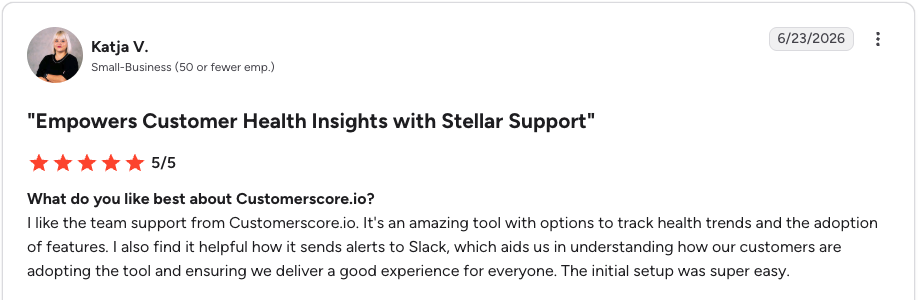
We also hold ourselves to the same standard we judge the others by: Customerscore.io is rated 4.8/5 on G2. Reviews like this one are why we build the way we do:
The 8 best customer success tools in 2026
1. Customerscore.io: Best for mid-market B2B SaaS
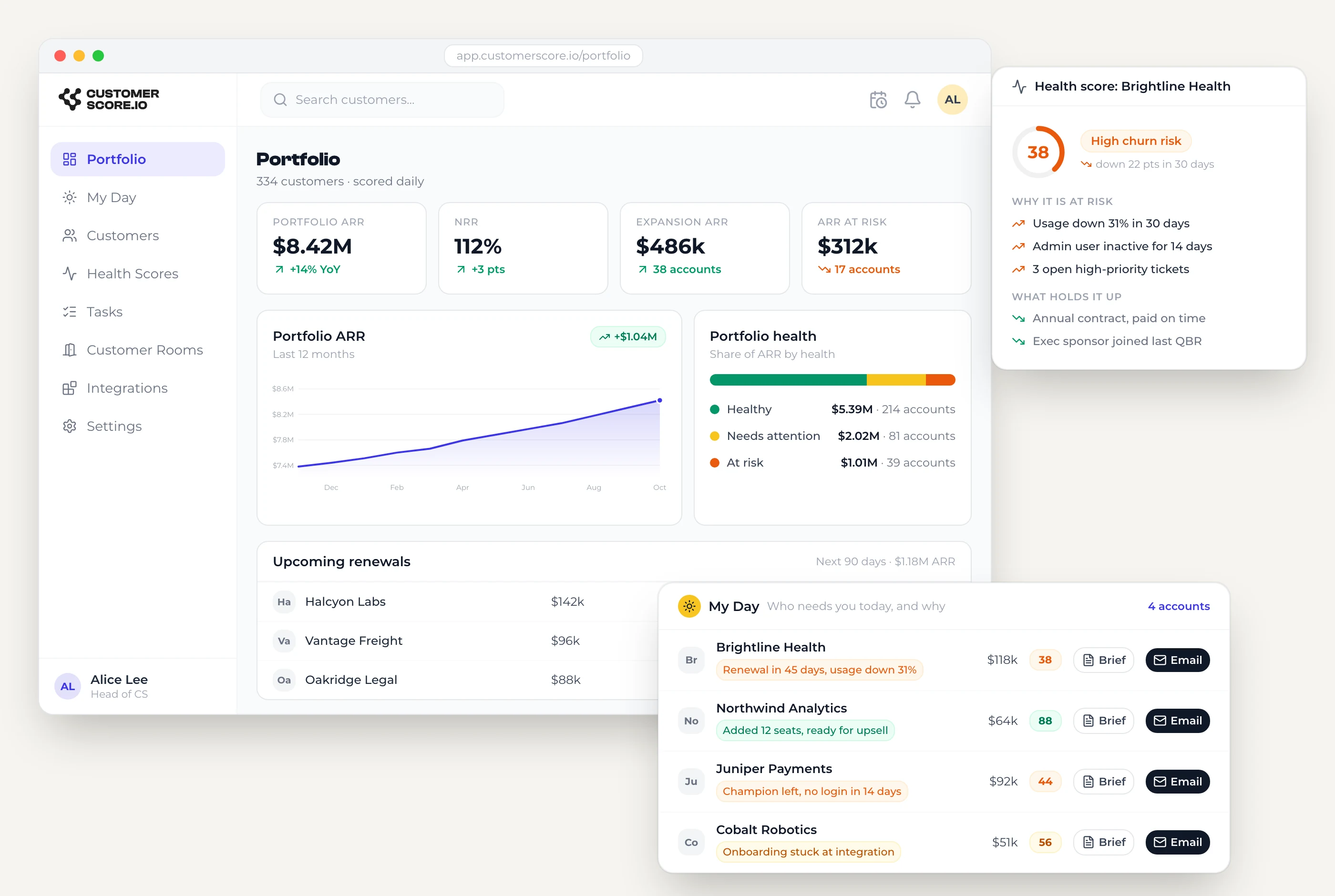
Customerscore.io is an AI-native Customer Success platform. It connects to your billing, CRM, and product data and scores every account daily, from 1 to 5, for both churn risk and expansion, then explains the score with the specific drivers and brakes behind it, so it is never a black box.
What sets it apart is that it answers the question every CS lead asks: who should my team talk to today, and why? Each CSM starts the day in My Day: who needs them today, why, and what to prepare, with the account brief and QBR and renewal prep built from the full account history. And it is a real system of record for customer management: every touchpoint, conversation, note, and data point lives on one account page, so your team sees the full picture and spends its time on the customers who actually need it.
It is built for B2B SaaS teams with named, high-value accounts: every CSM runs a bigger book without dropping the ball, and automated playbooks cover the accounts that need no human touch. Setup is live in 1 to 3 weeks, done with you by the team behind the scoring engine, with no admin to hire. You can book a demo and see exactly how the scoring works before you commit.
Key features:
- My Day and routines: every CSM starts the day knowing who to reach out to, why, and what is due, instead of assembling it from dashboards
- Churn and upsell scoring: every account scored daily from 1 to 5 for churn risk and upsell potential, with the drivers and brakes behind each score
- Seasonality-aware scoring: each account is scored against its own history and usage rhythm, so an expected seasonal dip (a school in summer, a retailer after the holidays) is not flagged as churn risk
- Tasks: follow-ups with assignees, due dates, and priorities, linked to the account they are about
- QBR and meeting briefs: prepared from the account's full history and touchpoints, so prep takes minutes instead of an afternoon
- Customer Rooms: a shared workspace per customer, one link and no login needed on their side, for onboarding plans, QBRs, and renewals
- MCP support: ask about your customer base straight from Claude or Slack in natural language, plus a conversational AI agent in the app
- Integrations and security: Stripe, HubSpot, Salesforce, Mixpanel, PostHog, Segment, Intercom, Chargebee; ISO 27001 certified, EU hosting, GDPR compliant
- Signals in the tools you already run: churn and upsell scores can also sync to HubSpot, Intercom, Slack, and webhooks
Pricing: One platform fee based on your ARR, with every feature included and never per seat. You get a tailored offer after one call; see pricing.
Pros:
- Explainable ML scoring, so CSMs act with context instead of guessing at a black-box number
- Live in 1 to 3 weeks with expert-led setup, no dedicated admin or CS Ops hire needed
- Every feature included in one platform fee based on ARR, never per seat
Cons:
- No in-app walkthroughs or product tours; that is where ChurnZero and Gainsight PX are stronger
- Scores refresh daily rather than in real time, and there is no mobile app; alerts go to Slack and email
- Not a CRM or PSA replacement; it syncs with HubSpot and Salesforce instead
G2 rating: 4.8/5. Reviewers highlight the Slack alerts, the way it connects data across tools, and the hands-on, expert-led setup. As Katja V., Head of Customer Success at tl;dv, puts it: "It gives us a clear read on customer health and feature adoption, and the Slack alerts keep us on top of every trend. Setup was super easy and the team support is amazing."
2. Gainsight: Best for enterprise CS teams with a dedicated admin
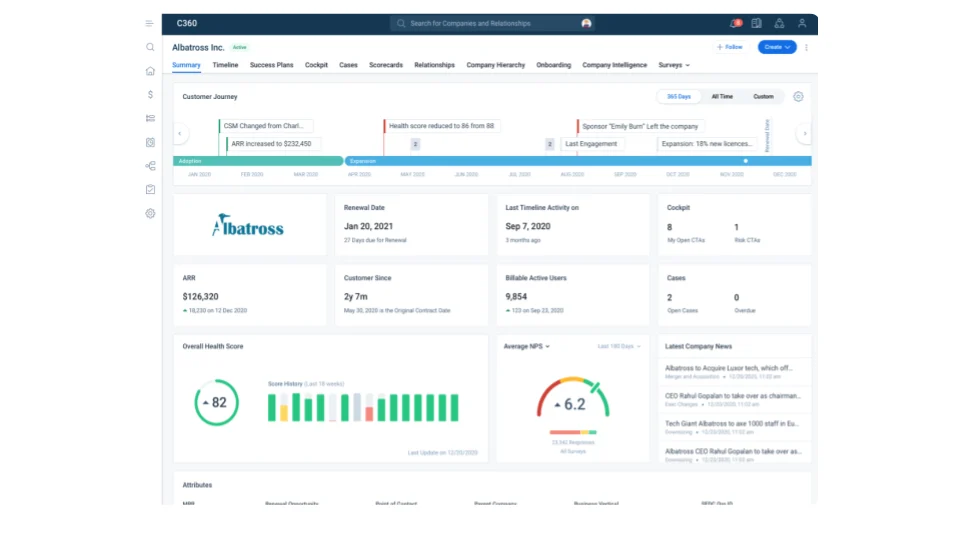
Gainsight is the enterprise standard. It bundles customer journey orchestration, in-app product experiences (Gainsight PX), communities, a powerful Rules Engine, and deep reporting into one suite, and it now leans hard into "agentic AI" for retention. If you have CS Ops resources and want the full toolkit, it is genuinely hard to outgrow.
The trade-off is weight. The Rules Engine is powerful but hard, and reviewers consistently recommend a dedicated Gainsight Admin to run it. Implementation is a services project, and reviewers advise cleaning and organizing your data before the rollout even starts. Gainsight has invested seriously in AI (Staircase AI conversation signals, Atlas agents, Agent Studio, a live MCP server), but the health scorecard itself is something your team designs and maintains. See the detailed Gainsight alternative comparison, or compare the Gainsight pricing and best alternatives.
Key features:
- Customer journey orchestration with the Rules Engine and Journey Orchestrator
- Gainsight PX for in-app engagement, walkthroughs, and product analytics
- Customer communities and education products under one vendor
- Deep, configurable reporting and dashboards with tight Salesforce integration
- Atlas AI agents, Agent Studio, and an MCP server, plus Staircase AI for conversation signals
Pricing: Quote-based, priced mainly on customer record volume and modules. Vendr reports a median of about $50,000 a year, with implementation services typically quoted separately at 20 to 40% of the first-year subscription (Vendr, October 2026).
Pros:
- The most complete CS suite on the market, with an ecosystem of admins, consultants, and integrations to match
- Scales to thousands of CSMs and the most complex enterprise motions
- Strong reporting depth once configured
Cons:
- Reviewers recommend a dedicated admin; complexity and the learning curve are the most consistent complaints
- Implementation is a services project, quoted separately
- Extra products (PX, Communities, Skilljar, Staircase) are separate offerings
G2 rating: 4.5/5. Reviewers praise the comprehensive customer view; complexity and setup effort are the most consistent complaints.
3. Vitally: Best for teams that want a polished CSM workspace
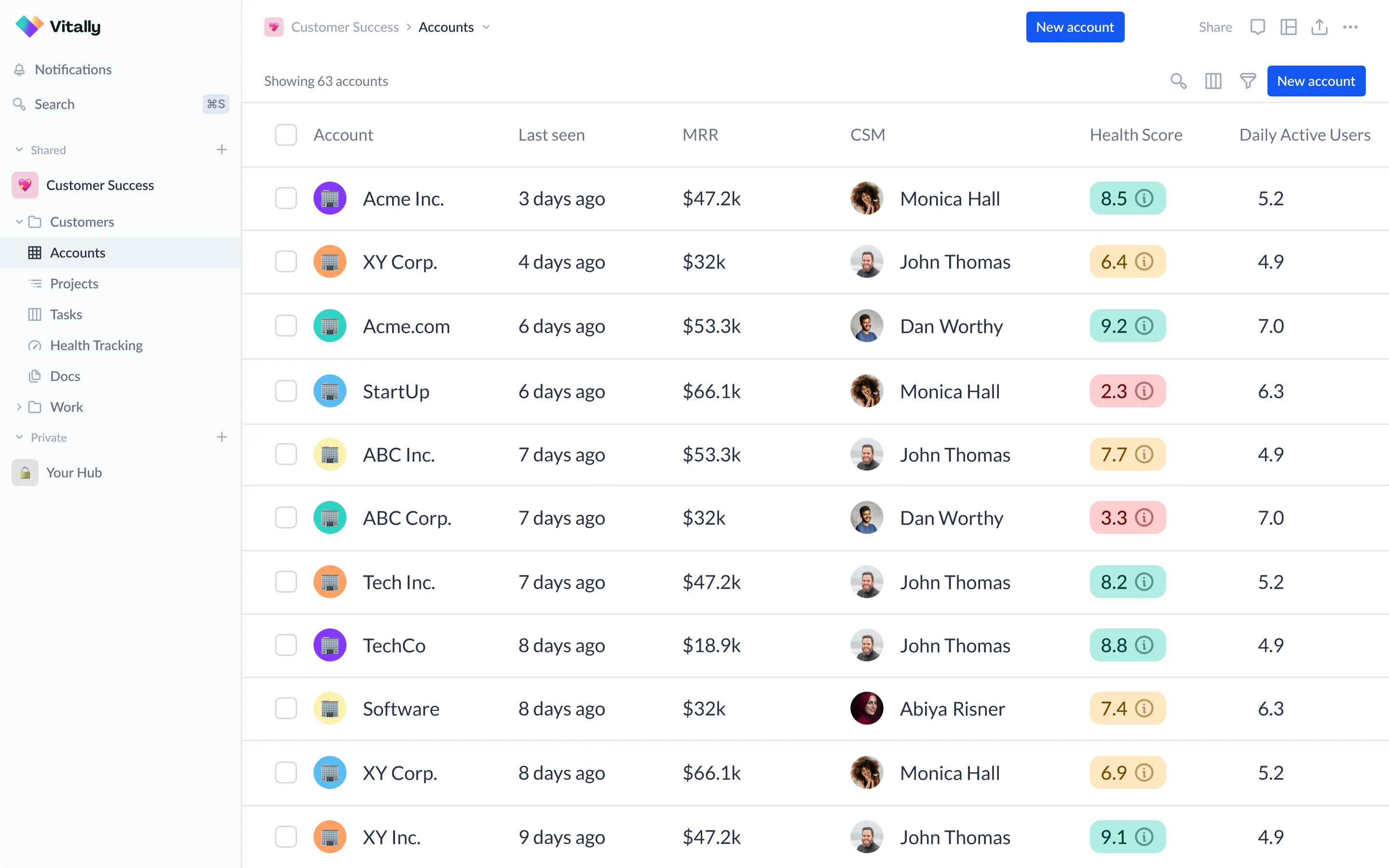
Vitally is a well-designed CS workspace: customizable health scores, tasks, playbooks, customer-facing Docs, and a polished UI that human-led teams genuinely enjoy. Vitally AI assists with meeting notes, summaries, and drafted actions, and it shines for teams that want to manage portfolios and collaborate with customers in one place.
The trade-off is that the health score is rules and weights your team configures, so its value hinges on the data and configuration you feed it. Reviewers note that you need an owner to configure health scores, rules, and playbooks before it pays off. See the Vitally alternative comparison.
Key features:
- Customizable health scores, segments, and playbook automation
- Customer-facing Docs and project boards for collaborative success plans
- Task management and portfolio views CSMs actually enjoy using
- Vitally AI (meeting recorder, summaries, drafted actions) and a read/write MCP server
Pricing: Quote-based, driven mainly by the number of accounts you manage, with onboarding fees on top. Vendr reports a median of about $35,000 a year (Vendr, October 2026).
Pros:
- One of the most polished UIs in the category, with strong momentum on G2
- Strong customer collaboration story with Docs and shared project boards
- Faster implementation than the enterprise suites (Vitally reports a 1.9-month average go-live)
Cons:
- The health score is configured rather than predicted; outcomes depend on how well you set up scores and playbooks
- Health rules and playbooks need an owner to maintain
- Its value hinges on the data and configuration you feed it
G2 rating: 4.5/5. Reviewers highlight the UI, automation builder, and Docs; the configuration lift is the most common criticism.
4. ChurnZero: Best for in-app engagement and playbooks
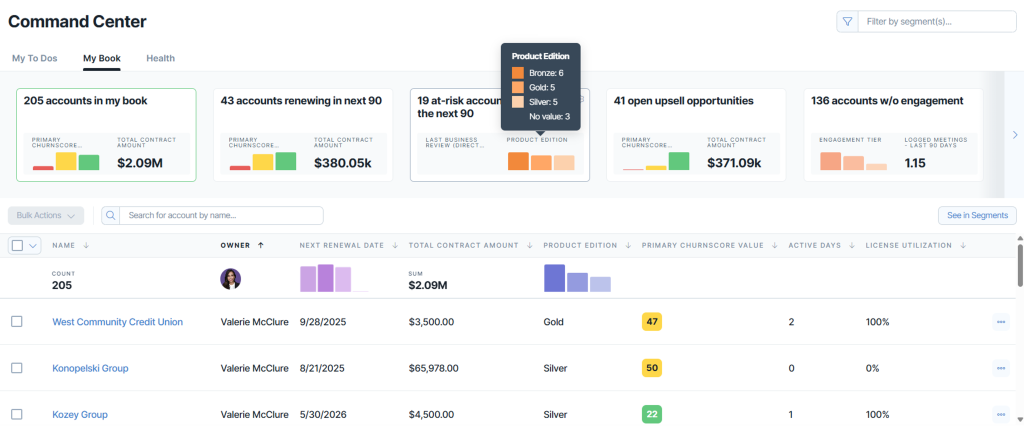
ChurnZero is strong on its Plays automation engine, in-app communications, WalkThroughs, and customer-facing Success Centers. It is a genuinely capable suite for mid-market and enterprise CS teams that want to run structured, in-app engagement programs.
But the ChurnScore is something your team builds: five to seven weighted factors you pick, adding up to 100, per segment. Reviewers describe weeks of setup and a learning curve, and it typically needs an owner. See the ChurnZero alternative comparison, or compare the ChurnZero pricing and best alternatives.
Key features:
- Plays automation engine for segment-triggered playbooks
- In-app communications, WalkThroughs, and customer-facing Success Centers
- Composite ChurnScores with configurable inputs
- Strong segmentation and journey tracking
- Agentic Essentials: 20 ready-made AI agents plus ChurnZero Connect (MCP), sold as a subscription with credits
Pricing: Quote-based. Third parties report different pricing models; Vendr reports a median of about $44,600 a year, plus onboarding fees (Vendr, October 2026).
Pros:
- The highest-rated large suite on G2, with best-in-class marks for support
- In-app engagement (WalkThroughs, Success Centers) is a real differentiator
- Powerful, flexible automation once configured
Cons:
- Weeks of setup before the scores and Plays are in place
- Learning curve is the most-cited complaint; most teams need an owner for the configuration
- Reporting rigidity and navigation are recurring criticisms
G2 rating: 4.7/5 on roughly 1,500 reviews, #1 in G2's customer success category.
5. Planhat: Best for a custom data model
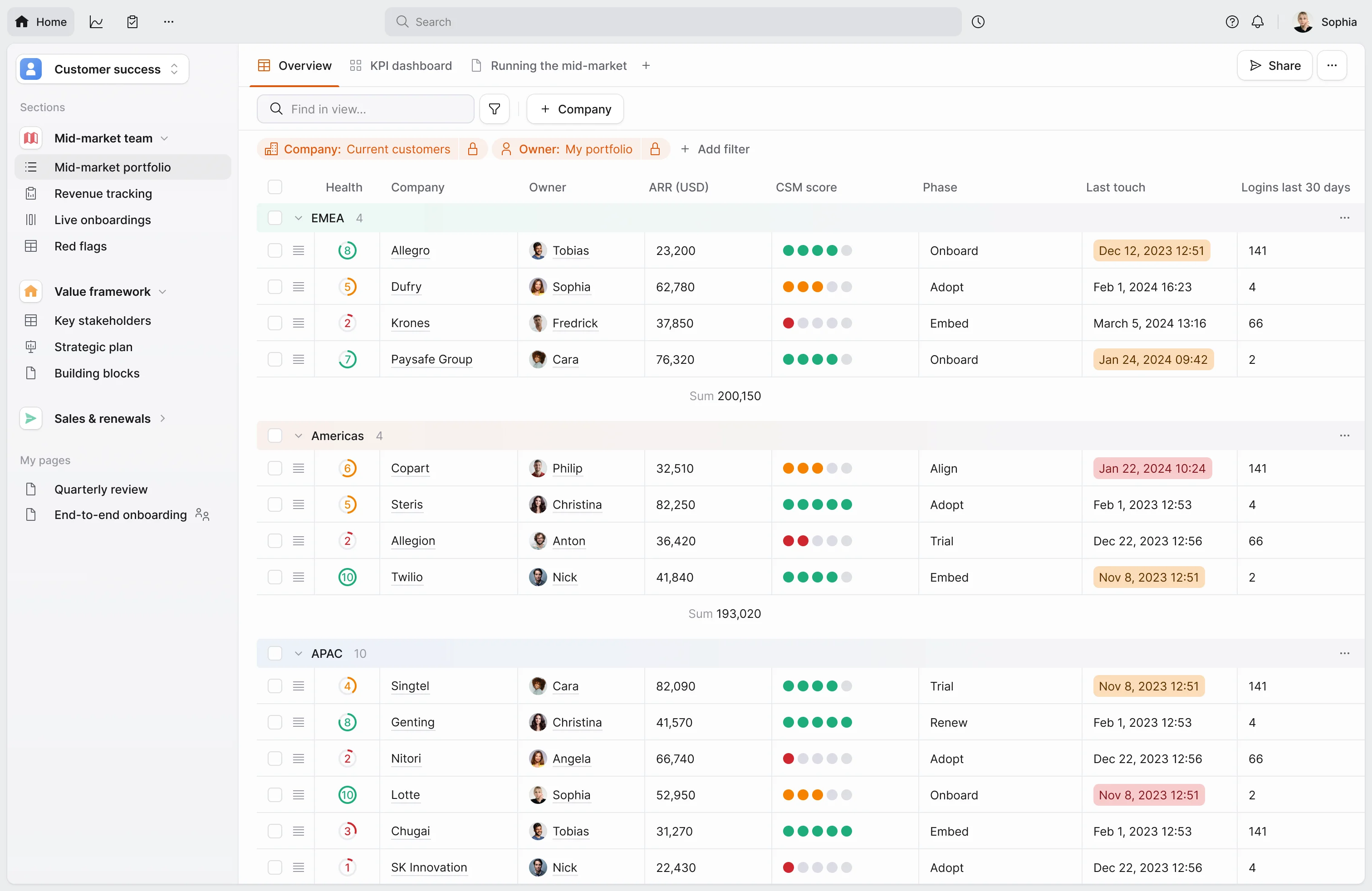
Planhat positions itself as a flexible customer platform, CSP, CRM, and PSA in one, with a custom data model and strong revenue workflows. For enterprises that need deep customization and want to model their own objects and processes, it is one of the most adaptable platforms on this list.
That flexibility is also the catch: reviewers note it can become overwhelming, and most teams need a dedicated admin to configure and maintain it. Your team designs and maintains the health score logic, and setup runs weeks to months in data-heavy setups, per reviews. See the Planhat alternative comparison or the Planhat pricing and best alternatives.
Key features:
- Fully custom data model: define your own objects, fields, and relationships
- CSP, CRM, and PSA workflows in one platform
- Health scoring, dashboards, and revenue management
- AI agents and an MCP server for Claude
Pricing: Quote-based, with paid add-ons such as the upgraded AI platform, portals, and email marketing. Vendr reports a median of about $41,000 a year (Vendr, October 2026).
Pros:
- The most adaptable data model in the category; it bends to complex books rather than forcing a template
- Reviewers rate it strong value against Gainsight for a comparable feature set
- Polished UI for a platform this deep
Cons:
- Weeks to months of setup, with real data-modeling work up front
- Needs a dedicated admin to configure and maintain
- Learning curve and occasional integration friction are recurring review themes
G2 rating: 4.5/5. Reviewers praise the customization and health tracking; the steep learning curve is the most common criticism.
6. Velaris: Best for teams that want autonomous AI agents
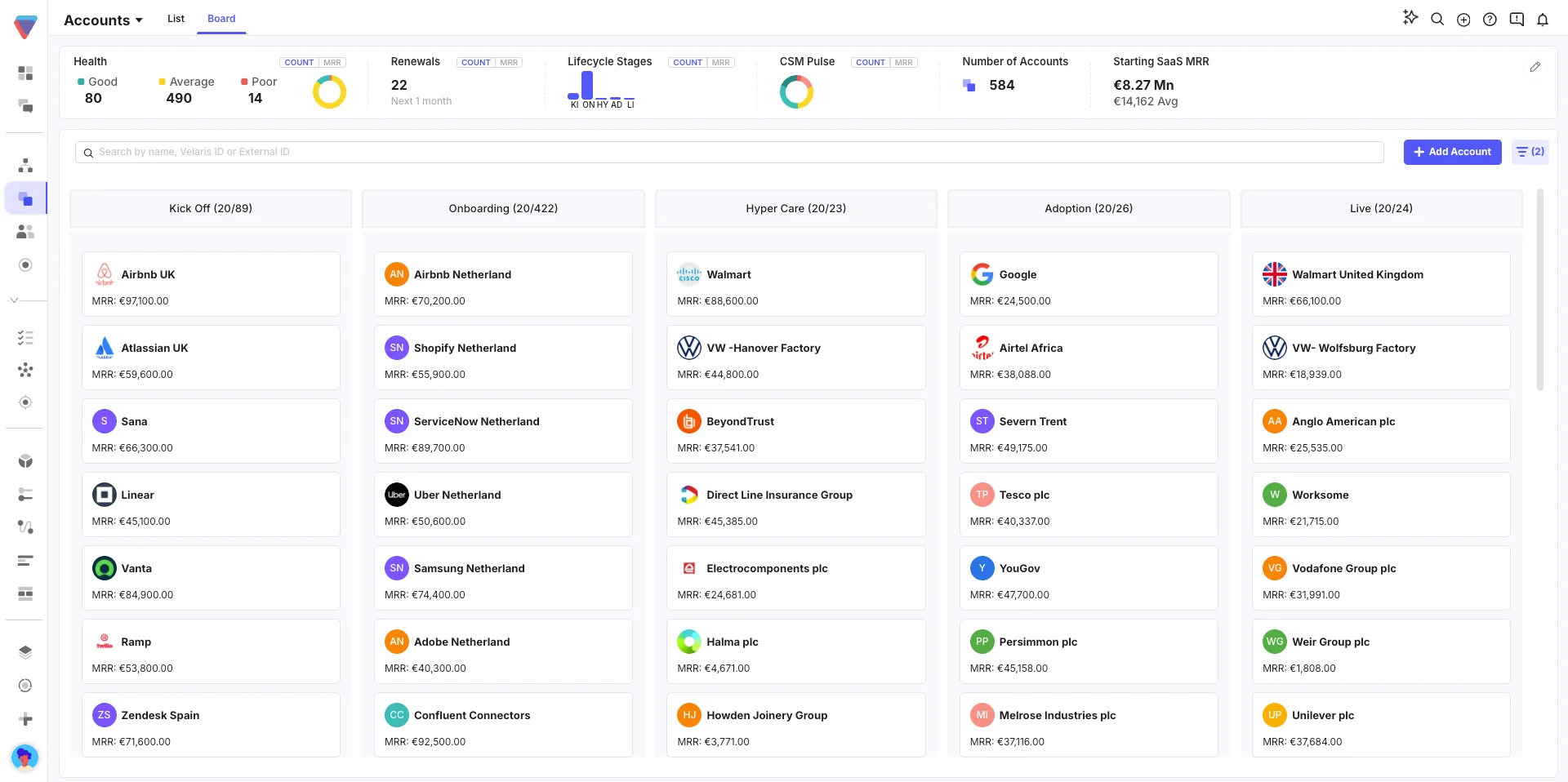
Velaris is an AI-native customer success platform built for mid-market and enterprise B2B SaaS teams managing large account books. At the center sits a proprietary context graph, a continuously updated map linking product usage, conversations, support activity, and relationship history for every account, so agents and CSMs work from the same real-time picture instead of piecing it together across separate tools.
What sets Velaris apart is how much it takes off a CSM's plate. Autonomous agents run in the background watching for risk and opportunity, handling the monitoring work that used to fall to a human checking dashboards. Velaris quotes 4 to 8 weeks for implementation, with its team doing the data mapping and integrations. See the Velaris alternative comparison.
Key features:
- Proprietary context graph unifying usage, conversations, support, and relationship data
- Autonomous agents that monitor accounts for risk and opportunity in the background
- Custom agent builder with your own instructions and event-based triggers
- Velaris Intelligence MCP server
Pricing: Quote-based; no public figures. The license includes five users and unlimited viewers, with the customer portal and support ticketing sold separately.
Pros:
- Agents genuinely reduce the monitoring load on CSMs
- Strong G2 marks for ease of admin and quality of support
- Responsive, hands-on support is a consistent review theme
Cons:
- A 4 to 8 week implementation before the agent layer runs on its own
- A younger platform than the incumbents, so less long-term evidence at enterprise scale
- The breadth of functionality brings an initial learning curve
G2 rating: 4.7/5. Reviewers praise the intuitive interface and support; the initial learning curve is the most common criticism.
7. Totango: Best for modular, incremental CS rollouts
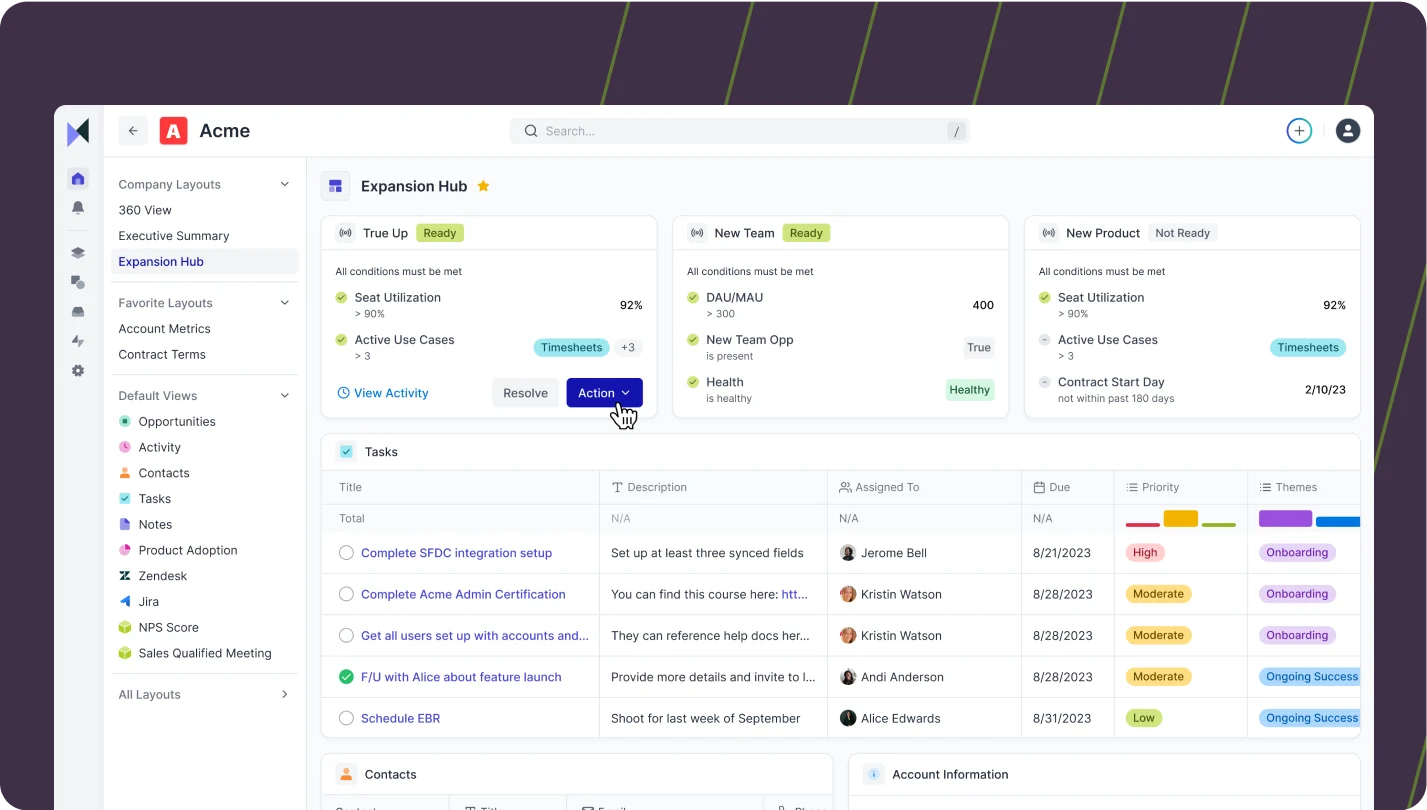
Totango's modular "SuccessBLOC" approach lets teams roll out CS programs incrementally, health scoring, journey templates, and basic automation, so you can start small and add modules as you mature. Following its merger with Catalyst, it also brings a more polished CSM workspace alongside the modular engine.
The flexibility cuts both ways: scaling insights and keeping the setup tidy takes hands-on effort over time, and the combined product surface is broad. Predictive, explainable scoring is not its core strength; it is closer to a configurable CS workspace than a platform that predicts risk per account and turns it into daily priorities.
Key features:
- Modular SuccessBLOCs: pre-built programs you adopt one at a time
- Journey templates, health scoring, and workflow automation
- Expansion Hub for expansion signals and account conditions
- Catalyst-derived CSM workspace on top of the modular engine
Pricing: Quote-based, scaling with modules and accounts. Entry points have historically been more accessible than the heavyweight suites on this list, but expect a real contract for a full deployment.
Pros:
- Incremental rollout: start with one program instead of a big-bang implementation
- Expansion signals alongside health scoring
- Broad feature surface after the Catalyst merger
Cons:
- Keeping the modular setup tidy takes ongoing hands-on effort
- Explainable predictive scoring is not its core strength
- The merged product surface can feel broad rather than deep
G2 rating: 4.4/5. Reviewers like the modular approach and usability; depth and setup upkeep draw the most criticism.
8. ClientSuccess: Best for startups and relationship-first CS teams
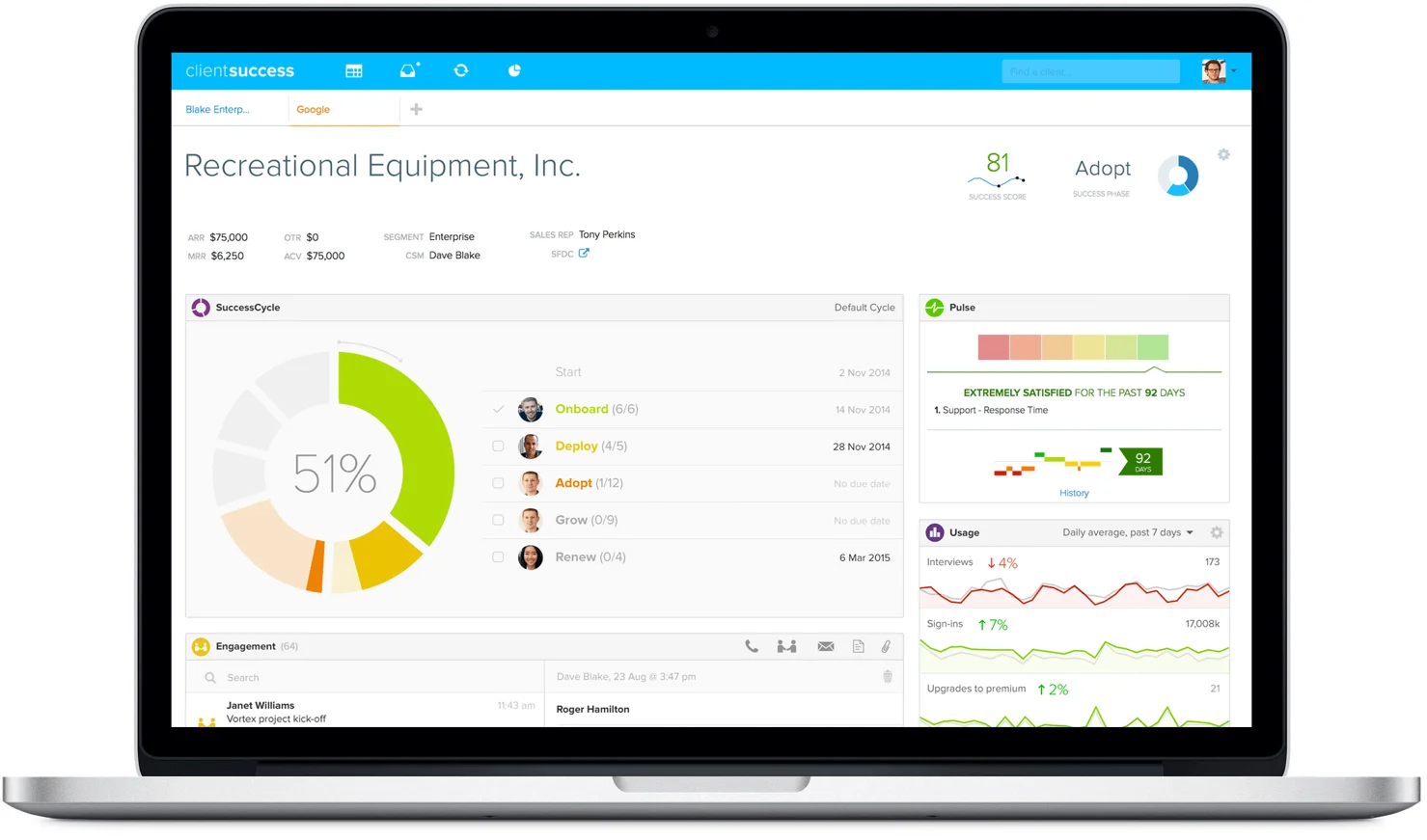
ClientSuccess is a straightforward, relationship-focused platform: SuccessScore health tracking, account plans, renewal and revenue management, and SuccessCycle workflows, wrapped in a clean, easy-to-adopt UI. For teams that prioritize CSM relationships and renewals over heavy automation, it is one of the simplest platforms to roll out.
That simplicity is also its ceiling. It organizes relationships and renewals well, but the SuccessScore is configured rather than predicted, and it lacks the deep automation and explainable predictive scoring the stronger platforms here offer.
Key features:
- SuccessScore health tracking and account monitoring
- Account plans, renewal management, and revenue tracking
- SuccessCycle lifecycle workflows
- Clean, fast-to-adopt UI
Pricing: Quote-based. Generally positioned for mid-market teams rather than enterprise budgets.
Pros:
- Reviewers consistently praise its ease of use and implementation
- Teams adopt it daily without extensive training
- Strong fit for renewal-focused, relationship-led CS motions
Cons:
- Lacks deep automation and explainable predictive scoring
- The SuccessScore is configured rather than predicted
- Light on in-app engagement compared to ChurnZero or Gainsight PX
G2 rating: 4.4/5. Reviewers praise the intuitive interface and ease of tracking client health; limited depth is the most common criticism.
Other customer success tools worth considering
Custify: Best for ease of use
Custify is a European customer success platform known for ease of use (#1 Easiest to Use on G2, 4.7/5) and hands-on support, with a customer 360, health scores, segments, playbooks and tasks. CustifyAI and its 2026 AI agents add risk detection from emails and meeting prep, and it ships an official MCP server. The trade-off is that your team defines the segments, metrics and health scores, which is where reviewers say the effort goes. Onboarding is a four-week concierge program; Vendr puts the median contract around $16,800 a year (Vendr, October 2026). See the Custify alternative comparison.
HubSpot Service Hub: A service desk with basic health scores
HubSpot Service Hub is a service desk first, with a Customer Success Workspace and health scores in the Professional and Enterprise tiers. You build the score from property and event groups that add or subtract points and set the thresholds yourself; product usage counts only if you push it into HubSpot. The Customer Health Agent (beta) grades one account at a time and uses HubSpot credits. Most CS teams that run on HubSpot still add a dedicated customer success platform once they own renewals across hundreds of accounts, and sync its scores back into HubSpot. Read more on HubSpot customer health scores.
Comparison table: best customer success software in 2026
| Platform | Best for | Health scoring | Monitoring and priorities | Setup | G2 rating | Pricing model |
|---|---|---|---|---|---|---|
| Customerscore.io | Mid-market B2B SaaS | Predicted per account (1 to 5), with drivers, seasonality-aware | Daily priorities for every CSM, alerts | 1 to 3 weeks, expert-led | 4.8 | Platform fee based on ARR, all features included |
| Gainsight | Enterprise CS teams | Scorecards you configure, plus AI agents | Rules and journeys an admin builds | Services-led project | 4.5 | Quote, by modules |
| Vitally | Polished CSM workspace | Rules and weights you configure | Workspace and playbooks you set up | Depends on your data | 4.5 | Quote, by accounts |
| ChurnZero | In-app engagement | Composite score from factors you pick | Plays your team builds, AI agents | Weeks | 4.7 | Quote |
| Planhat | Custom data model | Health scores you design and maintain | Views and workflows CSMs build | Weeks to months | 4.5 | Quote, with add-ons |
| Velaris | Autonomous AI agents | Context graph with drivers | Autonomous agents | 4 to 8 weeks | 4.7 | Quote, by seats |
| Totango | Modular rollouts | Configurable modules | Programs you assemble | Incremental | 4.4 | Quote, by modules |
| ClientSuccess | Startups, relationship-first teams | SuccessScore you configure | CSM-driven | Fast | 4.4 | Quote |
| Custify | Ease of use | Health scores you define | Playbooks and tasks you set up | 4-week concierge onboarding | 4.7 | Quote, by seats |
| HubSpot Service Hub | Basic health scores inside the CRM | Points-based score you configure | Inside HubSpot | Depends on your HubSpot setup | 4.4 | Included in Professional and Enterprise |
Comparison last updated October 2026, based on publicly available information and Vendr benchmarks; G2 ratings as of October 2026. Most tools do not publish pricing; figures change, so verify on each vendor's site.
How to choose the right one for your stage
- Before your first dedicated CSM or roughly $1M ARR: a well-kept CRM is often enough. If you want a CS tool already, ClientSuccess or Custify are the easiest to start with.
- Mid-market B2B SaaS with a CS team that owns renewals: prioritize daily priorities for each CSM, a score predicted from your own data, the full account history in one place, and a setup that does not need an admin. Customerscore.io is built for this.
- Enterprise with CS Ops: Gainsight or Planhat offer the depth and customization you can staff and configure.
- In-app engagement matters most: ChurnZero's WalkThroughs and Success Centers are a real edge.
- You want autonomous agents and can plan a longer rollout: Velaris, with a 4 to 8 week implementation.
- Check your data first: any platform is only as good as the data it reads. Billing and CRM data are enough to start; product usage makes the score sharper.
The honest rule: match the tool to your motion and to how much configuration your team wants to own. If you want AI to catch silent churn early, explain it, and show every CSM where to act next, without a configuration project, Customerscore.io is likely your best fit: book a demo. Coming from Planhat? See the Planhat alternative.
Related guides: Gainsight pricing and best alternatives · Planhat pricing and best alternatives · Best customer health score software · Best churn prediction software · Best customer retention software
FAQs
What is customer success software?
Customer success software helps SaaS companies reduce churn and grow net revenue retention by tracking customer health, managing accounts and tasks, and helping the team reach out proactively. The best modern tools also score churn and expansion risk with AI and put the accounts that need attention in front of your team.
What is the best customer success software for SaaS businesses?
It depends on your company type. For enterprises with a CS Ops team, Gainsight is the most complete suite. For mid-market B2B SaaS, Customerscore.io predicts churn and expansion for every account and gives each CSM today's priorities. Planhat fits teams that want a custom data model, ChurnZero fits in-app engagement, and ClientSuccess or Custify suit startups.
What is the best customer success software for mid-market SaaS?
Customerscore.io is built for mid-market B2B SaaS companies whose CS team owns renewals and NRR. It predicts churn and expansion for every account with the drivers behind each score, gives every CSM a daily list of who needs them and why, and keeps the full account history and QBR prep in one place. Setup is expert-led, with no admin to run it.
What is the best customer success software for startups?
ClientSuccess and Custify are the easiest to roll out for a first CS team. Before your first dedicated CSM, a well-kept CRM is often enough.
What is the best customer success software for small SaaS teams?
For a lean CS team of two to seven people that owns renewals and expansion, Customerscore.io is the strongest fit. Each CSM starts the day knowing which accounts need them and why, the model watches every account so nothing slips between check-ins, and briefs and QBR prep come from the full account history. There is no admin to hire and no configuration project: setup is expert-led and live in 1 to 3 weeks. If you have no dedicated CSM yet, a well-kept CRM, ClientSuccess or Custify is usually enough to start.
What is the best customer success software for early-stage B2B SaaS?
It depends on whether a CS team already owns renewals. Before the first dedicated CSM, a CRM covers most of it. Once you hire a second CS manager, sign named accounts with real renewals at stake, or raise a round that puts net revenue retention on the board agenda, Customerscore.io is the best fit: it predicts churn and upsell for every account from your billing, CRM and product data, explains the drivers, and turns them into daily priorities, without a platform your team has to build and maintain.
What is the best AI customer success platform for B2B SaaS?
Customerscore.io is an AI-native Customer Success platform: a predictive model, pre-trained on tens of thousands of SaaS users and tuned to your data, scores every account daily for churn risk and upsell potential and shows the drivers behind each score. Most established suites (Gainsight, ChurnZero, Planhat) add AI agents on top of a health score your team configures; Velaris is built around autonomous agents with a longer rollout. Check whether the score itself is predicted or configured, because that decides how much the AI layer can see.
Which customer success software has the most accurate AI churn risk scoring?
Accuracy depends less on the vendor than on how the score is built. A score predicted from your own history learns which signals preceded churn in your accounts; a score built from rules and weights only reflects what your team assumed. Look for three things: the score is predicted rather than configured, it shows the drivers behind each change, and it accounts for seasonality so an expected dip is not flagged as risk. Customerscore.io does all three and refreshes every account daily.
Which customer success platforms have built-in AI workflows for revenue teams?
Gainsight (Atlas agents and Agent Studio), ChurnZero (Agentic Essentials) and Velaris (autonomous agents) all ship AI workflows. In Customerscore.io, when the model flags an account, a playbook creates the task sequence and assigns it to the account owner with a due date, My Day shows each CSM what to do next and why, and meeting briefs and QBRs are prepared from the account history. The playbook organizes the work; the CSM does it.
Do I need a customer success platform if I already use a CRM?
Not always. A CRM tracks the sales pipeline; a customer success platform tracks account health, renewals and expansion from product usage, billing and support data that usually does not live in the CRM. Once a CS team owns renewals across hundreds of accounts, a dedicated platform shows who needs attention and why. Most platforms sync two-way with HubSpot or Salesforce.
What is explainable AI scoring in customer success?
Explainable AI scoring uses behavioral, product, and billing signals to score each account for churn or expansion, and shows the specific drivers behind the score (the "why"), not just a number. That lets teams act with context instead of guessing. See our complete customer health score guide.
How long does it take to implement a customer success platform?
It varies widely. Enterprise suites like Gainsight or Planhat commonly take months and a dedicated admin. Customerscore.io connects your data and goes live in 1 to 3 weeks with expert-led setup.
Do we need Gainsight or Planhat?
Only if you need what comes with them: a suite your CS Ops team configures, or CRM and PSA in the same platform. If you want the same depth for customer success without a configuration project, Customerscore.io gives every CSM today's priorities from day one. Compare the Planhat alternative and Gainsight alternative.
Do small SaaS teams need Gainsight?
Usually not. Gainsight is built for enterprises with a CS Ops team: reviewers recommend a dedicated admin, and implementation is a services project. A lean CS team that owns revenue gets more from a platform that is live in weeks and needs no one to run it. Customerscore.io gives that team the same high-touch depth (account history, renewal and QBR prep, predicted churn and upsell) with expert-led setup in 1 to 3 weeks. See the Gainsight alternative.
How much does customer success software cost?
Most CS platforms are quote-based. The real cost is the licence plus add-ons, the implementation services, the admin who runs the platform, and the months before it is live. Customerscore.io charges one platform fee based on your ARR, with every feature included and never per seat, and expert-led setup; book a demo for a tailored offer.
Related articles
Multi-Year Renewals in B2B SaaS: When to Offer Them and How
When a multi-year renewal pays off, what discount to expect, which clauses protect both sides, and how to time the offer.
BlogCustomer Success Org Design: Structure, Roles and CSM Capacity
How to structure a customer success team, size books by hours rather than ratios, and evolve the org as the company grows.
BlogSales to Customer Success Handoff: Template, Checklist and Other Handoffs
A one-page handoff brief, the fields it needs, timing targets, and how support to CS and product to CS handoffs work.
BlogChurn Survey Questions: Templates and How to Use the Answers
Two churn survey questions you can copy, where to ask them, and how to turn the answers into a ranked list of fixes with an owner.