
One-Page Brief in 48 Hours for SaaS: Sales to Customer Success Handoff


Require a confirmed handoff brief within 48 hours of closed-won and a kickoff within five business days. The brief must name the customer's success metric, map the stakeholders, and flag every commitment the account executive made during the sale. No brief, no kickoff. That's the rule, and everything else in the sales to CS handoff process exists to support it.
TL;DR:
- A confirmed handoff brief should be completed within 48 hours after deal closure, including success metrics, stakeholder mapping, commitments, and technical constraints.
- The internal AE-to-CSM review meeting must occur within two business days of closing to verify the brief before customer introduction.
- The customer kickoff is best scheduled within five business days of closed-won to ensure a smooth transition and early engagement.
- Key metrics for evaluating handoff quality include a 90% or higher brief completion rate, fewer than five days to kickoff, and measurable improvements in first-value and account health scores.
- Automating parts of the process with AI should support quick draft creation and flag commitments for review, but human confirmation remains essential to avoid liability.
Table of Contents
- What Is the Sales to Customer Success Handoff?
- Why a Clean Handoff Protects Retention and Revenue
- The Handoff Document: Fields, Template, and Acceptance Checklist
- Step-by-Step: The Handoff Process and Timing Targets
- How to Measure Handoff Quality
- Common Failure Modes and How to Fix Them
- Where AI and Automation Actually Help
- Rolling Out a One-Page Brief Culture
- How Customerscore Supports a Faster, More Reliable Handoff
- Sources
- FAQ
What Is the Sales to Customer Success Handoff?
The sales to customer success transition is the point where an account executive passes ownership of a customer to the person responsible for keeping them, growing them, and getting them to value. It usually happens at closed-won, but the smart version of this process starts earlier: at the SDR-to-AE checkpoint, again at AE-to-CSM, and sometimes a third time when an implementation team gets involved before the CSM takes the wheel.
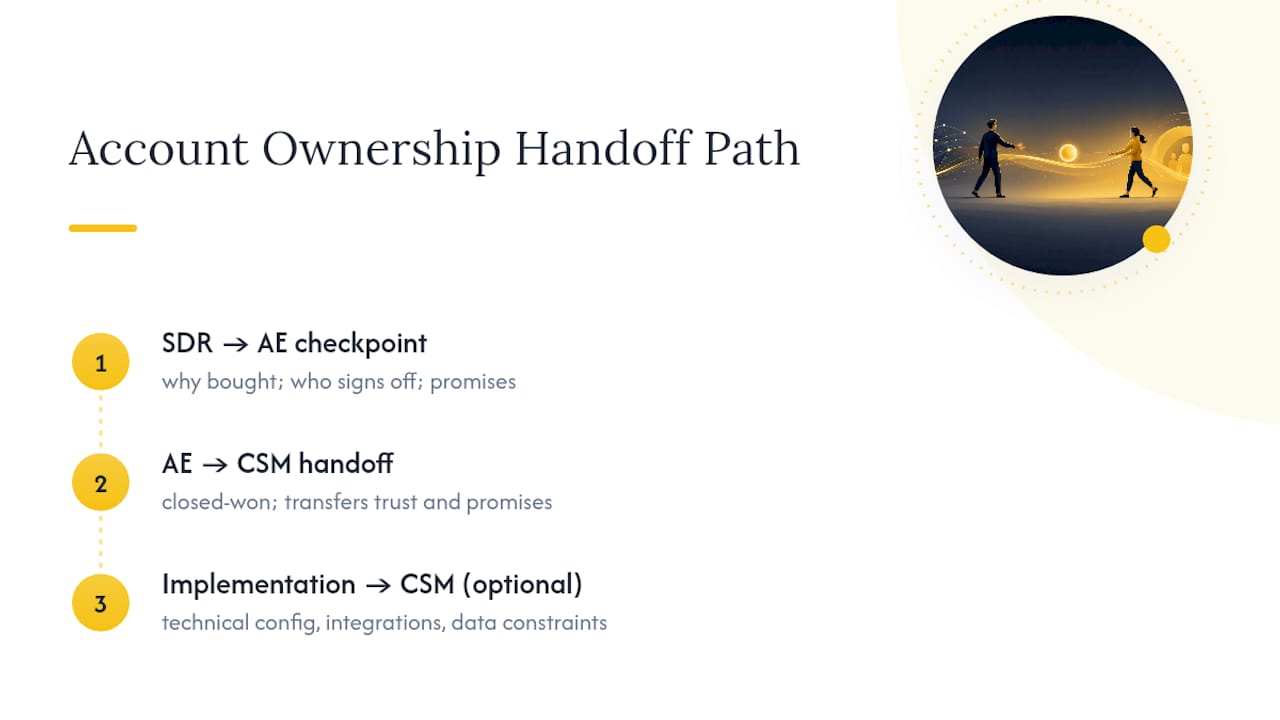
Waiting until the ink dries to think about handoff prep guarantees rework. The AE who closed the deal already knows why the customer bought, who signs off internally, and what was promised verbally in the last call. If nobody writes that down before the deal closes, the customer success manager starts from zero, and the customer notices immediately.
There's a difference worth naming here: a relationship handoff transfers trust and context (who trusts whom, what was promised, what the political map looks like), while a technical handoff transfers configuration details, integration requirements, and data constraints. Most failed handoffs skip the relationship half entirely and hand over a CRM record instead.
Why a Clean Handoff Protects Retention and Revenue
Deals fail at the handoff more often than most sales leaders admit. When contextual knowledge doesn't move from the seller to the success team, the customer effectively gets re-sold on their own decision, and every re-explained detail chips away at trust built during the sales cycle.
The operational fallout shows up fast. A CSM without a named success metric can't build an onboarding plan around what the customer actually cares about, so time-to-value slips. A CSM without a stakeholder map schedules kickoff calls with the wrong people, or worse, never learns who the actual economic buyer is until a renewal conversation goes sideways.
The math is simple: a structured handoff that transfers goals, stakeholders, commitments, and success criteria within days of closing correlates with faster time-to-value and fewer early-stage escalations, according to handoff process research from OutboundSalesPro.
For leadership, the takeaway is narrow and enforceable. A functioning handoff process produces a document, not a verbal summary in Slack. It happens on a schedule, not whenever the AE gets around to it. And it gets checked, the same way a deal desk checks a contract before it goes out.
The Handoff Document: Fields, Template, and Acceptance Checklist
A handoff brief is only useful if it forces specificity. Vague fields produce vague briefs, and vague briefs produce CSMs who ask the customer questions the AE already had answered weeks earlier.
The essential fields, in the order a CSM actually needs them:
- Purchase thesis — why the customer bought, in their own words, not the AE's sales pitch language
- Success metric(s) — the specific outcome the customer is measuring, with a target date attached
- Stakeholder map — economic buyer, champion, day-to-day users, and anyone who pushed back during the sale
- Verbal commitments — anything promised on a call that isn't in the contract (a custom report, a faster response SLA, a specific integration timeline)
- Technical constraints — data residency requirements, SSO needs, integration dependencies
- Timeline and milestone owner — the first 30/60/90-day milestone and who on the customer side owns hitting it
Build the brief through three states, not one. Draft is AE-authored, usually pulled together in the final week before close. Confirmed means the AE has reviewed the draft against their own notes and signed off. Verified means the CSM has read it and accepted it as sufficient to start work. Skipping straight from draft to kickoff is where most of the damage happens, because nobody actually checked the brief for accuracy.
Pro Tip: Treat the brief as the account's canonical memory, not a CRM export. A CRM field dump tells you what was clicked. A confirmed brief tells you what was promised, and that distinction is what a structured handoff is actually for.

Before any kickoff gets scheduled, run an acceptance checklist: CRM fields updated, call recordings attached, AE confirmation logged with a timestamp, and a CSM formally assigned. If any one of those four is missing, the deal isn't ready for handoff yet, regardless of how eager the AE is to move on to the next quota cycle.
Step-by-Step: The Handoff Process and Timing Targets
Run the process in four stages, each with a clear owner and a deadline.
- Pre-close prep (before signature). Assign a provisional CSM as soon as the deal reaches late-stage negotiation. Capture discovery call artifacts, notes, and recordings while they're fresh, and get tentative agreement from the champion on what success looks like in the first 90 days.
- Internal AE-to-CSM alignment meeting (within 2 business days of close). Run a focused 30 to 45 minute session with a fixed agenda: open risks, verbal commitments that need verification, integration or technical needs, and a walkthrough of the stakeholder map. This meeting is where the confirmed brief gets stress-tested before the customer ever sees it.
- Customer introduction. Give the champion a primer on what to expect, send a personalized introduction email from the AE (not a template done), and have the AE join the first CS-led kickoff call, even briefly. A five-minute appearance from the person who built the relationship carries more weight than any handoff document.
- Kickoff. This should happen within 5 business days of closed-won, full stop.
The timing math backing this sequence comes from operational playbooks used across B2B SaaS teams: brief confirmed within 48 hours, internal review complete within 2 business days, kickoff within 5. Every day beyond that window is a day the customer spends wondering if anyone on your side remembers what they signed up for.
How to Measure Handoff Quality
Waiting for a renewal conversation to find out your handoff process is broken is too late. Four leading indicators catch the problem while there's still time to fix it, and industry playbooks consistently point to these over lagging metrics like NRR:
- Brief completion rate — the percentage of closed-won deals with a fully confirmed brief before kickoff. Target 90% or higher.
- Days-to-kickoff — the gap between closed-won and the first CS-led session. Target under 5 business days.
- Time-to-first-value — how long until the customer hits the first milestone defined in the brief.
- Day-90 health delta — the change in health score from kickoff to day 90, which tells you whether the handoff set the account up correctly or left it playing catch-up.
Wire these into a RevOps dashboard that updates weekly, not quarterly. A named success metric that lags by day 30 is an early warning sign worth feeding directly into a churn model rather than waiting to notice it during a renewal review. Run a short weekly audit of the past week's handoffs against the acceptance checklist, and treat repeated misses as an SLA violation, the same way you'd treat a missed response-time target in support.
Common Failure Modes and How to Fix Them
Most broken handoffs fail for the same handful of reasons, and none of them require a system rebuild to fix.
- Missing CRM gates. Deals move to "closed-won" without required fields populated. Fix it with mandatory fields and RevOps automation that blocks stage progression until the brief exists.
- No AE confirmation. A draft brief sits unreviewed. Add a five-minute confirm step to the AE's closing workflow, not a separate task they'll deprioritize.
- Verbal commitments never get written down. Whatever was promised on the last call disappears until the customer brings it up angrily three months later. Require commitment capture as part of the draft, not an afterthought.
- No AE presence at kickoff. The relationship handoff never actually happens; only the technical one does. Make a brief AE appearance part of the standard kickoff agenda, not optional.
The fix that works isn't a mandate memo. Pilot the new process on your highest-value deals first, get CSM feedback on where the onboarding handoff still leaves gaps, and iterate the template before rolling it out company-wide. Change management sticks better when the first wins are visible and specific.
Where AI and Automation Actually Help
AI earns its place in this process by removing the tedious parts, not by replacing judgment. A model that reads a call transcript and CRM history can draft a one-page brief in minutes: purchase thesis, flagged success metric, stakeholder map, and a list of verbal commitments pulled straight from the recording. That draft still needs a human AE confirm step, because an AI-generated summary without review is a liability, not a shortcut.
The automations worth building:
- Auto-populate handoff fields from call transcripts and CRM activity
- Trigger the internal alignment meeting automatically at closed-won
- Convert meeting notes into assigned action items instead of a static summary
- Flag every verbal commitment as "verify by AE" until confirmed
Customerscore's Claude-based skills apply this directly. One skill turns meeting notes into action items automatically; another converts support tickets into product themes, useful once the account moves past kickoff. Feed the named success metric into explainable health scoring, and you get an early-warning trigger the moment that metric starts to lag.
Pro Tip: Automation should shorten the path to a confirmed brief, not replace the confirmation itself. If your AI tool skips the AE review step, you've automated the wrong part of the process.
Rolling Out a One-Page Brief Culture
Expect pushback the first time you ask AEs to spend ten extra minutes on a brief right after closing a deal. Start with your highest-value accounts, not a company-wide mandate, and let the Onramp-style pilot approach prove itself before scaling. Track brief completion rate and days-to-kickoff weekly, and put the early wins in front of the team that resisted hardest. Nothing sells a process change like a CSM saying kickoff finally felt easy.
— Patrik
How Customerscore Supports a Faster, More Reliable Handoff
If you're piloting AI-assisted handoffs, look for three things in any tool you evaluate: how fast it deploys, whether its scoring is explainable enough to defend in a customer conversation, and whether it actually enforces a confirmation step instead of just generating drafts nobody reviews. Customerscore is built around that last point specifically. It's AI-native and deploys in days rather than months, pulling from product usage, billing, CRM, and support data to build health scores you can explain line by line instead of trusting a black box.

The same Claude-based skills that turn meeting notes into action items also flag verbal commitments for AE review, and feed named success metrics straight into churn prediction so a lagging milestone triggers an alert before day 90 instead of at renewal. If you're ready to see how a confirmed brief workflow fits your stack, check pricing, a flat platform fee tiered by your client ARR rather than per seat, or book a demo to walk through it with the team.
Sources
- How to Run a Sales Handoff: The Process for Every Transition in B2B Sales - JB Sales
- Deal handoff process — OutboundSalesPro
- Sales to Customer Success Handoff: The B2B Playbook That Sticks - Darwin AI
FAQ
What Is the Sales to Customer Success Handoff?
It's the structured transfer of ownership, context, and commitments from the account executive who closed the deal to the customer success manager responsible for onboarding and retaining the account. A functioning handoff includes a confirmed brief covering the purchase thesis, success metrics, stakeholder map, and any verbal promises made during the sale, delivered within 48 hours of closed-won.
What Does CS Mean in Sales?
CS stands for customer success, the team responsible for a customer's outcomes after the sale closes, including onboarding, adoption, renewals, and expansion. In the context of a sales to CS handoff, "CS" specifically refers to the customer success manager who inherits the account from the AE.
Can I Transition from Sales to Customer Success?
Yes, moving from an AE or SDR role into customer success is a common career path, since both roles require relationship management and an understanding of customer goals. The skills that make someone good at closing deals, like stakeholder mapping and reading commitments accurately, translate directly into running a strong handoff and, later, managing renewals.
How Fast Should a Handoff Brief Get Confirmed?
Within 48 hours of closed-won, with the internal AE-to-CSM alignment meeting following within 2 business days. Kickoff with the customer should happen within 5 business days of the deal closing.
What Should Be Tracked to Measure Handoff Quality?
These leading indicators catch handoff failures early, rather than waiting for a renewal cycle to reveal the damage, as industry playbooks recommend.
Recommended
Related articles
Cut CSM Intervention 18%: Predictive Playbooks for CS & RevOps
Cut CSM Intervention 18%: Predictive Playbooks for CS & RevOps ! Predictive playbook geometric title card Predictive playbooks link a churn prediction to a specific, repeatable action so customer
BlogPinpoint B2B SaaS Adoption Gaps and the Fix That Lifts Renewal
Pinpoint B2B SaaS Adoption Gaps and the Fix That Lifts Renewal ! Analysts reviewing SaaS adoption gaps Adoption gap analysis identifies the funnel stage where eligible users or accounts fail to reach
BlogAnalysts: 6–12 Month Cohort Forecasts for Net Dollar Retention
Analysts: 6–12 Month Cohort Forecasts for Net Dollar Retention ! Analyst reviewing cohort retention forecast The most reliable way to forecast net dollar retention is cohort-based modeling that
BlogStop Surprise Churn: 5 Phase Data Mapping for RevOps and CS
Stop Surprise Churn: 5 Phase Data Mapping for RevOps and CS ! Analyst mapping customer data fields Data mapping for CS means connecting product usage, billing, CRM, and support data to the fields your