
Customer Success Leaders: Hours Based Org Design, Not Ratio Guesswork


The best customer success org design starts with segmentation, not headcount. Group accounts by ARR and complexity, assign a touch model to each segment, then staff using hours-based capacity math instead of guessing at ratios. Layer a reason-coded health model and lifecycle plays on top, tied directly to gross and net revenue retention. Run a capacity check on your top ARR accounts this week. That single exercise usually reveals more about your structure than any org chart redesign.
TL;DR:
- Segment accounts by ARR and complexity, then staff based on capacity calculations rather than generic ratios to ensure balanced workloads.
- Use four main models—generalist, specialist, pods, and digital—to match your company's size, product complexity, and renewal risk profile.
- Build a role structure that includes leadership, onboarding specialists, CSMs, renewal roles, and CS operations, each with clear KPIs aligned to business outcomes.
- Continuously monitor capacity with hours-based math, crop misalignments in coverage, and adjust segmentation or headcount before issues impact renewal and growth.
- Implement reason-coded health scores and feedback loops from billing, product, and support data to proactively identify at-risk accounts and improve collaboration across functions.
Table of Contents
- Customer Success Org Design: Picking the Right Model
- Which Roles Belong in a Modern CS Org?
- How Should You Segment and Assign Coverage?
- How Do You Calculate CSM Capacity and Book Size?
- What Lifecycle Plays and Handoffs Should You Build?
- How Do You Build a Health Score and CS Ops Function?
- How Should CS Compensation Tie to Retention?
- What Does a CS Maturity Roadmap Look Like?
- How Customerscore Supports These Org Design Choices
- How Do You Manage the Shift to a New CS Org Structure?
- How Do You Build Feedback Loops Into the Org Structure?
- How Should CS Collaborate With Sales, Product, and Support?
- The Ratio Mistake Almost Every CS Leader Makes
- Ready to Instrument Your CS Org With Real Data
- Sources
- FAQ
Customer Success Org Design: Picking the Right Model
Four models dominate customer success team structure, and the wrong one for your stage is a common reason CS feels chaotic even when everyone is working hard.
A generalist model has each CSM handling onboarding, adoption, and renewal for their book. It works well for early-stage companies with fewer than 100 accounts because it keeps context with one owner. A specialist model splits the lifecycle across dedicated onboarding, adoption, and renewal roles. This scales better once volume climbs past a few hundred accounts, but it adds handoff risk. Pods combine a CSM, support engineer, and sometimes a solutions architect around a shared enterprise book. They fit high-ACV, complex products where continuity matters more than efficiency. Digital/pooled models serve SMB and long-tail segments through tech-touch programs and shared CSM coverage rather than named ownership.
Use this quick checklist to match model to context:
- Average contract value under $10,000: pooled or tech-touch, not a dedicated CSM.
- Complex, multi-product implementations: pods or specialist teams with a support engineer attached.
- Fewer than 150 total accounts: stick with generalists until volume forces a split.
- High renewal concentration risk: specialists, so no single person owns both the sale and the save.
The pedowitzgroup framework frames this as a sequencing problem: define outcomes first, then segment, then design coverage. Skipping straight to "we need more CSMs" is how most designing customer success roles projects go sideways.
Which Roles Belong in a Modern CS Org?
A functioning customer success team structure needs more than CSMs with a title change. Here's the role map that tends to hold up as companies scale past their first 500 accounts:
- Leadership (VP/Chief Customer Officer). Owns GRR, NRR, and overall retention strategy, and reports revenue risk to the executive team alongside sales leadership.
- Onboarding specialists. Own time-to-value (TTV) and milestone-based implementation, separate from the renewal conversation entirely.
- CSMs. Own adoption, health, and expansion identification within their assigned book, measured on adoption index and save rate.
- Account managers or renewal specialists. Own the commercial renewal and expansion motion, freeing CSMs to focus on outcomes rather than paperwork.
- Solutions engineers or professional services. Handle technical implementation for complex or custom deployments.
- CS Operations. Owns the data model, dashboards, and capacity monitoring across the whole function.
- Enablement and customer education. Build the scalable content, training, and community assets that reduce 1:1 CSM time per account, a shift Chief Customer Officer Council argues is what actually breaks the linear headcount trap.
Each role needs a one-page charter mapping its KPI to a business outcome, not a vague job description.
How Should You Segment and Assign Coverage?
Segmentation drives everything else in customer support team organization, and most mismatches trace back to skipping this step. Segment on four criteria: ARR, product complexity, strategic potential (logo value, references, expansion headroom), and renewal risk profile.
Common mappings that hold up across most B2B SaaS companies:
- Enterprise (typically top 10-20% of ARR): named CSM or pod, high-touch, quarterly business reviews.
- Mid-market: pooled named coverage, one CSM per 25-50 accounts, proactive but not white-glove.
- SMB and long-tail: tech-touch or pooled digital programs, automated onboarding and in-app guidance.
- Strategic accounts regardless of size: named coverage if they carry outsized reference or expansion value.
Assignment rules matter as much as the model itself. Never load one CSM's book with renewals concentrated in the same quarter. A balanced book caps how much revenue can come up for renewal at once, which the ooligo book-of-business framework calls renewal-date distribution, and it's the single easiest way to avoid a quarter where three big accounts all churn at the same time. Spread onboarding load evenly too, since a CSM absorbing five new accounts in one month while managing a full book will neglect both.
A quick diagnostic: if your SMB accounts are getting quarterly business reviews and your enterprise accounts are getting a monthly email blast, your coverage model is inverted. That mismatch quietly drains margin on one end and risks your biggest logos on the other.
How Do You Calculate CSM Capacity and Book Size?
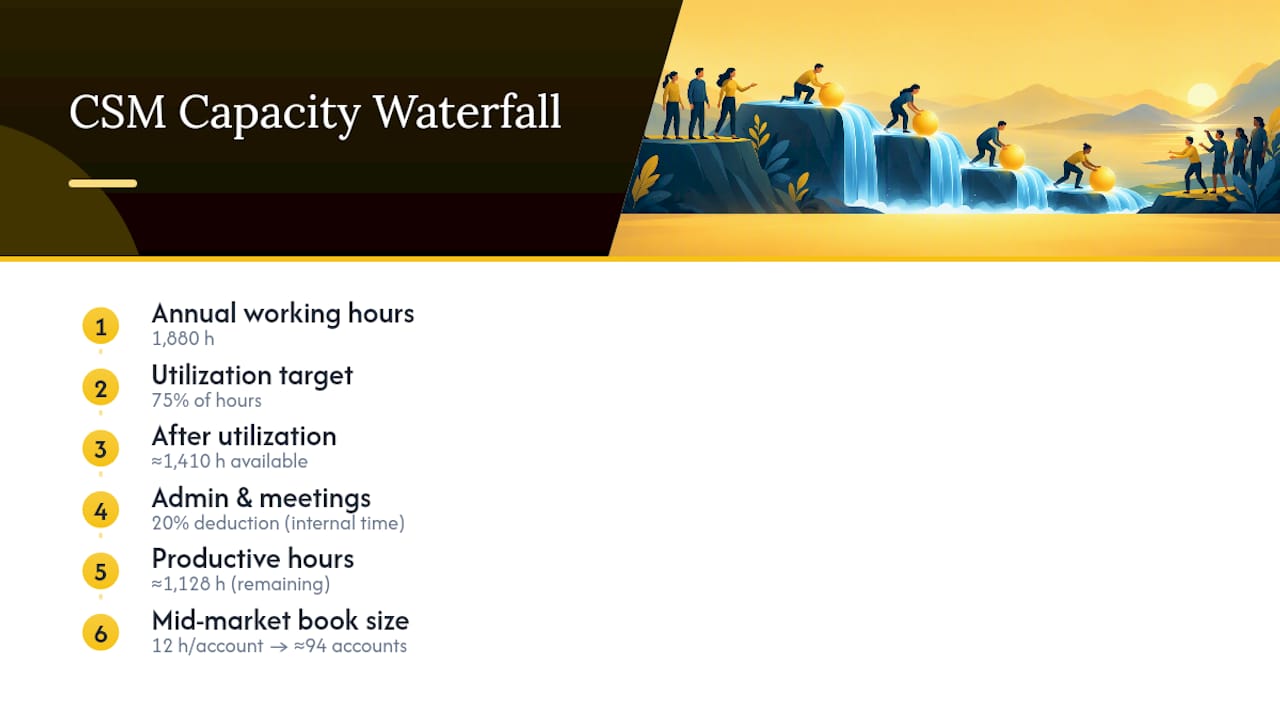
Ratios like "1 CSM per 50 accounts" are a starting guess, not a plan. The defensible way to size a book comes from hours, not headcount folklore. The formula: available hours × utilization rate × (1 − admin overhead) ÷ hours required per account per year.
Say a CSM has 1,880 working hours annually, a 75% utilization target, and 20% of time lost to admin and internal meetings. That leaves roughly 1,128 productive hours. If a mid-market account needs 12 hours of attention per year, that CSM can carry significantly fewer or more accounts depending on specific account needs. For enterprise accounts requiring substantially more time per year, the book size is much smaller accordingly. This is why a capacity calculator built on this exact waterfall produces a more defensible number for finance than a ratio pulled from a benchmark deck.
Common heuristics still help as sanity checks: enterprise CSMs typically run 1:8 to 1:15, mid-market 1:25 to 1:50, and pooled SMB 1:100 to 1:400. But those bands only work when ACV and hours-per-touch roughly match your business.
Plan headcount in lockstep with sales hiring, since capacity planning that ignores sales growth is one of the fastest ways to overload CS just as expansion revenue needs the most attention.
Continuous monitoring against those triggers catches burnout and churn risk before either shows up in your renewal numbers.*
What Lifecycle Plays and Handoffs Should You Build?
Every effective customer success framework runs on four phases with a named owner and exit criteria for each:
- Onboarding. Owned by the onboarding specialist or CSM. Exit criteria: defined milestones hit and time-to-value achieved, not just "kickoff call completed."
- Adoption. Owned by the CSM. Exit criteria: usage against a defined adoption index threshold, tracked by feature or workflow depth.
- Value realization. Owned by the CSM, often with an executive sponsor play triggered. Exit criteria: a documented outcome or ROI conversation with the buyer.
- Renewal and expansion. Owned by the account manager or CSM, depending on your model. Exit criteria: signed renewal or expansion, or an early-risk flag routed back to the CSM.
Standard plays worth documenting: a risk rescue play triggered by a health score drop, an expansion trigger play fired by usage crossing a threshold, and an executive sponsor activation play for accounts above a certain ARR. Document each play with its trigger, owner, steps, and target SLA, and review play performance monthly against lift in save rate or expansion bookings. The pedowitzgroup sequencing model treats playbook operationalization as the step that comes after coverage design, not before.
How Do You Build a Health Score and CS Ops Function?
A useful health score blends signals from at least four sources: product usage depth and frequency, support ticket sentiment and volume, billing and payment behavior, and executive engagement or NPS/CSAT trends. Weighting only usage data misses accounts that are technically active but commercially at risk.

The strongest version is reason-coded, not just a single number. Instead of "health score: 62," the system should say why: declining login frequency, an unresolved critical ticket, or a champion who left the company. Reason-coded models feeding automated alerts let a drop in score route directly into the correct play instead of landing in a CSM's inbox as one more unlabeled task.
CS Operations owns this whole layer:
- Single source of truth across billing, product usage, CRM, and support data.
- Dashboards for capacity, book health, and play performance by segment.
- Instrumentation for every play, so lift can be measured, not assumed.
- Cadence ownership: weekly risk standups, a monthly revenue council reviewing at-risk ARR, and quarterly org reviews tied to the maturity roadmap.
Treating CS Ops as an afterthought is one of the more common gaps in customer experience organizational design. Without it, health scores drift out of date and nobody owns the dashboard everyone claims to check. Building this discipline also connects directly to how teams use data for insights to drive growth, since the same telemetry powering churn alerts usually feeds expansion targeting too.
How Should CS Compensation Tie to Retention?
Comp design is where a lot of good org charts quietly fail. The core principle: separate who's accountable for renewal execution from who's accountable for adoption and health, and never let both roles claim credit for the same dollar.
- CSMs: base-heavy mix (80/20 or 85/15), with variable tied to adoption milestones, health score movement, and save rate rather than a renewal dollar amount they don't commercially own.
- Account managers/renewal specialists: more balanced mix (70/30 or 60/40), with variable tied to GRR and expansion bookings.
- Leadership: variable tied to portfolio-level NRR and GRR, not individual account outcomes.
Set a monthly or quarterly measurement cadence, and build a clear dispute resolution process for credit splits between CSMs and AMs on expansion deals; ambiguity here breeds resentment faster than almost anything else in a CS org.
What Does a CS Maturity Roadmap Look Like?
A maturity matrix maps each capability from ad-hoc to fully operationalized, and gives you language for prioritizing what to fix next instead of fixing everything at once.
- Segmentation and coverage: moves from uniform staffing to a tiered model with named, pooled, and tech-touch tiers.
- Onboarding: moves from unstructured kickoff calls to milestone-based implementation with TTV checkpoints.
- Health scoring: moves from a manual spreadsheet to a reason-coded, automated model.
- Governance: moves from ad-hoc check-ins to a fixed cadence of weekly standups and quarterly design reviews.
Sequence your first 12 months around whichever capability sits lowest on this matrix, not whichever one is loudest in Slack that week. Prioritize tooling investment before headcount whenever a capability gap (like missing health data) is blocking every other fix.
How Customerscore Supports These Org Design Choices
A customer 360 data model pulling from billing, product usage, CRM, and support gives CS Ops the single source of truth this whole structure depends on. Churn prediction helps prioritize which books need rebalancing first, before a risk trigger becomes a lost renewal. Automated plays route tech-touch and pooled segments without adding headcount, and dashboards give leadership the capacity visibility a maturity roadmap requires. The customer success metrics guide and CS glossary are useful starting points for standardizing definitions across teams before you instrument anything.
How Do You Manage the Shift to a New CS Org Structure?
Reorganizing a CS team is a change management problem before it's an org chart problem. The single biggest mistake: announcing a new structure without explaining what happens to existing account relationships. CSMs worry about losing their best accounts, AMs worry about commission disruption, and customers notice the anxiety even when nobody says anything to them directly.
Sequence the rollout in phases. Start by communicating the "why" behind the redesign tied to a business outcome, such as reducing renewal risk concentration or freeing CSMs to focus on expansion instead of onboarding admin. Then run the new segmentation and assignment logic as a parallel exercise before flipping ownership, so any obvious errors surface while the old structure is still live as a backstop.
Give departing account owners a structured handoff protocol: a written account summary, a joint call with the customer where both the old and new owner are present, and a 30-day overlap window for complex enterprise accounts. Skipping the joint call is a common shortcut that erodes trust fast, especially with accounts that have a strong relationship with one individual.
Internally, update comp plans and territory assignments before the reorg goes live, not after. Nothing damages a redesign's credibility faster than CSMs learning their book changed only when a commission statement looks wrong. Set a 90-day checkpoint to review whether the new coverage model is actually reducing renewal risk concentration or ticket backlog, and be willing to adjust segment boundaries once, based on real data, rather than treating the first draft as final.
How Do You Build Feedback Loops Into the Org Structure?
Feedback only improves a customer success org design when it has a defined owner and a routing path, not just a survey tool nobody checks. Assign NPS, CSAT, and qualitative feedback ownership to CS Ops, and require every score below a set threshold to trigger a named play, the same way a health score drop would.
Build a closed loop with product and support rather than a one-way survey. When a customer flags a feature gap in an NPS comment, that comment needs a path to product's roadmap review, not just a CSM's private notes. Some orgs formalize this with a monthly "voice of customer" digest that CS Ops compiles from support tickets, survey comments, and QBR notes, then routes to product and leadership with volume and theme tags attached.
Segment feedback analysis by tier. Enterprise feedback deserves individual follow-up from the account's named CSM within a defined SLA, often 48 hours. Pooled and tech-touch segments need aggregate trend analysis instead, since individual follow-up doesn't scale at that volume.
Tie feedback data back into the health score itself. A customer with declining product usage and a recent low CSAT score is a stronger risk signal than either metric alone, and that combination should visibly move the reason-coded score rather than sitting in a separate feedback dashboard nobody cross-references.
Review feedback themes at the same cadence as your revenue council, quarterly at minimum, so recurring complaints influence the org's playbook library and not just individual account plans.
How Should CS Collaborate With Sales, Product, and Support?
Cross-functional friction is where a lot of otherwise solid customer success team structures quietly break down. Sales-to-CS handoff needs a defined data package: what the customer was promised, who the champion is, and what success looks like in the first 90 days. Without that handoff document, CSMs spend their first weeks reconstructing context sales already had.
Product collaboration works best through a structured feedback channel rather than ad-hoc Slack messages. Many mature orgs run a monthly product-CS sync where CS Ops brings aggregated usage gaps and feature requests, tagged by revenue impact, so product can prioritize against actual ARR exposure rather than whoever complained loudest that week.
Support and CS need explicit escalation rules: which tickets route to CS immediately (anything touching a strategic account or a renewal within 60 days) versus which stay purely in support's queue. Blurring this line either buries CSMs in ticket triage or leaves support handling accounts that need commercial context they don't have.
The common thread across all three relationships is the same one running through the rest of your customer success org design: shared data. When sales, product, support, and CS pull from the same account record instead of four separate systems, collaboration stops depending on someone remembering to forward an email.
The Ratio Mistake Almost Every CS Leader Makes
The most common mistake in customer success org design is treating industry ratio benchmarks as doctrine instead of a rough sanity check. A "1:30" figure copied from a peer's org chart tells you nothing about your own hours-per-account reality. Run the capacity math for your top ARR buckets first, then rebalance from there. That one exercise will tell you more than any benchmark deck.
— Patrik
Ready to Instrument Your CS Org With Real Data
This type of platform supports the problem this guide walks through: turning segmentation and capacity decisions into something you can actually run day to day, not just plan on a whiteboard. It provides explainable health scores pulled from connected billing, product, CRM, and support data, automated churn prediction to flag which books need rebalancing first, and playbook automation for the tech-touch and pooled segments that would otherwise consume CSM hours you may not have to spare.
A good first project is running a capacity sanity check on your top ARR segment using your own usage and billing data, then instrumenting a reason-coded health score behind it. From there, automated churn prediction can tell you which accounts to rebalance before a renewal cliff hits, and customer success playbooks turn your lifecycle plays into something that runs without manual triage. Customerscore charges a flat platform fee tiered by your client ARR rather than per seat, quoted in one call from the Customerscore pricing page. If you'd rather walk through it live, you can book a demo and see how the health model would apply to your segments.
Sources
Before you finalize headcount or segment boundaries, run your numbers against a few reference tools:
- CSM Book of Business Calculator — Capacity & Ratio Planner (Free)
- How to Calculate CSM Capacity and Size a Book of Business
- How should you structure a customer success team
FAQ
What Is a Typical CSM Salary?
CSM compensation varies widely by region, seniority, and whether the role skews enterprise or pooled SMB, and no single figure applies globally. Most comp plans combine a base salary with a variable component tied to adoption, health score movement, and save rate rather than straight commission, which better reflects what a CSM actually controls.
Will CSMs Be Replaced by AI?
AI is automating the repetitive parts of the CSM role, like data aggregation, health scoring, and tech-touch outreach, not the relationship and judgment work. Platforms like Customerscore handle churn prediction and play automation so CSMs can focus on strategic conversations, expansion identification, and executive relationships that still require a person.
What Are the Core Pillars of Customer Success?
Most effective customer success frameworks build around a similar core: onboarding and time-to-value, adoption and engagement, health monitoring and risk management, renewal and expansion, and advocacy or reference generation. These pillars map directly to the lifecycle phases and role charters covered earlier in this guide.
What Are the Common Organizational Structure Models?
Common structures include functional, divisional, matrix, flat, team-based, network, and hierarchical models, and CS orgs typically borrow from functional (specialist roles by lifecycle stage) or team-based (pods) patterns rather than adopting a full corporate hierarchy. The generalist, specialist, pod, and pooled models covered in this guide are CS-specific applications of those broader patterns.
How Do I Know If My CS Org Is the Right Size?
Run the hours-based capacity formula for each segment: available hours × utilization × (1 − admin overhead) ÷ hours per account, and compare the result to your actual book sizes. If any CSM's book exceeds that calculated capacity by more than 15%, it's time to rebalance or hire, using the capacity calculator methodology as your baseline.
Recommended
Related articles
Cut CSM Intervention 18%: Predictive Playbooks for CS & RevOps
Cut CSM Intervention 18%: Predictive Playbooks for CS & RevOps ! Predictive playbook geometric title card Predictive playbooks link a churn prediction to a specific, repeatable action so customer
BlogPinpoint B2B SaaS Adoption Gaps and the Fix That Lifts Renewal
Pinpoint B2B SaaS Adoption Gaps and the Fix That Lifts Renewal ! Analysts reviewing SaaS adoption gaps Adoption gap analysis identifies the funnel stage where eligible users or accounts fail to reach
BlogAnalysts: 6–12 Month Cohort Forecasts for Net Dollar Retention
Analysts: 6–12 Month Cohort Forecasts for Net Dollar Retention ! Analyst reviewing cohort retention forecast The most reliable way to forecast net dollar retention is cohort-based modeling that
BlogStop Surprise Churn: 5 Phase Data Mapping for RevOps and CS
Stop Surprise Churn: 5 Phase Data Mapping for RevOps and CS ! Analyst mapping customer data fields Data mapping for CS means connecting product usage, billing, CRM, and support data to the fields your