
10 Best Customer Retention Software Tools for SaaS (2026)

We analyzed 44,000 SaaS users to find what actually keeps customers, and the pattern is clear: retention is won early, in the product and in the relationship, long before the renewal. The customers who stay take a core action, adopt key features, and engage as a team; the ones who churn quietly disengage weeks before they cancel (here are all eight findings).
No single tool covers all of that. "Customer retention software" is really a stack across four jobs: knowing which accounts need attention and why (a Customer Success platform), understanding what drives retention (product analytics), getting customers to value fast (onboarding and adoption), and reaching them at the right moment (lifecycle messaging). This guide breaks down the 10 best customer retention tools for B2B SaaS in 2026 by category, what each is best for, and how to combine them.
Quick answer
- Best Customer Success platform for retention: Customerscore.io
- Other Customer Success platforms: Gainsight, Planhat, Vitally, ChurnZero
- Best product analytics: Mixpanel, Pendo
- Best onboarding & adoption: Userpilot, Product Fruits
- Best lifecycle messaging: Intercom
What to look for in customer retention software
- Predicts, and explains. It should surface at-risk (and expansion-ready) accounts early, with the why, not just a dashboard you read after the fact.
- Reads product usage. Usage against each account's own baseline is the strongest retention signal. Billing and support data alone miss it.
- Turns risk into today's work. Priorities, tasks, and alerts for the CSM who owns the account, with Slack and your CRM kept in sync.
- Fast to value, no admin project. You shouldn't need a multi-month rollout or a dedicated admin to see retention signals.
Customer Success platforms
1. Customerscore.io: Best CS platform for teams that own retention and NRR
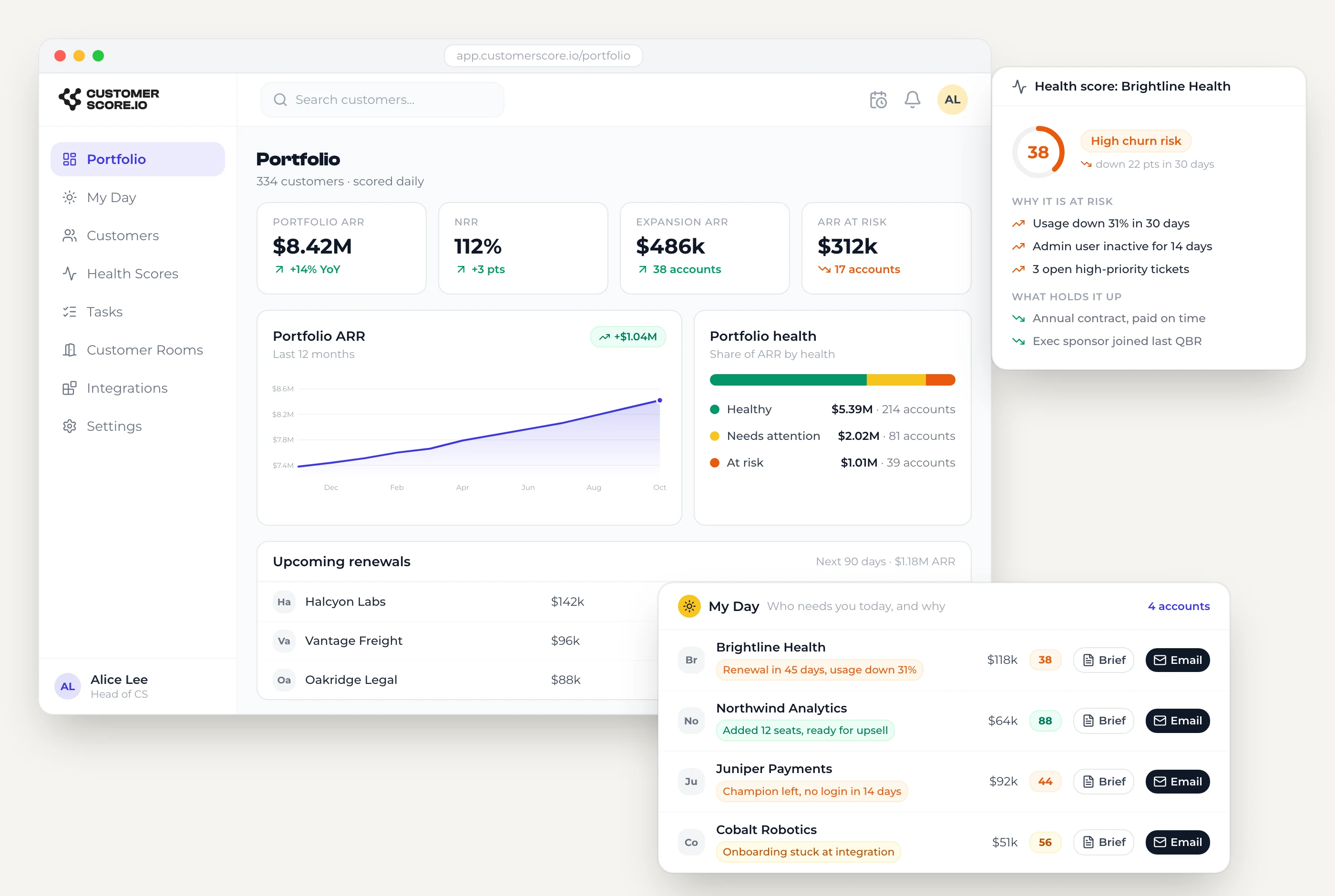
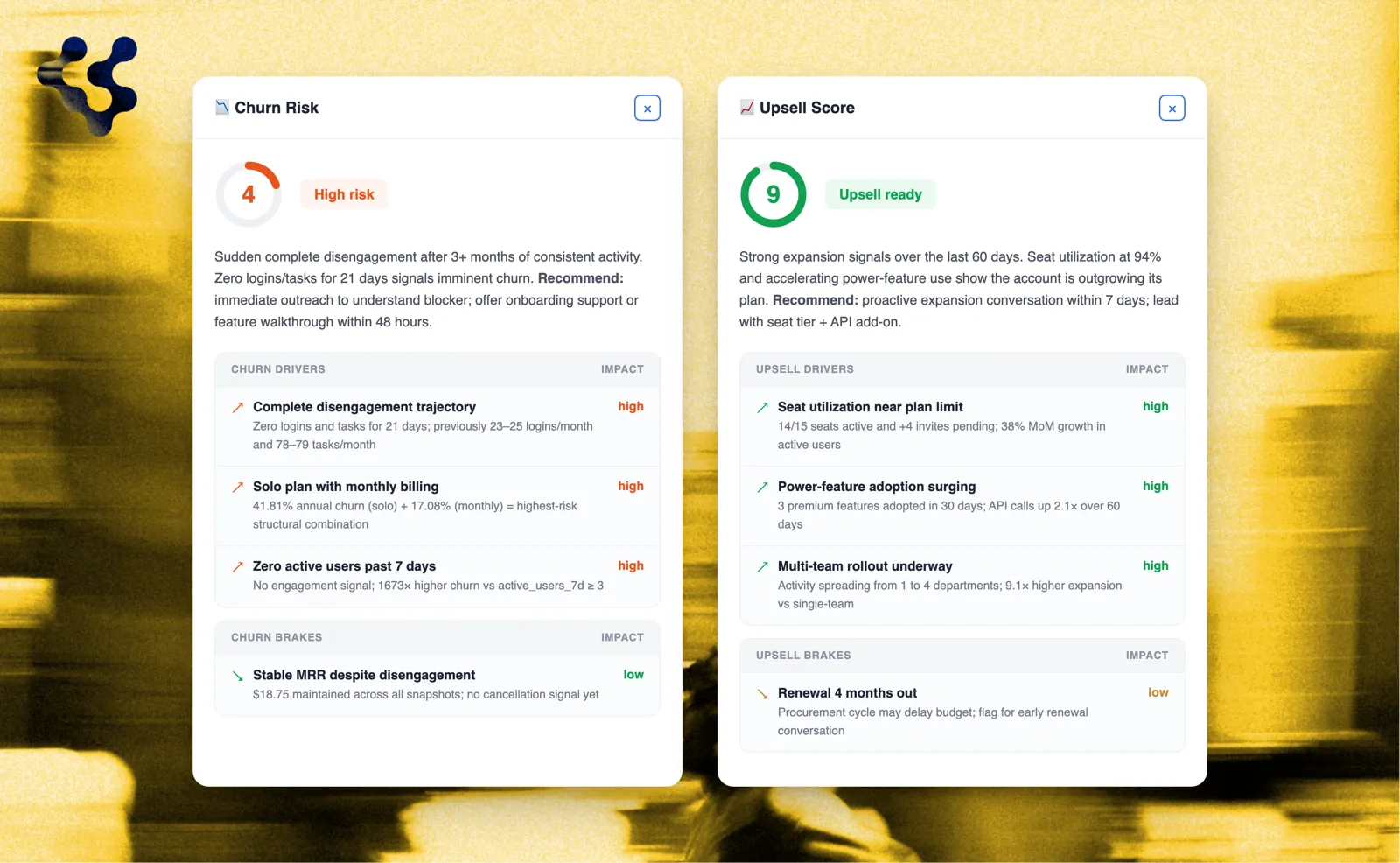
Customerscore.io is an AI-native Customer Success platform for B2B SaaS teams that own renewals and NRR. It connects your billing, CRM, and product data (Stripe, HubSpot, Salesforce, Mixpanel, PostHog, Segment, Intercom, Chargebee) and predicts both churn risk and expansion for every account, daily, each score carrying the drivers and brakes behind it.
The part that matters for retention specifically: it tells you which behaviors separate your retained customers from your churned ones, so you get the retention answer (what drives it, who is at risk) without building cohorts and funnels in a separate analytics tool. Under the hood, a model trained on tens of thousands of SaaS users learns the patterns of churn in your base and grades each active account against its own history. That is also why seasonal customers do not turn red every quiet month: an expected dip, like a school in summer or a retailer after the holidays, is not read as churn risk, while the same drop in an account that never shows one is. Prefer manual control, and there is rule-based scoring too.
Around the score sits a full CS platform. My Day gives each CSM today's priorities and the reason behind each one, every account has one record with usage, billing, CRM, support, and recorded calls, QBR and renewal prep is built from that history, and Customer Rooms run onboarding and renewals together with the customer. Setup is live in 1 to 3 weeks, expert-led, with no admin to hire. Pricing is one platform fee based on your ARR, with every feature included and never per seat; you get a tailored offer after one call, and you can book a demo to see exactly how it works. It is ISO 27001 certified with EU hosting. Scores and drivers also sync to HubSpot, Intercom, and Slack.
- Best for: B2B SaaS CS, Account Management, and RevOps teams that own retention and want one platform for the daily work and the analysis behind it.
- Limitation: if you mainly need in-app walkthroughs, product tours, or a customer community, pair it with an onboarding tool below.
2. Gainsight: Best for enterprise CS operations
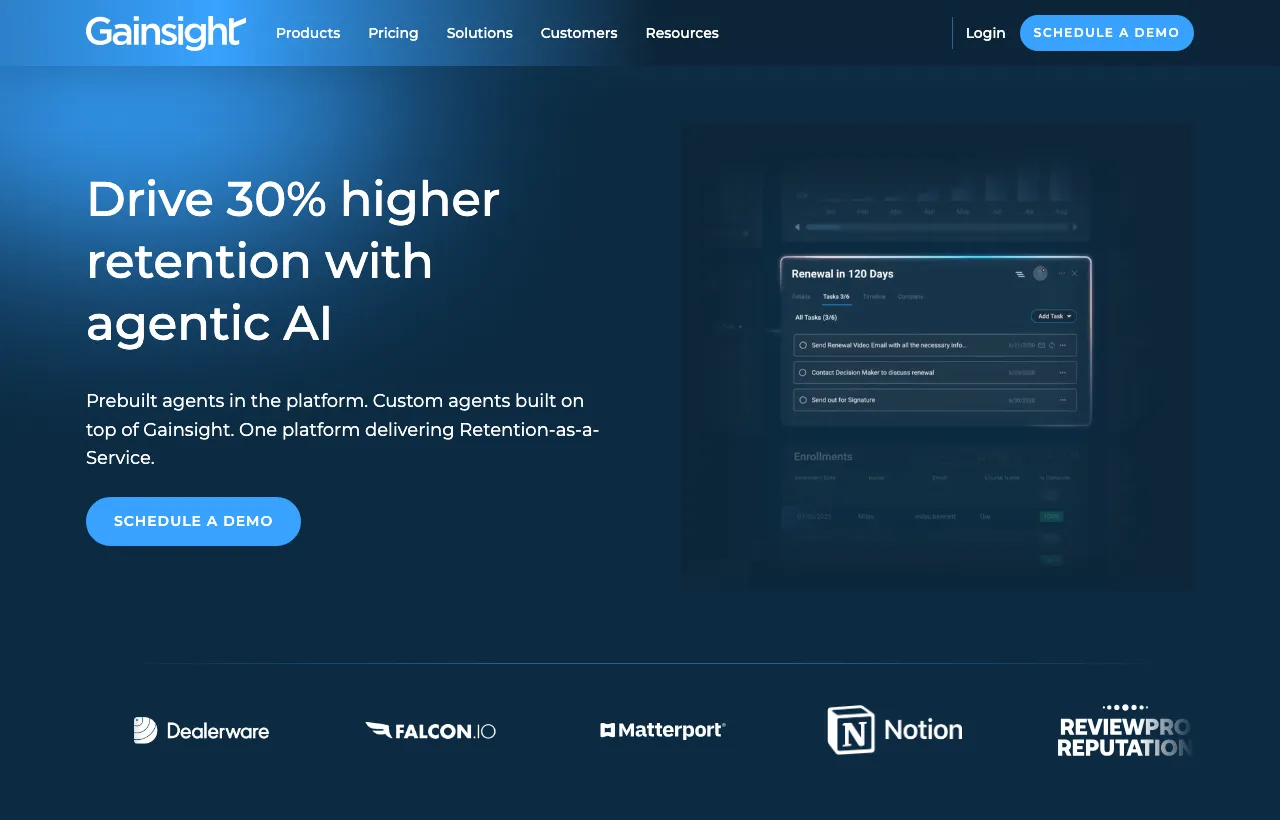
Gainsight is the enterprise standard: customer journey orchestration, in-app experiences (PX), communities, a powerful Rules Engine, and deep reporting. For large CS Ops teams it is hard to outgrow. The trade-offs are a services-led implementation quoted on top of the licence, extra products sold separately, and a dedicated admin to run it. Vendr reports a median contract of about $50,000 a year (Vendr, October 2026). See the Gainsight alternative comparison.
3. Planhat: Best for teams that want CS, CRM, and PSA in one configurable platform
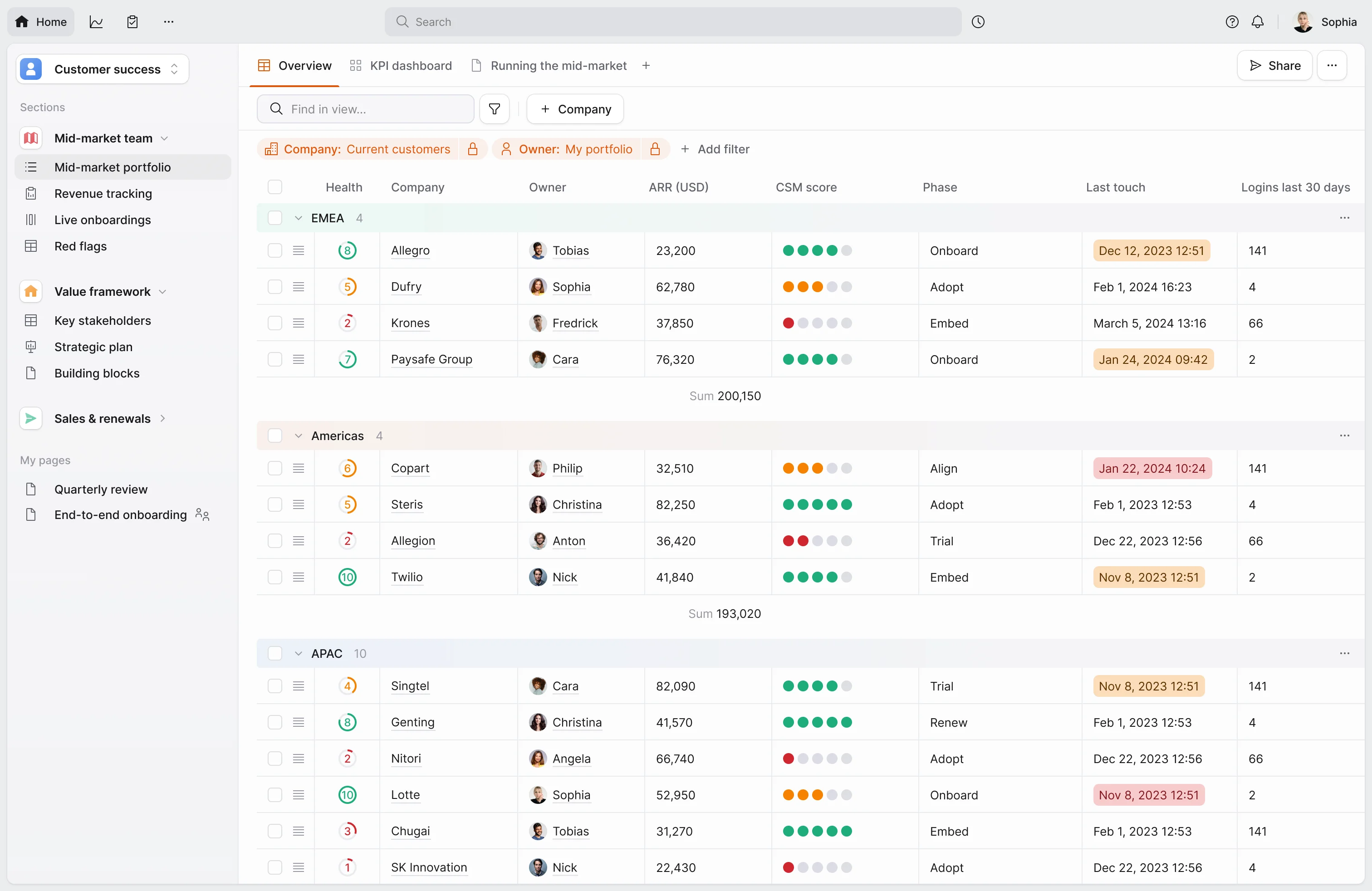
Planhat is a deep, highly configurable customer platform that can cover CS, CRM, and PSA in one product. The trade-off: your team designs and maintains the health score logic, and the upgraded AI platform, portals, and email marketing are paid add-ons. Vendr reports a median of about $41,000 a year (Vendr, October 2026). See the Planhat alternative comparison.
4. Vitally: Best for high-touch CSM teams
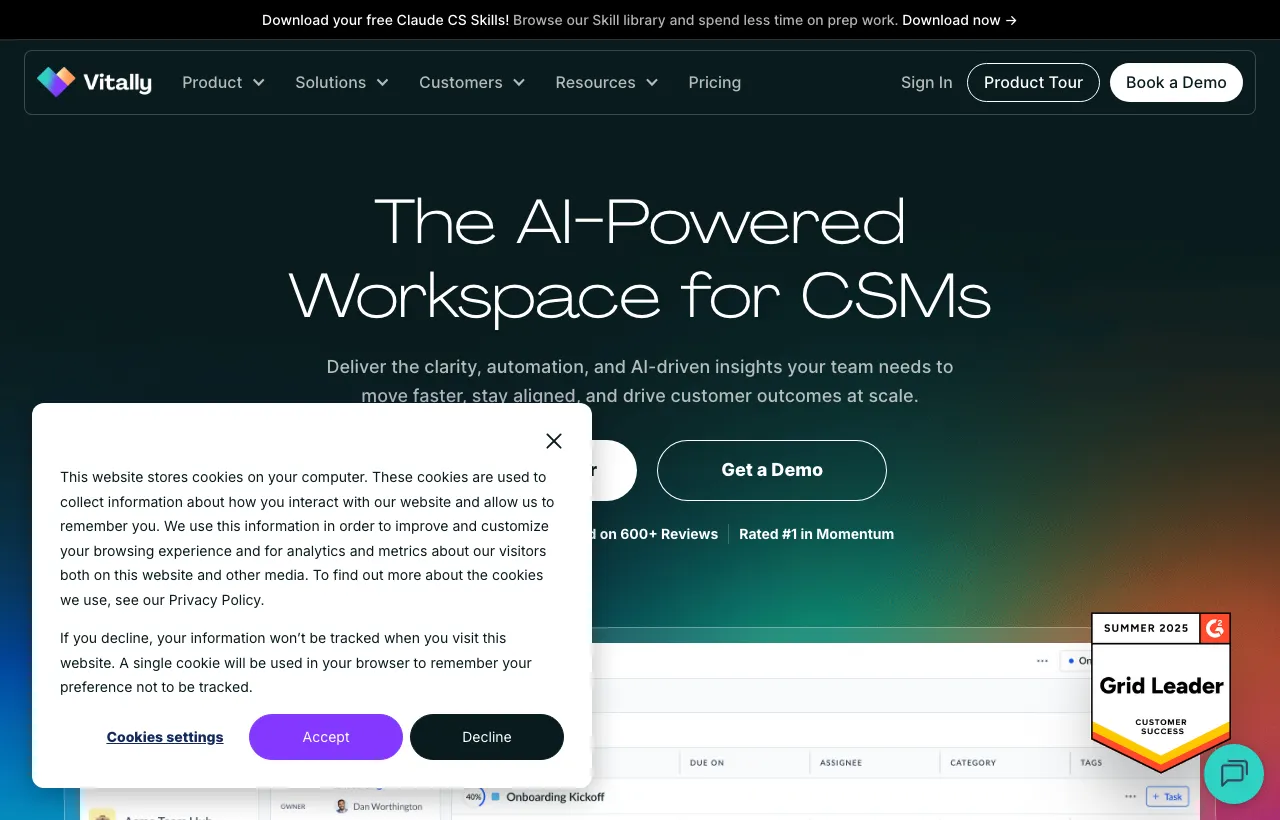
Vitally is a polished CS workspace with customizable health scores, tasks, playbooks, and customer-facing Docs. It shines for human-led teams managing portfolios. The catch: the health score is rules and weights your team configures, with Vitally AI and an MCP server assisting, so its value depends on the data you feed it, and pricing is quote-based by number of accounts. See the Vitally alternative comparison.
5. ChurnZero: Best for in-app engagement

ChurnZero pairs health scoring (ChurnScores) with a strong Plays automation engine, in-app messaging, WalkThroughs, and customer-facing Success Centers, good for structured, in-app retention programs. But the ChurnScore and Plays are configured and run by your team, and reviewers describe weeks of setup and a learning curve. Since June 2026 it also sells 20 AI agents and an MCP server. See the ChurnZero alternative comparison.
Product analytics
6. Mixpanel: Best for behavioral retention analysis

Mixpanel is a powerful product-analytics workbench: event tracking, funnels, and retention cohorts that show how usage correlates with staying or leaving. It is excellent for teams that want to explore the data themselves.
How this differs from Customerscore.io: Mixpanel tells you what users do; you build the cohorts and funnels and interpret them. Customerscore.io does the retention analysis for you (which behaviors drive retention, which accounts are at risk) and gives your CS team the daily priorities that follow from it. Many teams use both; if you want answers rather than a workbench, that is the line.
- Best for: product and growth teams that want flexible, self-serve analytics.
- Limitation: it surfaces patterns, but does not score accounts or give CSMs their priorities.
7. Pendo: Best for analytics plus in-app guidance
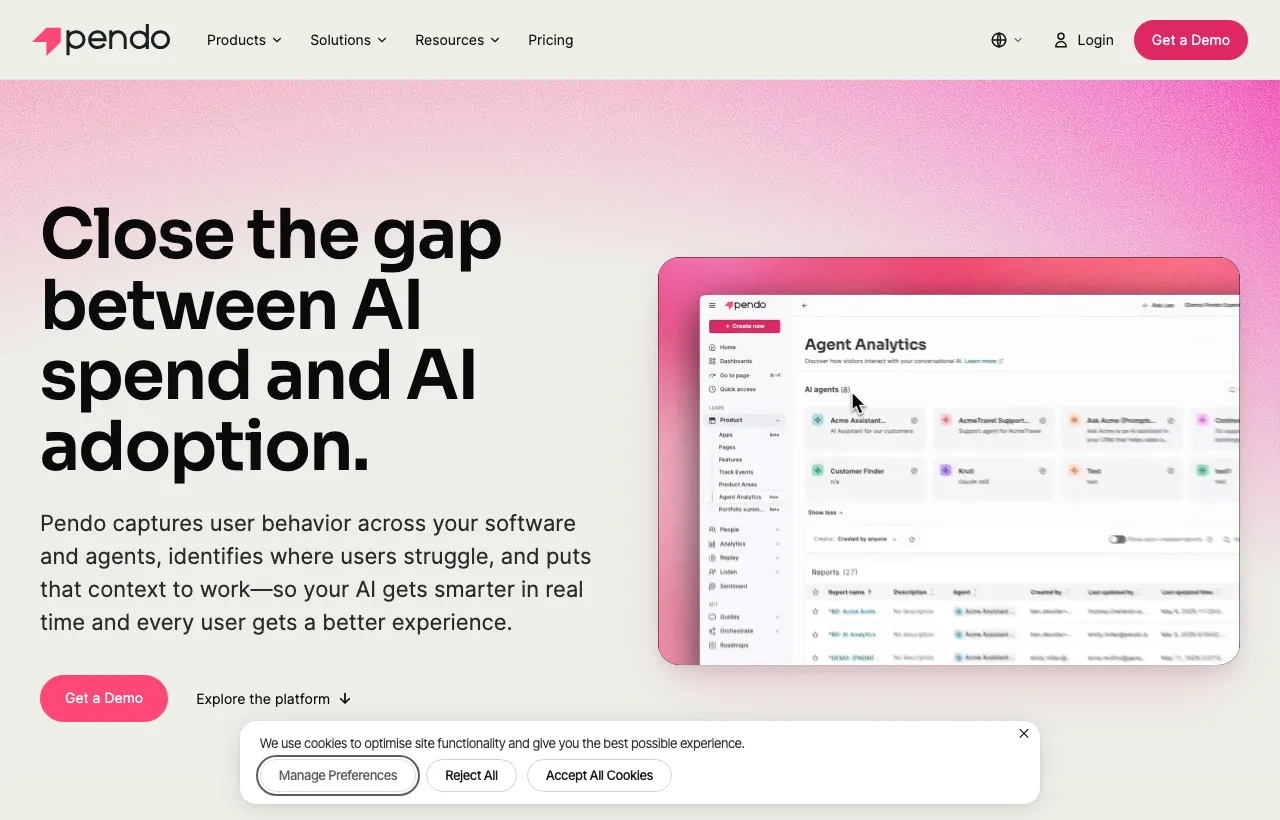
Pendo combines product analytics with in-app guides and feedback, so you can both measure adoption and nudge it in one tool. Strong for product-led teams driving feature adoption (a key retention lever). The trade-off is price at scale and that, like Mixpanel, it is an analytics-and-guidance tool rather than an account-level CS platform.
Onboarding & adoption
8. Userpilot: Best for no-code onboarding flows

Userpilot lets product teams build onboarding flows, tooltips, and in-app experiences without engineering, getting users to value faster, which is where early churn is decided. Best for PLG teams focused on activation and feature adoption. It covers the in-product layer, not account-level health scoring or CS workflows.
9. Product Fruits: Best all-in-one onboarding suite

Product Fruits bundles onboarding (tours, checklists, hints), in-app announcements, and a knowledge base into one affordable platform, a strong fit for SaaS teams that want the whole onboarding-and-engagement layer without stitching point tools together. It focuses on the in-app experience rather than predictive account scoring.
Lifecycle messaging
10. Intercom: Best for messaging plus support
Intercom combines lifecycle messaging, product tours, and AI-assisted support in one inbox, useful for reaching customers proactively and resolving issues before they become churn. Best for teams that want messaging and support together. It is not a retention-scoring tool, but it is a strong channel for outreach (and Customerscore.io can push scores into it). If you need behavior-triggered email and push campaigns at scale instead, Customer.io is the common alternative.
Comparison table
| Tool | Category | Scores account health | Reads product usage | Turns risk into work | Setup |
|---|---|---|---|---|---|
| Customerscore.io | CS platform | ✅ churn + expansion, explained | ✅ | ✅ priorities, tasks, alerts, playbooks | ✅ 1 to 3 weeks, expert-led |
| Gainsight | CS platform | ⚠️ configured | ⚠️ via integrations | ✅ admin-built | ❌ months |
| Planhat | CS platform | ⚠️ configured | ⚠️ via integrations | ✅ workflows you build | ⚠️ weeks to months |
| Vitally | CS platform | ⚠️ configured | ⚠️ via integrations | ⚠️ playbooks, AI assists | ⚠️ data-dependent |
| ChurnZero | CS platform | ⚠️ configured | ✅ | ✅ team-built plays | ❌ weeks |
| Mixpanel | Product analytics | ❌ | ✅ | ❌ | ⚠️ instrumentation |
| Pendo | Product analytics | ❌ | ✅ | ⚠️ in-app guides | ⚠️ |
| Userpilot | Onboarding | ❌ | ⚠️ in-product | ⚠️ in-app | ✅ |
| Product Fruits | Onboarding | ❌ | ⚠️ in-product | ⚠️ in-app | ✅ |
| Intercom | Messaging | ❌ | ❌ | ✅ | ✅ |
Comparison last updated October 2026, based on publicly available information and Vendr benchmarks. Verify current details on each vendor's site.
How to combine them (without buying five tools)
- CS team that owns renewals: start with the CS platform. Customerscore.io gives every CSM today's priorities, the account record, and QBR and renewal prep, with predictive scoring underneath, so you often don't need a separate analytics tool on day one.
- Strong in-product motion: pair an onboarding tool (Userpilot or Product Fruits) for activation with Customerscore.io, so your CS team sees which activated accounts are still slipping.
- Enterprise: a full suite like Gainsight or Planhat if you have CS Ops to configure it, plus analytics (Mixpanel or Pendo); Customerscore.io if you want the same depth for customer success without a configuration project.
- Outreach channels: Intercom or Customer.io send the messages, and they are most valuable when a CS platform decides who and when.
If you want one platform where your CS team sees who needs them today and why, with the account history and renewal prep next to it, Customerscore.io is built for exactly that. Book a demo to see it.
Related guides: 8 best customer success software · Best customer health score software · Best churn prediction software · Churn prevention: 8 strategies
FAQs
What is customer retention software?
Customer retention software is any tool that helps you keep and grow existing customers, by tracking account health, understanding what drives retention, driving product adoption, and reaching customers proactively. In practice it spans four categories: CS platforms, product analytics, onboarding/adoption, and lifecycle messaging.
Do I need separate tools for retention and analytics?
Not necessarily. General analytics tools (Mixpanel, Pendo) tell you what users do but leave the retention analysis to you. Customerscore.io does the retention-specific analysis (which behaviors drive retention and which accounts are at risk) and turns it into daily priorities for your CS team, so it covers both the CS-platform and the retention-analytics job.
What should a B2B SaaS CS team look for in retention software?
A platform the team works in every day: who needs attention today and why, the full account history in one place, QBR and renewal prep, and a score that is predicted from your own usage, billing, and history rather than configured by hand. Customerscore.io does this and is live in 1 to 3 weeks with expert-led setup.
How does customer retention software reduce churn?
It surfaces at-risk accounts early (before the renewal), explains why they're at risk, and helps your team act: with a CSM task, a renewal conversation, an automated email for accounts that need no human touch, or an in-app nudge. The earlier and more explainable the signal, the more churn you can prevent.
Key Takeaways
- Retention isn't one tool. It's a stack across four jobs: a CS platform, analytics, onboarding, and messaging.
- General analytics (Mixpanel/Pendo) shows what happens; a CS platform tells you who needs attention, why, and what to do today.
- For CS teams that own revenue, one platform that predicts, explains, and organizes the daily work beats stitching point tools together.
- Customerscore.io predicts churn and expansion for every account, explains the drivers, and turns them into today's priorities for your CS team. See how it compares in our 8 best customer success software guide.
Related articles
8 Best Customer Health Score Software Tools (2026)
The 8 best customer health score tools in 2026, compared on how they actually score health: configured vs predicted, churn and expansion, setup time, and admin effort.
BlogSaaS Retention Statistics: 8 Findings From 44,000 Users
1 in 4 paying customers is doing nothing. Monthly plans churn 4.7× faster than annual. Eight findings from analyzing 44,000 SaaS users.
BlogHow Accurate Is Churn Prediction? What Data on 48,000 B2B SaaS Customers Shows
How accurate is churn prediction? We checked the risk scores of 48,000 B2B SaaS customers against what happened next, for AI and rule-based scoring.
BlogAccount Health Dashboard: A B2B SaaS Guide for 2026
What an account health dashboard is, the metrics it should track, how to implement one your team actually trusts, and how it fits into your B2B SaaS workflows.