
Cut Response Time 60% with This Slack for Customer Success Playbook


Slack works best for customer success when it functions as the conversation layer, not the system of record. Pair Slack Connect channels with internal triage, Workflow Builder automations, and CRM integrations, and you get faster responses without losing ownership. Skip the structure, and Slack becomes another inbox nobody's accountable for. Teams that use it this way report meaningfully faster resolution and fewer status meetings.
TL;DR:
- Using Slack Connect channels with structured triage, automation, and CRM integrations reduces response times by about 60% and cuts account manager meetings in half.
- Proper setup involves dedicated customer and internal channels, clear naming conventions, and governance rules to prevent duplicate channels and ensure accountability.
- Automations like welcoming workflows, message routing, and automated check-ins save hundreds of hours monthly and improve engagement metrics.
- Synchronizing Slack with CRM and support tools provides real-time context, such as ticket status and renewal dates, enabling better team coordination.
- Slack alone is insufficient to track customer health risk or SLA compliance at scale; integrating with solutions like Customerscore offers proactive risk alerts and predictive insights.
Table of Contents
- Why CS Teams Use Slack for Customer Success
- How to Set Up Customer-Facing Slack Channels
- Turning Slack Chatter Into Actionable Work
- Automation and Bots Worth Building in Slack
- Keep Slack Connected to CRM and Support Systems
- Evidence: Success Bot, Response Metrics, and the Salesforce Story
- Training Customer Success Teams to Use Slack Well
- Managing Multiple Customer Success Teams or Regions
- When Slack Is Enough, and When It Isn't
- Turning Slack Signals Into Health Scores With Customerscore
- Sources
- FAQ
Why CS Teams Use Slack for Customer Success
The case for slack for customer success comes down to speed and continuity. Customer success communication moves faster in a shared channel than it does bouncing between email threads and calendar invites, and the handoff from sales to success stays intact when the same channel just changes purpose instead of resetting to zero.
By the numbers: Companies using Slack Connect for customer success report response turnaround times cut by roughly 60% and account manager meetings reduced by about 50%.
Three benefits show up consistently:
- Faster first response, because customers ping a channel instead of waiting on a support queue
- Fewer recurring status calls, since updates live in threads customers can check anytime
- Better continuity across the customer lifecycle when the same Slack Connect channel carries from onboarding through renewal
None of that happens automatically. It happens when someone designs the channel structure on purpose.
How to Set Up Customer-Facing Slack Channels
Building this well takes about an hour of upfront planning per account tier, and it pays off every week after.
- Pick a channel model. Use per-account channels for high-touch or enterprise customers, and per-initiative channels (a rollout, a migration) for accounts that need Slack only in bursts.
- Standardize naming. Something like
ext-customername-successkeeps external channels sortable and instantly recognizable as customer-facing. - Send a real invitation, not a link dump. Slack Connect lets external companies join shared channels, with support for members from up to 250 organizations in a single channel when needed for multi-partner deals.
- Post a welcome message on day one. State the channel's purpose, name the owners on both sides, and pin onboarding resources so nobody has to scroll for them.
- Set governance rules before you scale. Lock who can invite new members, require internal approval for new customer channels, and keep a pinned topic line describing scope and escalation paths.
Skipping step five is the most common mistake. Channels multiply fast, and without approval gates you end up with duplicate channels for the same account within a year.
Turning Slack Chatter Into Actionable Work
A customer-facing channel is only half the system. Every external channel needs a mirrored internal one where your team can talk honestly, without a customer reading over their shoulder.
Structure the internal side like this:
- Create a private triage channel per account or per pod, separate from the customer-facing one
- Assign a single named owner for each open customer channel, even if multiple people monitor it
- Set an SLA (say, four business hours for a first reply) and post it where the whole team can see it, not just in someone's head
- Document decisions and next steps directly in the thread, so the record survives even if the original responder is out
Pro Tip: Convert a Slack thread into a ticket or CRM note the moment it involves a commitment with a deadline, a bug report, or anything a second team member might need to reference later. A promise made in a Slack thread and never logged anywhere is the single most common way CS teams lose track of what they told a customer.
This is also where ClearFeed's guidance on Slack CSM workflows is worth internalizing: Slack should feed structured systems, not replace them. Treat the internal triage channel as the bridge between a live conversation and a durable record.
Automation and Bots Worth Building in Slack
Manual work is what kills Slack at scale. A CSM managing forty accounts cannot personally welcome every new user or nudge every dormant one, so automation carries that load instead.
Workflow Builder handles the repeatable stuff well:
- Trigger a welcome workflow the moment a customer joins a Slack Connect channel, introducing the account team and linking key resources
- Route incoming messages to the right owner based on keywords or channel membership
- Send automated check-in prompts at fixed intervals in the customer lifecycle, like day 30 or 60 post-onboarding
For broadcast-style outreach, a custom bot pattern works better than one-off manual messages. Slack's own customer success team built an internal tool called Success Bot for exactly this. It saved roughly 200 hours per month and pulled a 22% average click-through rate on its automated messages, a level of engagement most email campaigns never touch.
The lesson transfers directly: keep broadcasts short, personalize the first line, and track click rates so you know which messages actually get read.
Keep Slack Connected to CRM and Support Systems
Slack becomes genuinely useful for customer success communication only when it stops being an island. A CSM shouldn't have to leave the channel to check whether a ticket is open or whether the account renewed last quarter.
Bring the context in instead:
- Surface CRM fields like contract value, renewal date, and account owner directly in the channel using integrations for CRM/support tools
- Pull open ticket counts and severity from your support platform so nobody has to ask "is this already logged somewhere?"
- Use link previews and summary cards so a shared Salesforce record or Zendesk ticket renders useful detail without a click
Slack's own integrations directory covers most common CRM and support connections, and it's worth auditing which ones your team actually installs versus which ones just sit there unused. The goal is a channel that stays lightweight for the customer while quietly carrying real account context for your team in the background.
Evidence: Success Bot, Response Metrics, and the Salesforce Story
The numbers behind slack for customer success aren't marketing fluff. They come from Slack's own internal usage and from named customers running large-scale support operations inside the platform.
Salesforce uses channel-based integrations inside Slack to bring case records, account data, and support signals directly to the people working an issue, cutting down the constant tool switching that used to slow resolution.
That pattern, documented in Slack's Salesforce customer story, matters because it shows the same principle at enterprise scale that a five-person CS team uses with a single Zendesk integration: pull the record to the conversation instead of sending the person to the record.
Combine that with the 60% faster response and 50% fewer meetings Slack reports and the 200 hours a month Success Bot saved, and you get a reasonable baseline for what a well-built Slack setup should deliver. If your team isn't seeing anything close to that, the channel structure or automation layer is probably the gap, not the tool itself.
Training Customer Success Teams to Use Slack Well
Most Slack rollouts fail on training, not tooling. Handing a CSM access to Slack Connect without a shared playbook produces exactly what you'd expect: inconsistent tone, missed messages, and channels that quietly go stale.
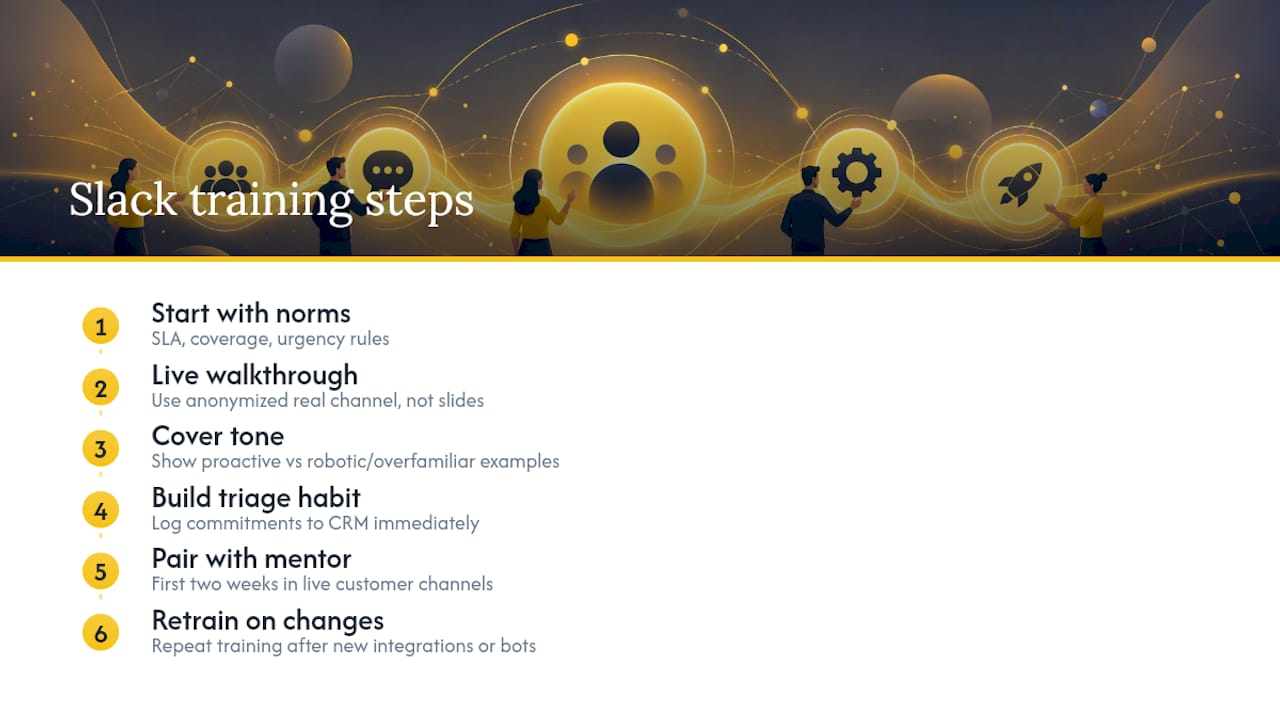
Start training with response norms, not features. New CSMs need to know the SLA for first response, who covers a channel when the primary owner is out, and what counts as urgent enough for an immediate reply versus something that can wait for the next business day. Run this as a short live walkthrough using a real (anonymized) customer channel, not a generic slide deck. People remember what they practiced, not what they were told.
Cover tone explicitly. A Slack message reads more casual than an email by default, and that's a feature for customer success communication, but it needs guardrails. Show new hires actual examples of a good proactive check-in versus a message that reads as robotic or, worse, overly familiar for an account that's currently unhappy.
Build muscle memory around the internal triage habit early. The CSMs who struggle most with Slack are usually the ones who never developed the reflex of logging a thread into the CRM the moment it produces a commitment. Pair new hires with a mentor for their first two weeks of live customer channels specifically to catch that gap before it becomes a habit.
Finally, revisit training every time you add a new integration or bot. A workflow that makes sense to the person who built it is often invisible to everyone else on the team until someone walks them through it.
Managing Multiple Customer Success Teams or Regions
Scaling Slack across regions or multiple CS pods introduces problems a single team never hits: naming collisions, timezone gaps, and channels nobody remembers creating.
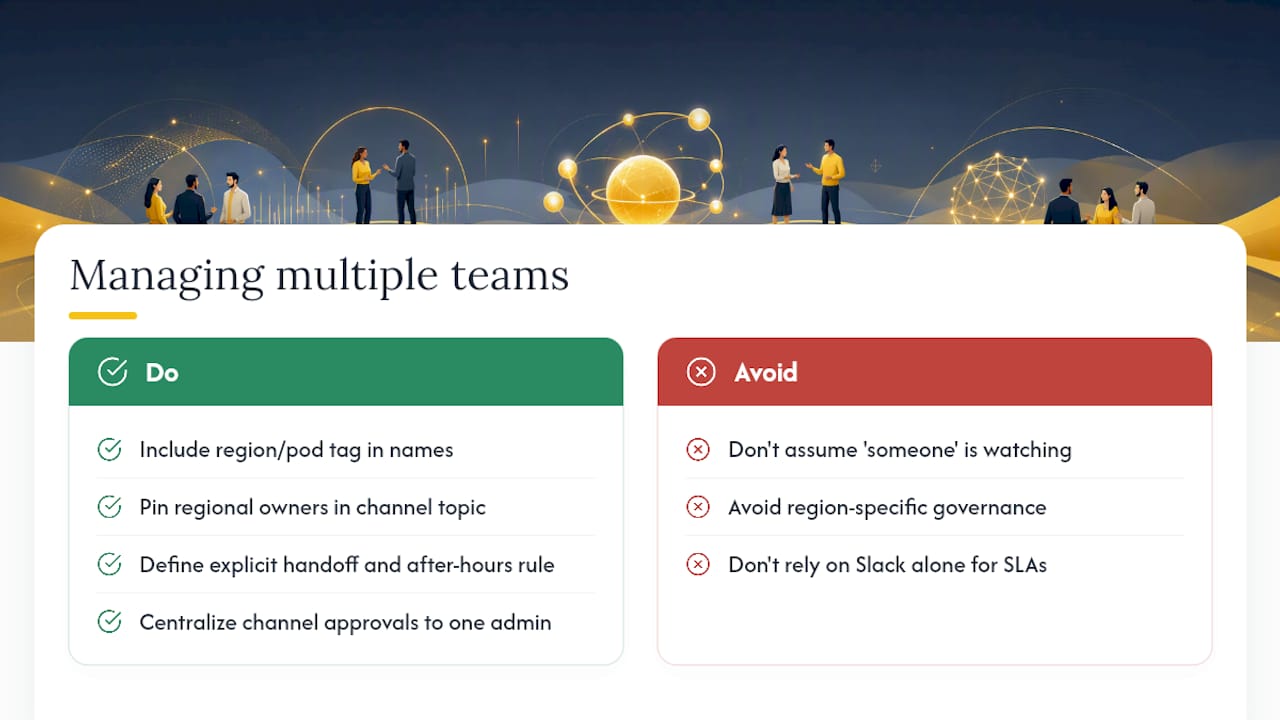
Solve naming first, because it's the cheapest fix with the biggest payoff. Extend your channel naming convention to include a region or pod tag, something like ext-acmecorp-success-emea, so a search instantly narrows results instead of returning a wall of near-duplicate channels.
Timezone coverage needs an explicit handoff protocol, not an assumption that "someone" is watching. If a customer channel spans US and EMEA business hours, name both regional owners in the pinned channel topic and set expectations for after-hours response, even if that expectation is simply "next business day, escalate to on-call for anything urgent."
Centralize governance even when execution is regional. One admin team should own the approval process for new customer-facing channels, regardless of which region requests it, so you don't end up with EMEA running a different structure than APAC. Standardized Workflow Builder templates help here too. Build the onboarding automation once, then let each region customize the message copy rather than rebuilding the logic from scratch.
Reporting is where multi-region Slack setups tend to break down hardest. Slack's own analytics show channel activity and member counts, but it won't tell you which regional pod is missing SLAs or which accounts have gone quiet. That gap is usually the first sign a team has outgrown Slack as its only system for tracking customer success communication.
When Slack Is Enough, and When It Isn't
Slack earns its place in customer success because it's fast and it's where relationships actually get built. A quick reply to a frustrated customer at 4 PM does more for retention than a perfectly worded email sent the next morning. That's real, and no CS platform replicates it.
But Slack was never built to track SLA compliance across two hundred accounts or tell you which ones are trending toward churn before anyone types a word. If you're maintaining a spreadsheet on the side to track health, or a CSM has forty open channels and no way to sort them by risk, that's the signal. Start small: one pilot channel, one internal triage process, one automation. Prove it works before you roll out wider, and add a dedicated platform once Slack's limits start costing you renewals instead of saving you meetings.
— Patrik
Turning Slack Signals Into Health Scores With Customerscore
Slack tells you a customer is unhappy the moment they type it. It won't tell you which of your other two hundred accounts are heading there quietly, without ever posting a message. That's the gap Customerscore closes for B2B SaaS teams: it ingests Slack activity alongside product usage, billing, and CRM data to build explainable health scores that flag risk before a customer says anything at all.
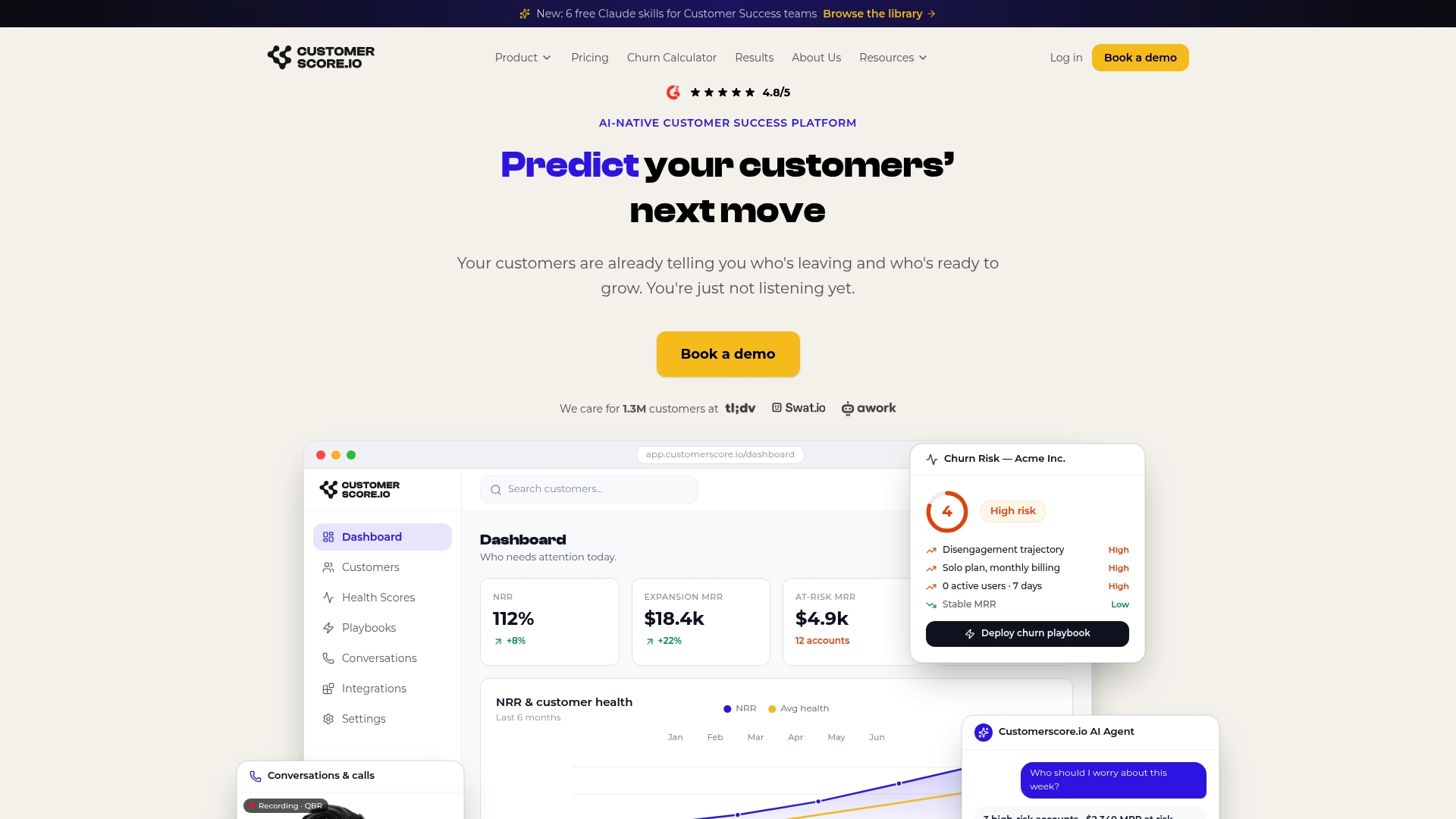
If your team is hitting repeated SLA misses across too many channels, wants proactive playbooks instead of reactive replies, or just needs one consolidated view of account health instead of forty separate threads, that's usually the point where Slack alone stops being enough. Customerscore's churn prediction software picks up exactly where Slack-based triage runs out of room. See how it fits your stack with a demo.
Sources
Slack's own documentation and customer stories back most of the practical guidance above, including the Success Bot case study and the Salesforce Channels story. For teams pairing Slack activity with structured health tracking, Customerscore's AI agent for customer success and Survio case study show what that combination looks like in practice.
- Slack: Slack for customer success: 4 ways to collaborate and improve customer experience
FAQ
Is Slack Considered a CRM Tool?
No. Slack is a communication layer, not a system of record. It works best connected to a CRM or a dedicated customer success platform like Customerscore that tracks account history, health scores, and renewal data over time.
Does Anyone Still Use Slack for Customer Support and Success?
Yes, extensively. Slack Connect is built specifically for external customer collaboration, and companies using it for customer success report response times cut by about 60% and account manager meetings reduced by roughly 50%.
What's the Difference Between Slack and Jira for Customer Success?
Slack handles real-time customer success communication and relationship management, while Jira tracks structured work items like bugs and feature requests. Most mature CS teams use both, converting Slack conversations into Jira tickets when a request needs formal tracking.
Who Competes With Slack for Customer-Facing Communication?
Microsoft Teams is the most common alternative for customer-facing chat, though it's less commonly used for external Slack Connect style channels. For the customer success layer specifically, teams typically pair chat tools with a dedicated platform like Customerscore for health scoring and churn prediction rather than treating chat as a full replacement.
Recommended
Related articles
90–120 Day Renewal System for CSMs: SaaS Renewal Playbook
90–120 Day Renewal System for CSMs: SaaS Renewal Playbook ! Team planning a structured SaaS renewal Run renewals as a 90 to 120 day managed pipeline, not a calendar reminder.
BlogProduct Led Customer Success in 90 to 180 Days Without a Data Team
Product Led Customer Success in 90 to 180 Days Without a Data Team ! Customer success operator reviewing product signals Product-led customer success uses product usage data and in-product
BlogPredict Churn 60–90 Days: Five Phase Customer Risk Scoring for B2B SaaS
Predict Churn 60–90 Days: Five Phase Customer Risk Scoring for B2B SaaS ! Customer success manager reviewing account risk dashboard Customer risk scoring produces a predictive, explainable health
Blog30/90/180-Day Health Score Model for SaaS CS: AUC & Playbooks
30/90/180-Day Health Score Model for SaaS CS: AUC & Playbooks ! Analyst calibrating SaaS health score dashboard A health score model is a validated, segment-aware index (usually 0 to 100) that