
Customer Success Automation: 5 Priorities for CSM Teams


Prioritize five automations that protect customer intimacy while saving CSM time: onboarding orchestration, health-alerting with prescriptive playbooks, renewal workflows, usage-driven expansion nudges, and QBR prep automation. For many B2B SaaS teams, Customerscore maps directly to all five key automations and is worth evaluating before assembling a stack of point tools.
Start here — three actions you can take this week:
- Enable real-time health alerts tied to product usage and billing signals
- Codify one playbook (start with onboarding or renewal risk) and assign a CSM owner
- Automate the handoff email from sales to CS so every new customer gets a consistent first touch
When to use a dedicated platform vs. point tools: if your team manages multiple accounts and your data lives across a CRM, billing system, and product analytics tool, a dedicated platform pays off faster. For smaller teams with fewer accounts or a single data source, a lighter setup may be enough to start.
Table of Contents
- What is customer success automation, really?
- Five priority automations with mini-playbooks you can copy
- What business outcomes should you expect?
- What to look for in a customer success automation platform
- How to implement: from pilot to scale
- How do you keep automation from killing customer intimacy?
- Which metrics tell you if your automation is working?
- Common pitfalls and how to avoid them
- Key Takeaways
- The case for getting the boundaries right
- The case for getting the boundaries right
- Customerscore covers all five automations out of the box
- Useful sources and further reading
What is customer success automation, really?
Customer success management platforms are AI-enabled SaaS solutions that guide the customer lifecycle by integrating product usage, CRM, and support data to automate health alerts, playbook execution, and customer outreach. The term "customer success automation" is the informal, search-friendly version of what practitioners call lifecycle automation or CS orchestration — the use of data-driven rules and AI to execute repeatable CSM tasks without manual intervention.

What it covers: health scoring, playbook triggers, automated outreach sequences, renewal alerts, usage-based nudges, and report generation. What it does not cover: executive relationship management, strategic account planning, or any conversation where context and judgment matter more than speed.
The table below draws the line clearly.
| Automated task | Human-only task |
|---|---|
| Health score update when usage drops | Executive business review conversation |
| Triggered onboarding email at day 3 | Diagnosing a complex implementation blocker |
| Renewal alert 90 days before contract end | Negotiating contract terms with a CFO |
| Usage-based expansion nudge | Crafting a multi-year growth strategy with a VP |
| QBR slide deck pre-population | Presenting findings and building trust in the room |
| Support ticket escalation routing | Managing a relationship after a major service failure |
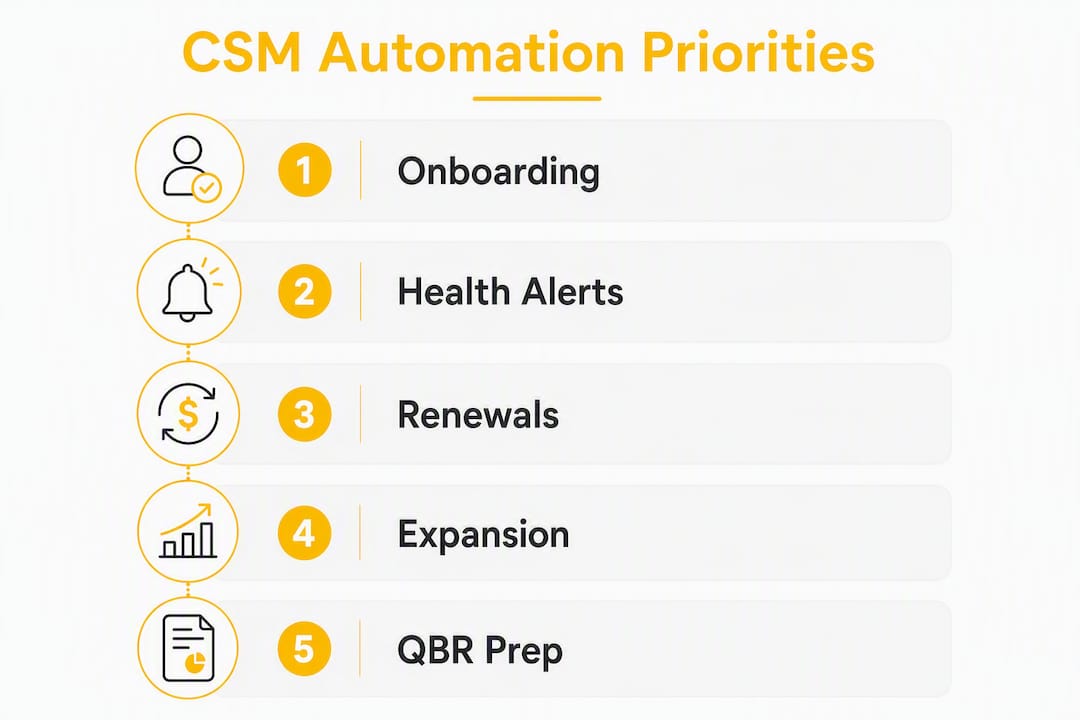
The data sources that make this work: your CRM (contact and account data), product telemetry (feature adoption, login frequency, session depth), billing system (ARR, contract dates, payment status), and support ticketing (open tickets, CSAT, resolution time). Without clean, connected data from at least two of these sources, most automations produce noise rather than signal.
Five priority automations with mini-playbooks you can copy
Customer engagement automation uses real-time behavior and lifecycle triggers to deliver personalized messages across channels — the exact mechanism behind each of the five automations below.
1. Onboarding orchestration
Objective: Get every new customer to their first value milestone without relying on a CSM to remember every step.

Triggers and data: Contract signed (CRM), product account created (telemetry), key feature not activated within N days.
Mini-playbook:
- Trigger a welcome sequence (day 0, day 3, day 7) tied to product activation milestones
- Auto-assign an onboarding checklist inside your CS platform
- Flag accounts that miss the day-7 activation threshold for a human CSM check-in
- Send a "first value" confirmation message when the milestone is hit
- Hand off to the ongoing CSM with a summary of what was completed
Human handoff: Any account that misses two consecutive milestones gets a live call, not another email.
You can use collaborative onboarding spaces to give customers a shared workspace where they track their own progress — which reduces inbound "where do I start?" tickets significantly.
2. Health-alerting with prescriptive playbooks
Objective: Surface at-risk accounts before a CSM would notice manually, and prescribe the exact next action.
Triggers and data: Health score drops below threshold (product usage + support + billing composite), no login in 14 days, support tickets spike.
Mini-playbook:
- Define health score thresholds (green/yellow/red) using weighted signals
- Set an alert rule: score drops to yellow → notify CSM + auto-send a check-in email
- Score drops to red → escalate to CSM manager + trigger a call-scheduling sequence
- Attach a prescriptive playbook to each alert tier (what to say, what to offer)
- Log all actions back to CRM automatically
Human handoff: Red-tier accounts always get a human call within 24 hours. No exceptions.
Pro Tip: Keep the automated check-in email short and written in first person from the CSM's name. Customers rarely notice it was triggered automatically, and response rates stay high.
3. Renewal automation
Objective: Eliminate missed renewals and give CSMs a 90-day runway to address risk before the contract date.
Triggers and data: Contract end date (billing/CRM), health score at 60 days out, finance/legal contact activity.
Mini-playbook:
- Pull contract end dates from billing and surface them in a renewal pipeline view
- Before renewal: auto-send a renewal prep email to the CSM with account health summary
- At 60 days: trigger a customer-facing "let's talk about next year" outreach
- At 30 days: escalate to CSM manager if no renewal activity is logged
- At 14 days: auto-draft a renewal summary for the CSM to review and send
You can automate SaaS renewal outreach using AI-assisted drafts and workflow templates that connect billing data directly to outreach sequences.
Human handoff: Any renewal over a defined ARR threshold gets a live executive sponsor call, regardless of health score.
4. Usage-driven expansion nudges
Objective: Identify accounts ready to expand based on actual product behavior, not gut feel.
Triggers and data: Feature adoption rate crosses a threshold, seat utilization above 80%, API call volume approaching plan limits.
Mini-playbook:
- Define expansion signals in your product analytics tool (Mixpanel, PostHog, Segment)
- Set a trigger: utilization above threshold → notify CSM with a suggested expansion conversation
- Auto-send a contextual in-app message or email highlighting the relevant upgrade
- Log the expansion opportunity in CRM as a pipeline item
- CSM follows up with a tailored conversation using the signal as the opener
Human handoff: The automated nudge opens the door. The CSM closes it.
5. QBR and executive summary automation
Objective: Cut QBR prep time from hours to minutes by auto-populating slides and summaries from live data.
Triggers and data: Quarterly calendar trigger, health score history, product usage trends, support ticket summary, NRR data.
Mini-playbook:
- Connect your CS platform to your reporting layer (or use built-in QBR templates)
- Auto-pull key metrics: health score trend, feature adoption, tickets resolved, ARR change
- Generate a first-draft summary the CSM reviews and personalizes
- Flag any accounts where the data tells a story the CSM needs to address proactively
- Send the pre-read to the customer 48 hours before the meeting
Human handoff: The CSM owns the narrative, the relationship, and the room. The automation handles the data assembly.
What business outcomes should you expect?
Automation's clearest wins show up in three places: retention, productivity, and revenue expansion. Teams that instrument these automations well typically see fewer missed renewals, faster time-to-value for new customers, and CSMs who spend more time on strategic conversations instead of administrative follow-up.
Leading indicators to watch during a pilot:
- Reduction in manual CSM touch hours per account per week
- Increase in renewal pipeline coverage (accounts with active renewal activity at 90 days)
- Decrease in time-to-first-value for new customers
- Playbook adoption rate among CSMs (are they using what you built?)
- Reduction in QBR prep time per account
Lagging outcomes to validate after 60–90 days:
- Gross and net revenue retention rates
- Churn rate by segment
- Expansion ARR from usage-triggered opportunities
- Customer health score distribution shift (more green, fewer red)
Metric callout: Gartner research shows that two-thirds of customers contact customer service after a bad experience — a signal that proactive health-alerting automation, which surfaces risk before a customer reaches out, directly reduces reactive support load and protects retention.
The productivity gain is often the earliest ROI signal. When CSMs stop manually pulling data for QBRs and chasing renewal dates, they reclaim hours each week for the conversations that actually move accounts forward.
What to look for in a customer success automation platform
Gartner Peer Insights describes CSM platforms as providing health scoring, playbooks, lifecycle automation, and integrations that enable proactive account management for subscription businesses. Use that as your baseline, then add the specifics below.
Core feature checklist
- Playbook and workflow builder: visual, no-code builder with conditional logic and multi-step sequences
- Real-time health scoring: composite scores from multiple data sources, not just one signal
- Alerting and orchestration: configurable thresholds with escalation rules and human handoff triggers
- Two-way CRM sync: bidirectional data flow so CRM stays current without manual updates
- Activity automation: auto-log emails, calls, and tasks back to the account record
- Reporting and A/B testing: playbook-level performance tracking and the ability to test variants
- API and webhooks: for custom integrations and event-driven triggers
- AI assist: meeting prep summaries, email draft generation, and health score explanations
Integration checklist
| Category | Examples |
|---|---|
| CRM | HubSpot, Salesforce |
| Billing | Stripe, Chargebee |
| Product analytics | Mixpanel, PostHog, Segment |
| Support | Intercom, Zendesk |
| Messaging | Slack |
| Calendar | Google Calendar, Outlook |
Sales force automation in your CRM collects and connects customer and operational data that CSM tools rely on — which is exactly why two-way CRM sync is non-negotiable, not optional.
Security and compliance basics
For U.S. B2B SaaS companies, look for SOC 2 Type II certification, role-based access controls, data residency options (especially if you serve customers in regulated industries), and audit logging. These aren't differentiators — they're table stakes for any platform handling customer account data.
Embedded automation vs. dedicated platform
If your team already uses HubSpot or Salesforce heavily, you can build basic CS automations inside those tools. The tradeoff: you get breadth but lose depth. A dedicated CS platform gives you health scoring models, playbook libraries, and CS-specific reporting that a general CRM cannot replicate without significant custom development. For teams managing 50+ accounts with multi-source data, a dedicated platform almost always wins on total cost of ownership.
How to implement: from pilot to scale
Implementation guidance consistently points to the same principle: map journeys first, then prioritize one or two stages to pilot before scaling.
- Define objectives and KPIs. Pick two or three metrics the pilot must move (e.g., renewal pipeline coverage, time-to-first-value, CSM hours saved). Write them down before you build anything.
- Map the customer journey. Identify every touchpoint from onboarding to renewal. Mark which are currently manual and which have the most variability in execution.
- Select a pilot use case. Choose one automation from the five above. Onboarding orchestration or renewal alerting are the most common starting points because the triggers are clear and the outcomes are measurable.
- Build the playbook and automation. Configure triggers, actions, and escalation rules. Assign a CSM owner who will monitor and iterate.
- Define guardrails and escape hatches. Set rules for when automation stops and a human takes over. Document these explicitly in the playbook.
- Run the pilot. Limit to one customer segment or ARR band (e.g., mid-market accounts between $10K–$50K ARR). Set a 30–90 day window with a weekly review cadence.
- Measure against KPIs. At 30 days, check leading indicators. At 60–90 days, check lagging outcomes. Use the data to decide whether to iterate or scale.
- Iterate before scaling. Fix what the pilot reveals before rolling out to the full book. One well-tuned automation outperforms five mediocre ones.
- Scale with change management. Train the full CSM team on the playbook, collect their feedback, and build a feedback loop so they can flag when automation misfires.
Success definition template (30–90 days):
- 30 days: Playbook is live, CSMs are using it, no major escalation failures
- 60 days: Leading indicators moving in the right direction (e.g., renewal pipeline coverage up, QBR prep time down)
- 90 days: Lagging outcomes visible (retention rate stable or improving, expansion opportunities logged)
For a practical walkthrough of running an AI pilot in customer success, Customerscore's published guidance covers how to validate outcomes and structure the pilot KPIs.
How do you keep automation from killing customer intimacy?
IBM's framework for customer experience automation identifies four capabilities that keep automated interactions human-centered: orchestration, segmentation, personalization, and automation. That four-part structure maps directly to how the best CS teams operate.
Here's how to apply it as an operational framework:
- Segment first. Not every customer should receive the same automation. Separate high-touch enterprise accounts from self-serve or SMB accounts. The automation rules for a $200K ARR account should look different from those for a $5K ARR account.
- Automate the routine. Automate tasks that are repeatable, data-driven, and low-stakes: meeting follow-up summaries, usage alerts, renewal reminders, QBR data pulls. These are the tasks that consume CSM time without requiring CSM judgment.
- Personalize the output. Automated messages should reference the customer's actual data: their feature adoption rate, their specific milestone, their contract date. Generic automation feels generic. Contextual automation feels like attention.
- Escalate with precision. Define the exact signals that trigger a human handoff. Health score drops to red, a key stakeholder goes dark, a support ticket sits unresolved for 72 hours — these are escalation triggers, not automation opportunities.
Example flow — renewal risk scenario: An account's health score drops from green to yellow at 75 days before renewal. The automation triggers a CSM alert with the account summary and a suggested outreach template. The CSM reviews, personalizes the message, and sends it. If the account goes to red within 10 days, the automation escalates to the CSM manager and schedules a call. The automation handled the detection and the prep. The human handled the relationship.
Pro Tip: Track your automation "escape rate" — the percentage of automated touchpoints that required a human override. A rate above 20% usually signals that your segmentation rules or triggers need refinement, not that automation is failing.
You can automate CS outreach with playbooks while keeping the human layer intact by building explicit escalation rules into every playbook before you launch it.
Which metrics tell you if your automation is working?
Tracking the right mix of leading and lagging indicators is what separates a pilot that produces a decision from one that produces a shrug.
Leading indicators (review weekly during pilot):
- Playbook adoption rate: percentage of CSMs actively using the playbook
- Automation escape rate: percentage of automated actions that required manual override
- Alert response time: how quickly CSMs act on health alerts
- Time to prepare QBRs: hours per account before vs. after automation
Lagging outcomes (review monthly/quarterly):
- Gross revenue retention (GRR) and net revenue retention (NRR)
- Churn rate by segment and ARR band
- Renewal win rate and time-to-renewal-close
- Time-to-value (TTV) for new customers
- Expansion ARR from usage-triggered opportunities
Example dashboard layout: Top row: GRR, NRR, churn rate, renewal win rate (the retention scorecard). Middle row: health score distribution (green/yellow/red account counts), alert volume and response time, playbook adoption rate. Bottom row: automation escape rate, QBR prep time, TTV trend. Review the top row monthly. Review the middle and bottom rows weekly during a pilot.
For a detailed guide on building the account health dashboard that surfaces these metrics, Customerscore's published walkthrough covers the layout and the data connections.
Common pitfalls and how to avoid them
Most automation failures trace back to one of five mistakes. Each has a straightforward fix.
- Automating without clean data. If your CRM has duplicate accounts, your billing system has stale contract dates, or your product telemetry has gaps, your health scores will be wrong and your playbooks will fire at the wrong time. Fix: audit data quality in your three core sources before you build a single automation.
- Over-automating high-touch moments. Sending an automated email to a $500K ARR account the day after a major product outage is a relationship risk. Fix: build an explicit "do not automate" rule for enterprise accounts during active incidents or escalations.
- Missing escalation rules. Automation without a human handoff is a dead end. Fix: every playbook must have at least one escalation trigger with a named owner and a response SLA.
- Weak playbook testing. Launching a playbook without testing it on internal or dummy accounts first is how you send 200 customers a broken email sequence. Fix: run every new playbook against a test segment for one week before going live.
- Ignoring CSM feedback. CSMs are the first to know when an automation misfires. If they're not in the feedback loop, you'll keep running broken automations. Fix: build a monthly 30-minute playbook review into the team cadence.
Pre-launch QA checklist:
- Data integrity verified in CRM, billing, and product analytics
- Playbook tested against dummy or internal accounts
- Escalation rules defined and owners assigned
- Rollback plan documented (how to pause or disable the automation quickly)
- CSM team briefed and trained on the playbook logic
Key Takeaways
Automation saves CSM time and protects retention when you prioritize the right five workflows, pilot before scaling, and build explicit human handoff rules into every playbook.
| Point | Details |
|---|---|
| Five priority automations | Onboarding orchestration, health-alerting, renewal workflows, expansion nudges, and QBR prep deliver the fastest ROI. |
| Pilot before scaling | Run a 30–90 day pilot on one customer segment with two or three defined KPIs before expanding. |
| Human handoffs are required | Every playbook needs explicit escalation triggers; red-tier health alerts always go to a human within 24 hours. |
| Metrics that matter | Track playbook adoption rate and automation escape rate as leading indicators; NRR and churn rate as lagging outcomes. |
| Customerscore maps to all five | Customerscore covers health scoring, playbooks, renewal workflows, expansion nudges, and QBR automation in one platform. |
The case for getting the boundaries right
The case for getting the boundaries right
There's a version of customer success automation that works well, and a version that quietly destroys relationships. The difference usually comes down to one decision: whether the team defined the human handoff rules before they launched the automation, or after something went wrong.
The conventional wisdom says to automate everything you can and let CSMs focus on "high-value" work. That framing is too loose. The real question is: which specific signals require a human response within a specific time window, and does your automation surface those signals reliably? A health alert that fires three days late is not automation — it's a delayed problem.
What practitioners often underestimate is the compounding effect of small automation errors. One misfired renewal email to a key account, one automated check-in sent during an active escalation, one QBR summary with stale data — individually, these feel minor. Cumulatively, they erode the trust that CS teams spend months building. The escape rate metric exists precisely to catch this drift before it compounds.
Customerscore's approach — explainable health scoring, prescriptive playbooks, and real-time alerts with human escalation paths — reflects what actually works in practice: automation that shows its reasoning so CSMs can trust it, and escalation rules that keep the human in the loop when it matters. The pilot-first path described in this article is a recommended way to validate that trust before you scale.
Customerscore covers all five automations out of the box
Most CS teams spend months stitching together a CRM, a health scoring spreadsheet, a billing integration, and a Slack bot before they get anything close to the five automations described above. Customerscore connects all of it from day one: AI-powered churn prediction and explainable health scoring pull from billing (Stripe, Chargebee), product analytics (Mixpanel, PostHog, Segment), CRM (HubSpot, Salesforce), and support (Intercom) simultaneously.
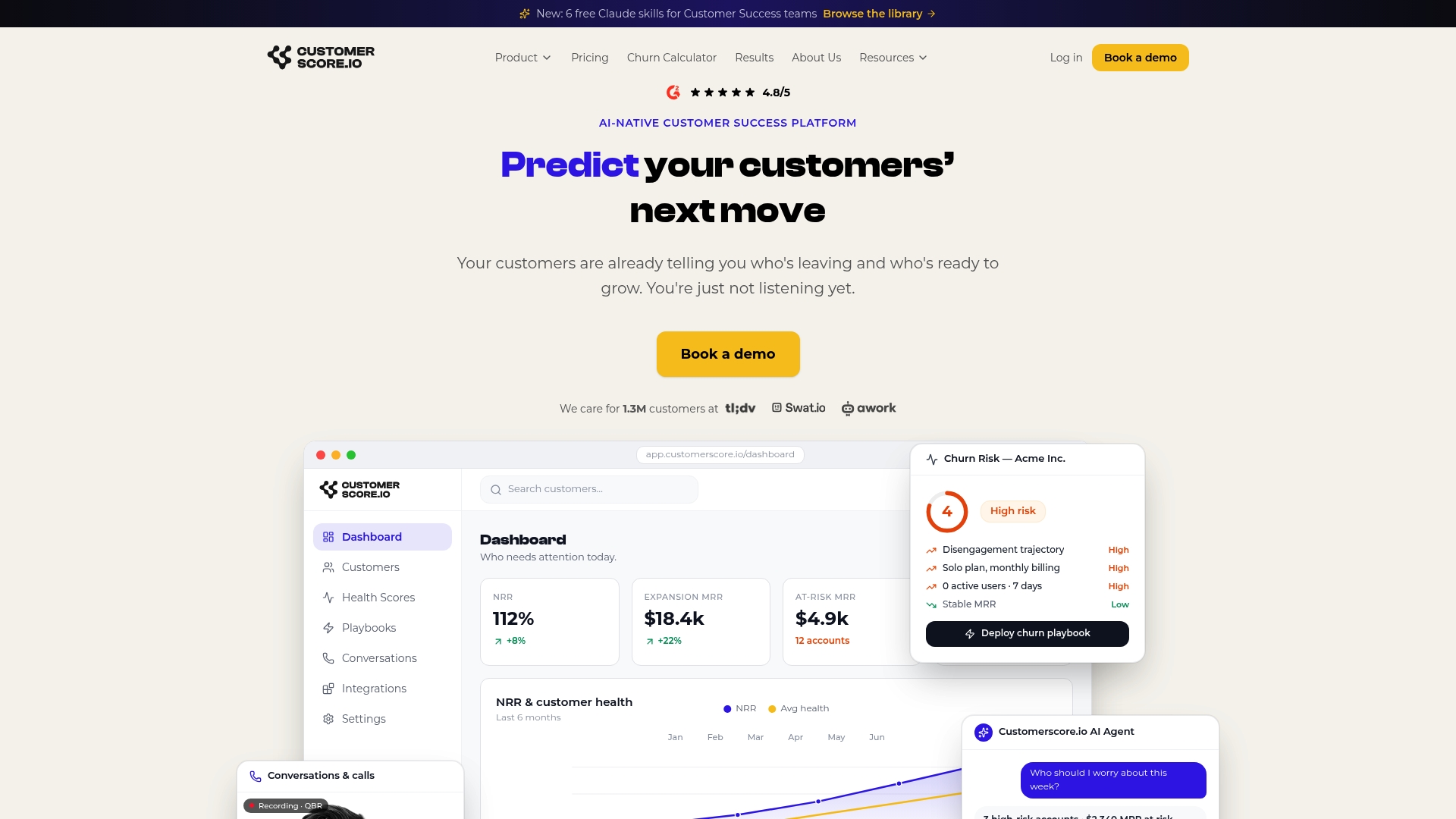
Playbooks are built visually, with conditional logic and escalation rules already baked in. Renewal workflows fire automatically at 90, 60, and 30 days. Expansion nudges trigger from real usage signals. QBR summaries pre-populate from live account data. The onboarding path is straightforward: connect your data sources, configure your health score weights, codify one playbook, and run a 30–90 day pilot with the KPIs you defined.
For teams ready to move from spreadsheets and manual follow-up to a system that actually scales, book a demo and see how Customerscore maps to your specific workflows and ARR band.
Useful sources and further reading
These resources cover the core concepts, platform evaluation, and implementation guidance referenced throughout this article.
- Customer success management platforms — Gartner Peer Insights: platform capability definitions and market positioning for CSM tools
- Customer success — Wikipedia: foundational definition of CS platforms and lifecycle automation scope
- Customer experience automation — IBM: the orchestration, segmentation, personalization, and automation framework
- Sales force automation — Oracle: how CRM data integration enables CS automation workflows
- AI customer success: a practical pilot — Customerscore.io: how to structure an AI pilot with KPIs and validation steps
- Customer success playbooks — Customerscore.io: feature-level detail on playbook automation and outreach execution
- Best customer success software for SaaS — Customerscore.io: platform evaluation overview for B2B SaaS teams
- SaaS customer success glossary — Customerscore.io: 100 terms explained for teams new to CS automation concepts
Recommended
Related articles
Benchmarked Save Playbooks: Two Churn Survey Questions for SaaS Teams
Benchmarked Save Playbooks: Two Churn Survey Questions for SaaS Teams ! Customer success manager reviewing churn survey The most effective churn survey for SaaS is a two-question in-flow cancel
Blog90–120 Day Renewal System for CSMs: SaaS Renewal Playbook
90–120 Day Renewal System for CSMs: SaaS Renewal Playbook ! Team planning a structured SaaS renewal Run renewals as a 90 to 120 day managed pipeline, not a calendar reminder.
BlogCut Response Time 60% with This Slack for Customer Success Playbook
Cut Response Time 60% with This Slack for Customer Success Playbook ! Customer success team routing a Slack conversation Slack works best for customer success when it functions as the conversation
BlogProduct Led Customer Success in 90 to 180 Days Without a Data Team
Product Led Customer Success in 90 to 180 Days Without a Data Team ! Customer success operator reviewing product signals Product-led customer success uses product usage data and in-product