
MCP AI Agents for CS & RevOps: Pilot-to-Scale Guide


MCP AI agents let B2B SaaS teams automate multi-step customer workflows by connecting AI models to your CRM, billing system, and product telemetry through a single standardized protocol. For Customer Success and RevOps leaders, that means churn prediction, renewal prep, and expansion playbooks can run autonomously across systems that previously required manual stitching. The Model Context Protocol is not a chatbot layer. It is an open standard that gives agents a consistent way to discover and call tools across your entire stack.
Three concrete benefits CS and RevOps teams see from a well-scoped pilot:
- Fewer manual handoffs. Agents pull data from Salesforce, Stripe, and Mixpanel in one pass instead of requiring a CSM to do it.
- Faster time-to-action. A renewal risk flagged at 11 PM triggers an outreach sequence before the next business day.
- Reusable playbooks. One agent definition covers onboarding, renewal, and expansion workflows without rebuilding connectors for each.
Start with a pilot on a single high-value workflow, renewals or a churn-prone segment, with defined acceptance criteria before you scale.
Pro Tip: Pick the workflow where a one-day delay costs the most. That is your pilot candidate.
Table of Contents
- How do MCP AI agents actually work?
- Why MCP agents change the math for Customer Success and RevOps
- What capabilities and integrations should you prioritize?
- How do you run a 0–6 month MCP agent pilot?
- What governance controls does an enterprise MCP deployment require?
- How do you measure whether MCP agents are working?
- What does Customerscore offer for MCP-capable AI agents?
- Key Takeaways
- Why MCP is the next platform shift for CS and RevOps
- Customerscore turns MCP agents into CS results
- Useful sources
How do MCP AI agents actually work?
MCP is a protocol, not a model. It standardizes how an agent discovers what tools are available and how it calls them. Think of it as a universal adapter: instead of hard-coding API calls to Salesforce, Stripe, and Intercom separately, your agent queries an MCP server for a manifest of available tools, then invokes whichever ones the task requires.
The flow looks like this: the agent sends a request to an MCP server, which returns a tool manifest. The agent picks the right tools, calls them, and assembles the results into a response or triggers the next step in a playbook. State lives in the agent's context window or an external store, not in the MCP server itself. That stateless server design, formalized in a major 2025 MCP update, means you can run MCP servers behind a standard load balancer without sticky routing headaches.
Key architectural points:
- Separation of concerns. Backend tools can be updated without rewriting agent orchestration logic.
- Tool discovery. Agents query the server at runtime, so adding a new connector does not require redeploying the agent.
- Stateless scale. Cloud-native load balancing works out of the box once servers are stateless.
- Low code footprint. Functional agents can often be defined with a low code footprint by pointing an agent framework at an MCP server and composing tool calls.
Pro Tip: A simple architecture diagram showing Agent → MCP server → tool connectors → data sources will save you 30 minutes in every stakeholder meeting.
Why MCP agents change the math for Customer Success and RevOps

These agents automate multi-step, cross-system playbooks that previously required a CSM to manually pull data, form a judgment, and trigger an action. The shift is not incremental. Red Hat frames it as moving from chatbots to "active applications," composable AI assets reused across workflows and departments.
Core use cases where the payoff is clearest:
- Churn prediction + renewal prep. An agent ingests billing signals, product usage drops, and support ticket volume, then surfaces a renewal risk score and queues the right outreach sequence automatically.
- Onboarding orchestration. Agents track milestone completion across your product, CRM, and onboarding workflows, and nudge the right stakeholder when a step stalls.
- Expansion playbooks. Usage thresholds in Mixpanel or PostHog trigger an upsell sequence in Slack or Intercom without a CSM having to notice the signal first.
- Real-time alert triage. Agents route escalations to the right owner and log context before a human ever opens the ticket.
The business impact CS leaders care about: reduced time from risk signal to outreach, fewer accounts falling through the cracks during high-volume renewal periods, and CSMs spending time on relationships rather than data assembly.
What capabilities and integrations should you prioritize?
The answer-first version: prioritize connectors, authentication governance, long-running task support, and interactive UI extensions. Everything else is secondary until those four are solid.
Connector checklist for CS/RevOps:
- CRM: HubSpot or Salesforce
- Billing: Stripe or Chargebee
- Product telemetry: Mixpanel or PostHog (or Segment as a unified layer)
- Support: Intercom
- Messaging: Slack
Agent skills that map to real CS workflows:
- Churn scoring + renewal playbook trigger
- Onboarding runbook automation with milestone tracking
- Meeting-note action extraction and CRM update
- Health-score-driven outreach sequencing
Enterprise features worth verifying before you commit to a vendor:
- Stateless server compatibility for cloud-native scale
- 12-month deprecation policy so integrations do not break without warning
- Enterprise Managed Authorization (IdP tie-ins via your identity provider)
- MCP Apps and MCP Tasks support for durable async workflows and server-rendered dashboards
The assets.dev MCP reference is a useful technical resource when evaluating protocol-level implementation options.
How do you run a 0–6 month MCP agent pilot?
Start with a pilot on a single workflow. Renewals or a churn-prone segment work best because the ROI is measurable and the blast radius of a mistake is contained.
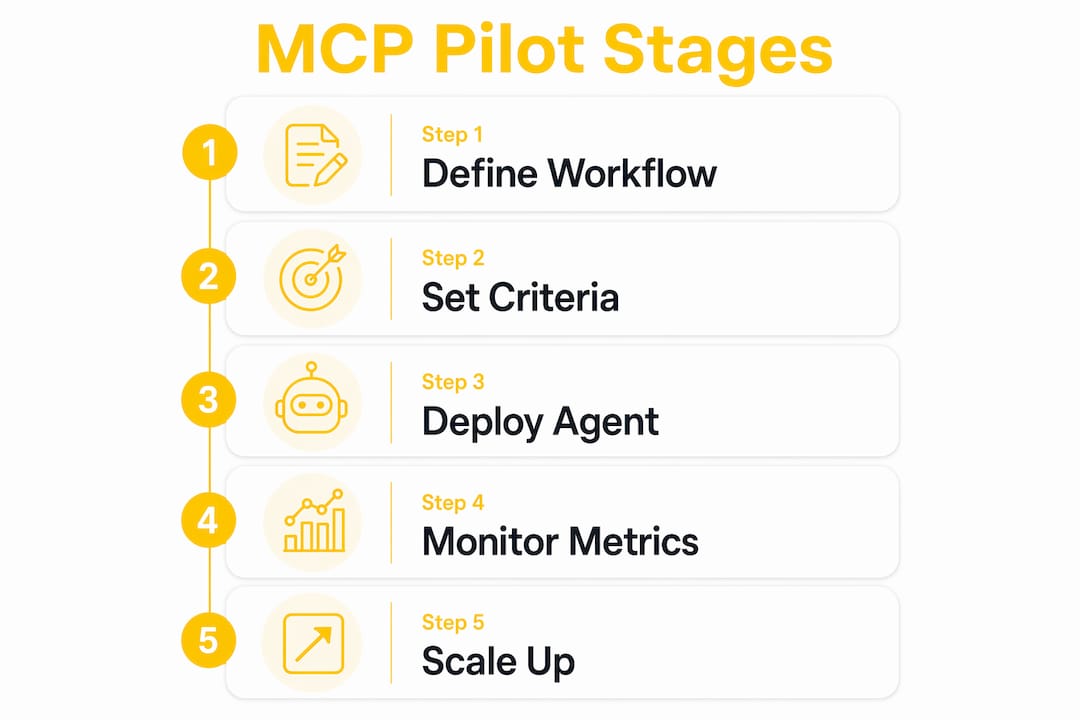
| Phase | Timeline | Key Activities |
|---|---|---|
| Scoping & data mapping | Month 0 | Define ROI hypothesis, map data sources, confirm IdP and subprocessors |
| Build | First weeks | Stand up MCP server, connect CRM/billing/telemetry, build minimal planner agent |
| Closed-loop pilot | Following weeks | Run with human-in-the-loop approvals, log every agent action |
| Measure & iterate | Following weeks | Review KPIs, tighten playbooks, decide scale criteria |
Pilot checklist:
- Define the ROI hypothesis (e.g., reduce renewal prep time by 50%)
- Map all data sources and confirm access credentials
- Confirm IdP integration and subprocessor list
- Write the playbook the agent will execute
- Set KPIs and baseline metrics before launch
- Run a test cohort of accounts before full rollout
Cost considerations to budget for:
- Engineering time to stand up and configure the MCP server
- Model compute costs (smaller reasoning models can reduce latency and cost for high-frequency tasks, per OpenAI cookbook patterns)
- MCP server hosting (containerized deployment on your cloud of choice)
- Operational runbook overhead for the human-in-the-loop review step
What governance controls does an enterprise MCP deployment require?
Governance must be enforced at three levels: the protocol, the server, and the playbook. Bolting it on after go-live is how revenue-impacting actions slip through without an audit trail.
Governance checklist:
- IdP integration via Enterprise Managed Authorization (tie agent permissions to your existing identity provider)
- Token scoping: agents get the minimum permissions required for each tool call
- Audit logs for every agent action, especially writes and outreach triggers
- Data residency controls: confirm where customer data is processed and stored
- Transparent subprocessors list: require vendors to publish which third parties handle your data
- Deprecation notice commitments: 12-month minimum before any breaking protocol change
- Terms of Use that explicitly cover agent automation, not just human-user access
Pro Tip: Require approval gates for any action that touches revenue: contract amendments, renewal pricing changes, or bulk outreach to at-risk accounts. Human-in-the-loop is not a UX nicety. It is your liability control.
The human-in-the-loop patterns documented by OpenAI are the clearest reference for enforcing approvals and audit trails in production agent workflows.
How do you measure whether MCP agents are working?
Track both operational and business KPIs from day one of the pilot. Operational metrics tell you if the agent is behaving correctly; business metrics tell you if it is worth scaling.
KPI list:
- Automation rate (proportion of playbook steps completed without human intervention)
- Mean time to resolution for escalations
- Renewal conversion rate within the pilot cohort vs. control group
- Reduction in manual handoffs per CSM per week
- False-positive rate for agent recommendations (how often the agent flags a risk that turns out to be a non-issue)
Experiment templates:
- A/B renewal outreach. Agent-assisted cohort vs. manual outreach cohort. Measure conversion rate and time-to-close.
- Canary rollout for high-risk actions. Route a portion of high-risk account actions through the agent with mandatory human approval. Expand only after false-positive rate drops below your threshold.
- Rollback criteria. Define in advance: if the false-positive rate exceeds X% or a destructive action fires without approval, the agent pauses automatically.
Run weekly operational dashboards during the pilot. Move to monthly business reviews once you scale.
What does Customerscore offer for MCP-capable AI agents?
Customerscore delivers MCP-capable AI agents built specifically for B2B SaaS Customer Success: churn prediction, explainable health scoring, and renewal automation in a single platform.
What's included:
- MCP and AI agent integration with prebuilt connectors for HubSpot, Salesforce, Stripe, Chargebee, Mixpanel, PostHog, Segment, Intercom, and Slack
- Explainable health scores that surface the specific signals driving a risk rating, not just a number
- Playbooks for onboarding, renewals, and expansion with human-in-the-loop approval controls
- Real-time alerts that trigger agent actions without requiring a CSM to notice the signal first
- Transparent subprocessors list, documented AI Terms of Use, and SLA commitments
GoodAccess used Customerscore to improve CS efficiency, demonstrating the kind of measurable operational gains a well-scoped MCP agent deployment can produce. Read the GoodAccess case study to see the specifics.
Book a demo to see the agent layer in action.
Key Takeaways
MCP AI agents reduce churn and accelerate renewals by connecting AI models to your CRM, billing, and telemetry through a single protocol, replacing manual data assembly with automated, auditable playbooks.
| Point | Details |
|---|---|
| MCP is a protocol, not a model | It standardizes tool discovery and invocation so agents avoid brittle, hard-coded integrations. |
| Start with one workflow | A 6–12 week pilot on renewals or a churn-prone segment gives measurable ROI before you scale. |
| Governance at three levels | Enforce controls at the protocol, server, and playbook levels; require human approval for revenue-impacting actions. |
| Measure both KPI types | Track automation rate and false-positive rate operationally; track renewal conversion and churn delta as business outcomes. |
| Customerscore | Offers MCP-capable agents with prebuilt CS connectors, explainable health scores, and documented trust signals. |
Why MCP is the next platform shift for CS and RevOps
Most CS teams still treat AI as a reporting layer. A dashboard that surfaces churn risk is useful. An agent that acts on it at 11 PM, queues the right outreach, and logs the action for review the next morning is a different category of tool entirely.
What makes MCP the right foundation for that shift is composability. Anthropic introduced MCP as an open standard precisely because fragmented connectors were the bottleneck. Every new integration was a new maintenance burden. MCP flips that: build the server once, and every agent in your stack can use it. That is how you get from "we have an AI pilot" to "AI runs our renewal motion" without rebuilding connectors for each new workflow.
The human-in-the-loop posture matters here too. Enterprise CS teams cannot afford agents that act without accountability. The right architecture keeps humans in the approval chain for anything that touches revenue, while letting agents handle the data assembly, risk scoring, and sequencing that currently consumes CSM hours.
Customerscore turns MCP agents into CS results
Churn does not wait for your next QBR. Customerscore's churn prediction software uses MCP-capable agents to monitor your entire customer base continuously, surfacing renewal risks and triggering playbooks before accounts go dark.
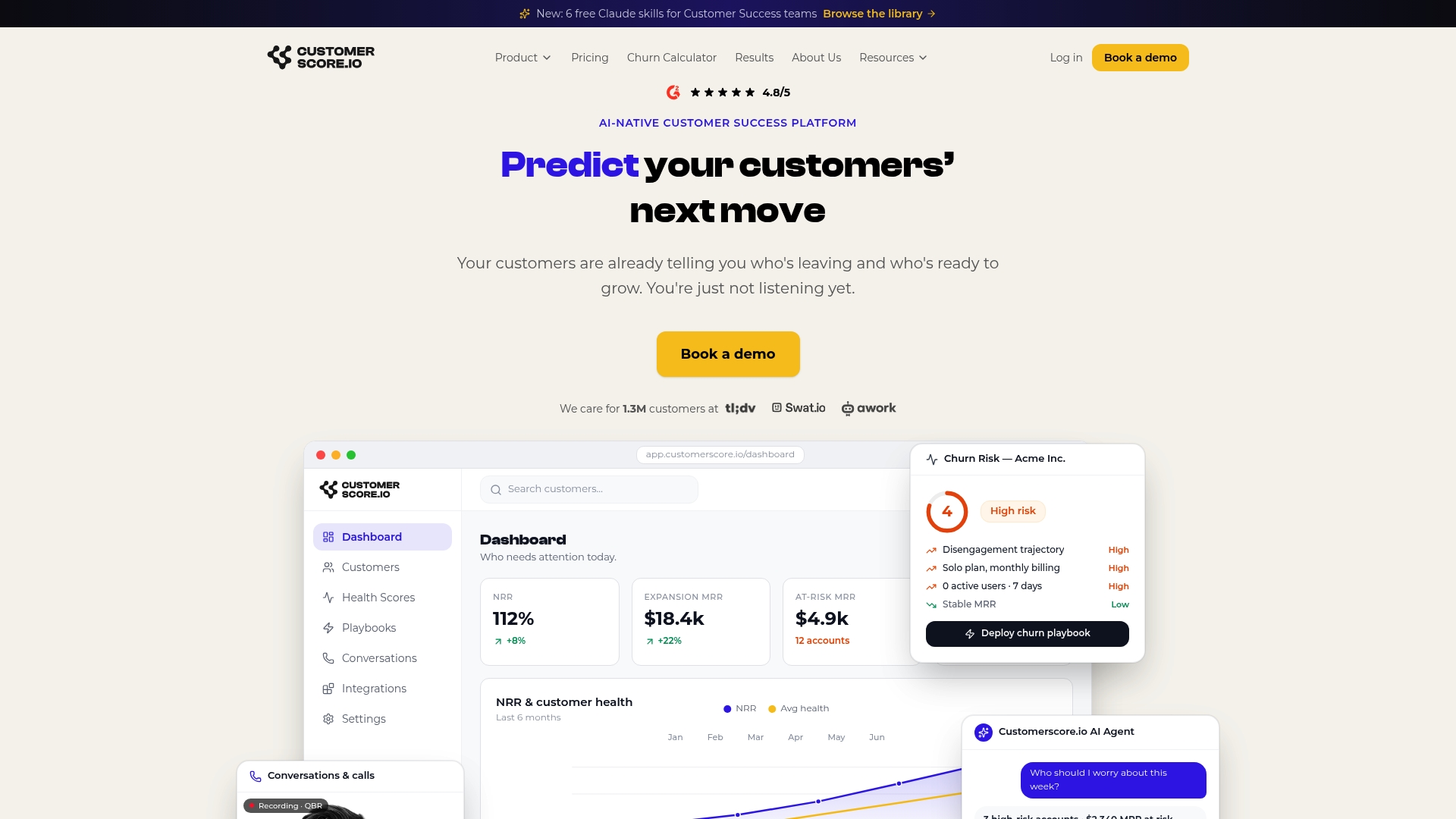
The platform connects to your existing stack (HubSpot, Salesforce, Stripe, Mixpanel, and more) through prebuilt MCP connectors, so your pilot can be live in days, not quarters. Every agent action is logged, every recommendation is explainable, and every revenue-impacting step requires human approval until you decide otherwise. The GoodAccess case study shows what that looks like in practice.
Book a demo and bring your renewal or churn use case. The team will map it to a working pilot scope in the first conversation.
Useful sources
- Model Context Protocol — Introduction: Protocol fundamentals, tool discovery, and the client-server architecture.
- Introducing the Model Context Protocol — Anthropic: Anthropic's original announcement explaining the open-standard rationale and developer use cases.
- MCP's biggest update — VentureBeat: Covers stateless architecture, Enterprise Managed Authorization, 12-month deprecation policy, MCP Apps, and MCP Tasks.
- MCP-Powered Agentic Voice Framework — OpenAI Cookbook: Practical planner agent patterns, model-selection tradeoffs, and human-in-the-loop handoffs.
- MCP Agent SDK — docs.mcp-agent.com: Composable agent framework patterns and low-code MCP server setup.
- Build Agents using MCP on Azure — Microsoft Learn: Architecture reference for consuming and building MCP servers in cloud-native environments.
- Customerscore AI agent page: MCP-capable agent features, connector list, and trust signals.
- Customerscore subprocessors and Terms of Use: Governance documentation for enterprise evaluation.
Recommended
Related articles
90–120 Day Renewal System for CSMs: SaaS Renewal Playbook
90–120 Day Renewal System for CSMs: SaaS Renewal Playbook ! Team planning a structured SaaS renewal Run renewals as a 90 to 120 day managed pipeline, not a calendar reminder.
BlogCut Response Time 60% with This Slack for Customer Success Playbook
Cut Response Time 60% with This Slack for Customer Success Playbook ! Customer success team routing a Slack conversation Slack works best for customer success when it functions as the conversation
BlogProduct Led Customer Success in 90 to 180 Days Without a Data Team
Product Led Customer Success in 90 to 180 Days Without a Data Team ! Customer success operator reviewing product signals Product-led customer success uses product usage data and in-product
BlogPredict Churn 60–90 Days: Five Phase Customer Risk Scoring for B2B SaaS
Predict Churn 60–90 Days: Five Phase Customer Risk Scoring for B2B SaaS ! Customer success manager reviewing account risk dashboard Customer risk scoring produces a predictive, explainable health