
90–120 Day Explainable AI Playbook to Reduce Renewal Risk for SaaS CS


To reduce renewal risk, you prioritize accounts daily using explainable risk signals and run a repeatable 90 to 120 day renewal playbook. That means triaging your top accounts every morning with a clear reason behind each flag, then starting the renewal cadence well before the contract date instead of scrambling in the final weeks. Platforms like Customerscore build this workflow into a single view of the account.
TL;DR:
- Prioritize at-risk accounts daily by referencing explainable risk signals across usage, billing, support, and relationship data to act before renewal deadlines.
- Use a 120 to 90 day renewal timeline with structured check-ins and escalation triggers such as sudden usage drops or champion turnover to prevent last-minute renewals.
- Match interventions to specific drivers like adoption, stakeholder alignment, or budget issues, and track their effectiveness through subsequent changes in account health.
- Consolidate all relevant data sources into one account record and employ explainable AI to identify precise risk drivers and prioritize actions effectively.
- Measure program success through renewal rate improvements, net revenue retention, and faster response times, confirmed by pilot comparisons against control groups.
Table of Contents
- Your daily and weekly renewal risk checklist
- What signals actually predict renewal risk
- The 90 to 120 day renewal timeline that prevents surprises
- Targeted interventions for common renewal risk drivers
- The data and integrations a renewal workflow needs
- How to measure whether your renewal program is working
- Where teams waste effort and where the returns are fastest
- How Customerscore.io supports a lower-risk renewal process
- Further reading on renewal and retention tactics
- FAQ
Your daily and weekly renewal risk checklist
Most renewal losses trace back to one thing: nobody noticed the warning signs early enough to act. A short, repeatable checklist fixes that.
Run this every morning:
- Pull your top at-risk accounts and write down the reason for each flag.
- Decide the next action for each one: a call, an email, an internal escalation, or a watch-and-wait.
- Send any outreach before lunch, while the context is still fresh.
Each week, audit for the things daily triage can miss:
- Billing flags such as failed payments, downgrades, or seat reductions.
- Usage drops across core features, not just overall login counts.
- Open critical support tickets that have gone unanswered past their SLA.
- Promises made on past calls that nobody has delivered on yet.
Pro Tip: Keep the outreach objective specific. "Checking in" gets ignored. "Following up on the reporting issue from last month" gets a reply.
What signals actually predict renewal risk
Renewal risk shows up across four categories: usage, billing, support, and relationship. A single data point rarely tells you much. A trend does.
- Usage: declining active users, abandoned key features, or a drop in logins from the account's main champion.
- Billing: late payments, downgrade requests, or seats removed at a previous renewal.
- Support: a rising volume of critical tickets or the same issue reopened more than once.
- Relationship: champion turnover, a quiet executive sponsor, or missed QBRs.
A single bad week of usage is noise. Several consecutive weeks of decline, paired with a support ticket that took twice as long as usual to close, is a signal worth acting on. Teams that build or use an explainable risk score, rather than a rule-based health grade, can see which of these drivers moved the number and by how much. Accounts with clear billing or adoption drops tend to be the highest signal-to-noise cases, which is why they deserve first attention rather than equal weighting with every flagged account. An explainable model lets a CSM point to the specific drivers behind a score instead of guessing from a single red or yellow label, a distinction covered in detail in Customerscore.
The 90 to 120 day renewal timeline that prevents surprises
Last-minute renewal panic almost always comes from starting too late. A defined cadence with named owners closes that gap, a structure laid out in Customerscore.io's 90 to 120 day renewal playbook.
- 120 to 90 days out: CSM reviews usage, billing, and support history, flags any open risk drivers, and schedules a check-in with the account's champion.
- 90 to 60 days out: Run a business review covering value delivered, open issues, and expansion opportunities. Loop in an executive sponsor if the account is strategic.
- 60 to 30 days out: Send the renewal proposal, confirm the decision maker and timeline, and resolve any outstanding commitments from earlier calls.
- 30 to 0 days out: Get written confirmation, finalize paperwork, and hand off any new commitments to the onboarding or support team.
Escalation triggers at any window:
- A champion leaves or goes quiet for more than two weeks.
- Usage drops sharply right after a QBR.
- The account requests a downgrade before the renewal date.
Pro Tip: Build your QBR and renewal readiness checklist once, then reuse it for every account. Consistency is what makes the 90 to 120 day system actually repeatable instead of a one-time effort.
Targeted interventions for common renewal risk drivers
Not every at-risk account needs the same fix. Match the intervention to the driver.
- Adoption sprint: for accounts with declining usage, a CSM runs a short, focused session on the features tied to the account's original use case.
- Re-onboarding: for accounts where the original champion left, walk the new stakeholder through setup again rather than assuming they inherited the context.
- Executive sponsor alignment: for strategic accounts showing relationship risk, bring in leadership from both sides to reset expectations.
- Targeted commercial options: for accounts citing budget pressure, a scoped discount or a temporary seat reduction can beat losing the account entirely.
CSMs own adoption sprints and re-onboarding. Account directors or leadership own sponsor alignment and commercial negotiation. Track success by whether the specific driver (usage, sentiment, or billing) moved in the subsequent weeks, and capture the outcome on the account record so the next renewal cycle benefits from it. Customerscore.io's guide to churn prevention strategies breaks down several of these interventions with more detail.
Pro Tip: Route to sales only when the fix is commercial. Routing a product adoption problem to sales just delays the real conversation.
The data and integrations a renewal workflow needs
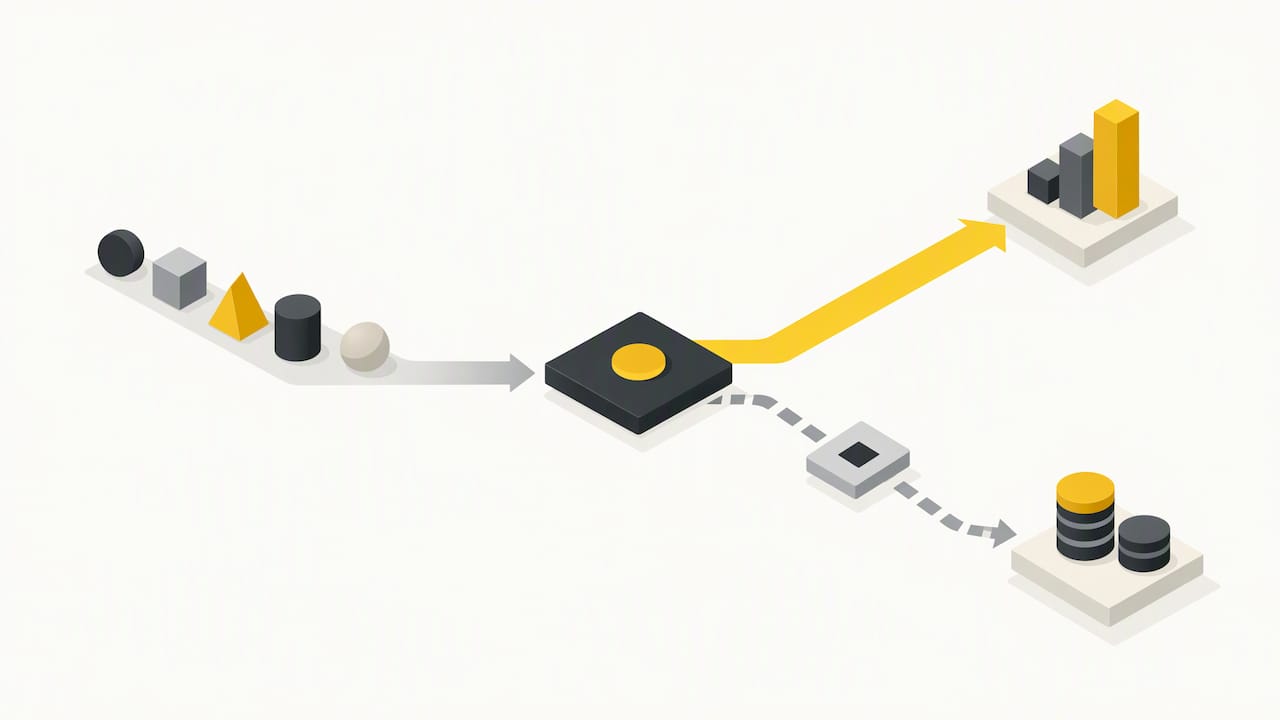
None of this works without the underlying data in one place. A renewal risk program needs billing data, CRM history, product usage, support tickets, and call notes feeding the same account record. Scattered data is the main reason the choice of which account to focus on is still often made on instinct.
- Billing systems (Stripe, Chargebee) surface payment failures and downgrade requests.
- Product analytics (Mixpanel, PostHog) show real usage trends rather than login counts alone.
- CRM (HubSpot, Salesforce) carries deal history, contract terms, and stakeholder records.
- Support and communication tools (Zendesk, Intercom, Gmail) flag unresolved issues and tone shifts.
- Call recordings (tl;dv, Fireflies) preserve what was promised on past calls, so it does not depend on one person's memory.
A single customer record that pulls all of this together, paired with explainable AI rather than a static rule-based score, is what turns scattered signals into a daily prioritized list rather than a quarterly report nobody reads.
How to measure whether your renewal program is working
The clearest proof is a pilot: run prioritized outreach on a group of at-risk accounts and compare the renewal outcome against a control group left on your old process.
- Renewal rate and gross churn by cohort, tracked over each quarter.
- Net revenue retention (NRR), which captures both churn and expansion in one number.
- Time-to-intervention, measured from the day a risk signal appears to the day a CSM acts on it.
A single portfolio dashboard showing every account's risk status, next to a per-account timeline of signals and interventions, is enough to run this verification without building anything custom. A faster time-to-intervention, verified through this kind of pilot, is one of the most direct ways to show the program is paying for itself, a measurement approach Customerscore.io outlines using its retention statistics from a 44,000-user study.
Where teams waste effort and where the returns are fastest
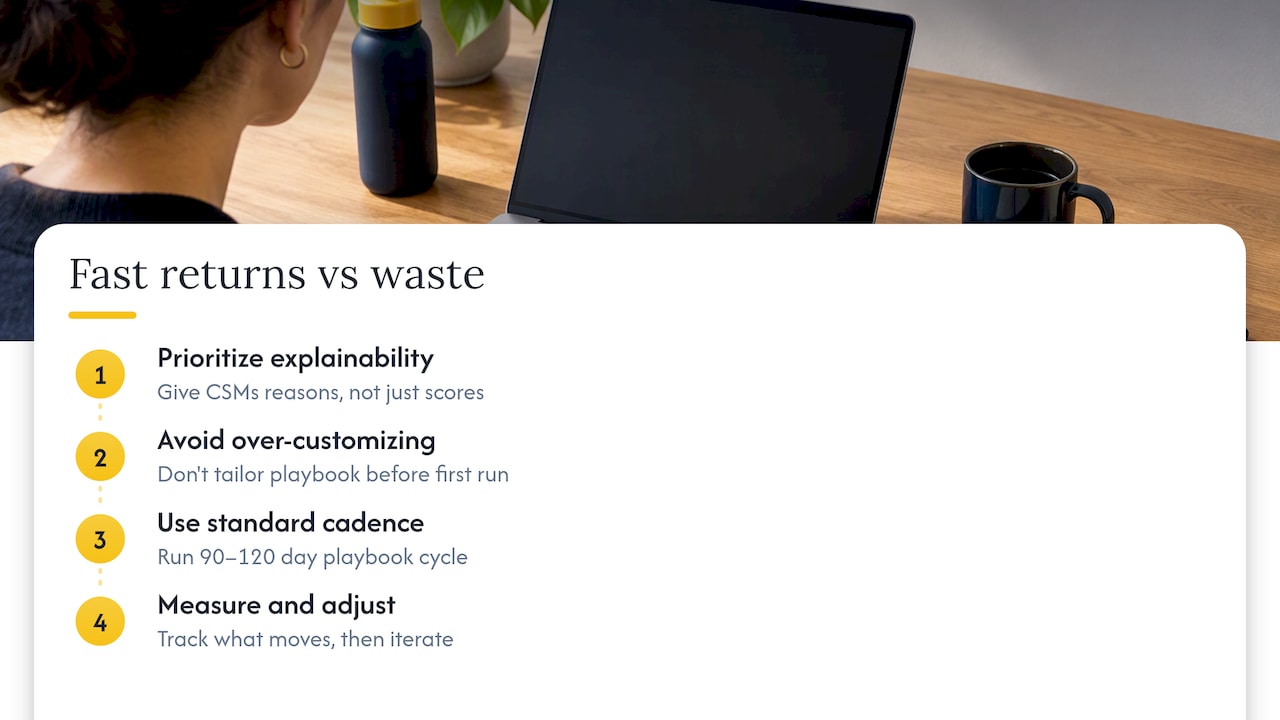
Explainability beats opacity every time. A CSM who can say exactly why an account is flagged, and what to do about it, acts faster than one staring at a color-coded score with no context.
The most common mistake is over-customizing the playbook before running it once, which delays time-to-value for months. Start with the standard 90 to 120 day cadence, measure what moves, then adjust.
— Patrik Chalupa
How Customerscore.io supports a lower-risk renewal process
Running this playbook by hand across hundreds of accounts is where most lean CS teams fall behind, not because the process is wrong but because nobody has time to check every signal manually. Customerscore.io was built to close that gap.
- Every morning, each CSM sees which accounts need attention today and the reason behind each one, drawn from usage, billing, support, and call data in one record.
- Renewal and QBR prep starts early, with the AI agent drafting the review from the period's numbers and conversations.
- Explainable churn and expansion predictions show the drivers behind a risk score, not just a color.
- Setup is expert-led and live in 1 to 3 weeks, with no admin hire required to run it, and the platform is ISO 27001 certified and EU-hosted.
Pricing is a flat platform fee based on annual recurring revenue rather than per seat, with the full platform for every customer. Check the pricing page for a tailored quote or see the full solution overview to evaluate fit for your team.
Further reading on renewal and retention tactics
For more on churn patterns, see Customerscore.io's churn analysis guide and its playbook templates. For broader retention tactics, see 10 proven retention strategies and subscription churn reduction tactics.
FAQ
What is the fastest way to reduce renewal risk this week?
Start by triaging your top at-risk accounts every morning, noting the specific reason each one is flagged, and sending targeted outreach before the day ends. This single habit, built on explainable signals rather than a single health score, catches most risk before it becomes a last-minute scramble.
How early should a renewal playbook start?
A 90 to 120 day cadence, as outlined in Customerscore, gives teams enough runway to spot risk drivers, run interventions, and still have time to negotiate before the contract date. Starting later than 60 days out usually means reacting instead of preventing.
What metrics show a renewal risk program is actually working?
Track renewal rate, gross churn, and net revenue retention by cohort, along with time-to-intervention from signal to action. Running a pilot with prioritized outreach against a control group is the clearest way to confirm the lift is real.
Does Customerscore.io replace a health score with something better?
Customerscore.io uses explainable AI models that predict churn and expansion for each account and show the specific drivers behind the prediction, rather than a static rule-based score. That lets a CSM point to the exact signal driving the risk instead of a single color-coded label.
Recommended
Related articles
Five Fields to Fix Playbook Trigger Design for B2B SaaS CS & RevOps
Five Fields to Fix Playbook Trigger Design for B2B SaaS CS & RevOps ! Isometric trigger routing system illustration The most reliable approach to playbook trigger design is to sort every alert into
BlogStop SaaS Downgrades: Save 31% of At Risk Accounts for CS & RevOps
Stop SaaS Downgrades: Save 31% of At Risk Accounts for CS & RevOps ! Isometric account protection title card The fastest way to prevent SaaS downgrades is to stop treating every at-risk account the
Blog24–48 Hour Handoffs: B2B SaaS Support to CS Checklist, Six Fields
24–48 Hour Handoffs: B2B SaaS Support to CS Checklist, Six Fields ! Isometric handoff cards crossing between platforms A reliable support to CS handoff transfers ownership and context so the new owner
BlogFix Product to CS Alignment in 60 Days for B2B SaaS CS and Product Leaders
Fix Product to CS Alignment in 60 Days for B2B SaaS CS and Product Leaders ! Product and CS alignment loop illustration Product to CS alignment is an operating model that turns customer signal into