
Fix Product to CS Alignment in 60 Days for B2B SaaS CS and Product Leaders

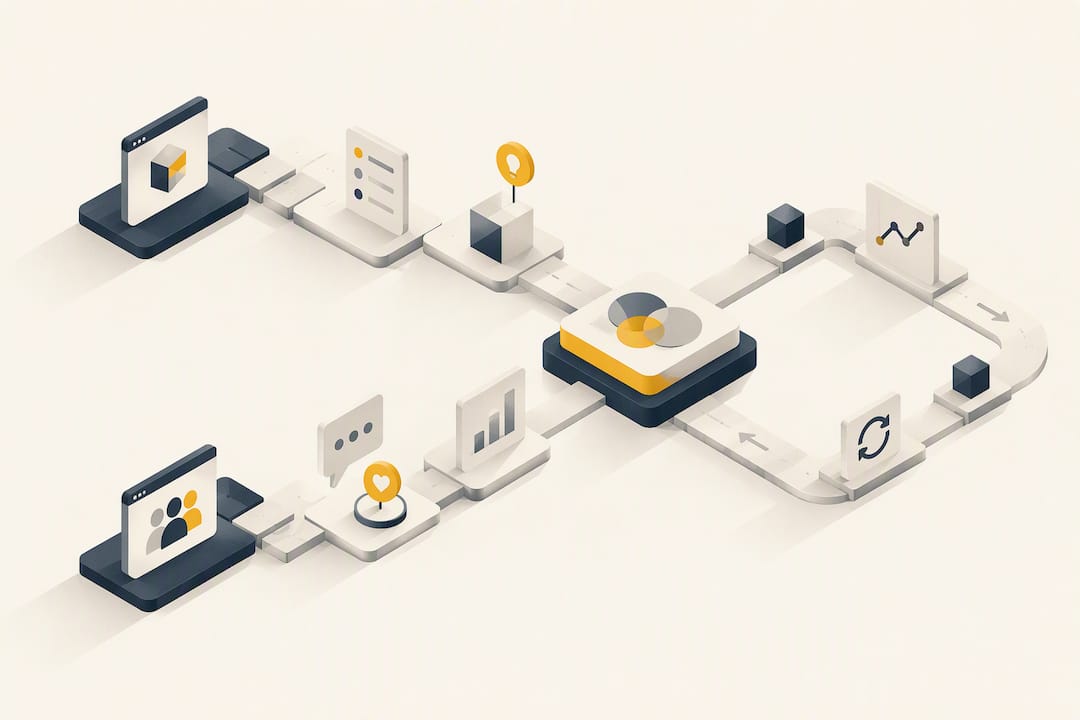
Product to CS alignment is an operating model that turns customer signal into product decisions and product decisions into customer-facing action. If you want progress this week, run a 30 to 60 minute session to agree on what "good feedback" looks like, then pick one submission path and schedule a biweekly PM-CSM cadence.
TL;DR:
- Most teams are at the ad hoc or structured stage of alignment, and moving to systematic practices requires formal ownership, logging, and SLA tightening.
- Clear roles, deadlines, and decision logs in biweekly CSM-PM cadences significantly improve feedback responsiveness and build trust over time.
- A standardized evidence package with key fields helps triage customer feedback efficiently and prevent valuable input from getting lost in spreadsheets.
- Bridge metrics like feature adoption at 90 days and retention cohort changes help both teams prioritize and demonstrate impact, but require dedicated ownership and regular review.
- The first 90 days should focus on establishing a single feedback submission path, agreeing on response SLAs, and building a shared cadence before scaling further.
Table of Contents
- What product to CS alignment really means
- Which alignment stage are you actually in?
- Rituals and roles that make alignment stick
- How to build a VoC pipeline that Product will actually use
- Shared metrics that change how both teams prioritize
- Closing the loop so CS can answer customers with confidence
- What the research says about making this stick
- What successful alignment looks like in practice
- Choosing the right communication channels between the teams
- Why this changes retention and satisfaction numbers
- The sequencing that actually works in the first 90 days
- Where Customerscore.io fits into this operating model
- Sources
- FAQ
What product to CS alignment really means
Alignment is not another standing meeting. It is a defined operating model built on three pillars: structured signal flow, shared accountability metrics, and closed feedback loops, and teams that build all three see higher adoption and lower churn than teams relying on informal Slack messages and hallway conversations, according to Rework's model of CS-Product alignment. The practical signature looks the same across companies: scheduled PM-CSM cadences, ARR-weighted feedback, and a roadmap shared with CS before it reaches customers.
The difference between this and "more meetings" is that each pillar assigns an owner, a format, and a response requirement. Feedback without structure becomes noise. Meetings without a decision log become status updates. Metrics that only one team tracks change nothing.
Done well, the model moves numbers both teams already care about:
- Feature adoption climbs when CSMs know what shipped and why, so they can push it into active accounts.
- The feature graveyard shrinks because prioritization uses evidence instead of whoever escalated loudest.
- Churn tied to product gaps drops because CS stops absorbing the same complaint quarter after quarter with no path to resolution.
Which alignment stage are you actually in?
Most teams overestimate their maturity. Before adding cadences or tooling, diagnose where you stand using Rework's maturity model, which warns that predictive practices only work once the earlier stages are solid: trying to skip ahead creates noise instead of signal.
- Ad hoc: Feedback arrives through DMs and hallway chats with no shared definition of what counts as useful input. Fix: agree on the feedback format first.
- Structured: A single intake path exists, but nobody tracks response rates or owns triage. Fix: assign an owner and start logging decisions.
- Systematic: Feedback is ARR-weighted, PM-CSM 1:1s run on a schedule, and decisions get logged with a status. Fix: tighten the SLA and formalize the pre-brief process.
- Predictive: CS signal feeds product discovery before customers ask for anything. Fix: protect the infrastructure that got you here so it doesn't decay under volume.
Most teams can move one stage within a quarter if they fix the one or two gaps that are actually blocking them, rather than rebuilding everything at once.
Pro Tip: If you can't name who owns your feedback repository today, you're at Stage 1, regardless of how many tools you've bought.
Rituals and roles that make alignment stick
Meetings fail when they have no required output. The fix is a two-tier cadence with a decision log requirement, a structure Rework's research on PM-CSM 1:1s recommends specifically because it stops strategic sessions from turning into status updates.
- Tier 1: VP of CS and Head of Product meet monthly to make prioritization calls and unblock anything Tier 2 escalated.
- Tier 2: PMs and CSMs meet biweekly to triage accounts. The most effective format has each CSM bring three structured briefs: account and ARR, the request or issue, what CS already tried, and a response deadline.
- Decision log: Every meeting produces at least one logged entry with an owner and a date. No entry means the meeting didn't produce a decision.
Product marketing sits between the two tiers as the translation layer. According to Rework's research on PMM as the bridge, PMM should convert raw CSM verbatims into ARR-weighted evidence and turn product specs into CS pre-briefs, in-app messages, and release notes, delivered before general availability. Skip that step and PMM becomes a cleanup crew instead of a bridge.
Pro Tip: Give Tier 2 meetings a hard 30-minute cap. Three account briefs per CSM is enough to keep PMs engaged without forcing long context-setting.
How to build a VoC pipeline that Product will actually use
CSMs stop submitting feedback when it disappears into a spreadsheet nobody reads. The fix is a standardized evidence package and one capture location, not a new tool for every complaint.
Each submission needs seven fields, a structure TSIA's research on customer adoption points to because it cuts PM triage time from hours to minutes:
- Verbatim problem: The customer's own words, not a paraphrase.
- Affected segment: Which tier, industry, or use case this hits.
- Frequency: How often this comes up across accounts.
- ARR exposure: The revenue tied to accounts raising it.
- Workaround: What CS is doing in the meantime, if anything.
- Desired outcome: What the customer actually needs, not just what they asked for.
- Supporting metric: A usage number that backs the claim.
Pick one submission path: a custom CRM field, a feature inside your CS platform, or a lightweight Airtable base. The tool matters less than having exactly one path with a named owner who tags and forwards weekly. During triage, weight items by ARR exposure alongside frequency and severity so the loudest account doesn't automatically win the queue.
Shared metrics that change how both teams prioritize
Alignment breaks down when Product optimizes for ship velocity and CS optimizes for save rate with no metric connecting the two. Bridge metrics fix that by giving both teams a reason to care about the same number.
Three work well in practice:
- Feature adoption at 90 days: Did accounts that received training or in-app nudges actually use what shipped?
- Retention cohort delta: Do cohorts that adopted a given feature renew at a different rate than those that didn't?
- Expansion rate influenced by product changes: Did a shipped fix or feature correlate with upsell conversations closing faster?
Fewer than 30% of companies report having aligned CS and product adoption targets, and TSIA's research on CS-product collaboration found that the ones that do co-create onboarding and adoption plans more consistently than the rest. Put one bridge metric into both teams' quarterly goals, with a single owner, a biweekly check-in, and a data source both sides trust, and prioritization conversations stop being about opinions. Our guide to customer success metrics covers how to pick the right ones for your stage.
Closing the loop so CS can answer customers with confidence
Feedback that vanishes into a backlog kills future contributions. A response commitment fixes that.
- Set a response window. TSIA's 2026 state of customer success research recommends every submission get a status within a predictable window, 30 days is a workable starting point, tagged as planned, declined with rationale, or under review.
- Deliver a CS pre-brief before launch. PMM should hand CSMs a pre-brief five business days before general availability, covering what shipped, who it affects, and how to talk about it.
- Separate outcomes from exploration. Roadmap visibility only helps when CS can tell a committed outcome from an early idea, so nobody promises a customer a date Product hasn't confirmed.
Skipping the response window is what causes repository decay: CSMs stop submitting once they notice nothing comes back.
What the research says about making this stick
The pattern across independent research is consistent: alignment fails less from lack of meetings and more from missing structure. Rework's alignment framework found that teams locking in a feedback format and a single submission path see measurable behavior change within 60 days, faster than most leaders expect.
A few non-obvious rules separate the programs that hold up from the ones that fade:
- Product's response commitment matters more than the intake process itself. Silence kills contribution faster than a bad form does.
- Biweekly reviews on the highest-impact themes beat monthly reviews on everything, based on Forrester's research on portfolio management, because evidence-based prioritization loses relevance if it waits too long.
- Anecdotes need translation into structured evidence before they reach a roadmap review, or they get dismissed as one-off complaints.
Customerscore.io's account record reflects this structure directly: usage, billing, CRM notes, and call transcripts sit on one customer view, so a CSM's evidence package is already assembled rather than rebuilt from six systems.
What successful alignment looks like in practice
The pattern in companies that get this right is not a single breakthrough moment. It is a sequence: one team gets tired of losing the same argument repeatedly, builds a small fix, and the fix holds because it was cheap enough to maintain.
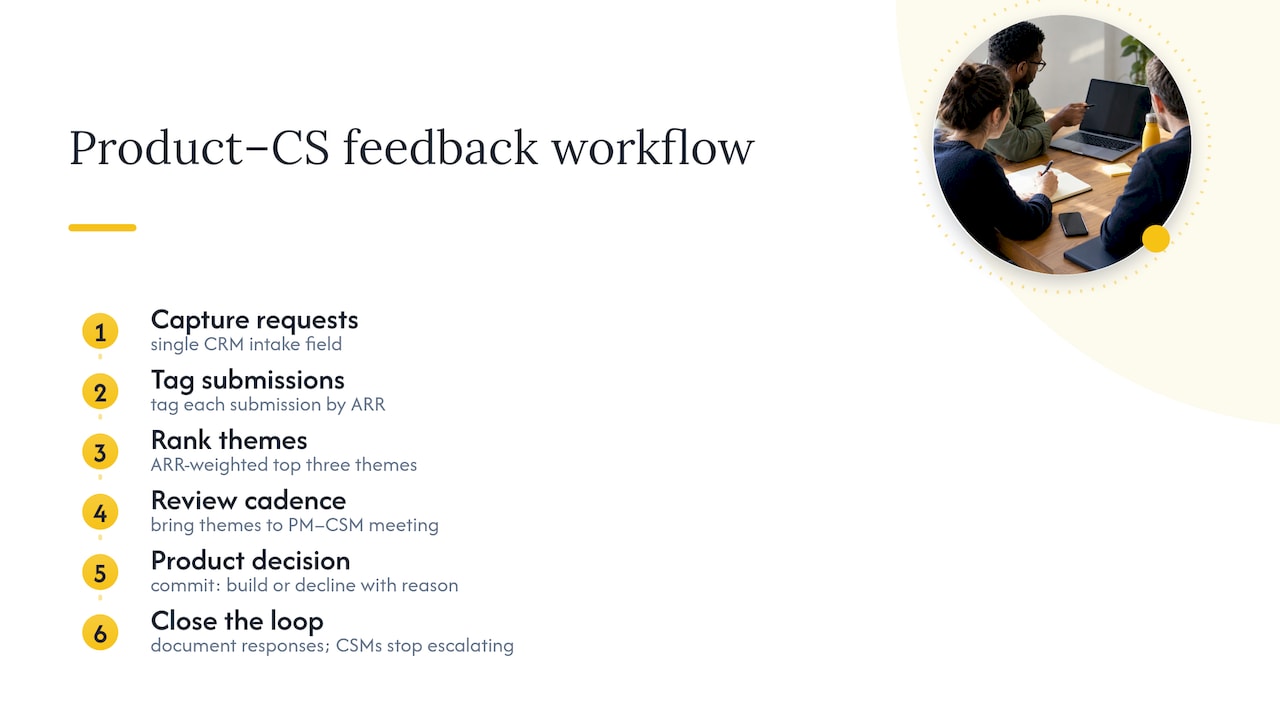
A common version plays out like this. A CS team notices the same three feature requests surfacing across renewal calls for two straight quarters, but Product has no visibility because the requests live in scattered call notes and Slack threads. CS Ops builds a single intake field in the CRM, tags each submission by ARR, and brings the top three ARR-weighted themes to the next PM-CSM cadence. Product commits to a response within the agreed window on all three. Two get built into the next release, one gets declined with a documented reason. CSMs stop escalating informally because they trust the queue now produces an answer.
The second pattern shows up around launches. A PM ships a feature with no CS pre-brief, and the first CSMs hear about it is when a customer asks why their invoice changed. The fix is procedural, not heroic: PMM starts delivering a pre-brief five business days before general availability, covering what shipped, who it affects, and the talking points CS needs. Renewal conversations stop starting with an apology.
Neither example depends on hiring anyone new or buying an enterprise platform. Both depend on someone owning the handoff and a commitment that the loop actually closes. That is the throughline across every alignment initiative that survives past its first quarter: a named owner, a defined format, and a response that shows up on schedule.
Choosing the right communication channels between the teams
The channel matters less than the discipline around it, but a few patterns consistently work better than others.
Keep async and synchronous communication separate by purpose. Slack or Microsoft Teams works for quick status questions and for surfacing something that needs attention before the next scheduled cadence, but it should never be the system of record for feedback. A thread that decides a roadmap priority disappears the moment someone searches for it three weeks later. Reserve structured cadences, the Tier 1 and Tier 2 meetings described earlier, for anything that needs a decision and a logged outcome.
Give CS a standing seat in roadmap reviews, not a summary after the fact. Reforge's guide to the product strategy stack frames alignment as a system connecting company strategy to adoption and retention rather than a list of features, and that system only works when CS sees decisions being made, not just announced.
Separate the channel for raising an issue from the channel for tracking its resolution. A Slack message can flag a problem, but the evidence package described earlier belongs in the single intake path, whether that's a CRM field, a CS platform, or an Airtable base, so it survives past the conversation that raised it. Mixing the two means good signal gets buried under routine chatter within days.
Finally, keep the pre-brief and release note cadence predictable. CSMs stop checking a channel that posts updates at random intervals, and PMs stop trusting a feedback channel that gets flooded with unrelated requests. Predictability, more than any specific tool, is what keeps a channel useful past the first month.
Why this changes retention and satisfaction numbers
Alignment shows up in the numbers CS leaders already report on, because the mechanism is direct: customers stop hearing "I'll check with product and get back to you" and start hearing specific, timely answers.
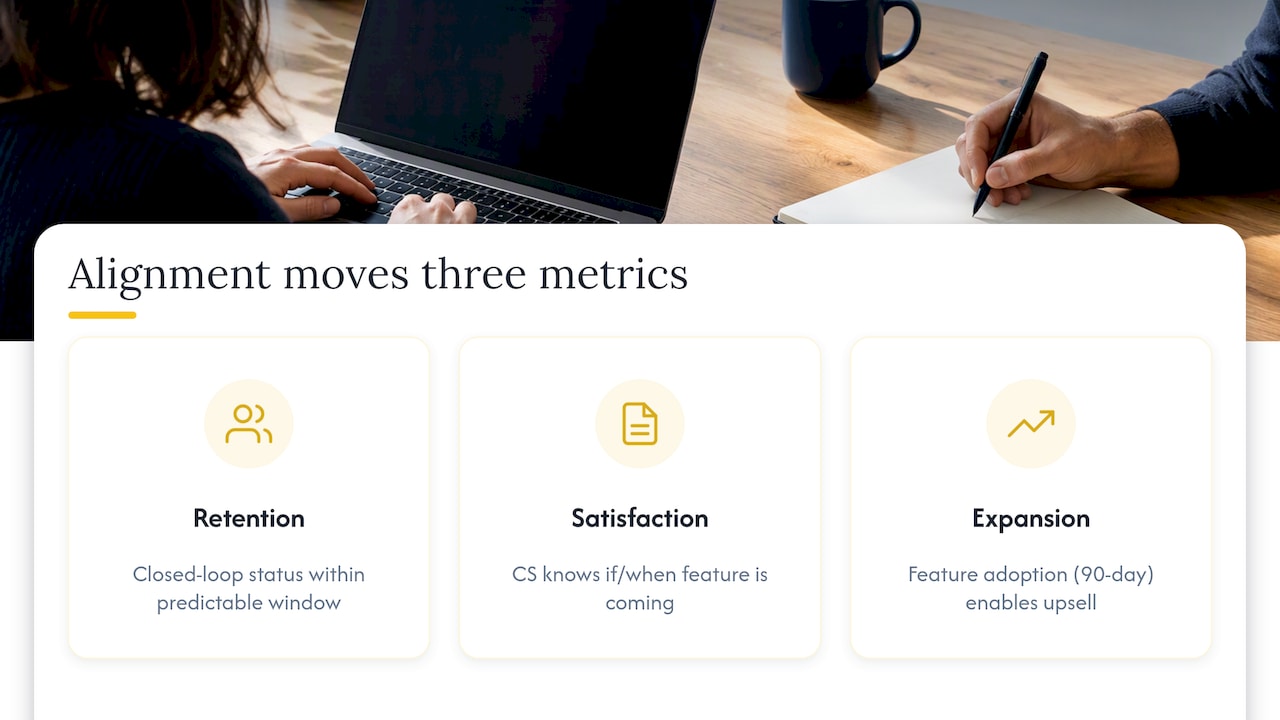
Retention responds first to the closed-loop commitment. When a customer's blocking issue gets a real status, planned, declined, or under review, within a predictable window, renewal conversations stop hinging on vague promises. CSMs walking into a QBR with a clear answer on outstanding requests close renewals with less friction than ones still waiting to hear back from Product weeks later.
Satisfaction moves with roadmap visibility specifically, not general communication volume. Customers don't need to see the whole roadmap. They need CS to know, before the customer asks, whether something is coming and roughly when, versus being an early idea nobody has committed to. Forrester's research on aligning product strategy with business strategy notes this distinction matters specifically because promising a date before Product confirms it creates the kind of broken trust that's hard to repair with a single good interaction later.
Expansion tracks a third lever: adoption of what already shipped. A feature nobody in CS knows how to position sits unused, and unused features don't justify upsell conversations. Bridge metrics like feature adoption at 90 days exist precisely to catch this before it becomes a churn reason instead of an expansion opportunity. Our breakdown of feature adoption in SaaS walks through how to track this without adding reporting overhead for CSMs already stretched across too many accounts.
None of these three levers move on their own. They move because the operating model, structured signal flow, a working cadence, and a closed loop, gives each team a reason to act on what the other team already knows.
The sequencing that actually works in the first 90 days
The order matters more than the tooling. Agree on what counts as good feedback first, then build one submission path and start the biweekly Tier 2 cadence. Only after both hold for a few weeks, commit to closed-loop responses and schedule the Tier 1 monthly meeting.
At 30, 60, and 90 days, track submission volume, whether responses hit your SLA, and any early adoption signal on items you acted on. Sponsor the program jointly between the VP of CS and Head of Product, with a CS Ops lead or PMM running it day to day. Sequencing beats scale here: two fixes that hold outlast five that don't.
— Patrik Chalupa
Where Customerscore.io fits into this operating model
Most of the work above is manual translation: pulling usage data, chasing call notes, and rebuilding evidence packages by hand every time a renewal comes up. Customerscore.io removes that overhead by putting usage, billing, CRM data, support conversations, and call recordings on one customer record, so the evidence package a CSM needs for Tier 2 triage is already assembled rather than rebuilt from six systems.
The platform's explainable churn and expansion predictions point CSMs to which accounts need attention today, and the AI agent drafts QBRs from the period's data and conversations, so renewal prep starts with a documented history instead of a scramble. Setup is expert-led and live in 1 to 3 weeks, with pricing a flat platform fee tiered by ARR rather than per seat.
If your VoC pipeline keeps decaying because nobody has time to maintain it, book a demo and see how the record works for your accounts.
FAQ
What is product to CS alignment in a B2B SaaS context?
It is an operating model that connects customer signal to product decisions and turns those decisions into customer-facing action, built on structured feedback intake, shared metrics, and closed feedback loops, as described in Rework's alignment framework. It is not a single meeting or tool but a repeatable process both teams follow.
How long does it take to see results from alignment efforts?
Teams that lock in a shared feedback format and a single submission path tend to see measurable behavior change within about 60 days, according to Rework's research. Deeper systematic and predictive practices take longer and depend on that early foundation holding.
What should a product response commitment actually look like?
A practical version gives every submitted item a status, planned, declined with rationale, or under review, within a predictable window such as 30 days, a structure TSIA's research recommends preventing feedback repositories from decaying. Without that commitment, CSMs tend to stop contributing once they notice nothing comes back.
Who should own the VoC pipeline between Product and CS?
Ownership typically sits with a CS Ops lead or a product marketing manager acting as the translation layer between CSM verbatims and ARR-weighted evidence for Product, per Rework's PMM bridge model. That owner tags submissions, runs weekly triage, and keeps the single intake path from turning into an abandoned spreadsheet.
Can a CS platform replace the need for these rituals?
A platform can reduce the manual work of assembling evidence and tracking accounts, but it does not replace the cadences, decision logs, and response commitments that make alignment durable. Customerscore.io, for example, unifies account data and drafts QBRs, which supports the rituals above without substituting for the joint sponsorship and scheduled meetings that keep them running.
Recommended
Related articles
Five Fields to Fix Playbook Trigger Design for B2B SaaS CS & RevOps
Five Fields to Fix Playbook Trigger Design for B2B SaaS CS & RevOps ! Isometric trigger routing system illustration The most reliable approach to playbook trigger design is to sort every alert into
BlogStop SaaS Downgrades: Save 31% of At Risk Accounts for CS & RevOps
Stop SaaS Downgrades: Save 31% of At Risk Accounts for CS & RevOps ! Isometric account protection title card The fastest way to prevent SaaS downgrades is to stop treating every at-risk account the
Blog24–48 Hour Handoffs: B2B SaaS Support to CS Checklist, Six Fields
24–48 Hour Handoffs: B2B SaaS Support to CS Checklist, Six Fields ! Isometric handoff cards crossing between platforms A reliable support to CS handoff transfers ownership and context so the new owner
Blog90–120 Day Explainable AI Playbook to Reduce Renewal Risk for SaaS CS
90–120 Day Explainable AI Playbook to Reduce Renewal Risk for SaaS CS ! Isometric illustration of explainable renewal risk decisions To reduce renewal risk, you prioritize accounts daily using