
24–48 Hour Handoffs: B2B SaaS Support to CS Checklist, Six Fields


A reliable support to CS handoff transfers ownership and context so the new owner can deliver first value without re-asking basic questions. At minimum, it needs a relationship map, the customer's own definition of success, deal history, open action items, and technical notes. Sales or support should trigger the handoff the moment the triggering event happens, with a clear service level agreement for when the packet lands in the CSM's hands.
TL;DR:
- A well-structured handoff packet must be completed within 24 to 48 hours of the trigger to ensure timely customer engagement and prevent miscommunication.
- Clear ownership roles and a responsibility matrix, including sales, support, and RevOps, are essential to avoid ambiguity and ensure critical fields like deal history and technical notes are accurately filled.
- An effective handoff involves a 15 to 30-minute meeting where context, priorities, and open actions are discussed, with the CSM confirming understanding by restating the plan.
- Tracking metrics such as handoff completeness rate, time-to-first-CS-call, and early churn rate helps measure handoff quality and identify areas for process improvement.
- Automating key fields and measuring process adherence during pilot phases allows teams to scale handoffs effectively, with operational ownership from RevOps improving consistency.
Table of Contents
- Complete handoff checklist: fields and why each one matters
- Step-by-step handoff workflow and timing
- Roles, ownership, and a simple RACI for the handoff
- Templates and a working example of an automated handoff
- Common failure modes and how to prevent them
- Metrics and KPIs to track handoff quality and business impact
- Scaling handoffs: practical next steps and adoption tips
- How Customerscore.io maps to this checklist
- FAQ
- Sources
Complete handoff checklist: fields and why each one matters
A handoff document is only useful if it answers the questions a new CSM would otherwise have to ask the customer directly. Every field below exists to prevent one of those awkward "can you remind me why you bought this" moments.
- Relationship map: names, titles, decision-making power, and communication preferences for every stakeholder, so the CSM knows who to call and who just watches from the sidelines.
- Customer definition of success: the specific, measurable outcome the customer expects, in their own words, not the vendor's assumption of what success should look like.
- Deal history: what was promised during the sales cycle, including any custom terms, discounts tied to usage commitments, or verbal assurances made on a call.
- Contract and billing details: plan tier, entitlements, renewal date, and any billing quirks (multi-year terms, usage caps, upcoming price changes) that could surface at renewal.
- Technical notes: open support tickets, integration requirements, required access or permissions, and any known blockers from implementation.
- Open actions with owners and deadlines: a short list of unfinished tasks from the sales or onboarding phase, each tied to a name and a date, plus a simple flag marking whether the packet is complete or still missing fields.
The completeness flag matters more than it looks. A packet with four of six fields filled in is not a minor gap, it's a guaranteed awkward first call. Teams that track completeness as its own metric catch these gaps before the customer does.
Step-by-step handoff workflow and timing
Handoffs fail most often because nobody defined when they should happen or how long each step should take. A workflow with explicit timing removes the guesswork.
- Trigger the handoff at a defined event: contract signed, trial converted, or a renewal that changes ownership. Ambiguous triggers ("whenever sales feels ready") are the most common reason handoffs slip.
- Package the handoff within 24 to 48 hours of the trigger. Sales or the account executive fills in deal history and the relationship map; support adds technical notes and open tickets.
- Hold a handoff meeting, 15 to 30 minutes, with sales, support, and the incoming CSM. Structure it in four parts: context (why the customer bought), priorities (what success looks like in the first 90 days), open actions (who owns what), and a short Q&A for the CSM to fill gaps.
- Confirm receipt and synthesis. The CSM should restate the plan back to the group, not just acknowledge the handoff. This single step, borrowed from structured clinical handoff practices, catches more misunderstandings than any checklist field alone.
- Run the post-handoff sequence: the CSM builds a first 30-day plan, assigns any inherited tasks, and sends a short introduction to the customer within the first week.
Pro Tip: Schedule the customer introduction call before the handoff meeting ends, not after. A CSM who leaves the meeting without a date on the calendar often lets it slip past the first week.
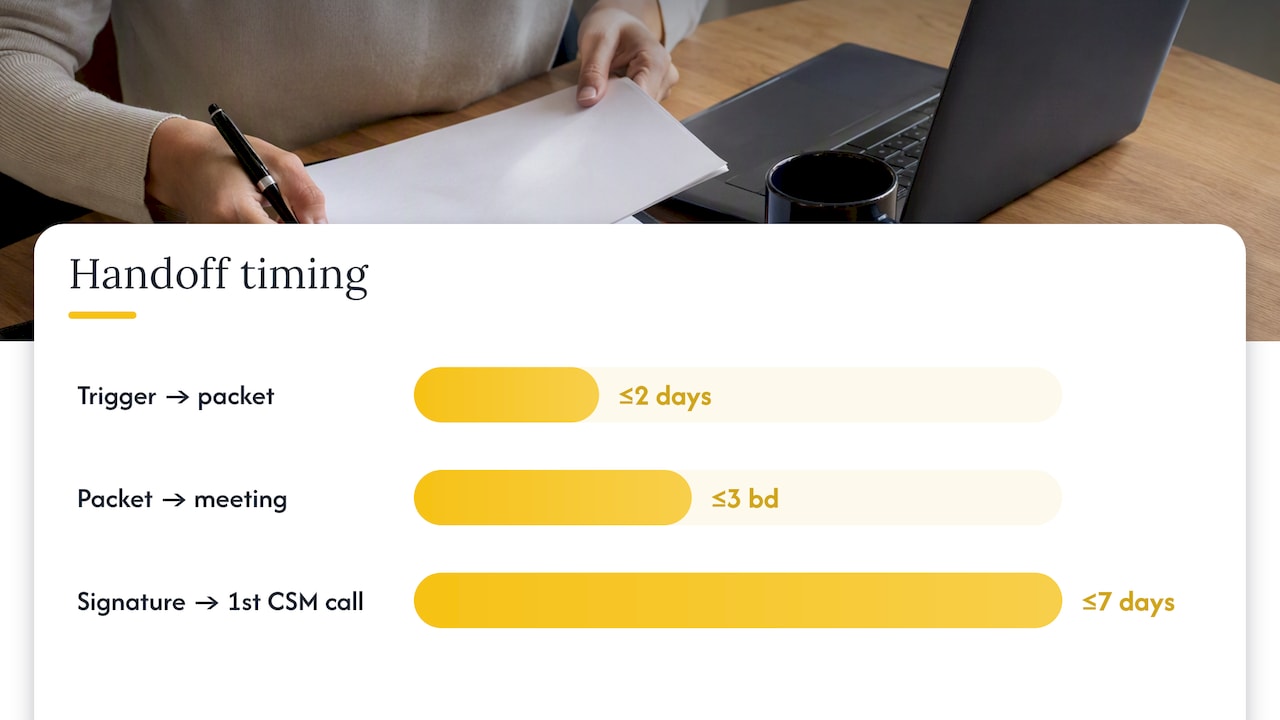
Recommended SLAs: handoff packet created within a couple of days of the trigger, handoff meeting held within a few business days, and the first CSM call with the customer shortly after contract signature. These numbers aren't arbitrary. The longer a new owner goes without talking to the customer, the more likely the customer is to assume nobody is paying attention.
Roles, ownership, and a simple RACI for the handoff
Ambiguity about who does what is the single biggest reason handoffs stall. A simple responsibility matrix fixes most of it without adding bureaucracy.
- Document preparation: Sales is accountable for deal history and the relationship map; support is accountable for technical notes; RevOps is consulted to confirm the template is complete.
- Meeting facilitation: The outgoing owner (sales or support) is responsible for scheduling and running the meeting; the CSM is accountable for confirming synthesis.
- Technical validation: Support is responsible for confirming integrations and access are live; the CSM is accountable for flagging anything still broken.
- Onboarding sequencing: The CSM is accountable; RevOps is informed so dashboards reflect the new ownership.
- Billing check: Finance or RevOps is responsible for confirming entitlements match the contract before the CSM's first call.
A support engineer should escalate to CS the moment a ticket touches business outcomes rather than a product bug, for example when a customer raises doubts about renewal value. CS takes ownership as soon as the account moves past onboarding into steady-state usage. RevOps is the natural owner of SLA adherence and completeness scoring, since it's the one function with visibility across sales, support, and CS systems.
Templates and a working example of an automated handoff
A usable template fits on one page, showing how customer feedback drives revenue growth strategies essential to CSM success. Below is a minimal structure a team can copy into a CRM record or a shared doc.
- Account: name, segment, ARR tier.
- Relationship map: stakeholder names, titles, preferred channel.
- Success definition: the outcome the customer stated during sales, in their words.
- Deal history: key promises, discounts, and any non-standard terms.
- Technical notes: integrations required, open tickets, access needed.
- Open actions: task, owner, due date.
- Completeness flag: complete or incomplete, with the missing field named.
A completed packet turns directly into a first 30-day plan: the CSM schedules the intro call within a week, maps the success definition to a first milestone, and closes any open action items from the list before the next touchpoint.
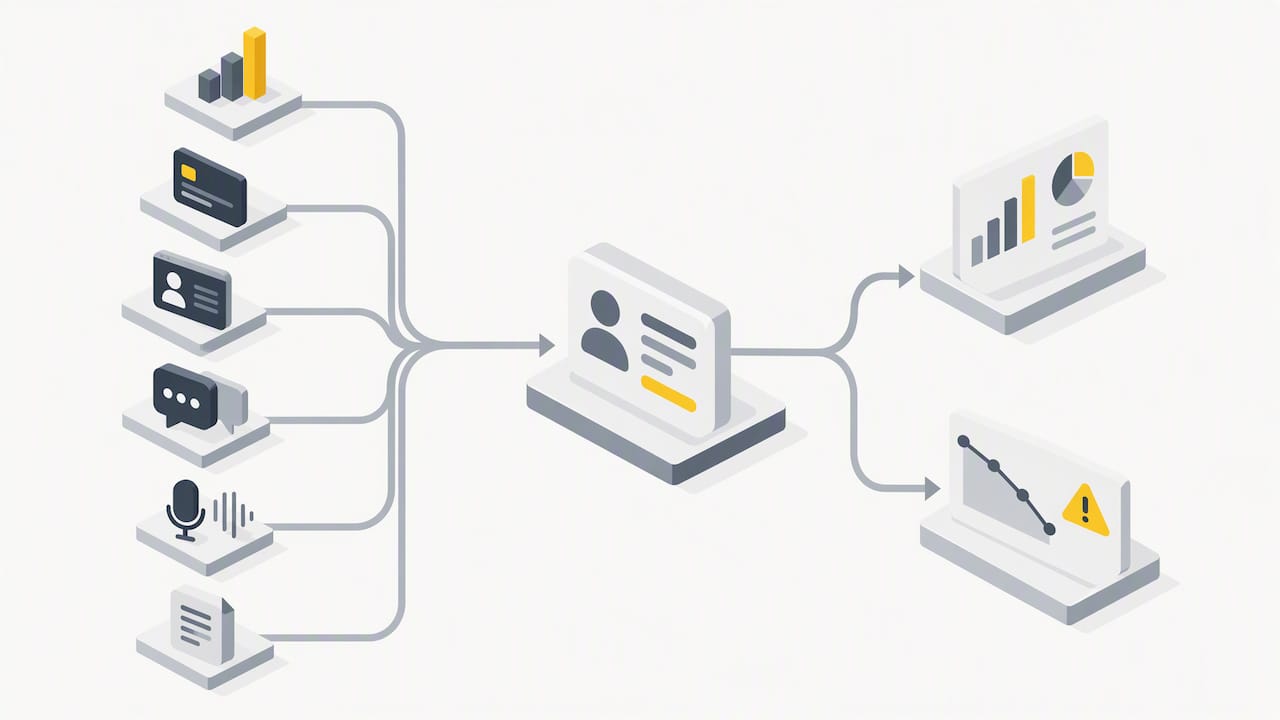
The platform can keep usage, billing, CRM data, support conversations, call recordings, and notes on a single customer record, so the relationship map and technical notes survive the handoff without depending on one person's memory. Its AI agent drafts quarterly business reviews from the account's numbers and conversations, and renewal preparation starts early with the drivers behind any risk surfaced. When evaluating any automation vendor for this job, check three things: how many of your existing systems it actually integrates with, how long setup takes before the team sees value, and whether its security posture (data residency, certifications) matches what your contracts require.
Common failure modes and how to prevent them
Most broken handoffs show the same symptoms: the CSM asks questions the customer already answered during sales, two people from the vendor reach out with overlapping messages, or a promised deliverable from onboarding quietly disappears.
- Missing context: fix with a mandatory completeness check before the handoff is marked done, not after.
- Late handoffs: fix with an enforced SLA (24 to 48 hours from trigger to packet) and a RevOps owner who tracks exceptions.
- Unclear ownership: fix with the RACI from the section above, reviewed quarterly as the team grows.
- Lost commitments: fix by capturing promises from calls directly into the deal history field rather than relying on memory.
Pro Tip: Run a random audit on five handoffs a month. It surfaces the same two or three recurring gaps almost every time, which tells you exactly what to automate next.
Start with a small pilot, measure completeness, then automate the fields that break most often rather than trying to fix the whole process at once.
Metrics and KPIs to track handoff quality and business impact
A handoff process without metrics is a policy nobody checks. Track a short list and report it where the team already looks.
- Handoff completeness rate: percentage of packets marked complete at the time of the meeting.
- Time-to-first-CS-call: days between contract signature and the customer's first conversation with their CSM.
- Time-to-first-value: days until the customer reaches the milestone tied to their stated success definition.
- Early churn rate: percentage of new customers lost within the first 90 days.
- Early CSAT or NPS: customer sentiment captured right after the handoff, before the relationship has time to settle.
A structured, consistent handoff process with clear written and verbal communication improves handoff quality, a principle that holds whether the handoff happens in a hospital ward or a SaaS onboarding flow. The specific target numbers matter less than the discipline of tracking the same three or four metrics every month and acting when completeness drops.
Scaling handoffs: practical next steps and adoption tips
Adoption usually stalls because leadership treats the handoff as a sales problem or a CS problem instead of a shared one. The fix starts with RevOps owning enforcement, since operationalizing handoffs with shared tooling and SLAs reduces friction better than asking either team to police itself.
Three steps, in order: pilot the new process on a small cohort of accounts, measure completeness before touching anything else, then automate the three fields that break most often. Everything past that is refinement.
— Patrik Chalupa
How Customerscore.io maps to this checklist
Every field in the handoff template above maps to something Customerscore.io already tracks. Usage, billing, CRM data, support conversations, and call recordings sit on one customer record, so the relationship map and technical notes don't depend on a spreadsheet someone forgot to update. The AI agent surfaces which accounts need attention each morning and why, which means a new CSM inherits priorities instead of starting from a blank account list. QBR prep and renewal drivers draft automatically from the account's own history, so the first quarterly review after a handoff doesn't start from zero.
The platform provides integrations with systems like HubSpot, Salesforce, Stripe, Chargebee, Mixpanel, PostHog, Segment, Intercom, Zendesk, and Slack. It is certified to an industry security standard and compliant with GDPR, relevant for teams exchanging contract or billing data across systems during handoffs. Setup can be completed quickly, with no dedicated admin required to run it.
Pricing runs on a flat platform fee tiered by annual recurring revenue rather than per seat, and every customer gets the full platform. Answer three questions on the pricing page for a tailored quote.
FAQ
Will CSMs be replaced by AI?
AI tools can draft QBRs, flag at-risk accounts, and automate parts of the handoff packet, but the relationship work, judgment calls, and customer trust-building still need a person. Most CS teams are using AI to remove administrative work rather than to replace the role itself.
What are the 7 pillars of customer success?
Definitions vary across the industry, and there's no single standardized list of seven pillars. Common themes across frameworks include onboarding, adoption, value realization, renewal, expansion, advocacy, and proactive risk management.
How do you provide good customer support?
Good customer support starts with fast, accurate responses and clear ownership of each issue until it's resolved. It also means documenting commitments and context so they carry forward if the customer's point of contact changes, which is exactly what a structured handoff protects.
What's the difference between customer support and customer success?
Customer support reacts to issues the customer raises, typically through tickets or calls. Customer success proactively manages the relationship toward the outcomes the customer bought the product to achieve, including renewals and expansion.
Sources
Recommended
Related articles
Five Fields to Fix Playbook Trigger Design for B2B SaaS CS & RevOps
Five Fields to Fix Playbook Trigger Design for B2B SaaS CS & RevOps ! Isometric trigger routing system illustration The most reliable approach to playbook trigger design is to sort every alert into
BlogStop SaaS Downgrades: Save 31% of At Risk Accounts for CS & RevOps
Stop SaaS Downgrades: Save 31% of At Risk Accounts for CS & RevOps ! Isometric account protection title card The fastest way to prevent SaaS downgrades is to stop treating every at-risk account the
Blog90–120 Day Explainable AI Playbook to Reduce Renewal Risk for SaaS CS
90–120 Day Explainable AI Playbook to Reduce Renewal Risk for SaaS CS ! Isometric illustration of explainable renewal risk decisions To reduce renewal risk, you prioritize accounts daily using
BlogFix Product to CS Alignment in 60 Days for B2B SaaS CS and Product Leaders
Fix Product to CS Alignment in 60 Days for B2B SaaS CS and Product Leaders ! Product and CS alignment loop illustration Product to CS alignment is an operating model that turns customer signal into