
Customer Escalation Management: 2026 B2B SaaS Guide


Customer escalation management is the structured process of routing customer issues beyond frontline support to the right authority, expertise, or resource before trust erodes and churn follows. For B2B SaaS companies, it is not a reactive scramble. Done right, it is a deliberate handoff that preserves context, assigns clear ownership, and resolves complex problems faster than ad hoc intervention ever could.
Research confirms that a large majority of customers will forgive a company's mistake when the service during resolution is excellent. That number reframes the entire conversation: escalations are not failures to hide. They are moments where you either deepen loyalty or accelerate churn.
A well-designed escalation process covers:
- Ownership: one person or role accountable from trigger to close
- Context preservation: issue summary, business impact, attempted fixes, and decision needed travel with the ticket
- Authority: the escalation owner can actually resolve the issue, not just relay it
- Communication: the customer and internal stakeholders receive timely, consistent updates
- Training: every team member knows the triggers, the path, and their role in it
Table of Contents
- What breaks escalation management before it starts
- How to build escalation workflows that actually hold up
- How AI platforms sharpen escalation management
- The strategic case for disciplined escalation management
- Training teams to handle escalations with confidence
- Knowing when to escalate: the criteria that remove guesswork
- Communication techniques that hold customer trust during escalation
- Metrics that tell you whether your escalation process is working
- Customerscore turns escalation risk into a managed workflow
- Key Takeaways
What breaks escalation management before it starts
Most escalation failures trace back to a handful of recurring mistakes, not bad intentions.
Ken McMahon at Nextiva points to the balance problem first: over-escalation floods senior staff with issues frontline agents could handle, while under-escalation lets serious problems fester until the customer is already gone. Both failures share the same root cause: vague criteria that force agents to make judgment calls they are not equipped to make.
Common pitfalls include:
- Inconsistent triggers: "escalate urgent issues" is not a policy; it is a suggestion
- Unclear ownership: when everyone is responsible, no one is
- Context loss: the escalation owner inherits a ticket with no history and re-asks the customer for information they already provided
- Siloed communication: the customer hears nothing while internal teams debate
- Undertrained agents: staff who lack authority or soft skills default to either stalling or escalating everything
Pro Tip: Track your escalation rate by tier weekly. A spike at tier one usually means your frontline criteria are too loose. A spike at tier two usually means your tier-one agents lack authority or training, not skill.
How to build escalation workflows that actually hold up
The difference between a documented escalation process and one that works under pressure is specificity. Vague rules collapse when a customer is angry at 11 PM on a Friday.
Start with objective triggers. Time elapsed, revenue at risk, SLA breach, and decision authority gap are all measurable. "Escalate any customer-impacting issue that will miss the four-hour response target" is a trigger. "Escalate urgent requests" is not.
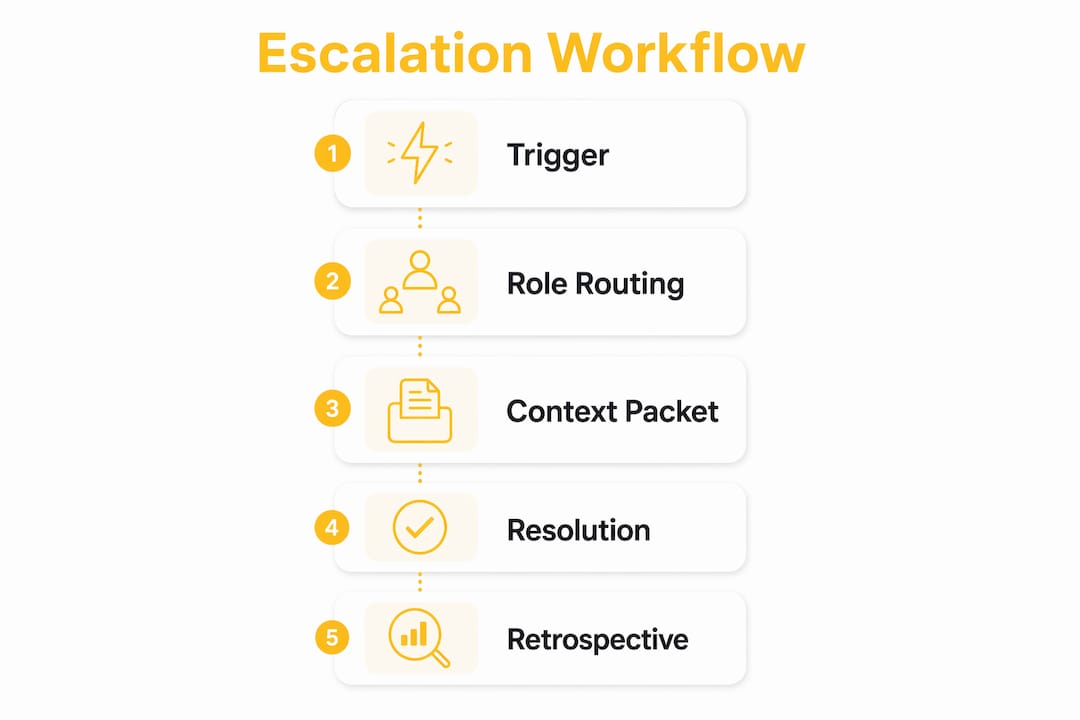
Route by role, never by name. Individuals take leave, change jobs, and become unavailable. Role-based routing linked to live on-call schedules keeps the process durable regardless of personnel changes.
A standardized context packet is what separates a fast resolution from a slow one. Every escalation should carry: issue summary, business impact, timeline, attempted fixes, and the specific decision needed. When the escalation owner has everything on arrival, resolution time drops significantly.
| Workflow component | What it defines |
|---|---|
| Trigger | Objective condition that starts escalation (time, SLA, revenue, authority gap) |
| Severity level | Low / medium / high / critical with response expectations for each |
| Escalation owner | Role with authority to resolve, not just relay |
| Context packet | Summary, impact, attempts, decision needed, deadline |
| Communication rule | Who is notified, which channel, at what cadence |
| Closeout record | Decision, timestamp, owner, and process change if needed |
Frequent escalations are a signal worth reading carefully. Post-escalation retrospectives often reveal broken upstream workflows: unclear SOPs, missing authority at frontline level, or capacity constraints that no escalation policy can fix on its own.
How AI platforms sharpen escalation management
Manual escalation routing depends on human judgment at exactly the moments when humans are most stretched. AI changes that equation.

Automated escalation policies that execute without human intervention handle the timing problem: timed notification chains fire regardless of who is available, removing the gap between when an issue qualifies for escalation and when someone notices it. AI pre-triage handles the routing problem: systems that process tickets with confidence-based scoring can handle 60% of tickets directly and escalate the remainder with context and suggested next steps already attached.
Key capabilities to look for in an AI-powered escalation platform:
- Automated health scoring that flags at-risk accounts before they self-escalate
- Churn prediction integrated with support data, billing signals, and product usage
- Playbook triggers that fire escalation workflows based on objective thresholds
- Multi-source data integration pulling from CRM, billing, product analytics, and support tools
- Real-time alerts routed to the right role via Slack or email without manual triage
- Audit trail capturing every handoff, decision, and communication for retrospectives
Customerscore connects churn prediction with health scoring and automated playbooks, so escalation triggers fire on data rather than gut feel. Integrations with HubSpot, Salesforce, Stripe, Intercom, and Mixpanel mean the context packet builds itself from live signals across your stack.
The strategic case for disciplined escalation management
Escalation management done well is a customer retention lever, not just a support function. The operational benefits compound quickly once the process is structured.
Strategic takeaways for CS and RevOps leaders:
- Structured escalation reduces churn by converting high-risk moments into trust-building resolutions
- Clear ownership at every tier eliminates the "who handles this?" delay that frustrates customers and teams alike
- Cross-functional collaboration improves when escalation paths are defined by role and authority, not by whoever is loudest in Slack
- Retrospectives on repeated escalations surface broken upstream workflows that no amount of faster response time will fix
- Continuous monitoring of escalation volume and resolution time turns the process into a feedback loop for the whole CS operation
Training teams to handle escalations with confidence
Policy without practice produces agents who freeze at the moment of decision. Training for escalation management needs to go beyond reading the runbook.
Scenario-based drills where agents classify severity, decide when to escalate, and execute the handoff build the judgment that written policies alone cannot provide. After each drill, structured coaching should review the specific decisions made, not just whether the outcome was good. Soft skills matter as much as process knowledge: empathy, active listening, and conflict resolution determine whether a customer feels heard during a difficult moment or feels passed around.
Knowing when to escalate: the criteria that remove guesswork
The clearest escalation criteria share one trait: they are measurable without debate. Time elapsed without resolution, scope or severity change mid-incident, a decision that exceeds the current owner's authority, a compliance or financial risk, or a customer commitment that is about to be missed. These are conditions, not judgments.
Escalation criteria should be short enough to apply in under 30 seconds. If an agent has to read a paragraph to decide whether to escalate, the criteria will not be used consistently under pressure.
Communication techniques that hold customer trust during escalation
The customer's frustration at the moment of escalation is almost always about the process so far, not just the original issue. Proactive, honest updates change that dynamic.
Set a communication cadence before the customer asks for one. Acknowledge the escalation explicitly, name the next owner and their role, and give a realistic timeline. Internal teams need the same discipline: the escalation owner should receive a warm handoff, not a forwarded ticket with no context. Every update to the customer should confirm that the issue is actively owned, not just queued.
Metrics that tell you whether your escalation process is working
Tracking escalation volume alone tells you very little. The metrics that matter are:
- Time to escalation: how long before a qualifying issue actually moves
- Time to resolution post-escalation: how fast the escalation owner closes it
- Escalation rate by tier: which tier is absorbing issues it should not own
- Repeat escalation rate: the same issue type appearing repeatedly signals a systemic fix is needed
- Customer satisfaction post-escalation: whether the resolution rebuilt trust or just closed the ticket
A six-step escalation playbook
When an escalation lands, a fixed sequence beats improvisation:
- Acknowledge within your response time. Recognize the impact, name the owner and give a time for the next update.
- Triage. What is the business impact in the customer's words? What are the account's ARR and renewal date? Which severity level does it map to? What outcome does the customer want? Has it happened before?
- Name one owner. One person owns external communication, internal coordination and the daily update.
- Keep a daily cadence. Send an update every day, even when nothing changed. Silence drives re-escalation more than slow resolution.
- Close with a root-cause note within 48 hours of the fix: what happened, why, what fixed it, what prevents it next time. Share a version with the customer.
- Recover the relationship. Book a check-in with the customer's leadership, watch the account's usage and risk signals closely for the next weeks, and put the recovery step on the calendar the day you close the ticket.
Turn the six steps into a playbook so each one becomes a task with an owner and a due date.
Customerscore turns escalation risk into a managed workflow
CS and RevOps leaders running escalation processes manually are leaving response time and retention on the table. Customerscore gives you the data infrastructure to catch escalation risk before the customer raises their hand.
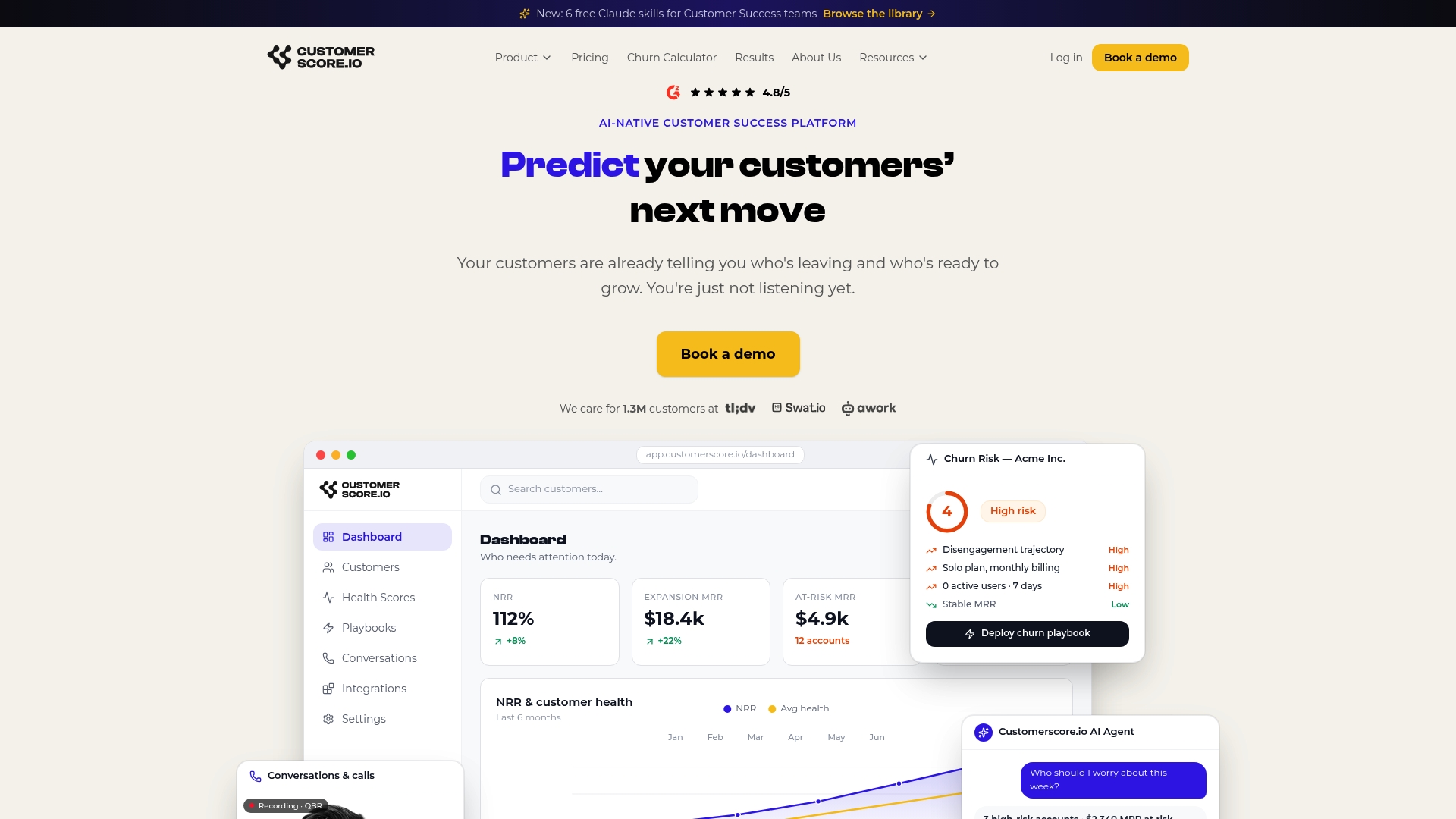
Every account gets a Churn Risk Score from 1 to 5, refreshed daily from billing, product usage, CRM and support signals, with the reasons behind it, so risky accounts surface before the customer raises their hand. Playbooks turn an escalation into tasks with owners and due dates, and alerts reach the right person in Slack or email. The result: your team spends time resolving high-impact issues, not deciding which ones qualify.
Book a demo to see how Customerscore fits your escalation and retention workflow.
Key Takeaways
Structured customer escalation management reduces churn by converting high-risk support moments into trust-building resolutions through clear ownership, objective triggers, and continuous retrospective improvement.
| Point | Details |
|---|---|
| 78% forgiveness rate | Customers forgive mistakes when escalation handling delivers excellent service throughout resolution. |
| Objective triggers only | Escalation criteria must be measurable (time, SLA, revenue risk) to be applied consistently under pressure. |
| Role-based routing | Assign escalation ownership to roles, not individuals, to keep the process durable through personnel changes. |
| Metrics that matter | Track time to escalation, resolution time post-escalation, and repeat escalation rate to find systemic gaps. |
| Customerscore | Automates escalation triggers using health scores, churn prediction, and playbooks across your full SaaS data stack. |
Recommended
Related articles
Best Customer Success Software for SaaS Teams in 2026
The 8 best customer success software platforms for SaaS in 2026, compared by company size and use case: health scoring, churn prediction, automation, pricing.
BlogMulti-Year Renewals in B2B SaaS: When to Offer Them and How
When a multi-year renewal pays off, what discount to expect, which clauses protect both sides, and how to time the offer.
BlogCustomer Success Org Design: Structure, Roles and CSM Capacity
How to structure a customer success team, size books by hours rather than ratios, and evolve the org as the company grows.
BlogSales to Customer Success Handoff: Template, Checklist and Other Handoffs
A one-page handoff brief, the fields it needs, timing targets, and how support to CS and product to CS handoffs work.