
Ditch Spreadsheets. Enterprise CS Needs Explainable Health Scores


The best CS for enterprise B2B SaaS companies is an AI-native platform that pairs churn prediction with explainable health scoring, then routes both into automated playbooks for onboarding, renewals, and expansion. That combination catches risk earlier than manual QBR reviews, cuts the time between a warning sign and a CSM action, and gives RevOps a defensible number to put in front of the board. Customerscore.io fits this profile for teams that want that stack without a year-long rollout.
TL;DR:
- Platforms should connect seamlessly to billing, product, CRM, and support systems without extensive customization to ensure comprehensive data coverage.
- Explainability of health scores is critical, requiring clear signals like support tickets, usage drops, or relationship history to justify risk assessments.
- A fast, phased implementation of 8 to 16 weeks with pilot testing, segment expansion, and full rollout is essential for enterprise-wide success.
- ROI depends on accurately capturing at-risk revenue, with early signals and CSM adoption being key indicators of platform effectiveness.
- Customerscore.io offers rapid deployment with AI-driven, explainable health scores and automated playbooks, reducing typical enterprise rollout timelines.
Table of Contents
- What Core Features Should an Enterprise CS Platform Have?
- How Do You Evaluate and Shortlist Enterprise CS Platforms?
- How Long Does Enterprise CS Implementation Take?
- How Do You Measure ROI From an Enterprise CS Platform?
- Why Customerscore.io Fits Enterprise B2B SaaS CS Teams
- What Does Enterprise CS Platform Pricing Actually Cost?
- Can Enterprise CS Platforms Scale and Customize as You Grow?
- How Are Enterprise Companies Actually Using CS Platforms?
- How Do Leading Enterprise CS Platforms Compare?
- What Are Best Practices for Onboarding a CS Platform Internally?
- Perspective: Trade-Offs Enterprise Leaders Should Accept
- How Customerscore.io Can Help You Move Faster
- Sources
- FAQ
What Core Features Should an Enterprise CS Platform Have?
Enterprise buyers get burned less often by missing features than by features that don't explain themselves. A churn model that flags an account as "high risk" with no visible reasoning is a liability the moment a CSM has to justify a save play to a VP. The platform needs to show which signals drove the score: a support ticket spike, a drop in weekly active seats, a stalled integration, a champion who left the company.
Health scoring has to pull from more than one data source, because no single system tells the whole story. Billing data shows payment friction and contract terms. Product usage shows adoption depth. CRM shows relationship history and deal context. Support data shows friction points. The strongest platforms let admins weight these sources differently by segment, since a usage dip means something different for a self-serve team than for a white-glove enterprise account.
From there, the platform needs to act, not just report. That means:
- Automated playbooks that trigger onboarding sequences, renewal checklists, and expansion nudges without a CSM manually starting each workflow
- Real-time alerts that surface the next best action the moment risk crosses a threshold, instead of waiting for a weekly digest
- Enterprise-grade integrations with systems like Salesforce, Stripe, and Mixpanel, since product analytics integrations directly shape how usage-driven health scores get built
- Role-based access and governance so a CSM sees their book of business while an executive sees portfolio-level trends
Customer success software exists to monitor account health, predict churn, and drive expansion revenue across the customer base. Miss any one of those three jobs and the platform becomes a dashboard nobody trusts.
How Do You Evaluate and Shortlist Enterprise CS Platforms?
Most enterprise CS evaluations fail because they compare feature lists instead of running finalists against the same data. A demo deck tells you what the vendor wants you to see. A pilot against your own accounts tells you what actually happens.
Build the shortlist around six criteria:
- Data coverage — can the platform actually connect to your billing, product, CRM, and support systems without a custom build?
- Explainability — can a CSM trace a health score back to the three or four signals that produced it?
- Time-to-value — how many weeks until the first usable risk alert fires?
- Admin overhead — how many hours per week does someone spend maintaining the system after launch?
- Playbook library — does it ship with templates for onboarding, renewal, and expansion, or do you build from scratch?
- Extensibility — can it flex as you add segments, products, or regions?
Run a genuine trial before signing anything. Pull a clean sample of 50 to 200 representative accounts and run every finalist against the identical dataset, then compare risk detection precision against actual outcomes and track CSM adoption at day 10. A platform with strong signal quality that nobody logs into is worse than a mediocre one your team actually uses.
Ask vendors directly how their models were trained, where data resides, and what the integration SLA guarantees. Watch for opaque AI that can't show its reasoning, connectors that break on the first sync, and pricing that hides implementation or "professional services" fees until the contract is on the table.
Pro Tip: Score the trial on adoption before you score it on accuracy. A model that's 90% precise but sits unused delivers zero ROI, while a slightly less precise model that CSMs actually open every morning starts paying back immediately.
How Long Does Enterprise CS Implementation Take?
Enterprise rollouts fail more often from sequencing mistakes than from bad software. The fix is a phased plan with checkpoints, not a single big-bang launch.
- Weeks 1 to 8: pilot. Connect one or two data sources, run the model against a single segment, and validate signal quality against known outcomes.
- Weeks 8 to 20: segment expansion. Add remaining integrations, extend playbooks to renewal and expansion motions, and start training the broader CSM team.
- Quarter by quarter: full roll-out. Scale to every segment, layer in governance and role-based permissions, and hand ongoing maintenance to CS Ops.
Before any of that, data prep decides whether the timeline holds. That means mapping which fields feed the health score, resolving customer identity across systems that spell account names differently, cleaning up inconsistent event tracking, and syncing billing so renewal dates are accurate.
Staffing matters as much as timeline. You need a CS Ops owner running the project, a data engineer or analyst handling integrations, CSM champions who test playbooks in the field, and an executive sponsor who protects the budget when priorities shift mid-quarter. Enterprise implementations commonly run 8 to 16 or more weeks depending on scope, well beyond the 4 to 8 week timelines mid-market tools often quote. Set pilot KPIs early, such as percentage of at-risk accounts correctly flagged and CSM login frequency, so you have proof before scaling further.
How Do You Measure ROI From an Enterprise CS Platform?
Four numbers matter more than any dashboard vanity metric: net revenue retention (NRR), gross revenue retention (GRR), churn rate, and expansion ARR as a share of new ARR. Everything else the platform reports should roll up into one of those.
Operationally, track precision and recall on risk signals, time-to-intervention from alert to CSM action, CSM account coverage ratio, and ARR managed per CSM full-time employee. These tell you whether the platform is actually changing behavior, not just generating alerts nobody acts on.
Building a simple ROI model: Multiply your at-risk ARR pool by your expected capture rate (the percentage of flagged accounts you can realistically save with faster intervention), then add projected expansion ARR uplift from proactive upsell plays. Compare that recovered and expanded revenue against platform cost and implementation hours.
Set expectations using real benchmarks, not hope. Expansion ARR contribution to new ARR rises with company scale, and larger ACV enterprise deals tend to show better CAC payback dynamics, which is exactly why expansion workflows deserve priority in any enterprise platform selection.
Why Customerscore.io Fits Enterprise B2B SaaS CS Teams
Customerscore.io was built around the exact requirements enterprise buyers list above: AI-driven churn prediction, health scores that show their reasoning instead of hiding it, and playbooks that fire automatically instead of waiting on a CSM's calendar. The platform pulls from billing, product usage, CRM, and support data at once, which is the multisource approach that separates a credible health score from a guess.
- Explainable health scoring built from connected billing, product, CRM, and support data, detailed on the AI customer health score page
- AI churn prediction designed to surface risk earlier than manual review cycles
- Native integrations with HubSpot, Salesforce, Stripe, Mixpanel, PostHog, Segment, Chargebee, Intercom, Slack, and MCP/AI agents
- Automated playbooks covering onboarding, renewals, and expansion, reducing the manual load on CSMs
- Plans that let teams match the platform's involvement to account tier
The platform positions itself as deploying in days rather than months, with hands-on onboarding and enterprise-grade compliance built in rather than bolted on later. For a deeper look at how the scoring methodology works, the customer health score definition guide breaks down the mechanics in plain terms.
What Does Enterprise CS Platform Pricing Actually Cost?
Sticker price is the smallest part of enterprise CS total cost of ownership. The bigger costs hide in implementation hours, integration maintenance, and the ongoing admin time someone spends keeping health score weights and playbook logic current.
Enterprise platforms are typically priced by tier of client ARR rather than by seat, which changes how you budget compared to per-user software. That structure lines up better with CS economics, since the value a CS platform delivers scales with the revenue it's protecting and expanding, not with headcount alone.
Admin overhead is the line item most buyers underestimate. A platform with opaque scoring logic needs a data analyst constantly explaining and re-explaining why an account got flagged. A platform with clear explainability needs far less hand-holding, because CSMs can read the reasoning themselves and trust it. That difference shows up in hours saved every single week, not just in the invoice.
When comparing total cost, ask each finalist for a realistic estimate of implementation hours, ongoing configuration time, and whether "professional services" is a separate line item or bundled into the subscription. Customerscore charges a flat platform fee tiered by your client ARR rather than per seat, quoted in one call from its pricing page, so spend tracks the size of your book rather than headcount or a service tier.
Can Enterprise CS Platforms Scale and Customize as You Grow?
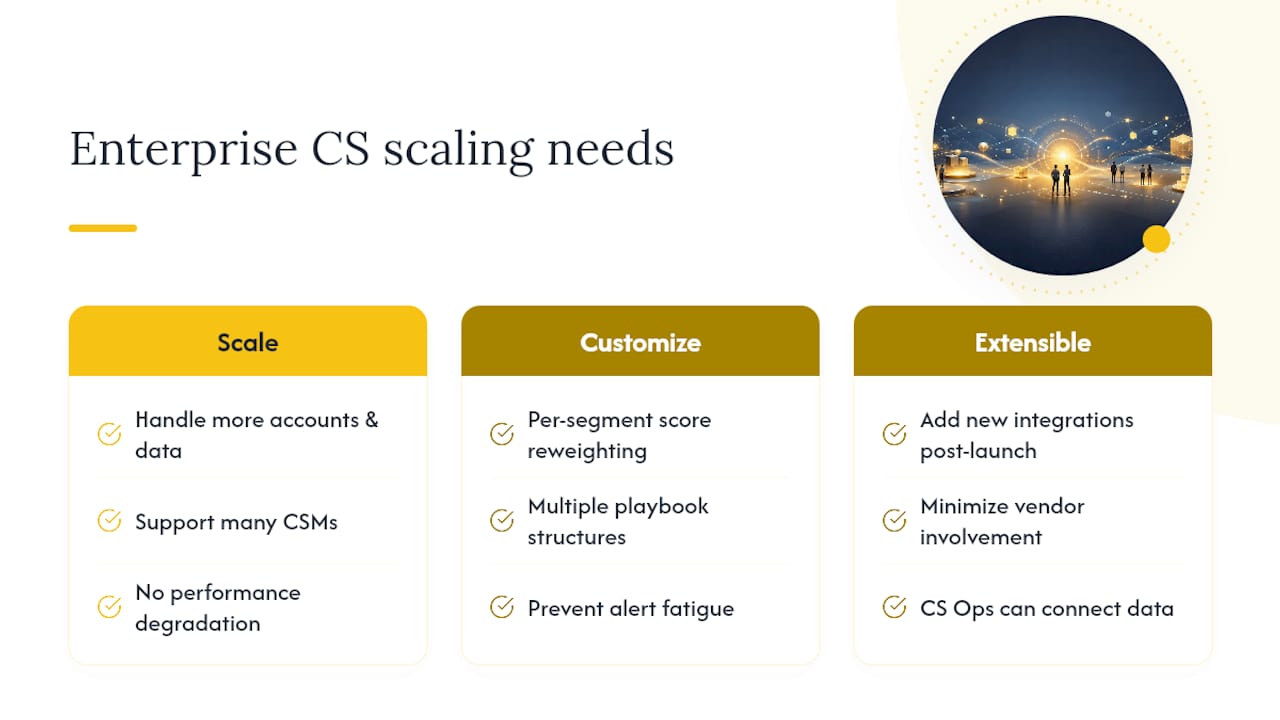
Scalability in CS software means two different things, and enterprise buyers need both. It means handling more accounts, more data sources, and more CSMs without performance degrading. It also means adapting the scoring logic and playbook library as your customer base segments into new tiers, regions, or product lines.
The platforms that scale well let admins reweight health score inputs per segment instead of forcing one formula across every account type. A usage drop that signals real risk for an enterprise account with a dedicated CSM might be completely normal seasonal behavior for a self-serve SMB account. A rigid, one-size scoring model treats both the same way and generates alert fatigue that trains CSMs to ignore the system.
Customization also extends to playbooks. Enterprise CS teams typically run different motions for different segments: white-glove onboarding for top-tier accounts, automated nurture sequences for long-tail accounts, and hybrid approaches in between. A platform that only supports one playbook structure forces your team to work around the software instead of the other way around.
Extensibility matters just as much when new integrations enter the picture. As a company adds tools, whether a new billing system after an acquisition or a new product analytics platform after a redesign, the CS platform needs to absorb those connections without a multi-month engineering project. Ask any finalist directly how new data sources get added post-launch, and whether that requires vendor involvement or can be handled by your own CS Ops team.
How Are Enterprise Companies Actually Using CS Platforms?
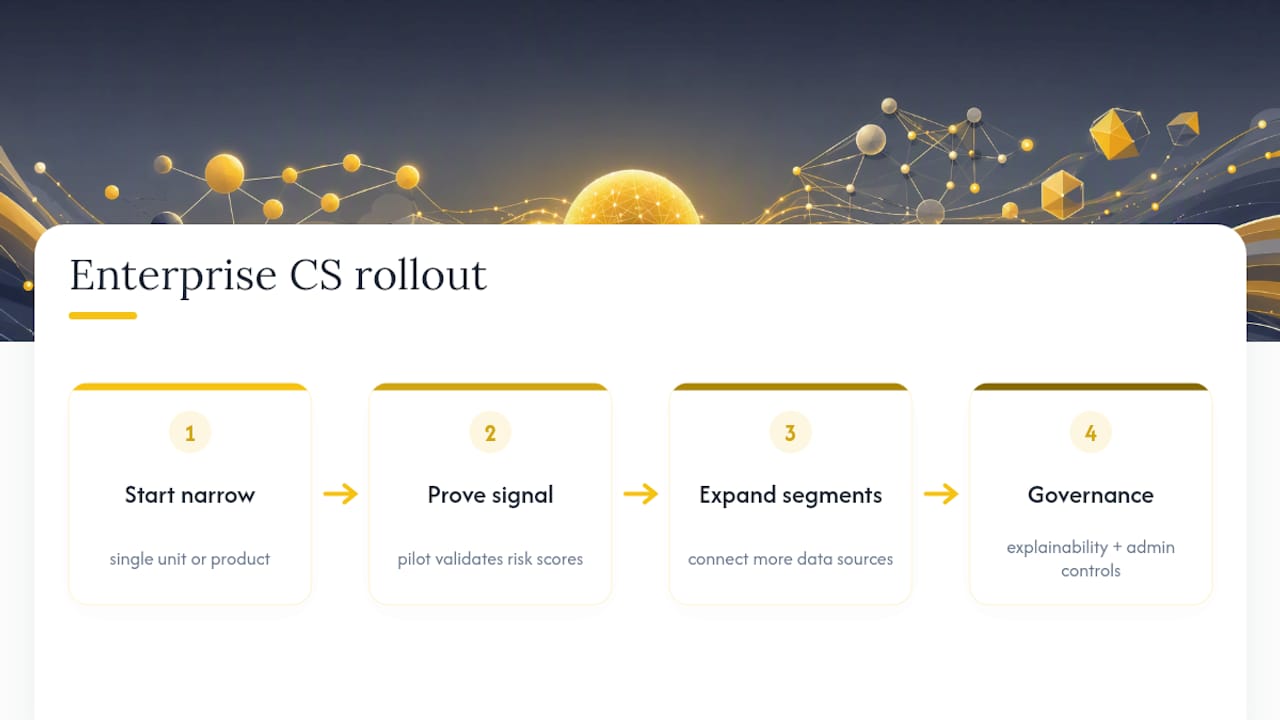
The pattern across successful enterprise CS deployments looks consistent: start narrow, prove signal quality, then expand scope segment by segment rather than company-wide on day one.
A typical rollout begins with a single business unit or product line where data is cleanest and the CS team is most engaged. That pilot group becomes the proving ground for whether risk scores actually match what CSMs already know intuitively about their accounts. Once the model earns trust in that narrow scope, expanding to additional segments becomes a matter of connecting more data sources rather than rebuilding trust from scratch.
The common thread in platforms that stick is early CSM involvement, not late-stage training after the system is already live. Teams that let CSMs see and validate risk scores during the pilot, correcting the model when it misses obvious context, end up with far higher long-term adoption than teams that deploy top down and train afterward. That validation loop is also where explainability pays off. A CSM who can see why an account got flagged is far more likely to trust the next flag than one who's told to "just check the dashboard."
Enterprise organizations with large CSM teams and complex account structures also tend to need more governance-first platform capabilities than smaller, faster-moving teams, which is exactly why the evaluation criteria in this guide weight explainability and admin controls so heavily. Skipping that governance layer to save implementation time tends to show up later as a trust problem, not a technical one.
How Do Leading Enterprise CS Platforms Compare?
Enterprise CS platforms generally split into two camps, and knowing which camp you're evaluating saves a lot of wasted demo time. One camp prioritizes depth: extensive customization, granular governance, and feature breadth built for large, complex CS organizations. The other prioritizes speed: faster deployment, simpler configuration, and lower admin overhead, often at the cost of some customization depth.
Enterprise-grade platforms typically deliver the deepest feature set but come with longer implementations and heavier configuration demands, while faster-deploying tools trade some of that depth for speed to value. Neither approach is universally correct. It depends on your organization's size, the complexity of your account structures, and how much internal engineering bandwidth you have to support a long build.
The evaluation categories that actually differentiate finalists are explainability of the AI model, breadth of native integrations, flexibility of playbook customization by segment, and total implementation timeline. Compare candidates against those four axes using your own account data during trial, not against a features checklist a vendor's sales team hands you. A platform that scores well on paper but takes six months longer to deploy than a competitor with comparable signal quality is rarely the right trade for a team trying to show NRR impact within a fiscal year.
What Are Best Practices for Onboarding a CS Platform Internally?
The platform is only as good as the team actually using it, and internal onboarding is where most enterprise CS rollouts either earn trust or lose it in the first month.
Start training with the "why" before the "how." CSMs who understand why a health score weights product usage more heavily than support ticket volume for their specific segment will trust the score far more than CSMs handed a login and a manual. Walk through real accounts from your own pilot dataset during training, not generic vendor examples, so the team sees the model reasoning against customers they already know.
Assign playbook ownership early. Someone on the CS Ops side should own keeping playbook templates current as segments and product lines evolve, otherwise automated workflows quietly go stale and start recommending outdated actions. Retention strategies work best when they're built into a consistent operating rhythm rather than treated as a one-time setup task.
Build a feedback loop where CSMs can flag when a health score or alert misses obvious context, and make sure that feedback actually reaches whoever tunes the model weighting. Platforms with explainable scoring make this loop far easier, since CSMs can point to the exact signal that produced a bad call instead of just saying "the score felt wrong."
Perspective: Trade-Offs Enterprise Leaders Should Accept
Depth and governance earn their cost when your account structure is genuinely complex: multiple business units, regulated data residency requirements, or CSM teams numbering in the dozens. Speed and low admin overhead should win when your priority is proving NRR impact within a fiscal year, not building the perfect system.
Most enterprise teams overestimate how much customization they need on day one. Choose the platform that gets a credible, explainable signal in front of CSMs fastest, then add governance as the organization's complexity actually demands it, not before.
— Patrik
How Customerscore.io Can Help You Move Faster
If everything above sounds right but the idea of a six-month rollout is the reason you haven't started, that's exactly the gap Customerscore.io was built to close. You get AI churn prediction, explainable health scores pulled from billing, product, CRM, and support data, and playbook automation for onboarding, renewals, and expansion, without the multi-quarter implementation timeline that enterprise-grade platforms often demand.
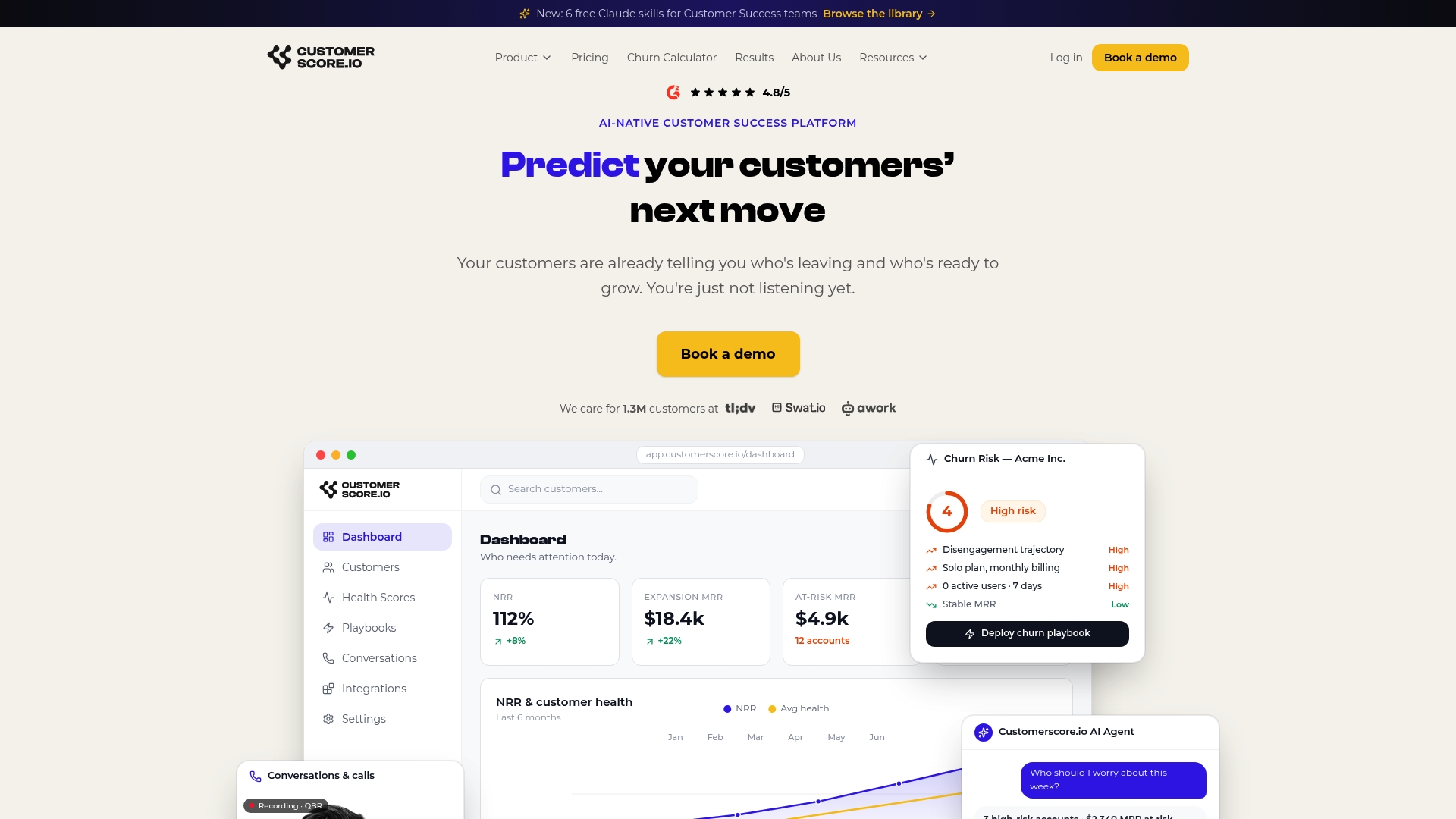
Start by getting a quote on the pricing page: a flat platform fee tiered by your client ARR rather than per seat. If churn risk is the most urgent problem right now, the churn prediction product page walks through exactly how the model surfaces at-risk accounts before renewal conversations go sideways. Ready to pressure-test it? Book a demo and bring the accounts that worry you most. That's the conversation that actually matters.
Sources
FAQ
How Long Does an Enterprise CS Platform Pilot Take?
A well-scoped pilot typically runs 4 to 8 weeks, covering one or two data sources and a single account segment. Full enterprise roll-out across all segments and integrations usually extends 8 to 16 or more weeks depending on data complexity.
What Integrations Should an Enterprise CS Platform Support?
At minimum, expect native connections to CRM systems like Salesforce, billing platforms like Stripe, and product analytics tools like Mixpanel or Segment. The platform natively integrates with a variety of common tools including HubSpot, Salesforce, Stripe, Mixpanel, PostHog, Segment, Chargebee, Intercom, Slack, and MCP/AI agents.
How Do You Size a Pilot for an Enterprise CS Platform?
Pull a clean, representative sample of 50 to 200 accounts across your key segments and run every finalist against that identical dataset. Measure both risk signal accuracy against known outcomes and CSM adoption around day 10 of the trial.
How Much Does Customerscore.io Cost?
The platform charges a flat fee tiered by your client ARR, never a per-seat rate. Every customer gets the full platform, and you get a tailored quote in one call.
When Should You Expect ROI From an Enterprise CS Platform?
ROI timing depends on how much at-risk ARR the platform helps you capture and how quickly CSMs adopt its alerts, but early signal validation typically happens within the first pilot cycle. Expansion ARR contribution tends to rise with company scale, so larger enterprise accounts often see faster and larger ROI from expansion workflows than from churn prevention alone.
Recommended
Related articles
Cut CSM Intervention 18%: Predictive Playbooks for CS & RevOps
Cut CSM Intervention 18%: Predictive Playbooks for CS & RevOps ! Predictive playbook geometric title card Predictive playbooks link a churn prediction to a specific, repeatable action so customer
BlogPinpoint B2B SaaS Adoption Gaps and the Fix That Lifts Renewal
Pinpoint B2B SaaS Adoption Gaps and the Fix That Lifts Renewal ! Analysts reviewing SaaS adoption gaps Adoption gap analysis identifies the funnel stage where eligible users or accounts fail to reach
BlogAnalysts: 6–12 Month Cohort Forecasts for Net Dollar Retention
Analysts: 6–12 Month Cohort Forecasts for Net Dollar Retention ! Analyst reviewing cohort retention forecast The most reliable way to forecast net dollar retention is cohort-based modeling that
BlogStop Surprise Churn: 5 Phase Data Mapping for RevOps and CS
Stop Surprise Churn: 5 Phase Data Mapping for RevOps and CS ! Analyst mapping customer data fields Data mapping for CS means connecting product usage, billing, CRM, and support data to the fields your