
5 Best Planhat Alternatives for SaaS (2026)

Planhat is one of the most flexible customer platforms on the market, and teams with CS Ops capacity get a lot out of it. That flexibility comes with work: your team designs the data model, health scores and workflows, implementations run weeks to months in data-heavy setups, and AI, portals and email marketing are sold as add-ons. If you are wondering whether your CSMs will work accounts or work the tool, you are not alone.
This guide breaks down the 5 best Planhat alternatives for B2B SaaS in 2026: what each is best for, how it handles customer health, where it is strong, and where it falls short. We lead with our own platform, Customerscore.io, and then give a fair assessment of the strongest competitors so you can build a shortlist fast.
Why teams look for a Planhat alternative
Planhat bundles a customer success platform, a CRM, and a services (PSA) layer into one highly configurable system with a custom data model, AI agents and an MCP server. The trade-offs show up quickly:
- Admin and complexity. The customisation is the product, and reviewers describe a steep learning curve and the need for a dedicated owner.
- Time to value. Implementations run weeks to months in data-heavy setups (Vendr, public reviews).
- Total cost. Planhat is quote-based and prices mainly by the number of customer accounts, with paid add-ons on top. Vendr puts the median around $41,000 a year (Vendr, October 2026), before the time of the person who runs it.
- Adoption. What we hear from CS teams: the platform shows plenty of data but does not tell the team what to do next.
Signs Planhat is more than you need
- Your team spends more time configuring the platform than working accounts, and someone has become the admin.
- Nobody fully trusts the health score, because the logic was built by hand and has not been touched in months.
- The platform shows data, but CSMs still decide on instinct who to call today.
- You use Planhat for customer success only, not as your CRM or PSA.
When Planhat still makes sense
If you run Planhat as your CRM or PSA as well, have a CS Ops team that owns custom objects and workflows, or your team uses it every day and is happy with the setup, Planhat is hard to beat. The alternatives below are for teams that want the same depth for customer success with less to run.
The 5 best Planhat alternatives in 2026
1. Customerscore.io: Best for CS teams that want every CSM to know who needs them today
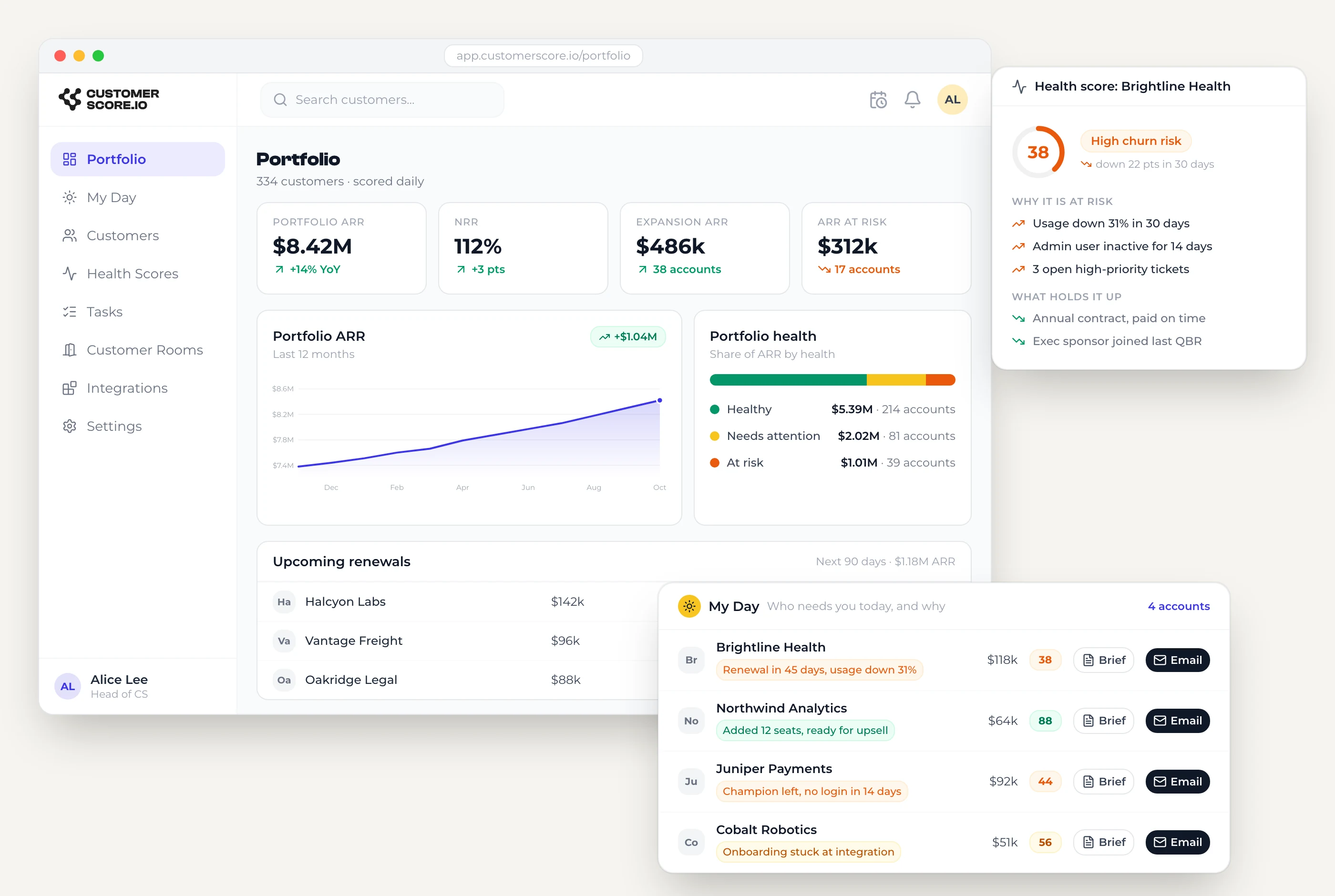
Customerscore.io is an AI-native Customer Success platform for B2B SaaS teams that own revenue. It plays in the same league as Planhat for customer success work and takes a different approach: Planhat gives your team a platform to configure, Customerscore.io tells each CSM who needs them today and why.
- Today's priorities for every CSM. My Day ranks the accounts that need attention, with the reason behind each one.
- One account record. Usage, billing, CRM, support, emails and recorded calls in one place, with an account brief and QBR and renewal prep built from the full history.
- Customer Rooms. Shared workspaces for onboarding, renewals and joint projects, with tasks for both your team and the customer.
- Predictive scoring on your own data from day one. A model trained on tens of thousands of SaaS users predicts churn and expansion for every account and shows the drivers behind each score, so nobody designs or maintains health score logic. How the scoring works.
- Seasonality-aware. Every account is scored against its own history and usage rhythm, so an expected seasonal dip is not read as churn risk, while the same drop in an account that never shows one is.
- Tasks, alerts and playbooks. Owned tasks, Slack and email alerts when something changes, and automated playbooks for the accounts that need no human touch.
- Two-way CRM sync. A native two-way HubSpot app and Salesforce, so scores and drivers stay the same in both places.
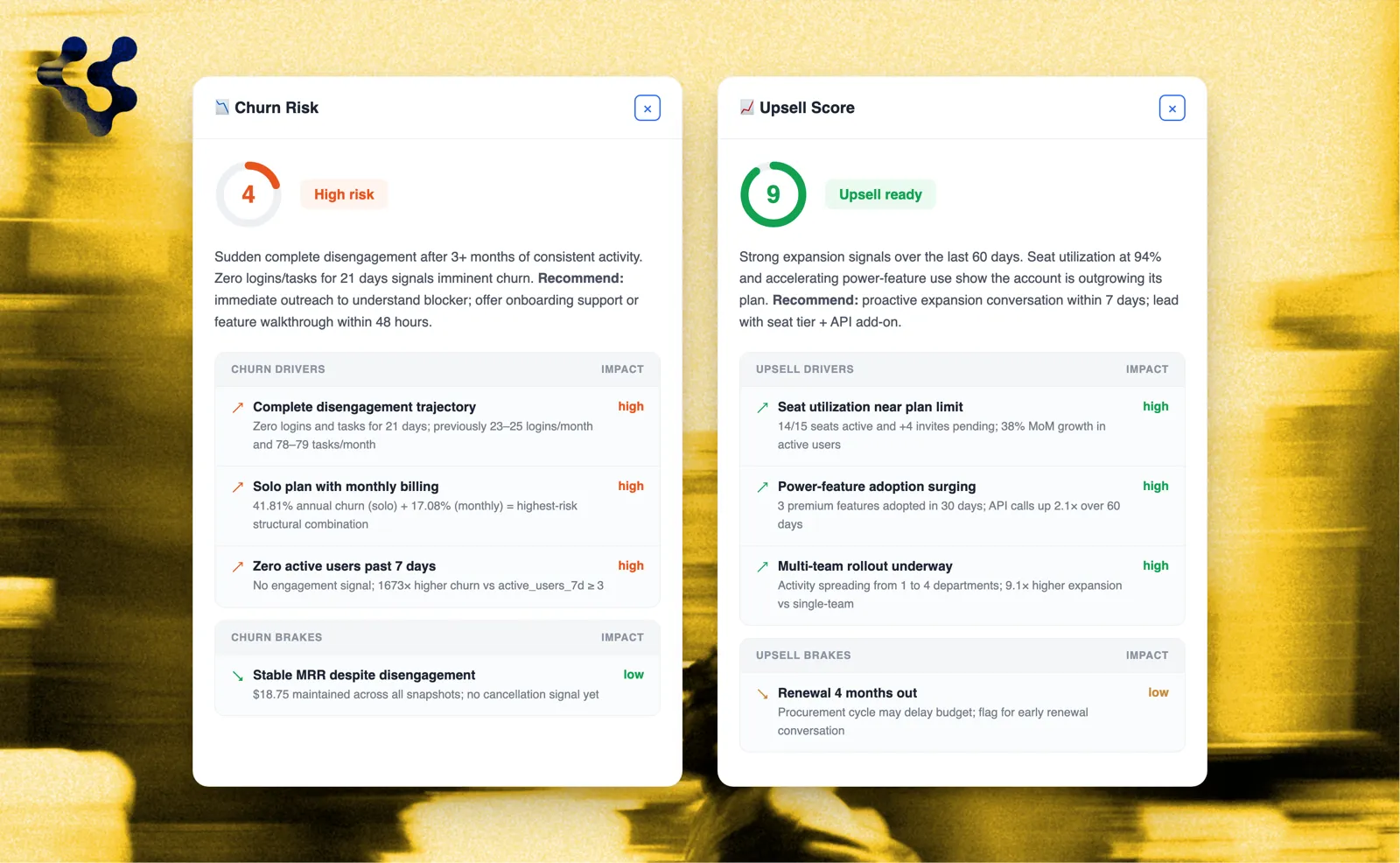
Setup is expert-led with the team behind the scoring engine, there is no admin to hire, and most teams are live in 1 to 3 weeks. Pricing is one platform fee based on your ARR, with every feature included and never per seat. You get a tailored offer after one call: see how pricing works or book a demo.
"It gives us a clear read on customer health and feature adoption, and the Slack alerts keep us on top of every trend. Setup was super easy and the team support is amazing." Katja V., Head of Customer Success, tl;dv (4.8/5 on G2)
- Best for: B2B SaaS CS teams that own revenue and want every CSM working the right accounts, without a configuration project or a platform admin.
- Strengths: daily priorities with reasons (My Day), one account record with brief and QBR and renewal prep, Customer Rooms, predictive churn and expansion scoring with drivers from day one, expert-led setup, all features included.
- Honest limitation: Customerscore.io does not replace your CRM or PSA and does not give you a fully custom data model to build on. If you run Planhat as your CRM or PSA too, or a CS Ops team owns custom objects and workflows, Planhat covers that better.
See the full Customerscore.io vs Planhat comparison.
2. Vitally: Best for teams that want a polished, modern CS workspace
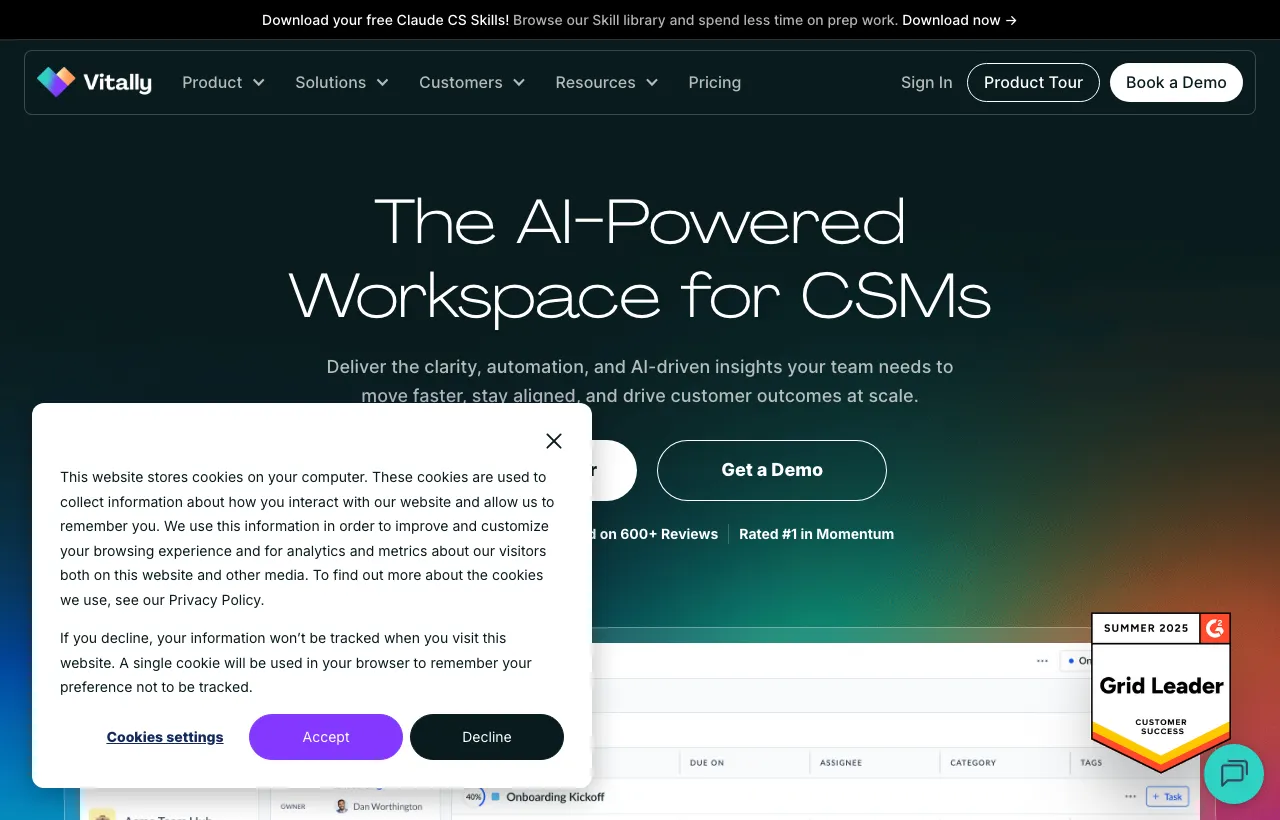
Vitally is a clean CS workspace with health scores, tasks, playbooks, Projects and customer-facing Docs, and reviewers find its UI simpler than older suites. Vitally AI records and summarises meetings and drafts tasks and replies, and a read and write MCP server launched in August 2026.
The trade-off is that health scores are rule-based, so your team defines the conditions and weights and keeps them current. Vitally is quote-based and priced mainly by the number of accounts you manage; Vendr puts the median around $35,000 a year (Vendr, October 2026). See the Vitally alternative comparison.
3. Gainsight: Best for enterprises that want the full CS suite from one vendor
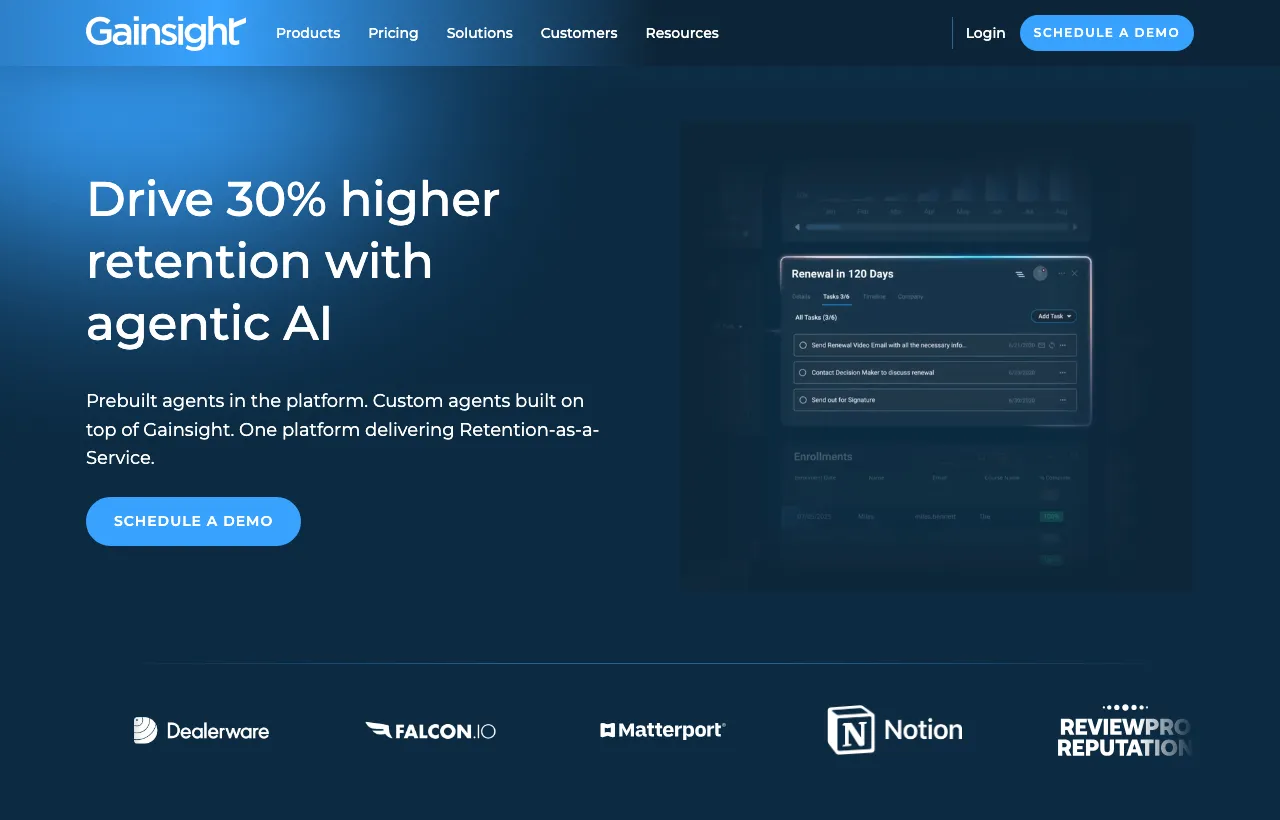
Gainsight named the customer success category. Gainsight CS brings scorecards, a Rules Engine, Digital Journeys and renewal forecasting inside a wider hub with in-app guides (PX), communities and customer education (Skilljar). Its AI investment is real: Staircase AI reads emails, calls and tickets for risk and expansion signals, and the 2026 Agentic Stack adds Atlas agents, an Agent Studio and a live MCP server.
The trade-off is the project. CS Ops and, as reviewers advise, a designated Gainsight admin configure and run the scorecards and rules, and implementation is a services project that Vendr puts at 20 to 40% of the first-year subscription. Gainsight is quote-based and packaged by users, customer records and products; Vendr puts the median around $50,000 a year (Vendr, October 2026). See the Gainsight alternative comparison.
4. ChurnZero: Best for teams that want in-app engagement built into their CS platform
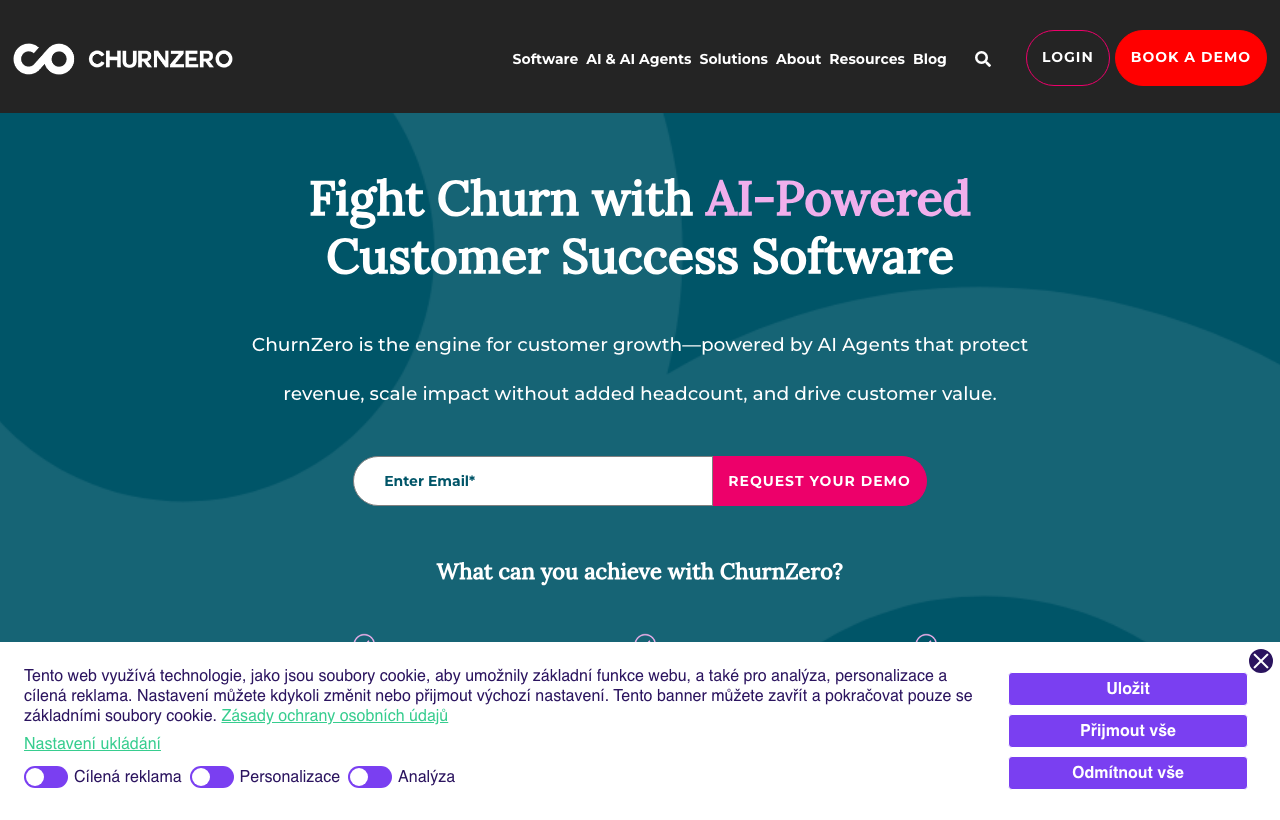
ChurnZero is a mature, well-reviewed CS platform (4.7/5 on G2 across more than 1,500 reviews) with ChurnScores, Plays automation, in-app messages, WalkThroughs and customer-facing Success Centers. Since June 2026 it also sells Agentic Essentials, a package of 20 AI agents and an MCP connector for Claude and ChatGPT, as a separate subscription with credits.
The trade-off is that your team picks the health score factors, weights them to 100 points, and then builds and maintains the Plays that run on them. Reviewers describe weeks of setup and a learning curve, and the setup often depends on one owner. ChurnZero is quote-based; Vendr puts the median around $44,600 a year (Vendr, October 2026), with onboarding quoted separately. See the ChurnZero alternative comparison.
5. Custify: Best for small and mid-sized teams that put ease of use first
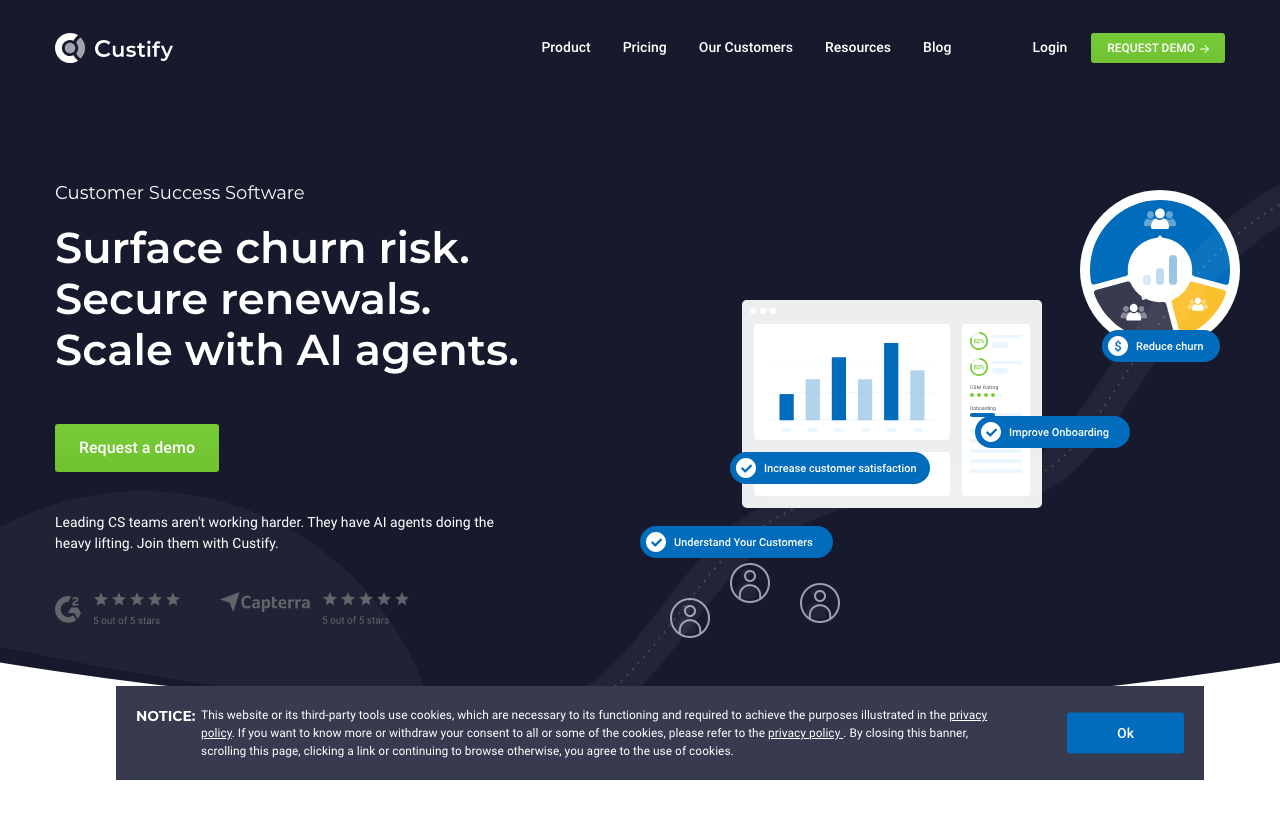
Custify is a European CS platform known for ease of use (#1 Easiest to Use on G2, 4.7/5) and hands-on support, with a customer 360, health scores, segments, playbooks and tasks. CustifyAI and its 2026 AI agents add risk detection from emails and meeting prep, and it ships an official MCP server.
The trade-off is that your team defines the segments, metrics and health scores, which is where reviewers say the effort goes. Onboarding is a four-week concierge program. Custify is quote-based; Vendr puts the median around $16,800 a year (Vendr, October 2026). See the Custify alternative comparison.
Comparison table: Planhat alternatives at a glance
| Platform | Health scoring | Daily priorities for CSMs | Admin to run it | Time to live | Pricing (public benchmark) |
|---|---|---|---|---|---|
| Customerscore.io | Predicted on your data, with drivers | My Day, with the reason for each account | Not needed | 1 to 3 weeks, expert-led | One platform fee based on ARR, all features included |
| Planhat | Health scores you design and maintain; AI platform upgrade sold as an add-on | Views and workflows you build | Often needed (reviews) | Weeks to months (Vendr, reviews) | Quote-based, mainly by customer accounts; median about $41,000/yr |
| Vitally | Rule-based scores you configure; Vitally AI and MCP | Workspace, tasks and playbooks you set up | An owner for scores and playbooks | Vitally's own figure: 1.9 months on average | Quote-based, mainly by accounts; median about $35,000/yr |
| Gainsight | Scorecards you configure, plus Staircase AI signals and Atlas agents | Rules, playbooks and journeys you build | Designated admin advised (G2) | Services-led project, often months | Quote-based by users, records and products; median about $50,000/yr |
| ChurnZero | ChurnScores: factors you pick and weight to 100; AI agents as an add-on | Plays and views you build | Often one owner for scores and Plays | Weeks of setup (reviews) | Quote-based; median about $44,600/yr |
| Custify | Health scores you define; CustifyAI agents and MCP | Playbooks and tasks you set up | Effort goes into defining scores and segments | 4-week concierge onboarding | Quote-based; median about $16,800/yr |
Last updated October 2026 from public sources: vendor websites, pricing pages and press releases, Vendr pricing benchmarks (Vendr, October 2026) and G2 reviews. None of these vendors publish prices; figures vary by contract. See how Customerscore.io pricing works.
How to choose the right Planhat alternative
- Start with the day-to-day job. If your CSMs need to know who needs them today and why, judge each tool on the priorities it gives them, not on how much you can configure.
- Ask who will run it. Find out who designs the health score, who maintains rules and workflows, and whether you would need an admin or a CS Ops hire.
- Compare total cost of ownership. Count the licence, add-ons, implementation services, the admin's time and the months before go-live. A lower licence with a long rollout is rarely the cheaper option.
- Check time to live. Ask each vendor for a dated plan to go live and who does the work.
If you want a Planhat alternative that gives every CSM today's priorities and the reason behind each one, predicts churn and expansion on your own data, and is live in 1 to 3 weeks without an admin to hire, book a demo or read the Customerscore.io vs Planhat comparison.
Related guides: 8 best customer success software · Best customer health score software · Best Gainsight alternatives · Best ChurnZero alternatives
FAQs
What is the best Planhat alternative for a CS team that owns revenue?
The best fit gives every CSM clear priorities without a configuration project. Customerscore.io tells each CSM who needs them today and why, predicts churn and expansion on your own data from day one, and is live in 1 to 3 weeks with expert-led setup. Vitally and Custify are lighter workspaces, but your team still defines and maintains the health score.
Why are teams leaving Planhat?
The reasons we hear most are complexity and admin work, low adoption by the CS team, a health score nobody fully trusts, and a platform that shows data without telling the team what to do. Teams that use Planhat only for customer success often find they pay, in money and admin time, for breadth they do not use.
Is there a cheaper alternative to Planhat?
Compare total cost, not only licence price. Total cost is the licence, plus add-ons and implementation services, plus the person who administers the platform, plus the months before it is live. Customerscore.io charges one platform fee based on your ARR, with every feature included and never per seat, and setup is expert-led, so you need no admin. You get a tailored offer after one call. Public benchmarks for Planhat are in the table above; ask each vendor for a full first-year quote.
Which Planhat alternative is best for expansion, not just churn?
Customerscore.io predicts both churn risk and expansion for every account from the same data and shows the drivers behind each score, so CSMs see upsell-ready accounts next to at-risk ones in their daily priorities.
Do these tools replace Planhat or work alongside it?
They replace it. Customerscore.io connects your billing, CRM, product and support data directly, so you do not depend on an export from Planhat, and you can time the switch with your Planhat renewal. Your team works its accounts in Customerscore.io, and scores and drivers sync two ways with HubSpot and Salesforce.
Key Takeaways
- Planhat is a powerful, configurable platform covering CS, CRM and PSA, and your team designs and maintains it.
- The right alternative depends on the job: a polished workspace (Vitally, Custify), the full enterprise suite (Gainsight), in-app engagement (ChurnZero), or daily priorities for every CSM from a predictive model (Customerscore.io).
- Customerscore.io plays in the same league for customer success, gives every CSM daily priorities from a predictive model on your own data, is live in 1 to 3 weeks with expert-led setup, and includes every feature in one ARR-based platform fee. See the full Customerscore.io vs Planhat comparison.
Related articles
5 Best Gainsight Alternatives for SaaS (2026)
Gainsight is the most complete CS suite, and it is a project to configure and run. Five Gainsight alternatives compared on health scoring, daily priorities, admin load, rollout time and total cost.
Blog5 Best ChurnZero Alternatives for SaaS (2026)
ChurnZero is a proven platform your team configures and runs. Five ChurnZero alternatives compared on health scoring, daily priorities, admin load, rollout time and total cost.
BlogAccount Health Dashboard: A B2B SaaS Guide for 2026
What an account health dashboard is, the metrics it should track, how to implement one your team actually trusts, and how it fits into your B2B SaaS workflows.
BlogHow to Build a Customer Health Score in HubSpot (Step by Step)
A step-by-step guide to building a customer health score in HubSpot, from a manual RAG score to weighted workflows, how to bring in product usage, and the pitfalls to watch.