
Best Rocketlane Alternatives for AI-Native CS Teams


For AI-first churn prediction and customer-facing onboarding, the vendors worth your time in 2026 are Customerscore, Gainsight, ChurnZero, Planhat, ClientSuccess, and HubSpot Service Hub. Each solves a different version of the same problem, so the right pick depends on whether you need explainable AI health scoring, PSA-depth financials, or a CRM-native experience.
Here is the short verdict on each:
- Customerscore — Best for B2B SaaS teams that want AI-driven churn prediction, explainable health scoring, and branded customer onboarding spaces without per-seat pricing. Subscription priced by ARR, not headcount.
- Gainsight — Best for enterprise CS orgs that need deep playbook orchestration and can absorb a longer deployment cycle and higher seat costs.
- ChurnZero — Best for mid-market SaaS teams that want real-time health alerts and a strong out-of-the-box integration with Salesforce or HubSpot.
- Planhat — Best for revenue-focused CS teams that want a clean data model and flexible pipeline views alongside health scoring.
- ClientSuccess — Best for smaller SaaS teams that need a straightforward CS platform without the overhead of an enterprise deployment.
- HubSpot Service Hub — Best for companies already on HubSpot CRM that want to unify support ticketing and CS workflows in one place.
Pro Tip: Before you demo any of these, add one non-negotiable line to your RFP: "Provide a sample export of historical project data in CSV and JSON formats within 14 days of contract signing." Vendors that hesitate on this are telling you something important about data portability.
The right reason to switch matters as much as the vendor you pick. Compliance or coverage gaps justify a full migration to a PSA platform. A purely functional preference often does not.

Table of Contents
- How do these Rocketlane alternatives compare on what CS and RevOps actually care about?
- What does each vendor actually do, and when should you pick it?
- How do you evaluate these options without wasting three months on demos?
- What does migration actually involve, and what should your RFP require?
- What should you actually do in the next two to eight weeks?
- Key Takeaways
- A CS and RevOps leader's perspective on switching away from Rocketlane
- Customerscore is built for exactly this job
- Useful sources and further reading
How do these Rocketlane alternatives compare on what CS and RevOps actually care about?
The table below maps each vendor against the dimensions that drive real procurement decisions. "AI-first" means the churn model is the core product, not a bolt-on. "PSA-depth" means the platform carries project financials, resource management, and billing. "Onboarding-first" means the product is built around the client-facing workspace experience.
| Vendor | Best for | Onboarding automation & client rooms | Churn prediction & AI | Integrations | Data portability | Security & compliance | Deployment time | Support & services | Pricing model |
|---|---|---|---|---|---|---|---|---|---|
| Customerscore | AI-native CS, B2B SaaS | Customer Rooms, automated playbooks | AI-first, explainable health scoring | HubSpot, Salesforce, Stripe, Mixpanel, Segment, Chargebee, Intercom, Slack | Full export, API sync | SOC2, GDPR-ready | 2–4 weeks | Onboarding included | Subscription by ARR |
| Gainsight | Enterprise CS orgs | Journey orchestration, Success Plans | AI health scoring, NXT engine | Salesforce-native, broad ecosystem | Export available, PS-assisted | SOC2 Type II | 8–16 weeks | Extensive PS team | Per-seat, enterprise |
| ChurnZero | Mid-market SaaS | Automated plays, in-app messaging | Real-time health alerts, AI scoring | HubSpot, Salesforce, Zendesk | Export available | SOC2 Type II | 4–8 weeks | Dedicated CSM | Per-seat |
| Planhat | Revenue-focused CS | Onboarding workflows, portals | Health scoring, usage-based signals | Salesforce, HubSpot, billing tools | API + export | SOC2 Type II | 4–8 weeks | Implementation support | Per-seat or usage |
| ClientSuccess | SMB SaaS teams | Basic onboarding workflows | Health scoring, pulse tracking | Salesforce, HubSpot, Zendesk | CSV export | SOC2 | 2–4 weeks | Standard support | Per-seat |
| HubSpot Service Hub | HubSpot-native teams | Ticket-based onboarding, portals | Limited native AI churn prediction | Full HubSpot ecosystem | HubSpot data tools | SOC2, GDPR | 2–6 weeks | HubSpot partner network | Per-seat, tiered |
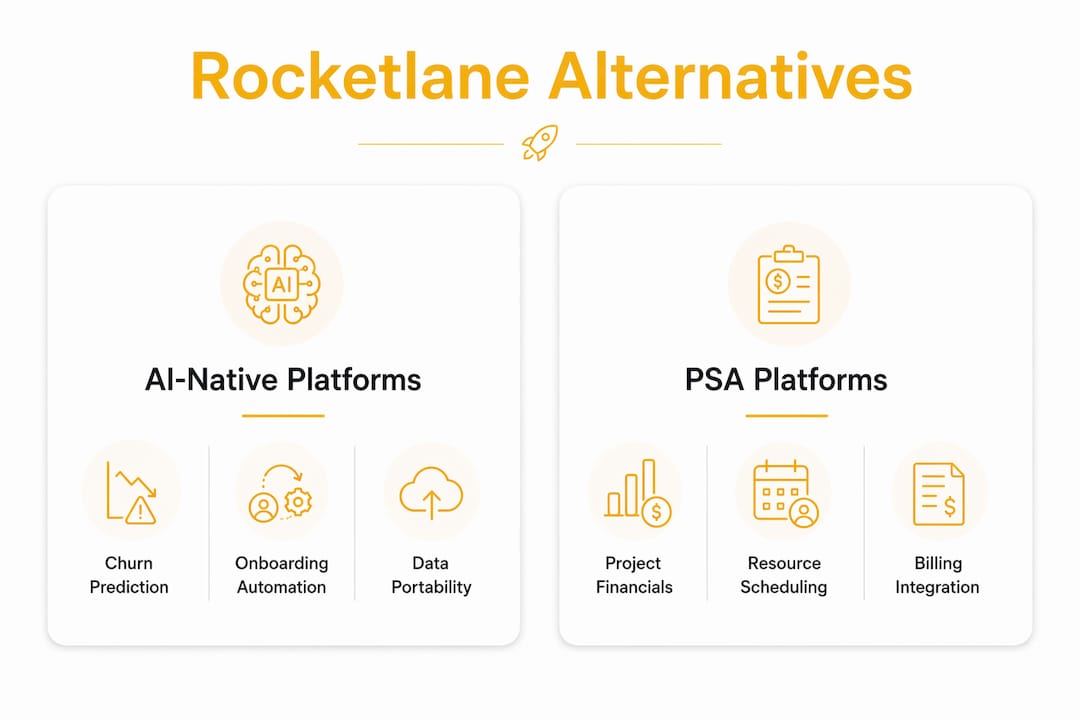
One pattern stands out across alternatives research: the market splits cleanly between PSA platforms (Gainsight, Certinia) and AI-native CS platforms (Customerscore, ChurnZero, Planhat). Buyers who need project financials and resource billing should look at the PSA tier. Buyers who need churn signals and customer health should stay in the CS platform tier.
What does each vendor actually do, and when should you pick it?
Customerscore
Customerscore is an AI-native customer success platform built specifically for B2B SaaS. It pulls data from billing (Stripe, Chargebee), product analytics (Mixpanel, PostHog, Segment), CRM (HubSpot, Salesforce), and support (Intercom) to generate explainable health scores and automated churn alerts. The Customer Rooms feature gives every customer a branded onboarding workspace without per-customer seat charges. Pricing scales by your ARR, not by how many seats your team or customers use.
Shortlist when: You want AI churn prediction that explains why a customer is at risk, not just a red/yellow/green score. Eliminate when: You need full PSA financials, resource scheduling, or project billing.
Gainsight
Gainsight is the category-defining enterprise CS platform, with deep playbook orchestration, a large professional services team, and a Salesforce-native architecture. Deployment typically runs several weeks and requires dedicated admin resources. The AI health scoring engine (NXT) is mature but the cost structure, including seat minimums and PS hours, can push total cost of ownership well above initial estimates.
Shortlist when: You have 10+ CS headcount, a Salesforce-first stack, and budget for a multi-month implementation. Eliminate when: You need to be live in under 60 days or your team is under 5 CS reps.
ChurnZero
ChurnZero focuses on real-time customer health and in-app engagement for mid-market SaaS. Its integration with HubSpot and Salesforce is strong out of the box, and automated plays trigger based on usage signals. Per-seat pricing is standard.
Shortlist when: Real-time health alerts and in-app messaging are your top priorities. Eliminate when: You need a customer-facing onboarding workspace or ARR-based pricing.
Planhat
Planhat offers a clean data model with flexible pipeline views, health scoring, and usage-based signals. It sits between a lightweight CS tool and a full enterprise platform, which makes it a reasonable fit for revenue-focused teams that want pipeline visibility alongside retention metrics.
Shortlist when: You want health scoring tied directly to revenue pipeline views. Eliminate when: You need deep AI explainability or a fully branded customer onboarding space.
ClientSuccess
ClientSuccess is a straightforward CS platform for smaller SaaS teams. It covers health scoring, pulse tracking, and basic onboarding workflows without the configuration overhead of enterprise tools. Migration from Rocketlane is relatively low-effort given its simpler data model.
Shortlist when: Your team is small, your stack is simple, and you want to be live fast. Eliminate when: You need AI-driven churn prediction or advanced automation.
HubSpot Service Hub
HubSpot Service Hub makes the most sense if your company already runs on HubSpot CRM. It unifies ticketing, knowledge base, and customer portals in the same platform your sales and marketing teams use. Native AI churn prediction is limited compared to dedicated CS platforms, but the integration depth is unmatched for HubSpot shops.
Shortlist when: You are HubSpot-native and want to consolidate tools. Eliminate when: Churn prediction and health scoring are your primary requirements.
Pro Tip: Task-based project management platforms like Asana or ClickUp frequently appear in generic alternatives lists, but they lack the client-visibility and engagement features that define purpose-built onboarding tools. Do not confuse project management with customer onboarding automation.
A useful signal from Gartner Peer Insights: buyers consistently flag integration depth and deployment complexity as the two factors that most often cause post-purchase regret. Nail those two before you sign.
How do you evaluate these options without wasting three months on demos?
Start with one rule: prioritize structural fit (AI capability, data model, migration effort) over feature-by-feature parity. A platform with 20 more features that takes 14 weeks to deploy and charges per external user will cost you more in every dimension.
Evaluation criteria checklist:
- AI model explainability: can the vendor show you which data inputs drive a churn score?
- Input data sources: does the platform ingest billing, product usage, CRM, and support data natively?
- Training refresh cadence: how often does the churn model retrain on new customer data?
- Exportable project and customer history: what formats (CSV, JSON, API) and what is the SLA?
- Pricing structure: per-seat vs. ARR-based vs. usage-based, and are external customer users charged?
- Integration depth with HubSpot, Salesforce, Stripe, and your billing tool.
- SOC2 Type II attestation and GDPR readiness documentation.
- Professional services scope: what is included vs. billed separately, and what are typical hours to production?
Exact questions to ask on vendor calls:
- "How is the churn model trained, and what minimum data inputs are required to generate a score?"
- "What formats do you export historical customer and project data in, and what is the turnaround time?"
- "What is included in your standard onboarding, and what triggers a professional services engagement?"
- "Are external customer users (inside client-facing portals or rooms) counted against our seat license?"
- "Can you share your SOC2 Type II report under NDA before we sign?"
Red flags to walk away from:
- No documented data export formats or a vague "we can work something out" answer.
- Per-customer or per-external-seat charges for client-facing portals. PSA platforms frequently carry these as hidden costs that materially increase TCO.
- AI health scoring that cannot explain which inputs drove a risk flag.
- Missing SOC2 attestation or an attestation older than 18 months.
Pro Tip: Ask every vendor for a reference customer in your ARR band and your vertical. A reference from a 500-person enterprise tells you nothing about how the platform performs for a 30-person SaaS team.
What does migration actually involve, and what should your RFP require?
Migration effort almost always concentrates in three places: mapping custom fields from Rocketlane to the new data model, preserving comment threads and attachments with original timestamps, and keeping historical user IDs intact for audit trails. These three items drive the majority of professional services hours in any migration.
Data migration checklist:
- Export project history in CSV and JSON from Rocketlane before you sign a new contract.
- Confirm attachment export (file formats, size limits, folder structure preservation).
- Validate that comment threads retain original author IDs and timestamps.
- Map all custom fields to the new platform's data model before migration begins.
- Run a sample migration on 10% of your customer base and validate against source data.
- Confirm SSO/authentication mapping for both internal users and external customer contacts.
RFP line items to require:
- Written migration effort estimate (hours and cost) before contract signing.
- Rollback plan with defined trigger conditions.
- Sample data migration pilot (minimum 10% of records) with written acceptance criteria.
- SLA for migration issue resolution (48-hour response minimum).
- Written commitment on data deletion timelines and retention policies post-migration.
- Current SOC2 Type II report and GDPR data processing agreement.
Typical migration timelines:
| Team size | Expected time-to-value | Common hidden-effort items |
|---|---|---|
| Small (1–5 CS reps) | 2–4 weeks | Custom field mapping, SSO setup |
| Mid-market (6–20 CS reps) | 4–8 weeks | Legacy attachment cleanup, user ID mapping |
| Enterprise (20+ CS reps) | 8–16 weeks | Multi-workspace migration, compliance review, change management |
Risk mitigation:
- Pilot on a subset of 10–20 customers before full migration.
- Keep Rocketlane in read-only mode for 30–90 days post-migration for audit access.
- Contract explicit migration acceptance criteria so "done" is defined before you start.
- Consider a hybrid approach: add a specialized CS platform for customer-facing onboarding while retaining your existing delivery engine, rather than a full rip-and-replace.
Pro Tip: Require a sample migration in the contract, not just a promise. Vendors that have clean migration tooling will agree immediately. Those that push back are signaling that the process is manual.
What should you actually do in the next two to eight weeks?
For AI-native churn prediction combined with customer-facing onboarding, Customerscore is the strongest fit for B2B SaaS teams that want to be live in under four weeks without per-seat pricing. For enterprise orgs with Salesforce-first stacks and multi-month timelines, Gainsight or ChurnZero are the credible second tier.
Three-step action plan:
- Shortlist (Week 1–2): Apply the structural fit criteria above. Eliminate any vendor missing SOC2, lacking data export documentation, or charging per external user. You should end with two or three vendors maximum.
- Pilot (Week 2–4): Run a two-week pilot on 10–20 live customers. Measure: time-to-live (days from contract to first health score), initial churn signal lift (how many at-risk accounts the model surfaces vs. your current manual process), activation rate (percentage of customers who engage with the onboarding workspace), and migration delta in admin hours vs. your estimate.
- Decide (Week 4–8): Score each vendor against your pilot metrics and the RFP checklist. The vendor that surfaces the most accurate churn signals with the least admin overhead wins, regardless of feature count.
If your primary risk is geographic coverage or compliance rather than functional gaps, adding a specialist provider alongside your current stack often reduces migration risk more than a full replacement does.
Key Takeaways
For B2B SaaS CS and RevOps leaders, the best Rocketlane alternatives split by use case: AI-native platforms for churn prediction, PSA platforms for project financials, and CRM-native tools for HubSpot-first teams.
| Point | Details |
|---|---|
| Match vendor to switch reason | Compliance or coverage gaps justify a PSA migration; functional preference often does not. |
| Require data portability upfront | Demand CSV/JSON export and a sample migration pilot before signing any contract. |
| Watch hidden seat costs | Per-external-user charges and per-seat AI add-ons can push TCO well above initial quotes. |
| Pilot before full migration | Run a 2-week pilot on 10–20 customers and keep the legacy system read-only for 30–90 days. |
| Customerscore for AI-native CS | Customerscore offers explainable churn prediction, Customer Rooms, and ARR-based pricing with a 2–4 week deployment. |
A CS and RevOps leader's perspective on switching away from Rocketlane
The conversation about replacing Rocketlane almost always starts in the wrong place. Teams spend weeks comparing feature matrices when the real question is simpler: does your current tool's data model support the kind of AI churn prediction you actually need, or are you trying to retrofit a project management tool into a customer intelligence job it was never designed for?
PSA platforms offer genuine depth on the delivery side: resource scheduling, project financials, billing. But that depth comes with governance overhead. You need a dedicated admin, a longer implementation, and a change management program that touches sales, CS, and finance simultaneously. For a 10-person CS team at a $5M ARR SaaS company, that overhead is rarely justified.
The more interesting trade-off is between a full replacement and a hybrid model. Adding a specialized AI-native CS platform alongside your existing delivery infrastructure often gets you 80% of the outcome at 30% of the migration risk. The teams that get this right involve three stakeholders from day one: the CS lead (who owns the customer experience), the RevOps lead (who owns the data model and integrations), and an executive sponsor (who can unblock budget and change management). Without all three, migrations stall at the custom field mapping stage.
Weekly migration standups with a defined decision log, plus a monthly executive checkpoint tied to pilot metrics, are the governance minimum. Everything else is optional.
Customerscore is built for exactly this job
If you have read this far, you are probably a CS or RevOps leader who needs more than a task tracker with a health score bolted on. Customerscore was built for that gap: AI churn prediction that explains which signals drove the risk flag, Customer Rooms that give every customer a branded onboarding workspace without per-customer seat charges, and integrations with HubSpot, Salesforce, Stripe, Mixpanel, PostHog, Segment, Chargebee, and Intercom out of the box.
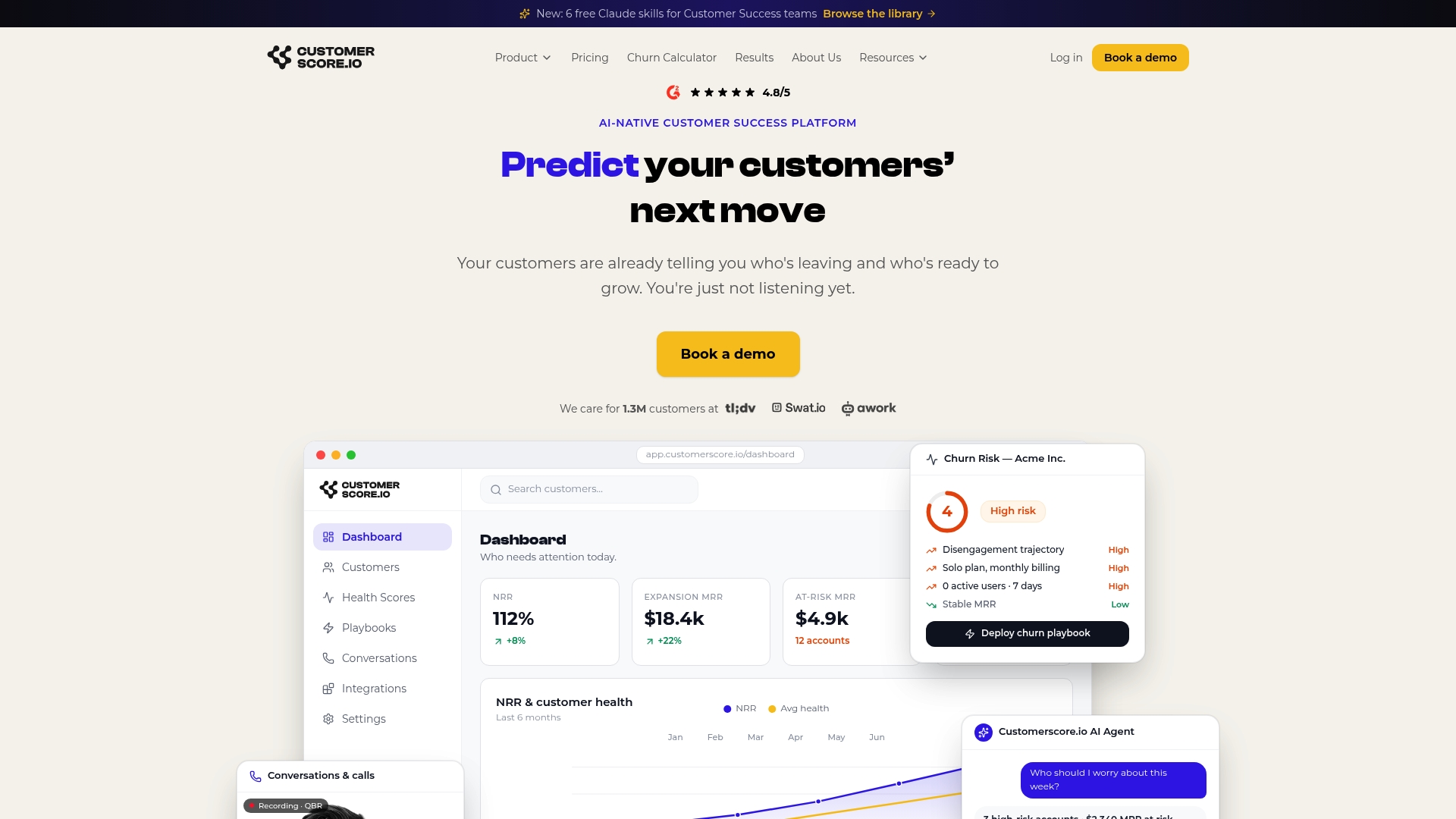
Pricing scales by your ARR, not by headcount, so your cost does not spike when you add CS reps or invite customers into their onboarding space. Deployment typically runs 2–4 weeks. SOC2 compliance and GDPR readiness are standard, not add-ons. The AI churn prediction engine pulls from billing, product usage, CRM, and support data simultaneously, and every risk flag comes with an explanation your team can act on.
Book a demo and bring your current Rocketlane export. The pilot scope, success metrics, and migration acceptance criteria can be defined in the first call.
Useful sources and further reading
The sources below back the claims in this article and are worth bookmarking for your procurement process.
- Gartner Peer Insights: Rocketlane Alternatives — Verified buyer reviews covering evaluation criteria, integration complexity, and deployment experience. Use this for vendor due diligence and reference customer sourcing.
- RFP.wiki: Rocketlane Alternatives & Competitors — Practitioner guidance on migration effort, RFP line items, data portability requirements, and the hybrid-approach recommendation. Use this as the foundation for your RFP template.
- Valuecase: 5 Best Rocketlane Alternatives (2026) — Detailed breakdown of hidden costs (seat minimums, per-user AI charges) and the distinction between project management platforms and purpose-built onboarding tools. Use this for pricing due diligence.
- AI Commerce: Rocketlane Alternatives & Pricing — Market segmentation analysis explaining the PSA vs. onboarding platform split. Use this to confirm which category a vendor belongs to before shortlisting.
- Assembly: 11 Best Rocketlane Alternatives in 2026 — Broader market roundup including GUIDEcx, monday.com, Kantata, and Ruddr for teams with PSA or collaboration-first requirements.
- SaaSHub: Rocketlane Alternatives — Community-verified product comparisons and user votes. Use for a quick sanity check on vendor reputation before a demo.
Recommended
Related articles
90–120 Day Renewal System for CSMs: SaaS Renewal Playbook
90–120 Day Renewal System for CSMs: SaaS Renewal Playbook ! Team planning a structured SaaS renewal Run renewals as a 90 to 120 day managed pipeline, not a calendar reminder.
BlogCut Response Time 60% with This Slack for Customer Success Playbook
Cut Response Time 60% with This Slack for Customer Success Playbook ! Customer success team routing a Slack conversation Slack works best for customer success when it functions as the conversation
BlogProduct Led Customer Success in 90 to 180 Days Without a Data Team
Product Led Customer Success in 90 to 180 Days Without a Data Team ! Customer success operator reviewing product signals Product-led customer success uses product usage data and in-product
BlogPredict Churn 60–90 Days: Five Phase Customer Risk Scoring for B2B SaaS
Predict Churn 60–90 Days: Five Phase Customer Risk Scoring for B2B SaaS ! Customer success manager reviewing account risk dashboard Customer risk scoring produces a predictive, explainable health