
Best GUIDEcx Alternatives for B2B SaaS CS Teams


Customerscore.io is the recommended pick for B2B SaaS CS teams that want onboarding and account management in one platform: Customer Rooms for the customer-facing plan, My Day so every CSM knows who needs them today and why, and predictive churn and expansion scoring on your own data from day one. That combination is not what GUIDEcx is built for. If you are shortlisting, run a demo of Customerscore alongside one enterprise implementation platform and one CRM-native tool to cover your bases.
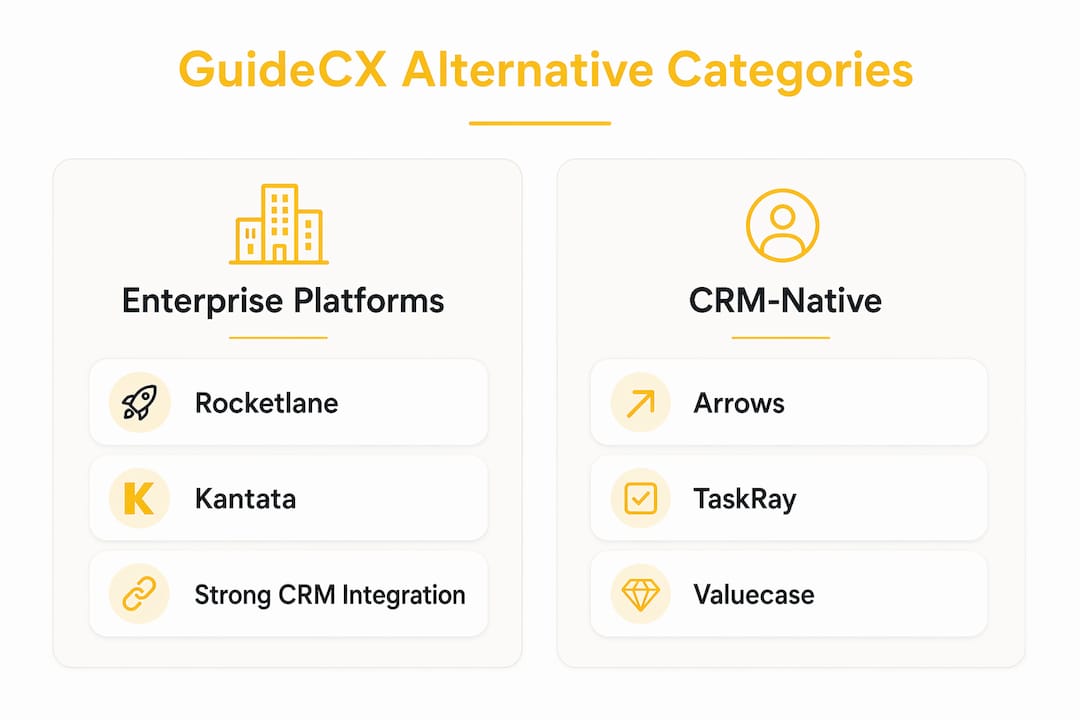
Here is how the alternative categories break down:
- Enterprise implementation platforms (e.g., PSA-focused tools): best when you run complex, multi-phase professional services rollouts with resource management and billing reconciliation built in.
- CRM-native onboarding tools: best for HubSpot or Salesforce shops that want onboarding embedded directly in the CRM rather than a separate platform.
- Lightweight PM/work-management tools: best when onboarding is a simple task list and you do not need a CS platform.
- Digital adoption platforms (DAPs): best when the core problem is in-app guidance and product walkthroughs rather than CS-led onboarding execution.
- AI-native Customer Success platforms: best for teams that want onboarding, daily priorities, renewal prep, and predictive health scoring in one platform; this is where Customerscore.io sits.
If your switching reason is geographic data residency or a narrow coverage gap rather than a full platform replacement, consider a secondary provider strategy before committing to a full migration.
Table of Contents
- What are the best GUIDEcx alternatives by category?
- Side-by-side comparison of GUIDEcx alternative categories
- How do you choose the right GUIDEcx alternative for your team?
- Why do teams look beyond GUIDEcx?
- Why Customerscore is the recommended GUIDEcx alternative for most B2B SaaS CS leaders
- Key Takeaways
- The real problem with how CS teams evaluate onboarding platforms
- Customerscore: see the difference AI-native CS makes for onboarding
What are the best GUIDEcx alternatives by category?
Industry directories map GUIDEcx competitors into four broad clusters: enterprise PSA, CRM-native onboarding, digital adoption platforms, and general PM/work-management tools. The tools the SERP consistently surfaces across those clusters include Rocketlane, Arrows, ChurnZero, Userpilot, TaskRay, Kantata, Valuecase, Monday.com, Asana, and ClickUp. Here is what each delivers and who it fits.
Enterprise implementation platforms: Rocketlane and Kantata
Rocketlane is purpose-built for B2B SaaS teams running complex, multi-phase customer rollouts. It handles parallel execution across multiple teams within a single customer engagement. Pricing is per seat with published tiers, and PSA-grade deployments land well above the entry price. Native integrations cover HubSpot, Salesforce, and Jira. G2 rates it 4.7 out of 5.
Pros: Strong customer-facing portals, deep project tracking, native CRM integrations, real-time reporting. Cons: PSA-grade cost and setup, a real learning curve, more platform than a repeatable onboarding plan needs. Best for: Enterprise and mid-market B2B SaaS with dedicated implementation teams.
Kantata (formerly Mavenlink) leans into professional services automation with resource management, financial forecasting, and ERP-adjacent billing reconciliation. If your CS org runs like a professional services firm with invoicing and utilization tracking, Kantata fits. Pricing is quote-based. It is not a CS-native platform, so health scoring and churn prediction are absent.
Pros: Deep resource management, strong financial reporting, ERP integrations. Cons: No native CS health scoring, steep learning curve, requires professional services to implement. Best for: Enterprise teams with heavy ERP/finance reconciliation needs.
CRM-native onboarding: Arrows, TaskRay, and Valuecase
Arrows embeds onboarding directly inside HubSpot, making it the cleanest option for HubSpot-native teams running linear, deal-to-onboarding workflows. G2 reviewers rate it 4.8 out of 5, with particular praise for its login-free customer-facing plans. Pricing starts at a few hundred dollars per month.

Pros: Frictionless HubSpot sync, login-free customer portals, fast setup. Cons: Limited outside HubSpot, no predictive analytics, thin reporting for complex projects. Best for: SMB and mid-market HubSpot shops with straightforward onboarding flows.
TaskRay is the Salesforce-native equivalent: onboarding projects live inside Salesforce records, which eliminates data duplication for Salesforce-heavy orgs. Pricing is per-user and quote-based. The tradeoff is that it inherits Salesforce's complexity and cost structure.
Pros: Native Salesforce data model, no separate login for CS reps, strong admin controls. Cons: Expensive when Salesforce licenses are factored in, limited customer-facing UX, no AI analytics. Best for: Salesforce-centric enterprise CS teams.
Valuecase focuses on digital sales rooms and customer collaboration spaces rather than full onboarding execution. It is a good fit when the primary gap is a branded, login-free space for prospects and new customers to track mutual action plans. Pricing is not publicly listed.
Pros: Clean customer-facing UX, mutual action plans, easy content sharing. Cons: Not a full CS platform, no health scoring, limited automation depth. Best for: Mid-market teams that need a polished customer collaboration layer.
Customer success platforms: ChurnZero and Userpilot
ChurnZero is a dedicated CS platform with health scoring, playbooks, and in-app communication. It competes more directly with Customerscore than with GUIDEcx, which means if you are evaluating it, you are really asking whether you need a CS platform or an implementation platform. Pricing is quote-based; third parties report different pricing models. Since 2026 it also sells a bundle of AI agents with an MCP connector. G2 reviewers consistently flag its Plays automation as a strength.
Pros: Strong playbook automation, health scoring, in-app messaging, renewal tracking. Cons: Health score and Plays are configured and maintained by your team, reviewers describe weeks of setup and a learning curve, and its Success Centers are a portal rather than a per-account onboarding plan. Best for: Mid-market to enterprise CS teams focused on renewals and expansion.
Userpilot sits at the intersection of product analytics and digital adoption. It is primarily a DAP: in-app flows, tooltips, onboarding checklists, and NPS surveys triggered by product behavior. If your onboarding problem is in-product guidance rather than CS-led project execution, Userpilot fits well. Pricing is published in tiers on its site.
Pros: Strong in-app UX, product analytics, no-code flow builder, fast deployment. Cons: Not a CS platform, no churn prediction, limited external project tracking. Best for: Product-led growth teams needing in-app onboarding and adoption flows.
Lightweight PM/work-management: Monday.com, Asana, and ClickUp
These three tools are not CS platforms. They are general work-management tools that teams adapt for onboarding when budget or simplicity is the priority.

Monday.com offers onboarding templates that work for simple, linear projects. G2 rates it 4.7. The customer-facing experience is limited without significant customization.
Asana is stronger for cross-functional project coordination. CS teams use it for onboarding task tracking, but it has no health scoring, no churn prediction, and no native CS playbooks.
ClickUp is the most configurable of the three. Its flexibility is also its weakness: without a dedicated CS template library, teams spend significant time building their own workflows. G2 rates it 4.7.
Shared cons for all three: No customer health scoring, no churn prediction, no native CRM sync for CS data, no customer-facing portals designed for onboarding. Best for: Early-stage teams or those with very simple onboarding needs and tight budgets.
Pro Tip: If you are evaluating Monday.com, Asana, or ClickUp as GUIDEcx alternatives, ask yourself whether you are solving an onboarding execution problem or a CS intelligence problem. If it is the latter, a PM tool will leave a gap that grows as your customer base scales.
Side-by-side comparison of GUIDEcx alternative categories
| Category | Best for / primary use case | Customer-facing UX | Key features | Integrations | AI & analytics | Pricing model | Implementation time | Scalability & enterprise | CS support |
|---|---|---|---|---|---|---|---|---|---|
| AI-native CS platform (Customerscore.io) | B2B SaaS onboarding, account management and renewals | Login-free Customer Rooms | My Day priorities, account briefs and QBR prep, predictive health scoring, tasks, alerts | HubSpot, Salesforce, Stripe, Mixpanel, Chargebee, Intercom, Slack | Explainable predictive Churn Risk and Upsell Scores | One platform fee based on ARR, never per seat | Live in 1 to 3 weeks, expert-led setup | ISO 27001, GDPR, EU hosting, roles | Expert-led setup, real-time alerts |
| Enterprise implementation platform | Complex multi-phase PSA rollouts | Customer portals (login required) | Project templates, resource management, billing, parallel execution | HubSpot, Salesforce, Jira, NetSuite | Limited predictive analytics | Per-user or quote-based | 2–4 months | Strong SSO, roles, audit logs | Dedicated PS team required |
| CRM-native onboarding tool | HubSpot or Salesforce-embedded onboarding | Login-free plans (HubSpot tools) or CRM-native views | Mutual action plans, task tracking, deal-to-onboarding sync | Deep CRM sync, limited billing/product analytics | Minimal or none | Per-user or flat monthly | 2–6 weeks | Inherits CRM's enterprise controls | Vendor onboarding support |
| PSA suite | Enterprise PS with ERP/finance reconciliation | Minimal customer-facing UX | Resource management, invoicing, utilization tracking | ERP, Salesforce, NetSuite | Financial reporting, no CS health scoring | Quote-based | 3–6 months | Strong enterprise controls | Professional services required |
| Lightweight PM/work-management | Simple task-based onboarding | None native | Task lists, templates, basic automation | Limited CRM sync, no billing/product analytics | None | Per-user, low cost | Days to 2 weeks | Basic roles, limited SSO | Community/self-serve |
| Digital adoption platform (DAP) | In-app product guidance and adoption flows | In-product UX (tooltips, checklists) | In-app flows, NPS, product analytics, no-code builder | Product analytics, CRM (limited) | Product usage analytics | Per-user or MAU-based | 2–4 weeks | Moderate enterprise controls | Vendor onboarding support |
How to read this matrix:
- Enterprise buyers should prioritize the enterprise implementation platform or PSA suite rows if professional services delivery and billing reconciliation are core requirements. Add an AI-native CS platform alongside for health scoring and renewal intelligence.
- SMB and mid-market teams get the fastest time to value from CRM-native tools (if already on HubSpot or Salesforce) or the AI-native CS platform row for combined onboarding and churn prevention.
- Teams with in-app onboarding needs should pair a DAP with a CS platform; the two complement each other rather than compete.
How do you choose the right GUIDEcx alternative for your team?
The single highest-priority criterion for CS leaders is this: can the platform combine onboarding execution with actionable health and predictive signals, integrate with your billing and CRM stack, and do it at a total cost of ownership your team can actually absorb? Everything else is secondary.
Evaluation checklist
Work through these dimensions before you shortlist:
- Integration readiness. Map your current stack: CRM (HubSpot or Salesforce), billing (Stripe, Chargebee), product analytics (Mixpanel, PostHog, Segment), and support (Intercom). A platform that cannot ingest data from at least three of these will produce incomplete health scores.
- Data model and health-scoring capabilities. Ask whether health scores are rule-based or ML-driven, and whether the vendor can explain why a score changed. Opaque scores are hard to act on.
- AI explainability. Predictive churn signals are only useful if a CS rep can read them and know what to do next. Confirm the vendor shows contributing factors, not just a red/amber/green indicator.
- Total cost of ownership. Compare the licence, paid add-ons, professional services and the admin time needed to run the platform, not just the list price.
- Professional services requirements. Some platforms bundle implementation in the contract; others charge separately. Get a line-item breakdown of what is included in the base subscription.
- Reporting and BI exports. Confirm you can export raw data to your BI tool (Looker, Tableau, or similar). Platforms that lock data inside proprietary dashboards create long-term dependency.
- Security and compliance. SSO, role-based access, and data residency matter at enterprise scale. Confirm these are included, not add-ons.
- SLAs and support. Ask what the escalation path looks like and whether a dedicated CSM is included or priced separately.
Vendor questions to ask in every demo
- What data sources feed your health scores, and how do you handle missing or delayed data?
- Walk me through a real customer onboarding project from kickoff to go-live: what does the customer see at each stage?
- What is included in onboarding versus what is billed as professional services?
- What does migration look like if we decide to leave? Can we export all playbooks, templates, and historical data in a portable format?
- What are your implementation milestones for a team our size, and what is the typical time to first value?
Red flags to watch for
Watch for pricing that leaves out the real cost: required professional-services contracts, paid add-ons for core features, and the admin time needed to run the platform. Ask for the full first-year cost in writing. A required professional-services contract of six months or more before you can go live is another warning sign. Platforms with no native CRM integration, limited BI export options, or SSO locked behind enterprise tiers deserve extra scrutiny. Buyer reviews repeatedly surface TCO surprises: professional services, template libraries, and admin overhead that are not visible in the base subscription price.
Timeline expectations: Rollouts range from 1 to 3 weeks for an expert-led CS platform setup to 3 to 9 months for a full enterprise suite with ERP integrations and custom playbooks.
Why do teams look beyond GUIDEcx?
Teams start searching for GUIDEcx alternatives when the platform creates a structural mismatch: the analytics are too shallow, the CRM integration is too loose, or onboarding is disconnected from what happens to the account afterward. These are the gaps buyers consistently cite across review platforms.
Common reasons teams move on:
- Shallow AI and analytics. GUIDEcx includes some AI capabilities, but they are not deeply embedded across the platform. Teams that need predictive churn signals or explainable health scoring hit a ceiling quickly.
- CRM workflow gaps. Teams deeply embedded in HubSpot or Salesforce often find GUIDEcx's CRM sync insufficient for bidirectional data flows.
- ERP/finance integration. Teams running professional services with invoicing and utilization tracking need more than GUIDEcx provides.
Migration considerations
Before you commit to a switch, run a structured migration assessment. Export all active playbooks, templates, and historical onboarding artifacts from GUIDEcx in whatever format the platform supports. Document your current data model: which fields map to health signals, which tasks are templated, and which automations are business-critical. Then map those elements to the candidate platform before the pilot starts, not after.
A staged pilot approach reduces risk. Start with one customer segment or one onboarding motion, seed it with real data, and measure time to value, onboarding completion rates, and renewal risk change over 4–6 weeks. Only expand after the pilot produces a clear signal.
Pro Tip: If the core reason you are evaluating alternatives is geographic data residency or a narrow coverage gap rather than a full platform failure, a secondary provider strategy, supplementing GUIDEcx rather than replacing it, often reduces risk and buys time for a more deliberate migration.
How we selected and evaluated these alternatives
- Selection criteria: integration depth (CRM, billing, product analytics, support), customer-facing onboarding UX, AI and analytics maturity, total cost of ownership (licence, add-ons, services and admin time), and enterprise controls (SSO, data residency, roles).
- Sources: G2 and TrustRadius review summaries, CB Insights market mapping, vendor product documentation, and buyer decision frameworks from industry analysts.
- Market scope: B2B SaaS teams in Europe and the US, with a focus on onboarding and post-sale delivery.
- Date scope: Evaluated for 2026 market conditions.
- Vendor-level scores were intentionally replaced with categorical guidance to surface decision signals rather than brand rankings. The goal is to help you map your specific requirements to the right category, then evaluate vendors within that category on your own terms.
Why Customerscore is the recommended GUIDEcx alternative for most B2B SaaS CS leaders
Customerscore.io fits the highest-priority buyer criteria better than any single alternative category: onboarding, daily priorities, renewal prep and predictive health scoring in one platform, built around the account record your team works in every day.
Core capabilities for onboarding and CS operations:
- My Day: every CSM starts the day knowing which accounts need them today and why, with the account brief and QBR or renewal prep built from the full history.
- Explainable health scoring: Scores are driven by multi-source data (billing, product usage, CRM, support) and show contributing factors, so a CS rep knows whether a score dropped because of low product adoption, a support spike, or a missed renewal milestone.
- Churn Risk and Upsell Scores: a model pre-trained on tens of thousands of SaaS users and tuned to your data flags at-risk and ready-to-grow accounts before the renewal conversation, giving CS teams time to intervene rather than react.
- Customer Rooms: one public link per customer, no customer login, with phases and tasks for both sides, files and links, comments and participants.
- Alerts, tasks and playbooks: Slack and email alerts surface the right account at the right moment, tasks keep follow-ups owned, and automated playbooks cover the accounts that do not need a human touch.
- Multi-source data ingestion: Native integrations with HubSpot, Salesforce, Stripe, Mixpanel, PostHog, Segment, Chargebee, Intercom, and Slack mean health scores reflect the full customer picture, not just CRM data.
Two scenarios where Customerscore delivers:
Scenario 1 (CS-led enterprise onboarding): A B2B SaaS company onboards a new enterprise customer. The CS team sets up a Customer Room with a phased plan. Customerscore.io reads product usage from Mixpanel and billing data from Chargebee. Three weeks in, the account's score drops because the customer has not adopted a key feature. The CSM sees it in My Day with the reason behind it, adds a task to the room for the customer's admin, and books a check-in before the gap turns into renewal risk.
Scenario 2 (renewal prep): A B2B SaaS company with 100+ named accounts has a renewal in 60 days. Customerscore.io pulls usage from PostHog, billing from Stripe and the CRM history into one account brief, flags that two key users went quiet, and drafts the QBR, so the CSM walks into the renewal call knowing what to fix.
Pricing is one platform fee based on your ARR, with every feature included and never per seat. You get a tailored offer after one call (pricing). For teams that have hit the ceiling on client onboarding software that stops at go-live, that is the difference: the same platform runs the onboarding and tells you whether it worked.
"Setup was super easy and the team support is amazing." Katja V., Head of Customer Success, tl;dv
Customerscore.io is rated 4.8/5 on G2.
Key Takeaways
The strongest GUIDEcx alternative for B2B SaaS CS teams that own revenue is Customerscore.io, because it runs onboarding, daily priorities, renewal prep and predictive health scoring in one platform.
| Point | Details |
|---|---|
| Recommended pick | Customerscore.io fits most B2B SaaS CS needs: Customer Rooms, My Day priorities and predictive health scoring in one platform. |
| Enterprise implementation gap | Teams running complex PSA rollouts with billing reconciliation need an enterprise implementation platform or PSA suite alongside a CS platform. |
| CRM-native fit | HubSpot or Salesforce shops get the fastest setup from CRM-native onboarding tools, but these lack predictive analytics. |
| PM tools have limits | Monday.com, Asana, and ClickUp work for simple task tracking but have no health scoring, churn prediction, or CS playbooks. |
| Customerscore.io next step | Book a demo, then map your data sources with the team behind the scoring engine; most teams are live in 1 to 3 weeks. |
The real problem with how CS teams evaluate onboarding platforms
Most CS leaders evaluate GUIDEcx alternatives the wrong way. They start with the feature list and end with the demo. The actual decision should start with two questions: where does your churn risk live, and does your current toolchain surface it in time to act?
The tools that win these evaluations are rarely the ones with the most features. They are the ones that connect onboarding execution to customer intelligence without requiring a separate CS platform, a separate analytics tool, and a separate customer portal. That three-tool stack is where most of the hidden TCO lives: not in the subscription price, but in the integration maintenance, the data lag, and the CS rep who has to check three tabs before making a call.
The category that gets underestimated most is the AI-native CS platform. Buyers often dismiss it because it looks like a CS tool rather than an onboarding tool. But once health scoring and churn signals sit next to the onboarding plan, they change how a team runs onboarding, not just how it manages renewals. Onboarding completion rates become a leading indicator for renewal risk. That connection is only visible when the data lives in one place.
One realistic warning: switching platforms mid-year is harder than it looks. Change management for CS teams is underestimated almost universally. Start with one customer segment, a clear success metric (time to value, onboarding completion rate, renewal risk delta), and a rollback plan. The first weeks are not a proof of concept for the vendor. They are a proof of concept for your team's ability to adopt a new workflow.
Customerscore: see the difference AI-native CS makes for onboarding
If your team is spending more time chasing onboarding status updates than acting on customer risk signals, the platform is the bottleneck. Customerscore.io gives B2B SaaS CS teams login-free Customer Rooms, a daily view of who needs them and why, and explainable predictive health scores.
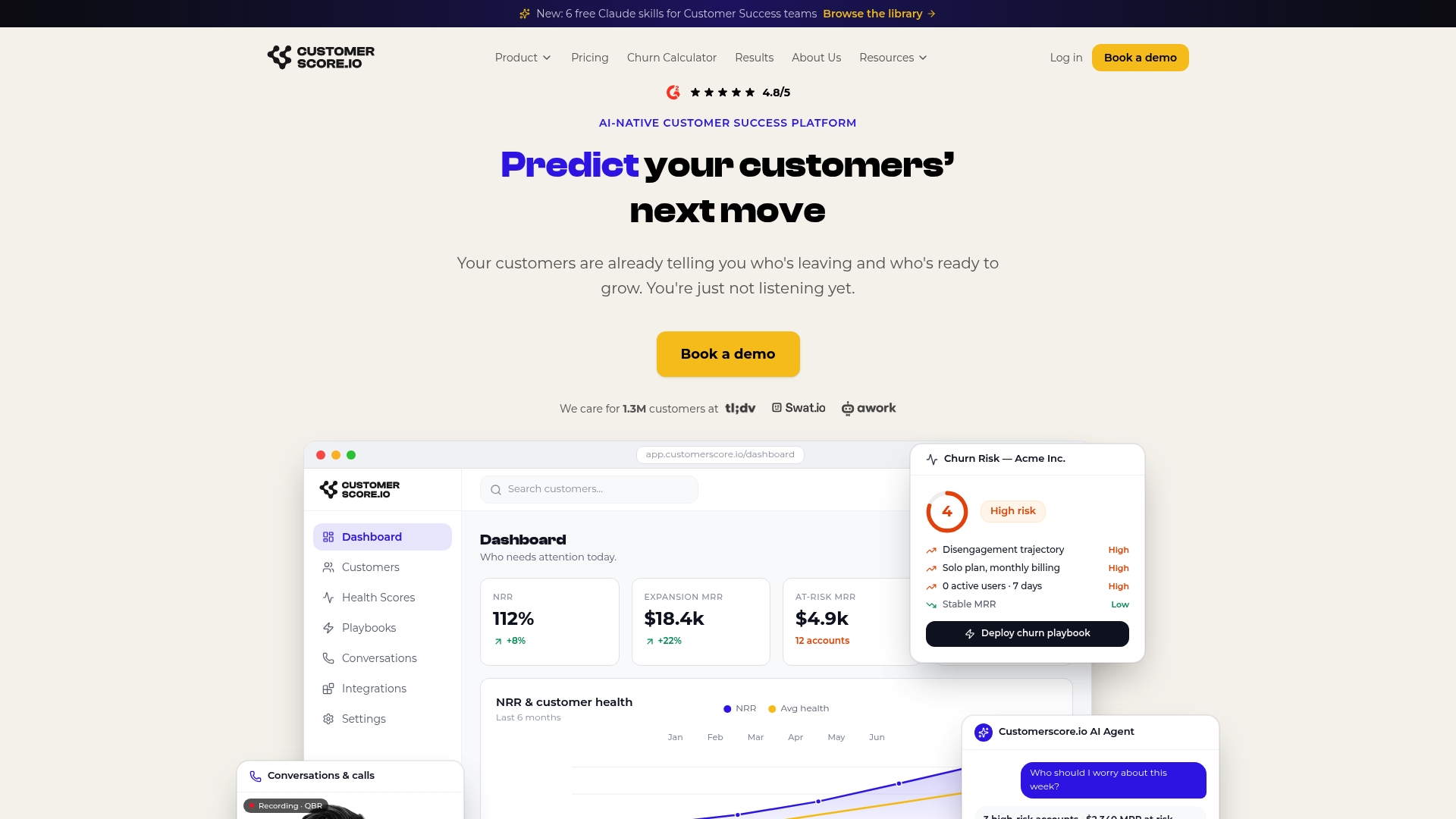
Three things that set it apart from the alternatives covered here:
- My Day priorities. Every CSM knows which accounts need them today and why, with the brief and QBR prep ready.
- Explainable AI health scores. Every score shows the contributing factors, so CS reps know exactly what to do next rather than guessing at a red indicator.
- Login-free customer rooms. Customers access their onboarding plan, milestones, and resources without creating an account, which removes the single biggest friction point in customer-facing portals.
See how AI churn prediction and health scoring work in practice, or book a demo to walk through a live onboarding scenario. Expert-led setup gets most teams live in 1 to 3 weeks.
Further reading and sources used for evaluation
The sources below were used to validate claims in this article. Each is annotated with what you will find there and why it is useful for vendor evaluation. Scope: B2B SaaS market in Europe and the US, onboarding and post-sale delivery focus, evaluated for 2026.
| Source | What you will find | Why it is useful |
|---|---|---|
| G2: GUIDEcx reviews | Verified buyer reviews of GUIDEcx covering workflow fit, integrations, and support | Surfaces real user pain points that drive the search for alternatives |
| G2: GUIDEcx review (implementation focus) | Detailed review of GUIDEcx from an implementation team perspective | Useful for understanding where GUIDEcx falls short for complex rollouts |
| G2: GUIDEcx review (analytics gap) | Buyer review highlighting analytics and reporting limitations | Supports the analytics gap rationale for switching |
| G2: GUIDEcx review (pricing and scaling) | Review covering pricing model concerns and scalability | Validates the TCO red flags in the how-to-choose section |
| G2: Arrows reviews | Verified buyer reviews of Arrows covering HubSpot integration and customer-facing UX | Useful for evaluating CRM-native onboarding tools |
| G2: Client onboarding category | Category overview with ratings and feature comparisons across onboarding platforms | Good starting point for mapping vendors to the categories in this article |
| Forrester: effective customer onboarding | Analyst perspective on onboarding as a driver of customer value and retention | Supports the argument that onboarding execution and CS intelligence should be evaluated together |
| TrustRadius: GUIDEcx alternatives | Marketplace review page listing GUIDEcx competitors with buyer ratings | Useful for cross-referencing buyer segments and common switching reasons |
| CB Insights: GUIDEcx competitors | Market mapping of GUIDEcx competitors by category | Supports the category-based grouping used in this article |
| Customerscore.io | Product positioning, feature list, and integration details for Customerscore | Primary source for Customerscore capability claims in the E-E-A-T section |
Recommended
Related articles
Best Customer Success Software for SaaS Teams in 2026
The 8 best customer success software platforms for SaaS in 2026, compared by company size and use case: health scoring, churn prediction, automation, pricing.
BlogMulti-Year Renewals in B2B SaaS: When to Offer Them and How
When a multi-year renewal pays off, what discount to expect, which clauses protect both sides, and how to time the offer.
BlogCustomer Success Org Design: Structure, Roles and CSM Capacity
How to structure a customer success team, size books by hours rather than ratios, and evolve the org as the company grows.
BlogSales to Customer Success Handoff: Template, Checklist and Other Handoffs
A one-page handoff brief, the fields it needs, timing targets, and how support to CS and product to CS handoffs work.