
Recover 5–15% of ARR with SaaS Winback Campaigns That Use Segmentation


Run winback campaigns as an automated, segmented sequence that starts within 24 hours of cancellation, not a one-off "we miss you" email. Payment-failure churners and customers who left in the last 30 days convert best, and structured 30/90/180 sequences recover 5 to 15% of churned customers when paired with segmentation and automation. The next step is mechanical: define your lapse windows today and let the first trigger fire this week.
TL;DR:
- Target payment failure churners immediately with frictionless, automated payment restore flows, as they convert two to three times higher than other segments.
- Prioritize recent, high-value, or high-MRR customers for winback sequences within the first 30 days, focusing on personalized, reason-specific messaging.
- Implement structured, multi-step sequences spaced over 14 to 21 days, emphasizing timing, personalization, and cancel-reason alignment for maximum recovery.
- Use omnichannel triggers, including email, SMS, and in-app messaging, based on real customer signals rather than calendar delays, to increase engagement.
- Measure winback success using segment-specific recovery rates, cost per recover, and re-churn rates, and leverage health scoring and cancel reason data to optimize targeting.
Table of Contents
- What Are Winback Campaigns in SaaS, and Why Do They Matter?
- Which Churned Customers Should You Target First?
- What Is the Right Timing and Cadence for Winback Sequences?
- What Winback Message Frameworks and Templates Actually Convert?
- How Should You Structure Offers Without Training Customers to Churn for Discounts?
- What Technical Setup Makes Reactivation Frictionless?
- How Do You Automate Winback Across Email, SMS, In-App, and Paid Channels?
- How Do You Measure Whether a Winback Program Is Working?
- How Churn Prediction and Cancel-Reason Data Raise Winback ROI
- What Should the First 30 Days After Reactivation Look Like?
- What Causes SaaS Churn, and How Should Winbacks Address It?
- Which Psychological Triggers Actually Move Churned SaaS Users?
- How Should Winback Strategy Differ Across SaaS Business Models?
- How Do You Keep Winback Emails GDPR and CAN-SPAM Compliant?
- What Do Real SaaS Winback Results Look Like?
- Treating Churn as a Temporary State, Not a Final Verdict
- See How Customerscore.io Fits This Playbook
- Sources
What Are Winback Campaigns in SaaS, and Why Do They Matter?
A SaaS winback campaign is an automated sequence of emails, in-app messages, or calls designed to reactivate a subscriber who canceled, paused, or let their trial expire. Unlike generic customer marketing, it targets someone who already knows your product, used it, and left for a specific reason. That history is the entire advantage.
The economics make winback one of the highest-leverage plays in a retention playbook. Winback campaigns convert at 2 to 5 times the rate of cold acquisition and cost a fraction of what it takes to find, convince, and onboard a brand-new customer. You are not building brand awareness or explaining what your product does. You are reminding someone who already bought why it was worth buying.
Timing compounds that advantage. ChartMogul's analysis of returned customers found that 45% of winbacks happen within 30 days of cancellation and 66% happen within 90 days. Wait too long and the opportunity decays fast, not gradually.
Why this matters operationally:
- Every canceled account still has residual product knowledge, meaning shorter sales cycles.
- Recovered ARR requires no new integration setup, no fresh champion identification, and often no procurement cycle.
- A working winback motion protects revenue that would otherwise show up as a permanent loss in your churn report.
- It gives you a live feedback loop on why customers actually leave, which is worth more than most exit surveys.
Treat winback as a revenue channel with its own funnel, its own segments, and its own conversion targets, not an afterthought bolted onto your churn dashboard.
Which Churned Customers Should You Target First?
Not every churned account deserves the same email.
Start with churn reason, because it determines the entire message strategy:
- Payment failure (involuntary churn). These customers didn't choose to leave. Payment-failure churn converts 2 to 3 times higher when the flow focuses on a frictionless payment restore rather than a discount. Treat this as an urgent, near-instant trigger, not a nurture sequence.
- Voluntary cancellation with a captured reason. Feature gap, price sensitivity, low usage, or "no longer needed" each require a different pitch. This is where cancel-reason capture pays off directly.
- Voluntary cancellation with no reason captured. Fall back to behavioral signals: last feature used, tenure, and MRR at time of cancellation.
Once you know the reason, prioritize by value and recoverability:
- Payment failures go first, automated, same day.
- Feature-gap churners go next, but only after checking whether the requested feature has since shipped.
- High-MRR or high-ARR accounts get a manual, human-led outreach from customer success or sales, never a generic discount email.
- Low-tenure, low-usage, low-MRR accounts can run on a lightweight automated sequence with no manual review.
A quick RFM-style checklist works for triage: recency (days since churn), frequency (how deep was usage before they left), and monetary value (MRR or ARR). Score each churned account on those three axes and you'll know within minutes which segment deserves a human and which deserves an automated trigger.
What Is the Right Timing and Cadence for Winback Sequences?
The 30/90/180-day pattern exists because the data behind it is stark. With a majority of winbacks landing in the first 30 days, with two-thirds by day 90, per ChartMogul's research, your sequence needs to be front-loaded, not evenly spaced.
Short-lapse sequence (day 0 to 30). This is where most of your recovered revenue lives. Klaviyo's analysis of winback campaigns recommends a three-step structure over 14 to 21 days: a re-introduction touch, a social-proof or feature-update touch, and an offer-plus-easy-unsubscribe touch. That cadence consistently outperforms a single blast.

Mid-lapse sequence (day 30 to 90). The tone shifts from "come back" to "here's what changed." This window works well for customers who churned over a feature gap that may since be resolved, or for seasonal SaaS products where a usage dip doesn't mean permanent disinterest.
Long-lapse sequence (day 90 to 180 and beyond). Response rates drop, so cadence should stretch out to monthly touches rather than weekly ones. Expect lower conversion, but not zero. Some of these accounts left over a budget cycle, not a product problem, and a well-timed "new tier" or "annual renewal alignment" message can still land.
Branch rules matter as much as the calendar:
- If a payment-failure account doesn't respond to two automated retry emails within 5 days, escalate to a manual outreach.
- If a high-MRR account cancels, skip the automated track entirely and route straight to customer success.
- If a customer opens every email but never clicks, switch the offer or channel before abandoning the sequence.
What Winback Message Frameworks and Templates Actually Convert?
Generic "we miss you" emails underperform because they ignore why the customer actually left. Personalized winbacks that reference the specific cancellation reason convert 3 to 5 times better than generic re-engagement copy, and that number climbs to 15 to 25% when the winback message references a feature the customer specifically requested that has since shipped.
Subject lines should do one of three jobs: acknowledge the specific reason for leaving, flag something new, or create a soft deadline. "We fixed the thing you told us about" beats "Come back to [Product]" every time.
Four templates worth adapting:
- Payment-failure reactivation: "Your account paused, not canceled. Update your card in one click and pick up right where you left off." No discount needed. Just remove friction.
- Feature-shipped re-entry: "You asked for [feature]. It's live." Lead with the specific feature name, link directly to it, and skip the sales language entirely.
- Feedback-led re-entry: "You told us [X] wasn't working. Here's what we changed." This works even when the fix is partial, because it shows the customer was heard.
- Last-chance offer: Reserved for the final touch in a sequence, this pairs a time-boxed incentive with a clear unsubscribe link, following the structure Klaviyo recommends for closing out a three-step cadence.
Pro Tip: Never open a winback email by apologizing for a bug or outage unless the customer's cancel reason explicitly mentioned it. Bringing up a problem they'd forgotten about can remind them exactly why they left.
Dos and don'ts: personalize with the account's actual usage history, not just their first name; keep CTAs to one action per email; avoid stacking three offers in a single message; and never use urgency language you can't back up with a real deadline.
How Should You Structure Offers Without Training Customers to Churn for Discounts?
Discounting every churned account teaches your best customers to cancel strategically and wait for a coupon. That is the single biggest risk in winback offer design, and it is avoidable with a clear escalation structure.
Core principles first:
- Protect long-term pricing integrity by reserving discounts for the later stages of a sequence, not the opening message.
- Match the offer to the segment's value. A $50-per-month account and a $50,000-per-year account should never see the same incentive.
- Prefer differentiated, non-cash value where possible: extended trials of premium features, dedicated onboarding, or priority support access.
An escalation framework tied to the 30/90/180 cadence looks like this: the day-0 to day-7 touch offers no discount at all, just friction removal or a feature update. The day-14 to day-30 touch can introduce a modest, time-boxed incentive if the account is mid-value. By day 90, if the account still hasn't returned and the reason was voluntary, a stronger offer becomes reasonable because the acquisition-cost math has shifted in your favor.
The exception is payment-failure churn, where frictionless payment restore outperforms discounting at every stage. Never discount your way into fixing a broken card.
Non-discount alternatives deserve more attention than most teams give them: a white-glove re-onboarding session, temporary credits toward usage-based features, or a 30-day premium support upgrade. These preserve price integrity while still giving the customer a reason to say yes.
What Technical Setup Makes Reactivation Frictionless?
The best copy in the world fails if the reactivation flow makes people work for it. One-click reactivation with a pre-applied offer is the single most commonly violated technical requirement in SaaS winback programs, and fixing it is often a bigger lever than rewriting your emails.
Build these into your reactivation flow:
- Tokenized checkout links that pre-fill the customer's plan, billing details, and any offer, so reactivation takes one click instead of a full signup flow.
- Separate payment-retry flows from voluntary-churn reactivation flows. A card update should never route through your full marketing checkout.
- Preserve UTM and attribution parameters through the reactivation link so your analytics correctly credit the winback channel.
- Include a working List-Unsubscribe header on every winback email. Deliverability for this entire program depends on keeping complaint rates low, and a broken unsubscribe link is the fastest way to get flagged as spam.
Pro Tip: Test your own reactivation link on a burner account every quarter. Checkout flows break silently when payment providers update APIs, and a dead reactivation link can go unnoticed for months while you keep sending traffic to it.
If your payment processor supports it, route involuntary churn through automated dunning retries before a human ever sees the account. Save the manual touch for cases where three automated attempts have failed.
How Do You Automate Winback Across Email, SMS, In-App, and Paid Channels?
Email is the default starting channel, but it isn't the ceiling. RevenueCat's guide to winback notes that omnichannel sequences, layering SMS, in-app messaging, and paid retargeting on top of email, can outperform email alone for specific segments, particularly high-engagement former users who've simply gone quiet.
Set up triggers that fire based on real signals rather than a flat calendar:
- Trigger the first email within 24 hours of a payment failure or voluntary cancellation, keyed to churn reason and captured at cancellation.
- If the account had a declining health score before churning, route it into a shorter, more urgent sequence, since these customers were likely already disengaged before they officially canceled.
- Add SMS only for time-sensitive touches, like a last-chance offer expiring in 48 hours, since overusing SMS burns goodwill fast.
- Layer in-app messaging for freemium or free-trial users who still have partial account access, since they'll see the message the next time they log in.
- Reserve paid retargeting for accounts that ignored three or more owned-channel touches but still show intent signals, like visiting your pricing page.
- Escalate to a named customer success or sales rep automatically once an account crosses a defined ARR threshold, rather than waiting for someone to notice.
The health score data behind these triggers matters more than the channel mix itself. Get the trigger logic right and the channel sequencing becomes a tuning exercise, not a guessing game.
How Do You Measure Whether a Winback Program Is Working?
Track five numbers, and track them by segment, not just in aggregate: winback rate, time-to-winback, cost-per-winback, re-churn rate, and recovered ARR. A program that looks healthy in aggregate can be quietly failing for your highest-value segment if you never break the data apart.
Structured 30/90/180 sequences with real segmentation and automation recover between 5 and 15% of churned customers. That range is wide because segmentation quality, offer design, and technical friction all swing the outcome hard in either direction.
Expect the bulk of that recovery to land inside the first 90 days, consistent with the front-loaded pattern ChartMogul documented. If your day-180 numbers look strong but day-30 numbers look weak, something in your fast-response flow is broken, not your patience.
Common measurement pitfalls worth avoiding:
- Failing to track re-churn rate, which quietly erases apparent wins. A customer who reactivates and cancels again within 60 days isn't a real recovery.
- Double-counting attribution when a customer returns through both a winback email and an organic re-signup around the same time.
- Reporting a single blended winback rate instead of breaking results down by churn reason, which hides which segments are actually working.
- Ignoring cost-per-winback, since a program that spends heavily on discounts to hit a high raw recovery number may be destroying margin even as it "succeeds" on paper.
A churn calculator can help model expected recovered ARR against your actual cost-per-winback before you scale a program company-wide.
How Churn Prediction and Cancel-Reason Data Raise Winback ROI
The teams getting the best winback results aren't waiting for cancellation to start working. Predictive health scoring flags accounts trending toward churn weeks before they cancel, which means you can launch a pre-emptive save sequence instead of a purely reactive winback one.
Practical steps that move the needle:
- Score every active account on churn risk and route declining accounts into a proactive outreach track before they ever hit the cancel button.
- Require a structured cancel-reason field at the point of cancellation rather than an optional free-text box. Structured cancellation capture is what makes highly targeted, high-conversion winback messaging possible in the first place.
- Route each captured reason to a matching template automatically: payment failure to a payment-restore flow, feature gap to a feature-shipped tracker, price sensitivity to a value-reinforcement sequence.
- Feed aggregated cancel reasons back to product and onboarding teams. Winback data is a live signal of what's actually driving churn, and that feedback loop measurably reduces future churn when acted on.
Health scores also help you decide, in real time, which reactivated accounts need a human touch in their first weeks back versus which can run on autopilot.
What Should the First 30 Days After Reactivation Look Like?
A reactivated customer is not a retained customer yet. Re-churn within the first month is common when teams treat reactivation as the finish line instead of the starting point of a second onboarding.
Treat the first 30 days post-reactivation as a distinct lifecycle stage with its own plan. Reintroduce the product's core value immediately, ideally referencing whatever brought them back, whether that was a fixed bug, a new feature, or a payment issue resolved. If they returned because of a specific feature, make sure their first session after reactivation actually surfaces that feature rather than dropping them back into a generic dashboard.
Check in earlier than you would with a brand-new signup. A reactivated customer already has baggage: something didn't work the first time. A proactive check-in at day 7, not day 30, catches friction before it becomes a second cancellation.
Watch usage signals closely during this window. If a reactivated account shows the same disengagement pattern that preceded their original churn, that's an early warning worth acting on immediately, not a data point to review at the next quarterly business review. This is where health scoring earns its keep twice: once to flag the original at-risk account, and again to catch a repeat pattern after reactivation.
Finally, consider a lightweight, no-pressure re-onboarding touch, even for self-service accounts. A short email walking through what's changed since they left often prevents the "I forgot how this works" drop-off that quietly drives a second cancellation.
What Causes SaaS Churn, and How Should Winbacks Address It?
SaaS churn clusters into a handful of recurring causes, and each one demands a different winback angle rather than a one-size-fits-all message.
Payment failures are the most mechanical and the most fixable. These aren't really churn in the traditional sense: the customer wanted to stay but a card expired or a bank declined a charge. Address this with an immediate, friction-free payment-restore flow, not a marketing email.
Feature gaps happen when the product didn't do something the customer needed. These customers are worth tracking closely, because if your roadmap catches up, they're among the easiest reactivations available. Reference the specific gap by name once it's closed.
Poor onboarding drives churn before a customer ever gets real value. These customers often respond well to a completely different second-onboarding experience, not just a "come back" message, since the first one clearly didn't work.
Perceived low value relative to price shows up when usage was healthy but the customer didn't see enough return. This is where a tier-adjusted offer or a usage-based alternative can outperform a blanket discount, because the actual objection was value, not price alone.
Budget or organizational changes are the hardest to win back through messaging alone, since the decision often wasn't about your product at all. A longer, patient cadence, checked-in quarterly rather than weekly, fits this group better than an aggressive short sequence.
Address the reason, not just the fact of cancellation, and your conversion rates on identical audiences can shift dramatically depending on which of these five buckets the customer actually falls into.
Which Psychological Triggers Actually Move Churned SaaS Users?
Churned SaaS users are a specific psychological audience: they made an active decision to stop paying for something, which means guilt-driven or generic-urgency messaging tends to backfire. The tone that works acknowledges their decision was reasonable at the time, rather than implying they made a mistake.
Loss aversion works, but only when it's specific. "You'll lose access to your saved reports" lands harder than "Don't miss out," because it names a concrete thing the customer actually built or stored. Vague urgency reads as manipulative to an audience that already knows your sales patterns.
Reciprocity is underused in winback copy. Leading with something free, a resource, an extended feature unlock, or a direct answer to their stated cancel reason, before asking for anything back tends to outperform leading with an ask.
Social proof matters less here than in acquisition messaging, because the customer already has firsthand experience with your product. A stat about "10,000 companies trust us" means nothing to someone who was one of those companies and left anyway. Replace it with proof tied to what actually changed since they canceled.
Autonomy preservation is the most overlooked trigger. Churned users respond better to messages that clearly offer an easy exit (a visible unsubscribe link, no guilt trip) alongside the pitch to return. Removing pressure paradoxically increases response rates, because it signals confidence rather than desperation.
Keep tone matter-of-fact and specific. Enthusiasm and exclamation points read as tone-deaf to someone who just canceled a subscription; calm, direct language reads as respect for their decision.
How Should Winback Strategy Differ Across SaaS Business Models?
A freemium product and an enterprise-tier subscription need fundamentally different winback logic, because the cost of a wrong message differs by order of magnitude.
Freemium-to-paid churn (a user who downgraded to free or stopped engaging with a free tier entirely) responds well to lightweight, high-frequency automated nudges tied to specific feature usage. Since acquisition cost per user is already low, an aggressive discount rarely makes sense here. Feature-unlock messaging and usage-based nudges do more work than price incentives.
Single-tier subscription churn benefits most from the standard 30/90/180 cadence described earlier, since most customers in this model fall into a fairly uniform value band. Segmentation by churn reason matters more than segmentation by account value in this model.
Multi-tier subscription churn requires value-matched offers. A customer on your entry tier shouldn't see the same incentive as one who canceled from your top tier; the entry-tier customer might respond to a modest discount, while the top-tier customer needs a human conversation and possibly a custom package.
High-ARR or enterprise churn should almost never touch an automated discount sequence at all. Route these accounts straight to customer success with tailored, human outreach, because automated discounting reads as tone-deaf and under-values what these accounts actually represent. A senior CS rep who understands the account's specific cancellation context will consistently outperform any templated email at this tier.
Match the sophistication of your winback approach to the sophistication of the buying decision that got them there in the first place.
How Do You Keep Winback Emails GDPR and CAN-SPAM Compliant?
Winback campaigns sit in a legal gray zone that trips up more marketing teams than any other retention tactic, because you're emailing people who explicitly chose to stop being your customer.
Under GDPR, the legal basis for continuing to email a churned EU customer depends on how their original consent was structured and what your privacy policy promised at signup. If a customer's original consent was tied specifically to active-customer communications, sending winback marketing after cancellation may require a separate legal basis or fresh consent. Review this with legal counsel for your specific market rather than assuming your original signup consent covers indefinite winback outreach.
Under the US CAN-SPAM Act, every winback email needs a working, honored unsubscribe mechanism, and requests must be processed within the law's required window. This is precisely why the List-Unsubscribe header matters technically, not just as a courtesy: a broken or ignored opt-out is a direct compliance failure, not just a deliverability problem.
A few practical safeguards apply broadly, though specific rules vary by jurisdiction and should be confirmed with qualified legal counsel:
- Never remove a customer's original opt-out or add them back to marketing lists after they've unsubscribed, even if they later reactivate through a different channel.
- Keep a clear record of consent basis and timestamp for every account you're targeting with winback outreach.
- Treat SMS winback messages with extra caution, since SMS marketing consent rules in most jurisdictions are stricter than email consent rules.
- If an account churned specifically citing a data or privacy concern, route it away from any automated marketing sequence and flag it for manual review.
What Do Real SaaS Winback Results Look Like?
The clearest pattern across published SaaS winback data is how much timing and personalization outweigh raw offer size. ChartMogul's analysis of returned customers across thousands of companies found the 45%-within-30-days, 66%-within-90-days curve holds broadly across company sizes, which is why programs built around a flat 30/90/180 structure consistently outperform ad hoc, occasional winback blasts.
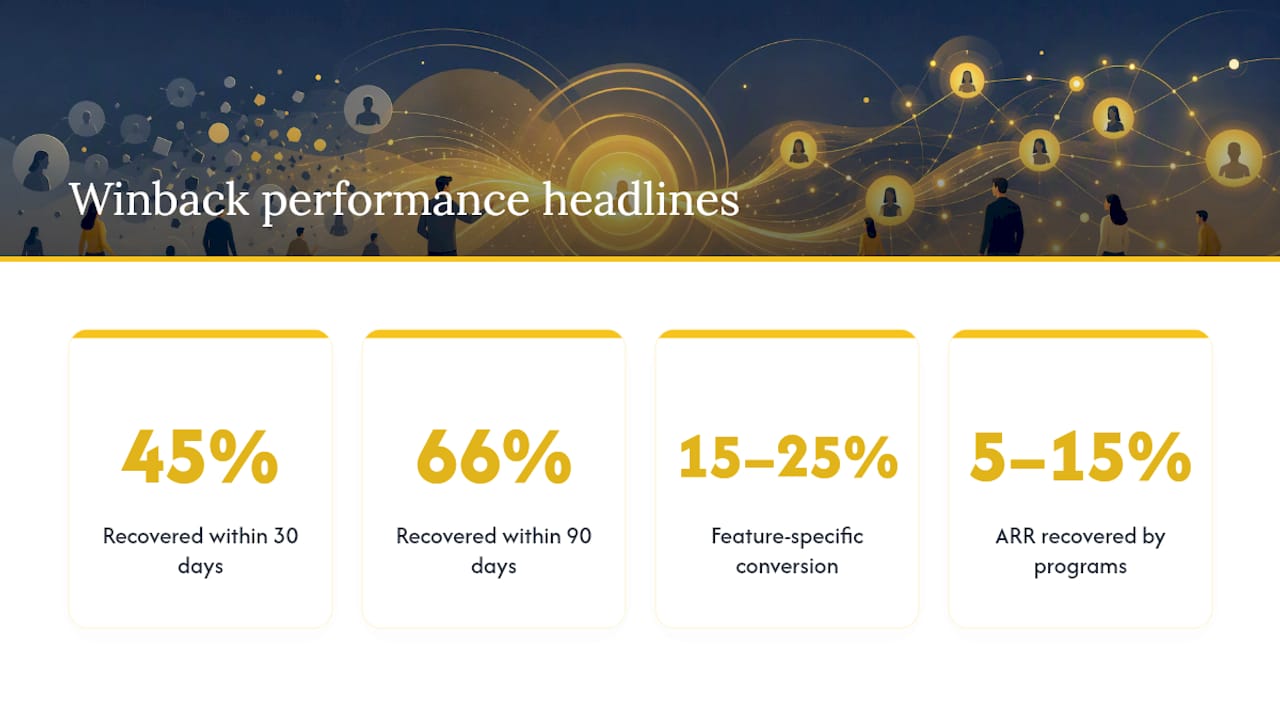
The personalization gap is even more dramatic. Feature-specific winback messages that reference a shipped feature the customer had asked for reach 15 to 25% conversion, compared to the 3 to 5x lift generic personalized messages get over blanket "we miss you" sends. That gap alone justifies investing in cancel-reason capture before investing in fancier email design.
On the sequencing side, Klaviyo's documented three-step structure, re-introduction, then social proof or feature update, then offer with a clear unsubscribe, consistently beats single-send campaigns across the accounts it's been tested on. The lesson isn't that any one email works. It's that the sequence itself, spaced over 14 to 21 days, does work the way a single blast never can.
Programs that layer segmentation, front-loaded timing, and structured cancel-reason routing together are the ones landing in the 5 to 15% recovery range that separates a functioning winback motion from a symbolic one.
Treating Churn as a Temporary State, Not a Final Verdict
Most SaaS teams still treat cancellation as the end of the relationship, log it, forget it, move on. That mindset alone caps your recovery rate before you've written a single email. Reframing churn as a recoverable, temporary state instead of a permanent loss tends to show up directly in retention numbers.
Start small: pick one segment, one three-step sequence, and one 60-day window to track actual recovered ARR against cost. Don't roll out five sequences across every segment on day one. And get customer success, marketing, and product in the same room before you launch, because the cancel reasons you capture are only useful if product actually sees them.
Patrik
See How Customerscore.io Fits This Playbook
Every tactic in this playbook depends on one thing: knowing why someone is about to leave before they do, and knowing exactly why they left after they do. That's the gap most winback programs never close, and it's the specific gap Customerscore's churn prediction platform is built to fill for B2B SaaS teams.
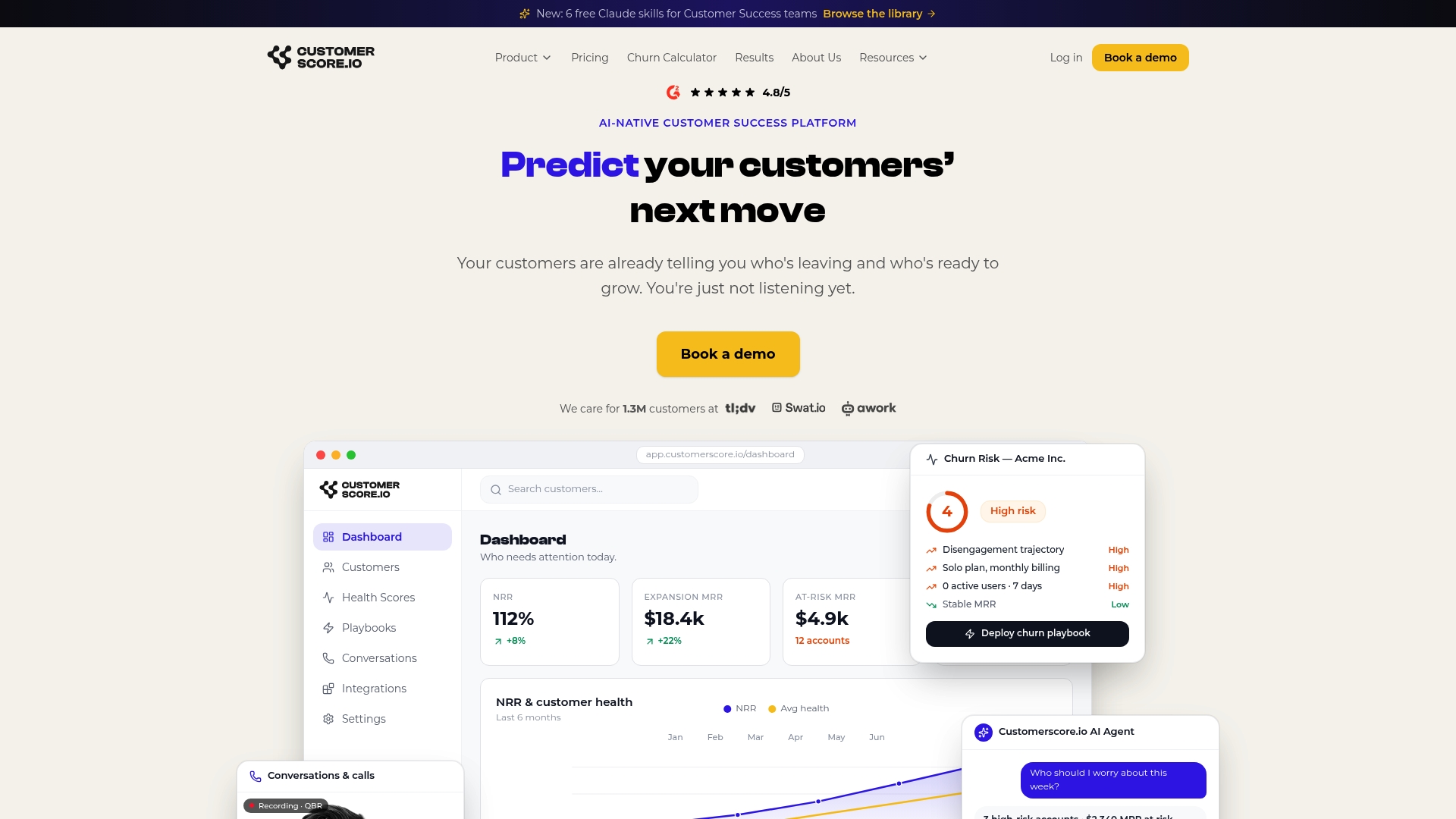
Customerscore combines explainable health scoring with structured cancel-reason capture across your billing, product usage, CRM, and support data, so the "payment failure first, feature gap next" prioritization described earlier isn't a manual spreadsheet exercise. It's a live health score that routes each churned or at-risk account to the right playbook automatically, with integrations across HubSpot, Salesforce, Stripe, Chargebee, and Intercom feeding the model.
If you're running winback manually today, or not running it in a structured way at all, the fastest way to see what a predictive, playbook-driven version looks like for your accounts is to book a demo and walk through your own churn data with the team.
Sources
The timing benchmarks, segmentation logic, and conversion figures in this playbook draw on ChartMogul's SaaS Winbacks Report, Retainly's data on structured winback sequences, Klaviyo's winback email best practices, and RevenueCat's guide to omnichannel reactivation. For a deeper look at churn segmentation methodology, see Aidventure's churn analysis playbook, and for cadence templates, Crono's retention template library is worth reviewing alongside the frameworks above.
- Win-Back Campaigns: Recovering Lost Revenue from Churned Customers
- The SaaS Winbacks Report: Why Winbacks Signal Growth | ChartMogul
- SaaS Win-Back Email Campaigns: Recover 5–15% of Churned Customers · Retainly
- Win-back email campaign examples and best practices | Klaviyo blog
Recommended
Related articles
Five Fields to Fix Playbook Trigger Design for B2B SaaS CS & RevOps
Five Fields to Fix Playbook Trigger Design for B2B SaaS CS & RevOps ! Isometric trigger routing system illustration The most reliable approach to playbook trigger design is to sort every alert into
BlogStop SaaS Downgrades: Save 31% of At Risk Accounts for CS & RevOps
Stop SaaS Downgrades: Save 31% of At Risk Accounts for CS & RevOps ! Isometric account protection title card The fastest way to prevent SaaS downgrades is to stop treating every at-risk account the
Blog24–48 Hour Handoffs: B2B SaaS Support to CS Checklist, Six Fields
24–48 Hour Handoffs: B2B SaaS Support to CS Checklist, Six Fields ! Isometric handoff cards crossing between platforms A reliable support to CS handoff transfers ownership and context so the new owner
Blog90–120 Day Explainable AI Playbook to Reduce Renewal Risk for SaaS CS
90–120 Day Explainable AI Playbook to Reduce Renewal Risk for SaaS CS ! Isometric illustration of explainable renewal risk decisions To reduce renewal risk, you prioritize accounts daily using