
SaaS Startups: Buy CS at 100–200 Customers, Run a 4–6 Week Pilot


Match your customer success tool to customer count, not company size: a CRM tag system works until roughly 100 customers, lightweight CS platforms cover 100 to 500, and mid-market or enterprise platforms take over past that. The trigger to buy is simple: once one person can no longer hold every account's status in their head, usually around 100 to 200 customers, it's time to move. Startups needing AI churn prediction and explainable health scores without a long rollout should look at Customerscore directly.
TL;DR:
- Once managing more than 100 to 200 customer accounts becomes unmanageable, it is time to transition from CRM tools to dedicated customer success platforms.
- The ideal platform size aligns with customer count stages, with lightweight tools suitable for 100 to 500 customers and enterprise solutions for beyond 1,500 accounts.
- Critical features include predictive churn signals, explainable health scores, onboarding workflows, automated renewal playbooks, and seamless integrations with billing, CRM, and product analytics.
- Evaluation should last four to six weeks, involving live trials with real data, reference calls, and clear pass/fail criteria focused on integration, automation, and scoring accuracy.
- Starting with a phased rollout and avoiding overbuying on complexity prevents shelfware, while onboarding speed depends heavily on platform category and integration readiness.
Table of Contents
- Stage-Based Customer Success Software Recommendations
- What Features Actually Matter for Startup CS Teams
- How Do You Evaluate a CS Platform Before Buying?
- Setting Up CS Software Without It Becoming Shelfware
- An Editor's Take on Buying Customer Success Software Too Early
- Getting Customerscore Running Without a Quarter-Long Rollout
- Sources
- FAQ
Stage-Based Customer Success Software Recommendations
The right tool depends on where your customer base and sales motion actually are, not where you hope to be in 18 months. Buying ahead of your stage burns budget on features nobody uses; buying behind it means renewals slip through cracks nobody's watching.
0 to 50 customers. A CRM (HubSpot, Salesforce) with custom fields and a shared spreadsheet handles this fine. You know every account by name. Spend money on product, not on customer success software yet.
50 to 200 customers. This is the real inflection point. Most teams adopt a dedicated CS platform around 100 to 200 customers, right when tribal knowledge stops scaling. Lightweight platforms are the fit here, and they're typically better value than enterprise tools for startups under roughly 500 customers. Product-led growth (PLG) companies should prioritize usage-event tracking; sales-led teams need tighter CRM sync for handoffs between sales and CS.
200 to 500 customers. Mid-market platforms start to earn their price tag, particularly if you've hired a dedicated CSM headcount and renewals are becoming a full-time job rather than a side task.
500 to 1,500 customers. You need automated playbooks and health scoring that update without a human refreshing a spreadsheet. Manual monitoring at this volume guarantees missed renewals.
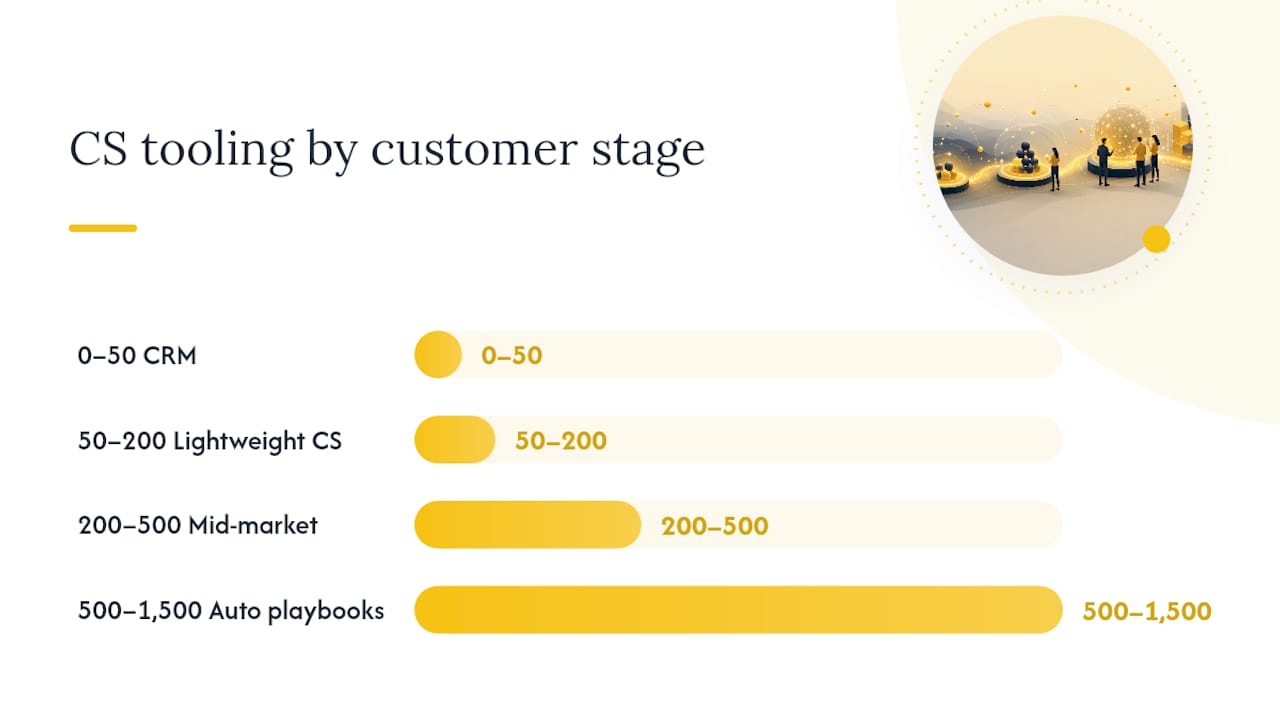
1,500+ customers. Enterprise platforms with deeper customization, SSO, and audit trails make sense, especially once compliance and multiple CS teams enter the picture.
Watch for these upgrade triggers regardless of your exact customer count:
- A single CSM manages more accounts than they can review weekly.
- Renewals get missed because nobody flagged the account 60 days out.
- Churn shows up in the revenue report before anyone saw it coming.
- Your CRM's custom fields have turned into a fragile, unofficial health score.
Budget bands track this curve closely. Entry-level platforms run free to a few hundred dollars a month; mid-market and enterprise tools can reach tens of thousands per year. Implementation timelines scale too: lightweight tools often go live in days, while enterprise deployments can take a full quarter once integrations and data cleanup are factored in.
What Features Actually Matter for Startup CS Teams
Not every feature on a vendor's homepage deserves your attention. Here's the priority order that actually moves retention and expansion numbers:
- Predictive churn signals. Models that combine billing history, usage drop-off, and support sentiment together catch risk earlier than any single data source alone, and earlier than a CSM's gut feeling.
- Explainable health scores. A score that says "at risk" without saying why is useless in a renewal conversation. You need the underlying factors visible, not a black box.
- Onboarding workflows. Time-to-value in the first 30 days predicts renewal odds more than almost anything else you'll measure.
- Renewal and expansion playbooks. Automated triggers (usage spike, seat growth, low login count 90 days before renewal) beat a CSM remembering to check a spreadsheet.
- Integrations. Billing (Stripe, Chargebee), product analytics (Mixpanel, PostHog, Segment), CRM (HubSpot, Salesforce), and support (Intercom) all need to feed the same system, or your health score is guessing.
For product-led startups specifically, warehouse-native connections to Snowflake or BigQuery often decide the shortlist, since usage data already lives there.
Ownership matters as much as the tooling. RevOps typically owns data pipeline integrity, and CSMs own how the health score gets used in day-to-day account conversations, not the model's math.
Pro Tip: Before demoing any vendor, list the exact fields you'd need to build a health score by hand in a spreadsheet. If you can't name them, no tool will fix that gap for you.
How Do You Evaluate a CS Platform Before Buying?
The most reliable purchase process starts with mapping your retention workflow and required data inputs, not with sitting through five vendor demos and picking whichever sales rep was most convincing.
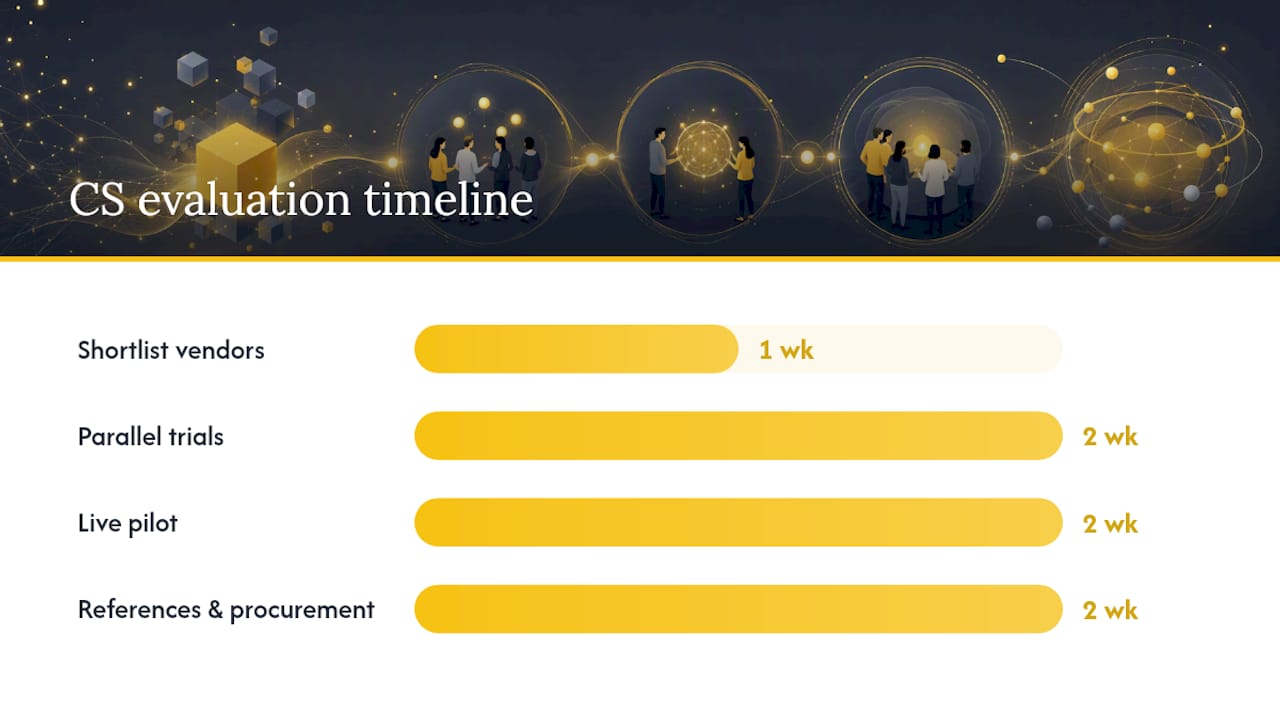
A realistic evaluation timeline runs four to six weeks:
- Week 1: Shortlist three vendors based on stage fit and integration compatibility.
- Weeks 2 to 3: Run parallel trials with a real (not sample) data set, ideally your billing and product analytics feeds.
- Weeks 4 to 5: Move the top candidate into a live pilot with a subset of actual accounts.
- Week 5 to 6: Run reference calls, then move to procurement.
Score each vendor on integration depth, health-score flexibility, playbook automation, reporting quality, admin overhead, and time-to-value. Roughly 100 to 200 customers is the point most teams cross before this evaluation becomes worth the time investment, a useful gut check if you're wondering whether you're early.
Set pass/fail criteria before the pilot starts, not after you've fallen for the interface. A red flag: if a vendor can't connect to your billing system without a custom engineering project, that's a preview of your ongoing admin burden, not a one-time setup cost.
Setting Up CS Software Without It Becoming Shelfware
Timelines vary sharply by category. Lightweight platforms with native integrations can go live in days; anything requiring custom data pipelines can stretch to a full quarter. Prebuilt templates and warehouse connectors are what actually shorten that window, not sales promises.
The mistakes that turn expensive software into shelfware are predictable:
- Buying for the company you'll be in two years, not the one you are now.
- Signing before checking whether your CRM and billing tool actually integrate cleanly.
- Skipping a live pilot with real accounts in favor of a canned demo.
- Underestimating ongoing admin time, someone has to maintain the health score logic, not just turn it on.
Mitigate with a phased rollout: launch a minimal health score first, expand playbooks once that's trusted, and name one CS Ops owner accountable for both.
An Editor's Take on Buying Customer Success Software Too Early
Most startups don't overbuy on price. They overbuy on complexity, signing enterprise contracts for problems a spreadsheet and a CRM tag still solve fine. Watch one number: the count of customers a single CSM can accurately describe from memory. When that number stops matching your actual customer count, buy. Not before. Customerscore's playbooks are built around that exact threshold, and the blog has case-pattern breakdowns worth reading before your first vendor call.
— Patrik
Getting Customerscore Running Without a Quarter-Long Rollout
Some platforms are built for the gap this guide points at: startups that have outgrown spreadsheets but don't have months to spend on a rollout. Such platforms may deploy in days, not quarters, and provide health scores with explainability rather than black-box labels.
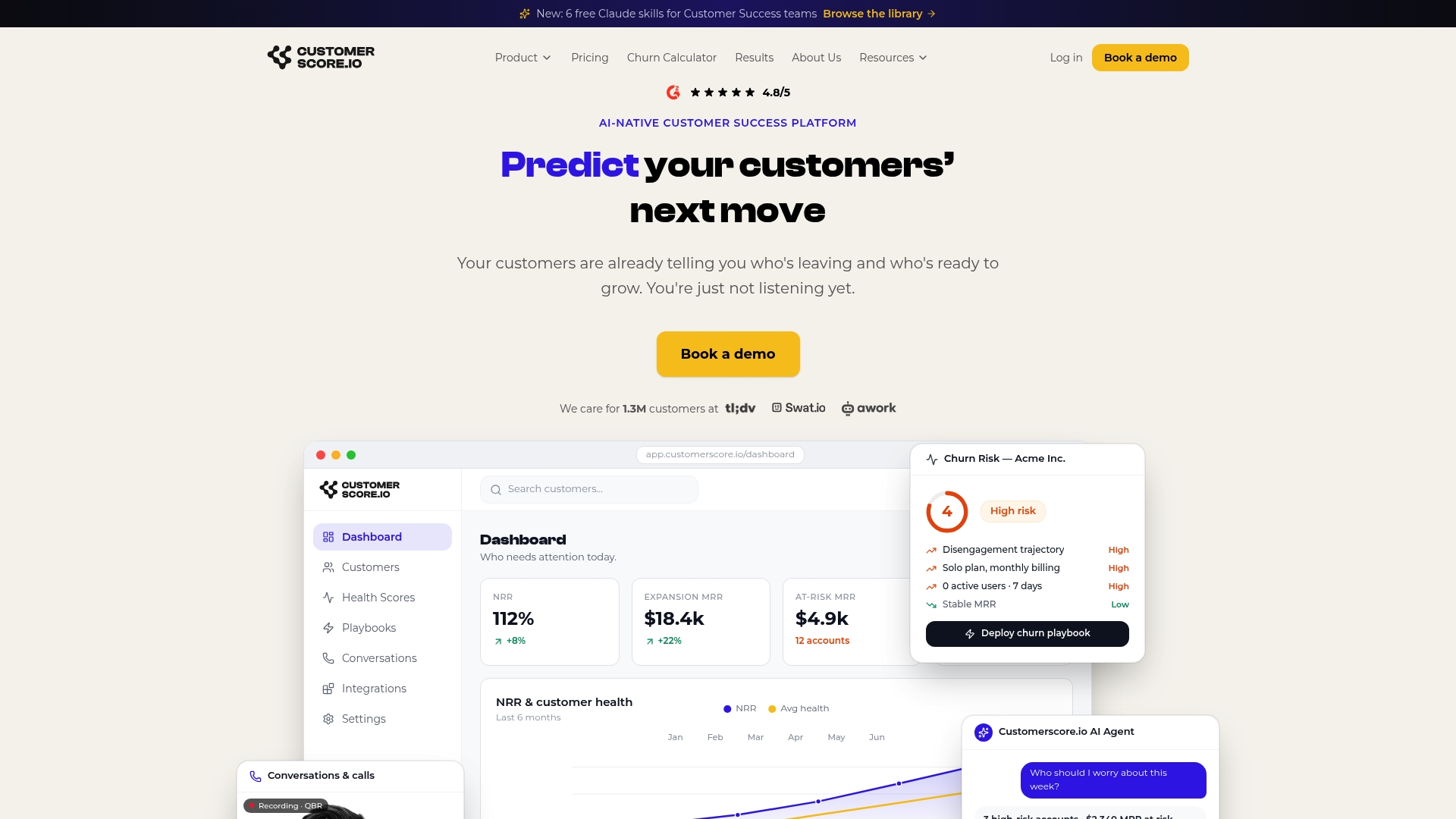
Coverage follows the same stage logic covered above: the same platform runs a leaner motion for high account volumes on automation and playbooks, or a deeper one for hands-on account management with dedicated CSMs. Common integrations include billing, CRM, product analytics, support, and collaboration tools, helping address integration needs from day one.
If churn prediction is your top priority, the churn prediction product page breaks down the model inputs. If explainable health scoring is the gap, the health score platform page shows exactly how the scoring logic surfaces to your team. Pricing is a flat platform fee tiered by your client ARR rather than per seat, quoted from the pricing page, and the fastest way to judge fit is to book a demo.
Sources
For deeper reading on vendor tiers and evaluation frameworks, see ChurnTools' decision guide, Inveo's platform category breakdown, and broader retention strategy from Baby Love Growth.
- How to Choose a Customer Success Platform (Decision Guide)
- Customer Success Platform: 3 Proven, Effective Categories
- Saasmentic
FAQ
What Counts as the Best CS Tool for a Startup?
There's no single best tool across all stages. The right choice depends on customer count and sales motion: a CRM extension under 100 customers, a lightweight platform like Customerscore between 100 and 500, and a mid-market or enterprise platform beyond that.
When Should a Startup Buy Dedicated CS Software?
The clearest trigger is when one person can no longer hold every account's status in their head, typically around 100 to 200 customers. Recurring missed renewals or churn discovered after the fact are also strong signals it's time.
How Much Does Customer Success Software Cost for Startups?
Budget bands run from free tools up to a few hundred dollars monthly for lightweight platforms, scaling into tens of thousands annually for enterprise tools. Customerscore.io does not list public pricing; it charges a flat platform fee tiered by your client ARR rather than per seat, quoted in one call.
How Long Does It Take to Implement a CS Platform?
Lightweight platforms with native integrations can go live within days, while enterprise deployments with custom data pipelines often take a full quarter. Warehouse connectors and prebuilt templates are the biggest accelerators regardless of platform size.
What Should a Pilot Test Before Signing a Contract?
A pilot should run with real accounts, not sample data, and test integration depth, health-score accuracy, and playbook automation against defined pass/fail criteria. Running this live pilot before signing an annual contract catches integration gaps that demos never surface.
Recommended
Related articles
Cut CSM Intervention 18%: Predictive Playbooks for CS & RevOps
Cut CSM Intervention 18%: Predictive Playbooks for CS & RevOps ! Predictive playbook geometric title card Predictive playbooks link a churn prediction to a specific, repeatable action so customer
BlogPinpoint B2B SaaS Adoption Gaps and the Fix That Lifts Renewal
Pinpoint B2B SaaS Adoption Gaps and the Fix That Lifts Renewal ! Analysts reviewing SaaS adoption gaps Adoption gap analysis identifies the funnel stage where eligible users or accounts fail to reach
BlogAnalysts: 6–12 Month Cohort Forecasts for Net Dollar Retention
Analysts: 6–12 Month Cohort Forecasts for Net Dollar Retention ! Analyst reviewing cohort retention forecast The most reliable way to forecast net dollar retention is cohort-based modeling that
BlogStop Surprise Churn: 5 Phase Data Mapping for RevOps and CS
Stop Surprise Churn: 5 Phase Data Mapping for RevOps and CS ! Analyst mapping customer data fields Data mapping for CS means connecting product usage, billing, CRM, and support data to the fields your