
Best Account Management Software for B2B SaaS (2026)


For B2B SaaS teams focused on retention and expansion, Customerscore is the strongest account management software available right now. It combines ML-driven multi-signal health scoring with explainable churn prediction and native workflow integrations into Slack, HubSpot, Salesforce, and Stripe. If you're a CS or RevOps leader who needs to move from reactive firefighting to proactive intervention, book a demo and scope a pilot before evaluating anything else.
Table of Contents
- What makes the best account management software for B2B SaaS?
- Customerscore: how it maps to the buyer checklist
- How do you evaluate and shortlist vendors quickly?
- What does a realistic 90-day implementation look like?
- How do CS platforms price, and what ROI should you expect?
- Key Takeaways
- What most teams get wrong when choosing a CS platform
- Customerscore makes the pilot easy to start
- Sources and further reading
What makes the best account management software for B2B SaaS?
The phrase "account management software" covers a lot of ground on the open web, most of it aimed at sales teams managing pipelines. This article is about something different: customer success platforms that predict churn, score account health, and orchestrate onboarding, renewal, and expansion workflows. That's the job-to-be-done for CS and RevOps leaders at B2B SaaS companies, and the evaluation criteria look nothing like a CRM shortlist.
The core feature checklist
Customer success management tools centralize data from product usage, CRM, billing, and support to enable unified health scoring and lifecycle automation. Any platform you evaluate seriously should deliver all five of these:
- Churn prediction: — ML models trained on multi-signal data (product usage, billing events, support volume, CRM activity), not a static formula someone built in a spreadsheet three years ago.
AI vs. rule-based scoring
Platforms that apply machine learning to multi-signal data outperform rule-based health scoring for churn prediction accuracy. Rule-based systems are fast to configure but brittle: they miss the interaction effects between signals (a customer who logs in daily but hasn't used a core feature in 60 days is a very different risk than the login rate alone suggests). ML models catch those patterns. The trade-off is explainability. A model that returns a score with no attribution is hard to trust and harder to act on. Require both: predictive accuracy and visible risk drivers.
Hybrid account motion support
Modern CS teams run two motions simultaneously: high-touch for strategic accounts and digital-led pooled journeys for the long tail. The platform you choose needs configurable, segment-specific health scoring so a 500-seat enterprise and a 10-seat SMB aren't evaluated on the same thresholds. Multi-channel orchestration, Slack alerts for CSMs, in-app nudges for self-serve accounts, and email sequences for pooled segments, should all be configurable from one place.

Integrations that actually matter
Best-in-class platforms embed health scores and alerts into existing workflows like Slack and CRM so teams act inside their day-to-day tools rather than logging into a separate dashboard. The integration list to require: HubSpot or Salesforce (CRM), Stripe or Chargebee (billing), Mixpanel, PostHog, or Segment (product analytics), Intercom or Zendesk (support), and Slack (comms). Missing any of these creates data gaps that degrade scoring accuracy.
Pro Tip: In your demo script, ask the vendor to show a live alert firing in Slack with a link back to the account's risk drivers. If they show you a dashboard screenshot instead, that's your answer.
Customerscore: how it maps to the buyer checklist
Customerscore is built specifically for B2B SaaS. Its AI health scoring platform applies ML to multi-signal data across billing, product usage, CRM, support, and communications to produce explainable scores with visible risk drivers. That last part matters: CSMs see not just the score but the specific signals pulling it down, so they know whether to trigger a training playbook, escalate to an account executive, or flag a billing issue.
Feature coverage
- ML churn prediction — trained on product usage, billing events, CRM data, and support activity
- Prebuilt playbooks for onboarding, renewal, and expansion, with configurable task assignment and multi-channel delivery
Integration coverage
Customerscore connects natively with HubSpot, Salesforce, Stripe, Chargebee, Mixpanel, PostHog, Segment, Intercom, Slack, and MCP/AI agents. That's the full stack a B2B SaaS CS team typically runs. No custom middleware required for the core integrations.
Trust signals and recognition
Customerscore was featured among the top customer retention tools in 2026, and its blog demonstrates active methodology transparency around AI scoring and retention outcomes. The GoodAccess case study shows measurable CS efficiency gains from the platform in production.
Market analysis confirms that AI agents automating administrative tasks deliver productivity gains beyond simple workflow automation. For CS teams carrying large account loads, that's the difference between a CSM managing 80 accounts reactively and managing 120 accounts proactively.
How do you evaluate and shortlist vendors quickly?
Use this checklist to qualify vendors in a single discovery call, then validate in a structured pilot.
- Scoring model: Does the platform use ML trained on your actual signal mix, or a configurable rule set? Ask for the model refresh cadence and how feature-level product usage feeds the model.
- Explainability: Can CSMs see per-account risk drivers, not just a composite score? Ask for a live example with named signals.
- Integrations: Which integrations are native vs. Zapier-dependent? Ask for integration latency and data freshness SLAs.
- Automation depth: Do alerts fire into Slack and CRM with account context, or do they require a CSM to log into the platform first?
- Data ingestion: How long does initial data ingestion take? Who owns the mapping work, your team or the vendor?
- Security: Is the vendor SOC 2 Type II certified? What data is stored, and for how long?
- Support SLAs: What's the response time for critical issues? Is there a named CSM or a support queue?
- Scalability: Can the platform score accounts differently by segment (enterprise vs. SMB) without separate configurations?
Red flags to walk away from: opaque scoring with no risk driver attribution; alerts that only appear in the platform dashboard; implementation timelines that require your engineering team for more than two weeks; no SOC 2 certification or vague SLA language.
For enterprise high-touch motions, weight scoring model depth and governance heavily. For product-led or pooled motions, weight automation, digital journey support, and self-serve onboarding playbooks.
What does a realistic 90-day implementation look like?
Time-to-value is where most CS platform purchases either prove themselves or stall. Here's a phased roadmap that works.
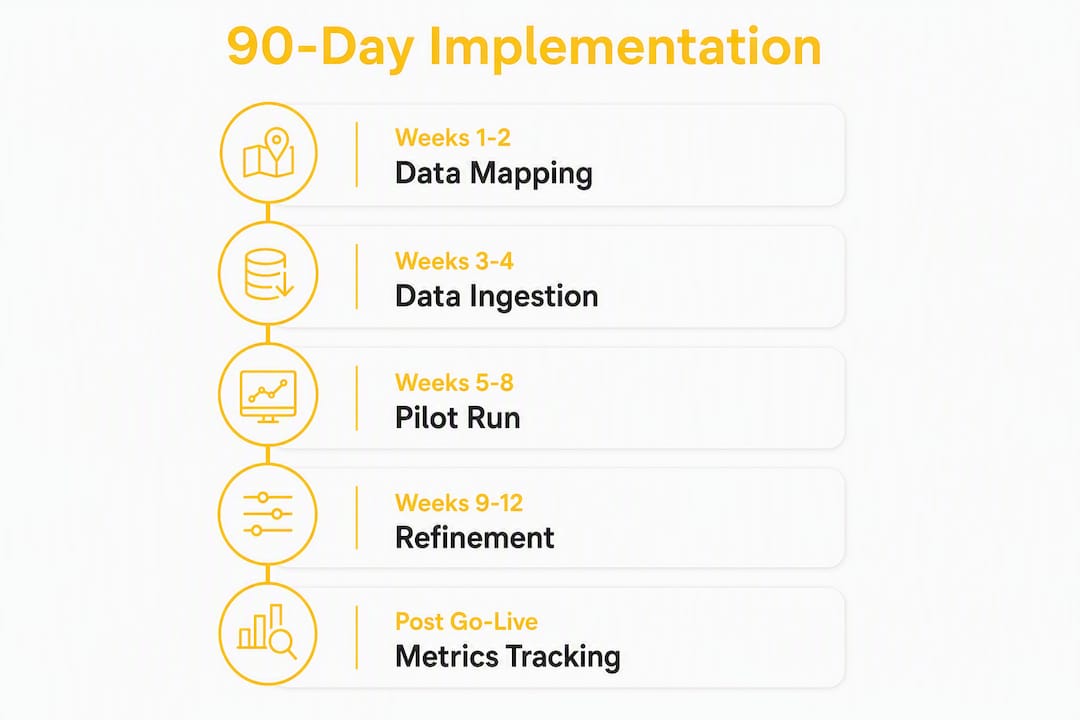
Weeks 1–2: Discovery and data mapping. Identify your primary data sources (CRM, billing, product analytics, support). Assign an internal data owner. Map fields to the platform's ingestion schema. This is where most delays happen, so front-load it.
Weeks 3–4: Ingestion and validation. Connect integrations, run initial data ingestion, and validate that health scores look directionally correct against accounts your team already knows are at risk. Spot-check 10–15 accounts manually.
Weeks 5–8: Pilot configuration and run. Select a representative pilot cohort: 50–100 accounts across at least two segments. Configure playbooks for one use case (onboarding completion or renewal risk). Define success criteria before the pilot starts: target churn rate change, onboarding completion rate, or CSM time saved per week.
Weeks 9–12: Refinement and staged rollout. Review pilot results against success criteria. Adjust scoring thresholds and playbook triggers based on what fired correctly and what generated noise. Begin staged rollout to the full account base.
Post-go-live metrics to track: churn rate change (monthly cohort), onboarding completion rate, expansion rate by segment, time-to-first-value for new accounts, and CSM capacity (accounts per CSM).
Pro Tip: Assign a named playbook owner for each lifecycle stage before go-live. Platforms fail on adoption when no one owns the playbook, not because the software doesn't work.
AI agents that handle administrative automation can meaningfully reduce the manual overhead during rollout, particularly for status updates, meeting prep, and account summaries.
How do CS platforms price, and what ROI should you expect?
Market comparisons group vendors into three tiers: enterprise platforms for deep modeling and governance, mid-market platforms for automation-first churn prevention, and lightweight tools for rapid time-to-value.
| Tier | Typical ARR range monitored | Pricing model | Estimated annual cost |
|---|---|---|---|
| Entry-level | Under $5M ARR | Flat monthly subscription | — |
| Mid-market | $5M–$50M ARR | ARR-tiered subscription | — |
| Enterprise | $50M+ ARR | ARR-tiered + data volume | — |
Cost drivers beyond the base tier include: number of accounts monitored, data event volume, AI/agent modules, number of integrations, and onboarding services. Always ask for a line-item breakdown.
A simple ROI frame: if your current annual churn rate is 12% on $10M ARR, that's $1.2M in churned revenue per year. A platform that moves churn from 12% to 10% recovers $200,000 annually. At a mid-market platform cost of $30,000/year, payback is under two months on churn reduction alone, before counting expansion revenue from renewal and upsell playbooks.
Negotiation tips: ask for a pilot discount tied to go-live milestones, request onboarding credits if implementation takes longer than the vendor's stated timeline, and clarify whether professional services are included or billed separately.
Key Takeaways
AI-powered account management software for B2B SaaS delivers measurable churn reduction and NRR improvement when it combines ML health scoring, explainable risk drivers, and workflow-native alerts with a structured 90-day pilot.
| Point | Details |
|---|---|
| Require explainability | Health scores without visible risk drivers are unusable; always ask for per-account signal attribution in demos. |
| Integrate into existing workflows | Platforms that deliver alerts inside Slack and CRM drive faster interventions than standalone dashboards. |
| Run a structured pilot | Define success criteria before the pilot starts; use 50–100 accounts across two segments over 60–90 days. |
| Build an ROI case early | A 2-point churn reduction on $10M ARR recovers $200,000 annually, often exceeding platform cost within two months. |
| Customerscore as a starting point | Customerscore's ML scoring, explainable outputs, and native integrations make it the recommended first platform to evaluate and pilot. |
What most teams get wrong when choosing a CS platform
The most common mistake is buying on dashboard quality. A vendor demos a beautiful health score view, the team is impressed, and the contract gets signed before anyone asks where the alerts actually land. Six months later, CSMs are logging into a third platform they don't check consistently, and adoption is at 30%.
The second mistake is scoping a pilot that isn't representative. A pilot of your 20 healthiest accounts proves nothing. You need accounts across the risk spectrum, including a handful you already know are churning, to validate whether the model catches what your team already sees and surfaces risks your team missed.
The third mistake is underinvesting in data quality before go-live. A health score is only as good as the signals feeding it. If your Salesforce data is incomplete or your billing system hasn't been connected, the model will score on partial information and generate noise. Fix the data pipeline first, then configure the scoring model.
The correction for all three: force vendors to run your actual data in a short pilot, require explainable risk drivers as a non-negotiable, and assign an internal data owner before the contract is signed. A procurement that skips the pilot almost always regrets it within a quarter.
Customerscore makes the pilot easy to start
If you're ready to move from reactive CS to proactive, data-driven account management, Customerscore's churn prediction platform is built for exactly this. A demo covers your data sources, integration requirements, and a sample pilot scope tailored to your account base and team motion.
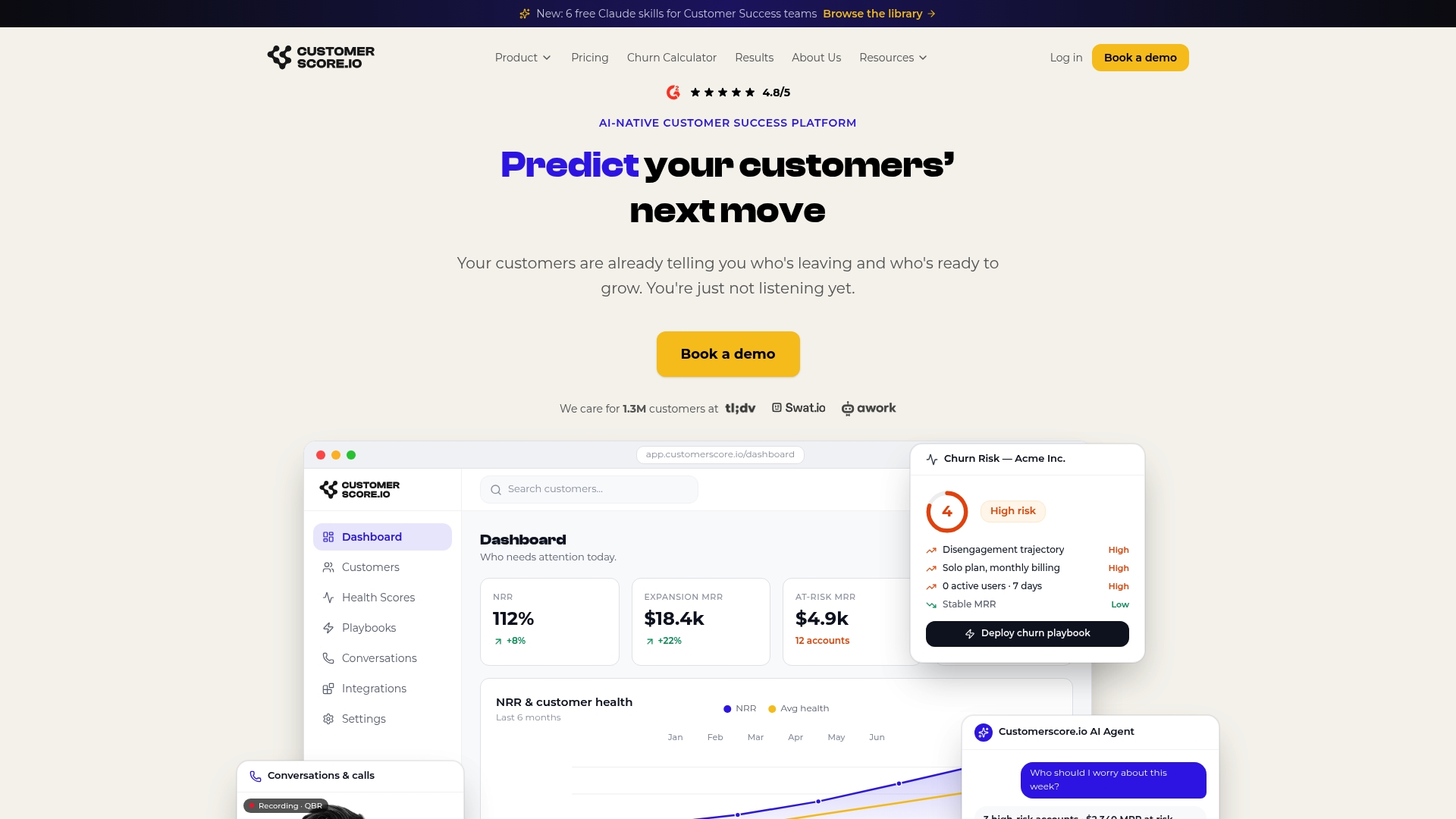
A typical pilot runs several weeks, covers a moderate number of accounts, and delivers a validated health scoring model, at least one live playbook, and a clear churn and expansion baseline. Your CS Ops lead and one integration owner are the only internal resources required. Customerscore handles configuration, onboarding, and model setup.
After the demo, expect a data readiness review within one week and a pilot kickoff within two. Book a demo to scope your pilot and get a timeline to first value.
Sources and further reading
These are the primary sources used to validate claims in this article. Use them during vendor evaluation to pressure-test vendor claims against independent analysis.
- AI Customer Health Score Software | Customerscore.io — product methodology and explainability approach; ask vendors to demonstrate equivalent transparency.
- 10 Best Customer Retention Tools (2026) | Customerscore.io — third-party recognition context and retention tool benchmarking.
- Customerscore.io helps you retain customers | Customerscore blog — AI scoring methodology and retention outcome framing.
- Best Customer Success Software for SaaS | Customerscore.io — buyer-oriented evaluation criteria and platform comparisons.
- Customer Success Software Options 2026: An Independent Viewpoint | Viewpoint Analysis — ML vs. rule-based scoring analysis and AI agent productivity findings.
Recommended
Related articles
Benchmarked Save Playbooks: Two Churn Survey Questions for SaaS Teams
Benchmarked Save Playbooks: Two Churn Survey Questions for SaaS Teams ! Customer success manager reviewing churn survey The most effective churn survey for SaaS is a two-question in-flow cancel
Blog90–120 Day Renewal System for CSMs: SaaS Renewal Playbook
90–120 Day Renewal System for CSMs: SaaS Renewal Playbook ! Team planning a structured SaaS renewal Run renewals as a 90 to 120 day managed pipeline, not a calendar reminder.
BlogCut Response Time 60% with This Slack for Customer Success Playbook
Cut Response Time 60% with This Slack for Customer Success Playbook ! Customer success team routing a Slack conversation Slack works best for customer success when it functions as the conversation
BlogProduct Led Customer Success in 90 to 180 Days Without a Data Team
Product Led Customer Success in 90 to 180 Days Without a Data Team ! Customer success operator reviewing product signals Product-led customer success uses product usage data and in-product