
6–10 Week PLG CS Pilot: Use Product Signals, Not Cadences


The best CS for PLG is a product-centric platform that scores accounts on real usage events, not call notes, and runs expansion and renewal plays automatically off those signals. It needs explainable health scores, native product and billing integrations, and automated triggers that fire without a CSM checking a dashboard. Skip anything built around calendar cadences. Read the checklist below before you sign a contract.
TL;DR:
- Effective PLG customer success platforms must prioritize product usage signals, with automated triggers for expansion and renewal, without reliance on manual dashboard checks.
- Most current CS tools are unsuitable for PLG because they focus on calendar cadences and sales-oriented scoring models that ignore recent, usage-based engagement.
- Building a successful PLG playbook requires instrumenting key product events, tracking time-to-value, and routing signals for automated follow-up within a 30 to 60-day pilot.
- Vendors should demonstrate real-time, explainable health scores that weight product signals heavily, and enable triggers to act immediately within the first two weeks of a pilot.
- Narrow, short-term pilots focusing on one funnel and a couple of expansion triggers are best for quickly assessing platform fit and measuring early success metrics.
Table of Contents
- What Does "Best CS for PLG" Actually Mean?
- Why Do Most CS Platforms Fail PLG Teams?
- What Does a PLG Customer Success Playbook Look Like?
- How Do You Evaluate a PLG Customer Success Platform?
- What Should You Budget for a Pilot Rollout?
- Why Customerscore.io's Approach to PLG CS Holds Up
- An Operator's Take on Getting PLG Customer Success Right
- Customerscore.io: A Faster Path to a Working PLG Pilot
- Sources
- FAQ
What Does "Best CS for PLG" Actually Mean?
"PLG-fit" is not a feature checkbox. It's an architecture decision: your customer success stack has to treat product usage as the primary signal, not a secondary enrichment field bolted onto a sales-built CRM.
The recommended setup has four layers working together: a product event feed, an explainable health scoring engine, automated playbooks that execute without human triggering, and integrations that connect CRM, billing, and support data into one picture. Miss any layer and you get a platform that looks complete in a demo but breaks down in production.
Four capabilities separate a PLG-fit platform from a repurposed sales tool:
- Product signal weighting. The score has to lean on usage events, not just logins or last-contact dates.
- Automated expansion triggers. Seat growth or usage-limit hits should fire a play instantly, not wait for a quarterly business review.
- In-app play execution. Plays need to reach users inside the product, not just through a CSM's outbound email.
- Score explainability. Every health score should show exactly which signals drove it, so a CSM or an AI agent can act on the "why," not just the number.
Pricing structure matters too. Teams under roughly $2 to 3 million ARR with simple, self-serve motions usually do fine with a low-touch model that runs mostly on automation. Once accounts start carrying multiple stakeholders, custom integrations, or six-figure ACVs, a high-touch model with dedicated CSM workflows earns its cost.
Why Do Most CS Platforms Fail PLG Teams?
Most customer success software was built for sales-led organizations, and it shows the moment you try to bend it toward a product-led motion. The defaults give it away fast: calendar-based check-in cadences, health scores that treat a friendly email reply the same as a live API integration, and workflows that assume every account has a named point of contact who takes sales calls.
The scoring itself is often the biggest problem. Many platforms use additive models that stack a dozen small signals together, which buries the two or three that actually matter. There's no decay window, so a customer who logged in heavily three months ago and has gone quiet still scores as "healthy." Compare that to teams that weight product signals heavily in scoring models, where usage depth and recency drive the number, not a blended average.
Operationally, the failure modes repeat across companies:
- Gating core product value behind a mandatory sales call, which kills the self-serve trust that got the user to sign up in the first place.
- Dashboard policing, where a CSM has to manually check a report every morning instead of the platform pushing a play the moment a signal fires.
- Treating every account the same regardless of use case, when segmentation by use case often predicts support needs better than revenue band alone.
The downstream cost shows up in the metrics that matter most: lower activation percentages, missed product-qualified leads (PQLs) that age out before anyone notices, and expansion pipeline that stalls because nobody flagged the seat-growth trigger in time.
Pro Tip: Ask any vendor to show you their default decay window during the demo. If they can't explain how a stale signal loses weight over time, their scoring model was built for a sales team, not a product-led one.
What Does a PLG Customer Success Playbook Look Like?
A working PLG playbook runs in five stages, and each one needs specific instrumentation before it can run on autopilot.
- Instrument. Capture the events that actually predict intent: three or more seats added, an admin invite sent, an integration connected, usage limits hit, or API call volume crossing a threshold. The most reliable early PQL signals are time-bound, org-level actions like an admin invite within 14 days, not raw login counts.
- Onboard. Track time-to-first-value (TTFV) directly, not as a proxy metric. Pair in-app guides with onboarding milestone alerts so a CSM knows the moment a new account stalls before day seven, not after the trial expires.
- Adopt. Watch feature adoption velocity alongside sentiment signals and outcome-based scoring. An account using one feature heavily but ignoring three others tells a different story than one spreading usage evenly.
- Expand. Route PQLs by persona, run AI research to pull account context before outreach, and attribute expansion ARR back to the specific trigger that fired. The 5-step motion of capture, score, research, engage, and attribute improves reply rates specifically because it uses fresh signals instead of a stale contact list.
- Renew. Build procurement timeline triggers at 180, 120, and 90 days out, each escalating in urgency, and run an executive review play before the 90-day mark rather than after a cancellation notice arrives.
Automated review triggers tied to usage events drive higher expansion rates than manual quarterly reviews, which is the entire argument for building this loop in software instead of a spreadsheet a CSM updates by hand. Teams that get this sequence instrumented end to end can scale their book of business with programmatic plays instead of adding a CSM for every 50 new accounts, a shift the Pedowitz Group's analysis of product-led CS strategy ties directly to tracking activation percentage, expansion ARR, and cohort net revenue retention as board-level metrics.
How Do You Evaluate a PLG Customer Success Platform?
Run the vendor through real tests, not a slide deck. Ask them to connect a live event payload from your actual product analytics tool, not a sanitized sample dataset, and check whether identity stitching correctly merges a user's actions across sign-up, trial, and paid accounts. Latency matters here: if usage data refreshes once a day instead of near real time, your expansion triggers will always be a step behind.
On scoring, insist that product signals make up the clear majority of the health score weighting, not an even split with firmographic data. Confirm there's a decay window so a signal from two months ago carries less weight than one from yesterday, and check whether a single very strong signal, like an enterprise SSO integration going live, can override a mediocre composite score on its own.
Automation needs a hard test too. Can a trigger fire a play in-app, through email, through Slack, and create a task in the CRM, all from one event, without a human routing it manually? If the platform uses AI to draft outreach or summarize accounts, ask for an audit trail showing what the AI ran and when.
Before you sign anything, check:
- Deployment timeline from contract to first live health score.
- Whether every score component is visible and explainable, not a black-box number.
- Pre-built playbook templates for onboarding, expansion, and renewal, plus a vendor consultation to adapt them.
- A written SLA on data refresh frequency.
- Peer validation on G2 for how the platform performs specifically in self-serve, usage-based accounts, not enterprise sales orgs.
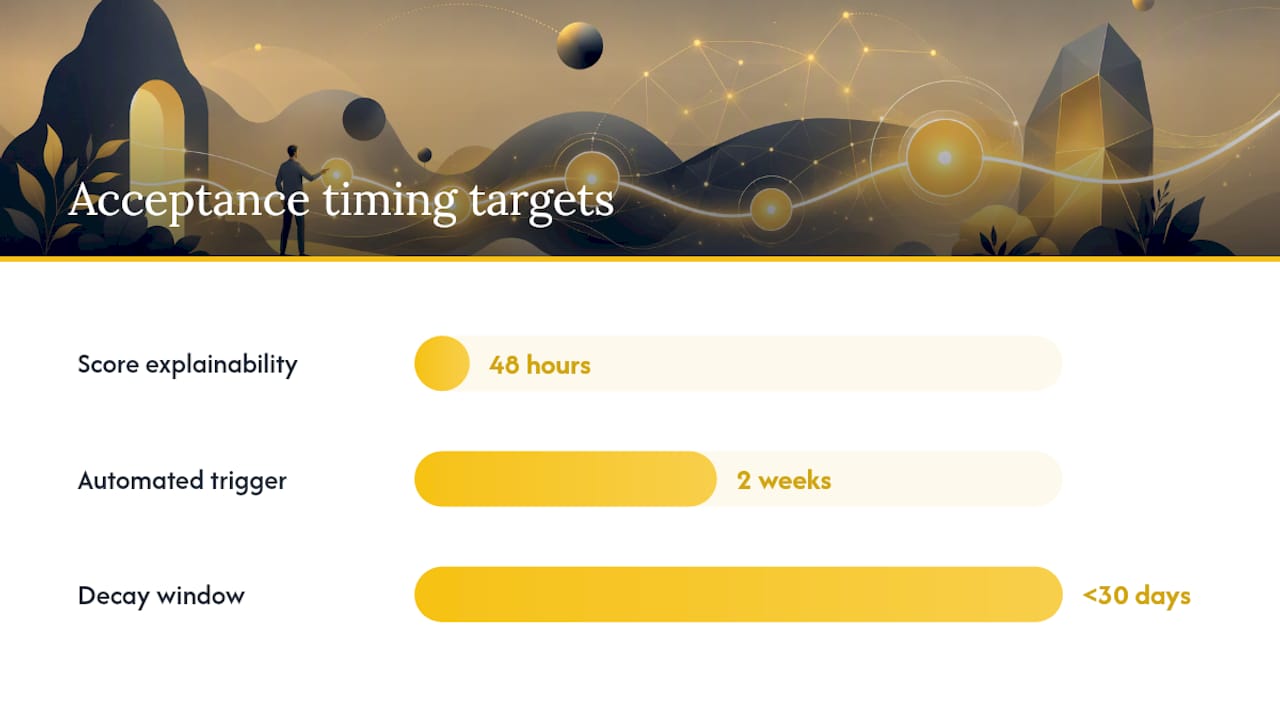
Copy these acceptance criteria straight into your RFP: score explainability within 48 hours of connecting live data, at least one automated trigger running within the first two weeks, and a documented decay window under 30 days for usage-based signals.
What Should You Budget for a Pilot Rollout?
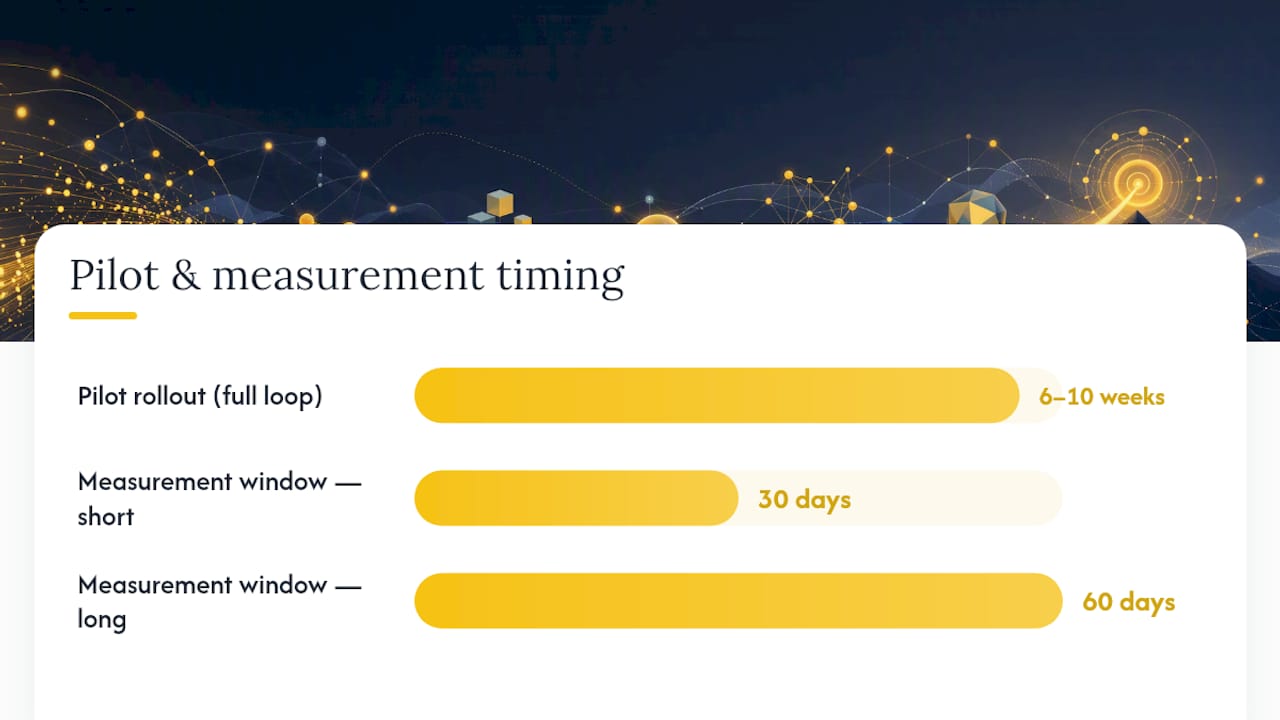
Scope a pilot to one product funnel and two or three expansion triggers, not your entire book of business. That narrow scope is what makes attribution clean enough to actually judge the platform. Expect six to ten weeks from kickoff to seeing a full signal, play, and measurement loop running, assuming your data is reasonably clean going in.
The engineering lift is real but bounded: mapping product events to the platform's schema, identity stitching across your sign-up and billing systems, QA on the first few triggers before trusting them at scale, integration to your CRM and billing tool, and tagging that lets you attribute expansion ARR back to a specific play later.
Cost drivers to watch:
- Pricing model based on your client ARR tier rather than per-seat cost, which changes how the bill scales as you grow.
- Integration and consulting fees for connecting non-standard data sources.
- Custom playbook design work beyond the vendor's templates.
- Data storage and retention costs if you're pulling high-volume event data.
Measure early success against TTFV, activation percentage, PQL-to-SQL conversion, and expansion ARR attributed to specific triggers, each tracked over a consistent 30 or 60-day window so you're comparing apples to apples as the pilot scales.
Why Customerscore.io's Approach to PLG CS Holds Up
Patrik built Customerscore.io's blog around one focus: operational PLG customer success playbooks, not generic CS advice repackaged for a self-serve audience. That focus shows up in the product itself.
Customerscore.io ships Claude-based skills that map directly onto the playbook stages above. Expansion Finder surfaces accounts hitting seat or usage thresholds before a CSM would catch them manually. QBR Prep Builder pulls the health score components and usage history into a review-ready summary, cutting the manual research that normally eats a CSM's week before a renewal conversation. Churn Early-Warning flags decay in engagement before it shows up as a support ticket or a cancellation request.
None of this replaces the discipline of instrumenting your own funnel correctly. What it does is remove the manual work of checking dashboards and building spreadsheets once that instrumentation exists, so a CSM spends time on the accounts the signals actually flag.
An Operator's Take on Getting PLG Customer Success Right
Most teams buy CS software backward. They hire a sales-oriented CSM, then buy a platform to support that hire's workflow, then wonder why the tool never surfaces anything useful. Flip the order: instrument one high-confidence PQL signal first, something like an admin invite within 14 days or three seats added in a short window, and prove it predicts expansion before you hire anyone against it.
Vendor demos love to show off feature lists. Ignore most of it and ask one question instead: can this platform explain every health score component, and can it execute one expansion trigger automatically within the first two weeks of a pilot? If a sales engineer hesitates on either, that's your answer regardless of what the rest of the demo looks like.
Run pilots short and narrow on purpose. One funnel, one or two triggers, thirty to sixty days. You'll learn more from watching one trigger fire correctly in production than from a thirty-slide roadmap of what the platform could theoretically do six months from now.
— Patrik
Customerscore.io: A Faster Path to a Working PLG Pilot
Some platforms offer health scores that can be explained and deploy quickly, instead of taking months like typical enterprise CS rollouts.
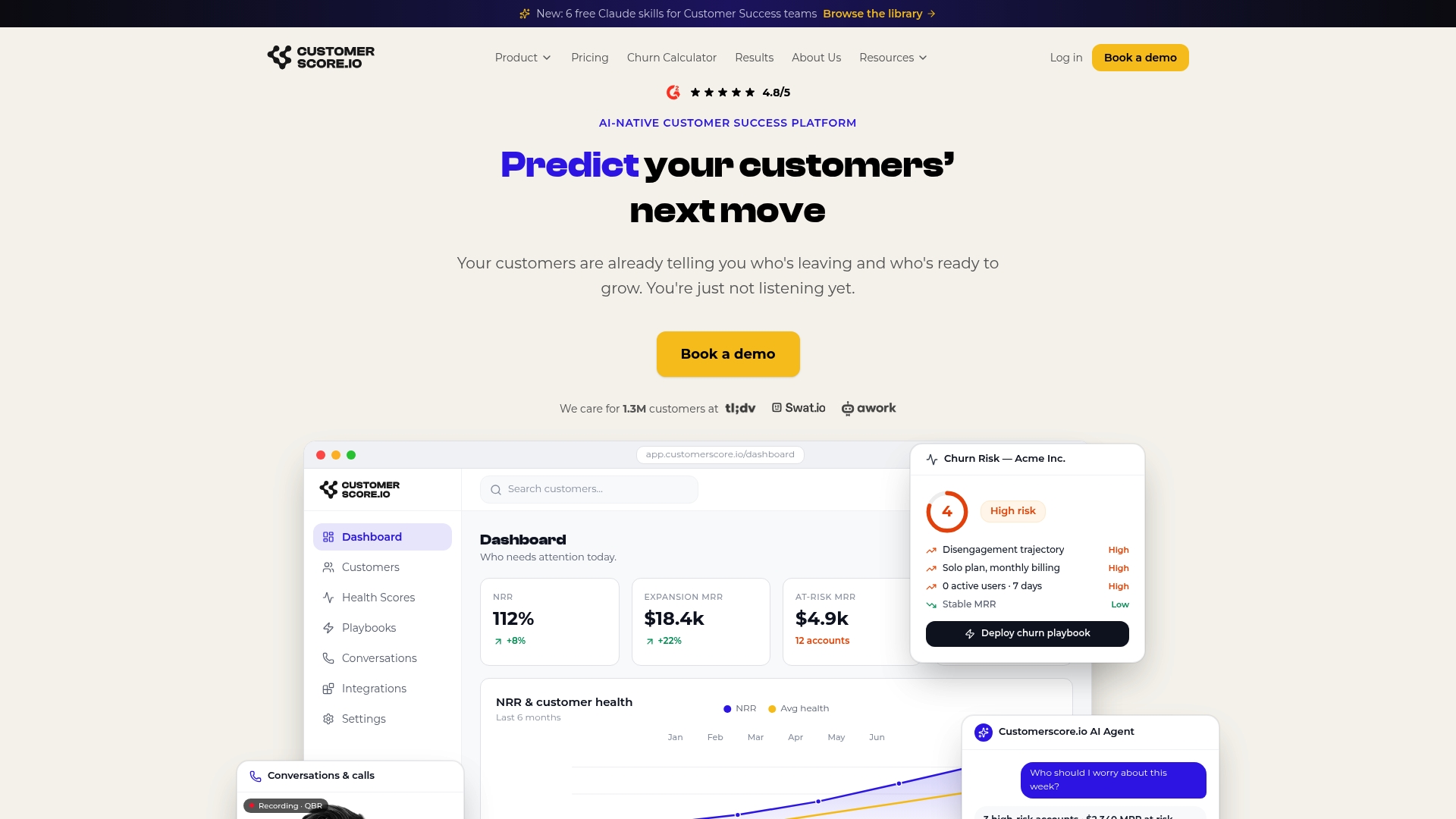
Certain platforms combine AI-driven churn prediction with explainable scoring using connected product usage, billing, CRM, and support data, allowing each score component to be traced back to actual signals. Automated playbooks can convert these signals into in-app prompts, alerts, and task creation without manual intervention, and native integrations enable connection of product analytics and billing data without custom development.
If you're ready to test this against your own funnel, start narrow: instrument one activation signal, enable one expansion trigger, and measure the loop over a single pilot window. Check pricing, a flat platform fee tiered by your client ARR rather than per seat, or explore the AI churn prediction capabilities directly. When you're ready to dig in, book a demo and bring your event schema to the call.
Sources
- Product-led-sales playbook (Pulse RevOps)
- How does product-led growth shift customer success strategy? (Pedowitz Group)
- PLG-to-enterprise pipeline playbook (Unify GTM)
FAQ
What Does PLG Stand For?
PLG stands for product-led growth, a go-to-market model where the product itself drives acquisition, activation, and expansion, not a sales team. Users typically sign up and get value before ever talking to a salesperson, which is why customer success in this model has to run on product usage signals rather than call notes.
What Are Examples of PLG Companies?
Well-known PLG companies include those that let users try or use the core product free before any sales conversation, often through freemium tiers or self-serve trials. The common thread is that expansion and upgrade decisions get triggered by in-product usage events rather than outbound sales outreach.
What Companies Use PLG?
PLG shows up most often in SaaS categories where a single user can get real value alone, like collaboration tools, developer platforms, and analytics software, before a team-wide purchase decision gets made. B2B SaaS companies selling to CS, RevOps, and growth teams increasingly run PLG motions specifically because product-led CS shifts value creation into the product itself, reducing reliance on manual sales touch.
What Does PLG Mean in Sales?
In sales, PLG means the product surfaces qualified leads through usage behavior, and sales teams engage only after a product-qualified lead (PQL) signal fires, such as a seat threshold or an admin invite. This flips the traditional model, where sales identifies and qualifies leads manually before any product usage exists.
How Much Does Customerscore.io Cost?
Customerscore.io charges a flat platform fee tiered by your client ARR rather than per seat, with a quote in one call. Every customer gets the full platform rather than a feature-gated tier.
Recommended
Related articles
Cut CSM Intervention 18%: Predictive Playbooks for CS & RevOps
Cut CSM Intervention 18%: Predictive Playbooks for CS & RevOps ! Predictive playbook geometric title card Predictive playbooks link a churn prediction to a specific, repeatable action so customer
BlogPinpoint B2B SaaS Adoption Gaps and the Fix That Lifts Renewal
Pinpoint B2B SaaS Adoption Gaps and the Fix That Lifts Renewal ! Analysts reviewing SaaS adoption gaps Adoption gap analysis identifies the funnel stage where eligible users or accounts fail to reach
BlogAnalysts: 6–12 Month Cohort Forecasts for Net Dollar Retention
Analysts: 6–12 Month Cohort Forecasts for Net Dollar Retention ! Analyst reviewing cohort retention forecast The most reliable way to forecast net dollar retention is cohort-based modeling that
BlogStop Surprise Churn: 5 Phase Data Mapping for RevOps and CS
Stop Surprise Churn: 5 Phase Data Mapping for RevOps and CS ! Analyst mapping customer data fields Data mapping for CS means connecting product usage, billing, CRM, and support data to the fields your