
Save High MRR with Cancel Survey Analysis for B2B SaaS CS & RevOps


Cancel survey analysis means examining offboarding survey responses alongside account MRR, contract data, and usage history to find out why customers actually leave. The first move is not a deep investigation: it is a revenue-weighted triage of last month's cancellations to find high-MRR, fixable reasons. That triage sets up the causal follow-up work described below, but it comes first because most teams have neither the time nor the need to analyze every response equally.
TL;DR:
- Prioritize cancellation reasons based on total lost MRR rather than response frequency to accurately identify high-value churn causes.
- Re-run the revenue-weighted impact and addressability matrix monthly to capture shifts like new features reducing previous structural issues.
- Code open-text survey responses into a standardized taxonomy for reliable analysis, routing ambiguous answers to human reviewers for accuracy.
- Link coded reasons to usage, billing, and CRM data to improve churn prediction models and trigger timely account interventions.
- Move to customer interviews for high-MRR accounts with recurring vague reasons to uncover deeper process or emotional issues behind cancellations.
Table of Contents
- A step-by-step workflow to process cancellation survey responses
- How to prioritize cancellation reasons with a revenue-weighted matrix
- Coding and standardizing open-text cancellation responses
- Linking survey signals to churn prediction and action
- When to move from survey data to real conversations
- Measuring whether your retention fixes actually work
- What we've learned running this at Customerscore.io
- Turning this workflow into a daily habit with Customerscore.io
- Sources
- FAQ
A step-by-step workflow to process cancellation survey responses
Raw survey exports are close to useless on their own. A cancellation reason means little until it is tied to how much revenue walked out the door and whether the account was already showing warning signs. Building that joined dataset is mechanical work, but skipping it is why so many cancel surveys sit unread in a spreadsheet.
Start the same day the export lands:
- Pull the survey export and join each row to account-level data: MRR or ARR, contract end date, last 90 days of product usage, and open or recent support tickets.
- Deduplicate responses, timestamp them, and map each account to its pricing tier and renewal window so nothing gets double-counted.
- Flag accounts that canceled inside their renewal window separately from those who churned mid-contract, since the fixable window is different for each.
- Segment quickly by self-serve versus enterprise, ARR band, and product line, so a pattern in one cohort does not get diluted by noise from another.
- Produce a single deliverable: a ranked list of accounts and reasons, sorted by lost MRR, with an owner assigned to each row.
That last step matters more than any dashboard. A short table or CSV that pairs a reason with a dollar figure and a name turns a research exercise into an assignable task list, which is the entire point of doing this the same day the data comes in rather than at the end of the month.
How to prioritize cancellation reasons with a revenue-weighted matrix
Counting cancellation reasons by frequency is the most common mistake in this process. If ten small accounts cite "missing integration" and one enterprise account cites "poor onboarding" while carrying triple the combined MRR of the other ten, a frequency count sends your team chasing the wrong fix. Weighting by lost MRR instead of response count is what turns survey data into a resourcing decision rather than a popularity contest.
Build a simple 2x2 matrix with revenue impact on one axis and addressability on the other:
- Revenue impact: total MRR attached to a given reason over the trailing quarter, high if it clears a threshold your finance team already uses for material churn.
- Addressability: can product, support, or CS realistically change this in the next two quarters, or is it structural (budget cuts, company shutdown, M&A)?
- Score and assign: anything in the high-impact, high-addressability quadrant gets an owner and a deadline within the week; everything else gets logged but not staffed yet.
Say your triage turns up three leading reasons: missing SSO support (high MRR, addressable, owned by product), slow onboarding (moderate MRR, addressable, owned by CS ops), and budget cuts (high MRR, not addressable, logged for win-back only). Only the first two get sprint capacity this cycle.
Pro Tip: Re-run the matrix monthly. A reason that was unaddressable last quarter, like a missing feature now on the roadmap, can move quadrants fast.
Coding and standardizing open-text cancellation responses
Free-text answers are where the real nuance lives, but they are unusable in a dashboard until someone turns them into consistent categories. The goal is a taxonomy narrow enough to be useful and broad enough to cover most SaaS cancellations without a "miscellaneous" bucket eating half your data.
- Draft a short taxonomy built for SaaS: product fit, price, support experience, competitor switch, and internal org change cover most cases.
- Sample fifty to a hundred recent responses, label them by hand, and have a second person reconcile disagreements before expanding the codebook.
- Let simple keyword rules handle obvious cases automatically, but route ambiguous or emotionally charged text to a human reviewer rather than forcing a code.
- Store the canonical reason code on the account record in your CRM while keeping the original free text attached, since the raw wording is what a follow-up interview will need later.
Keep a column for coder initials and confidence level. It sounds like overhead, but it is what lets you audit or retrain a model later without re-reading every response.
Linking survey signals to churn prediction and action
A coded cancellation reason is only valuable once it feeds something downstream. Research on churn feature engineering found that combining textual features from customer interactions with numerical usage and billing data materially improves churn model performance compared to using numerical features alone, which is the core argument for treating survey text as model input rather than a read-only report.
Practical integration points:
- Sync canonical reason codes to the CRM record so sales, CS, and RevOps see the same label.
- Attach coded reasons to product-usage events, since a "product fit" cancellation paired with declining login frequency is a stronger signal than either alone.
- Join reason codes to billing data to keep the MRR-weighted view current as new cancellations come in.
- Trigger automated alerts and CSM briefs when a live account matches the profile of a past cancellation reason, so the team acts before the renewal date rather than after.
A case study on B2B SaaS churn ranked service usage as the most impactful churn factor, ahead of pricing and support variables, which is a strong argument for prioritizing usage-linked survey reasons first. Before rolling a new playbook out broadly, test it on a holdout group or run a simple before-and-after comparison to confirm it actually moves renewal rates.
When to move from survey data to real conversations
Surveys are fast, but they flatten nuance. When the same vague reason keeps showing up across high-MRR accounts, or when a strategic account cancels with an answer that does not match its usage history, that is the signal to pick up the phone instead of trusting the dropdown menu.
- Prioritize interviews for accounts above your top MRR threshold and for any reason code that recurs without a clear pattern.
- Ask non-defensive, open questions: "walk me through the moment you decided to cancel" surfaces more than "why did you cancel."
- Probe for process blockers and emotional friction, not just feature gaps, since a master's thesis on SaaS churn prevention ties churn to inaccuracies across the customer journey more often than to any single missing feature.
- Scale this with call-transcript review and conversational AI tools so patterns across dozens of exit conversations surface without a human reading every transcript.
Pro Tip: Assign every insight from an exit interview an owner and a deadline before the call notes go cold, or the finding dies in a shared doc.
Measuring whether your retention fixes actually work
None of this matters if the fixes do not move the numbers. Define a small set of KPIs before you start: MRR saved from at-risk accounts, renewal rate uplift in the cohort that received an intervention, and the percentage drop in cancellations citing the same root cause quarter over quarter.
- Run pilots against a matched control group rather than rolling a fix out to everyone at once, so you can attribute the lift honestly.
- Keep a live dashboard showing trending cancellation reasons by MRR, with the owner responsible for each one, so a stalled item is visible before the next renewal cycle.
- Hold a weekly triage of new cancellations and a monthly root-cause review to keep the reason codes and owners current.
- Bring the trend data into QBRs as evidence for the product roadmap, since a repeated high-MRR reason is a stronger argument for engineering time than any single customer complaint.
What we've learned running this at Customerscore.io
Cancel survey analysis works best as triage, not as the whole system. On the Customerscore, we treat survey responses as one input feeding predictive churn models and CS playbooks, never as the final word on why an account left. The pattern we see most often: teams that weight reasons by MRR catch the accounts worth saving weeks earlier than teams reading every response in order.
— Patrik Chalupa
Turning this workflow into a daily habit with Customerscore.io
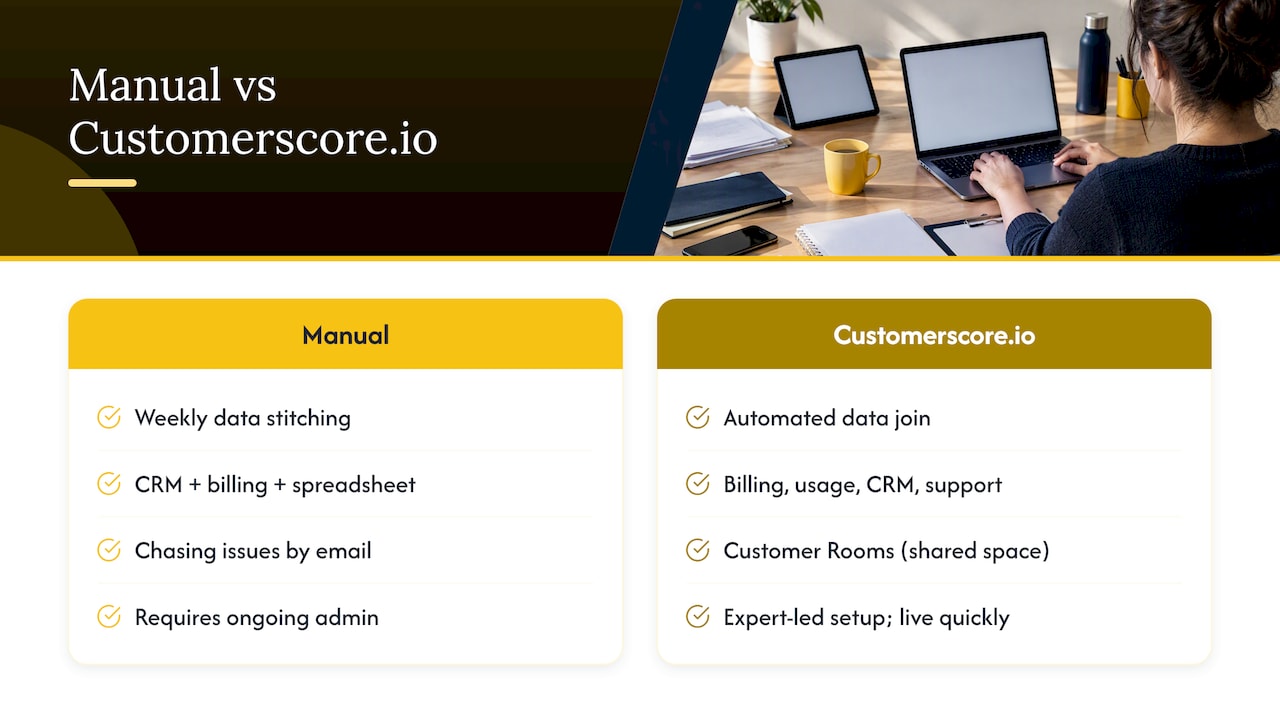
Running this playbook by hand means stitching together CRM exports, billing reports, and a spreadsheet of coded reasons every week. Customerscore.io joins that data automatically, billing, product usage, CRM records, and support conversations sit on one account record, and the platform's churn models explain which accounts match your highest-risk cancellation patterns before the renewal date arrives. Customer Rooms give CS and the customer a shared space to work the fix together instead of chasing it over email.
Setup is expert-led and the platform is live in 1 to 3 weeks, with no dedicated admin required to run it. If you want to see how this maps to your cancellation workflow, the pricing page gives you a tailored quote in three questions.
Sources
This playbook draws on churn factor prioritization research, text-enriched churn feature engineering, and a customer journey study on SaaS churn prevention, alongside practical templates on the Customerscore and Amigolabz.
- Prioritizing customer churn predictors in SaaS – A case study
- ChurnKB: A Generative AI-Enriched Knowledge Base for Customer Churn Feature Engineering
- How can SaaS startups prevent churn phenomenon? (Master thesis)
FAQ
What does "cancel survey analysis" actually involve?
It means joining cancellation survey responses to account data like MRR, usage, and contract dates, then coding open-text reasons into standard categories. The goal is to prioritize which reasons to fix first based on revenue at stake, not just how often a reason was mentioned.
How do I prioritize cancellation reasons with a small sample size?
Weight each reason by the total MRR attached to it rather than the raw response count, since a handful of high-value accounts citing the same issue can outweigh dozens of small ones. Cross-check small-sample patterns against usage data before committing engineering time.
Should I trust automated coding of open-text survey responses?
Automated keyword rules work for clear, repeated phrases but miss nuance in ambiguous or emotionally worded responses. Route uncertain cases to a human reviewer and keep the original text attached to the coded reason for later audits.
How do cancellation surveys connect to churn prediction models?
Coded survey reasons become model features alongside usage and billing signals, and research on churn feature engineering shows this combination outperforms numerical data alone. In practice, that means syncing reason codes to your CRM so live accounts can be matched against past cancellation patterns.
When should I move from survey data to customer interviews?
Move to interviews when a vague or ambiguous reason recurs across high-MRR accounts, since surveys rarely explain the full mechanism behind a decision. A short, non-defensive interview guide focused on process and emotional friction usually surfaces more than another survey question would.
Recommended
Related articles
Five Fields to Fix Playbook Trigger Design for B2B SaaS CS & RevOps
Five Fields to Fix Playbook Trigger Design for B2B SaaS CS & RevOps ! Isometric trigger routing system illustration The most reliable approach to playbook trigger design is to sort every alert into
BlogStop SaaS Downgrades: Save 31% of At Risk Accounts for CS & RevOps
Stop SaaS Downgrades: Save 31% of At Risk Accounts for CS & RevOps ! Isometric account protection title card The fastest way to prevent SaaS downgrades is to stop treating every at-risk account the
Blog24–48 Hour Handoffs: B2B SaaS Support to CS Checklist, Six Fields
24–48 Hour Handoffs: B2B SaaS Support to CS Checklist, Six Fields ! Isometric handoff cards crossing between platforms A reliable support to CS handoff transfers ownership and context so the new owner
Blog90–120 Day Explainable AI Playbook to Reduce Renewal Risk for SaaS CS
90–120 Day Explainable AI Playbook to Reduce Renewal Risk for SaaS CS ! Isometric illustration of explainable renewal risk decisions To reduce renewal risk, you prioritize accounts daily using