
Customer Success Software Cost: What to Budget in 2026


Most B2B SaaS companies pay between tens of thousands and over one hundred thousand dollars per year for customer success software, with the median deal landing below fifty thousand once you exclude enterprise contracts. The exact number depends on which pricing model a vendor uses: subscription tiers based on your annual recurring revenue, per-seat licensing, seatless pricing tied to customer accounts, or usage-based add-ons stacked on top of a base fee. Customerscore.io, for example, charges one platform fee based on your ARR, with every feature included and never per seat. Industry pricing trackers note that quotes for similar-sized deployments can vary by 50 to 200 percent, so a single "average price" number is nearly useless for budgeting.
Here's what actually moves the needle on your annual line item:
- Pricing model: ARR-based, per-seat, per-account and usage-based pricing each follow a different number, so know which one drives your quote.
- Company size and CS motion: tech-touch teams pay far less than high-touch enterprise operations.
- Implementation and data work: often adds 15 to 30% to your first-year bill.
- Add-ons: AI churn prediction, premium support, and extra integrations are frequently priced separately.
Key Takeaways
| Point | Details |
|---|---|
| Pricing models vary widely | ARR-tiered, per-seat, seatless, and usage-based pricing each scale differently as your team grows. |
| Budget by operating model | Public benchmarks put most CS platforms between about $15,000 and $50,000 a year at the median; enterprise suites with services run well above that. |
| Plan for hidden year-one costs | Implementation services, add-ons and the time of the person who runs the platform all land on top of the licence. |
| Negotiate before you sign | Multi-year commitments and pilot terms can reduce list price by 10 to 30 percent. |
| Customerscore.io prices by ARR | One platform fee based on your ARR, with every feature included and never per seat. |
Table of Contents
- How Much Does Customer Success Software Cost by Pricing Model?
- What Are Typical Customer Success Software Price Ranges?
- What Drives Customer Success Software Cost Up or Down?
- What Hidden Costs Should You Budget for in Year One?
- How Do You Calculate TCO and ROI for Customer Success Software?
- What Questions Should You Ask Vendors Before Signing?
- How Does Customerscore.io Structure Its Pricing?
- How Long Does It Take to See ROI From Customer Success Software?
- Sources
How Much Does Customer Success Software Cost by Pricing Model?
Vendors in this category use five distinct pricing architectures, and each one changes how your bill behaves as you scale.
Subscription tier by ARR charges you based on your company's annual recurring revenue, regardless of headcount. This is common among modern, AI-native platforms and tends to be the most predictable option for finance teams building multi-year forecasts.
Per-seat pricing charges per CSM or admin licence. It is easy to understand at signup, and your cost follows the size of your CS team.
Per-customer-account (seatless) pricing charges based on how many of your customer accounts flow through the platform, not how many internal users touch it. This favors CS teams managing large customer bases.
Usage or feature-based pricing layers charges on top of a base fee for things like AI model calls, advanced reporting, or extra data connectors.
Blended or hybrid pricing combines a base ARR tier with per-seat or usage components, which is increasingly common as vendors bundle AI features.
| Model | Predictability | Scales well for | Main negotiation lever |
|---|---|---|---|
| ARR-tiered | High | Any growth stage | Lock in current ARR band for multi-year term |
| Per-seat | Medium | Small, stable teams | Negotiate seat caps or bundled licenses |
| Seatless/per-account | High | Large customer base | Clarify account-counting definitions upfront |
| Usage/feature-based | Low | Teams with variable needs | Cap overage rates in contract |
Pro Tip: Ask every vendor to define "account" and "seat" in writing before you compare quotes. Two vendors can quote the same dollar figure while counting your customer base completely differently.
What Are Typical Customer Success Software Price Ranges?
Company size and CS operating model drive most of the variance you'll see across vendor quotes. Public benchmarks show the pattern:
| Platform | Median annual contract (Vendr, October 2026) |
|---|---|
| Custify | about $16,800 |
| Vitally | about $35,000 |
| Planhat | about $41,000 |
| ChurnZero | about $44,600 |
| Gainsight | about $50,000 |
Each median sits inside a wide range, and enterprise suites with services and extra modules run well above it. None of these vendors publish prices, so figures vary by contract.
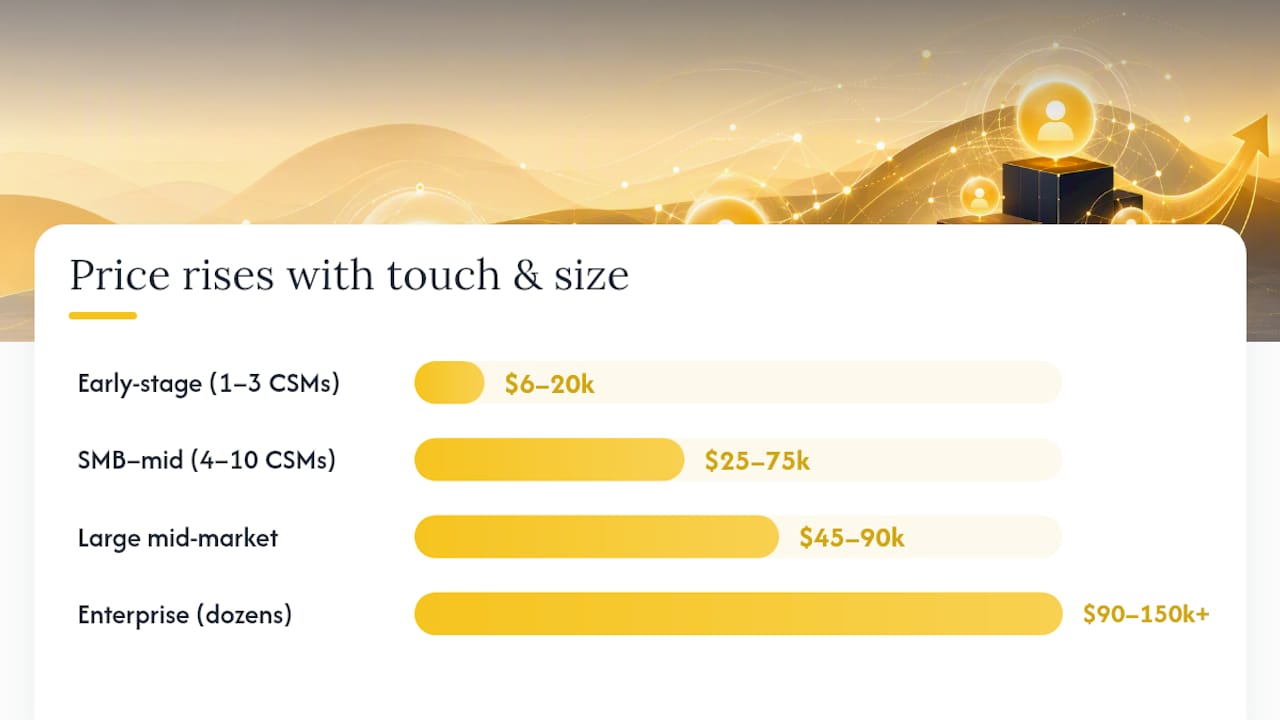
Here's roughly how that maps to company profile (estimates):
- Early-stage or small teams (1 to 3 CSMs, tech-touch): $6,000 to $20,000 per year for a lean, largely automated setup.
- SMB to mid-market (4 to 10 CSMs, hybrid-touch): $25,000 to $75,000 per year, often including basic integrations and onboarding support.
- Large mid-market (10+ CSMs, multiple product lines): $45,000 to $90,000 per year.
- Enterprise (dozens of CSMs, complex data environment): $90,000 to $150,000+ per year, frequently with custom implementation contracts on top.
One illustrative comparison found a traditional enterprise-grade platform running about $45,000 per year, versus a leaner AI-augmented approach landing near $18,000 per year for a comparable team footprint. That gap alone can fund an extra CSM headcount.
A few things push you from one band to the next: adding seats mid-contract, requesting custom data integrations, or paying for a services-led implementation on top of the licence. Multi-year commitments and volume discounts can also pull a quote back down, sometimes by 10 to 30 percent off list price.
What Drives Customer Success Software Cost Up or Down?
Seven variables account for most of the swing between a lean quote and a bloated one.
Seat and account counts are the most obvious lever. Integrations and data engineering come next: connecting billing, product usage, CRM, and support data into one health score often requires real engineering hours, and account-counting rules materially change the math between vendors. Custom playbooks, AI or advanced analytics add-ons, implementation scope, and premium support tiers round out the list.

Each driver increases total cost of ownership differently. Data engineering work can add weeks of vendor or internal staff time before you see a working dashboard. Premium support tiers and AI modules are often priced on top of the base subscription rather than bundled in.
Negotiation levers exist for nearly every driver: cap seats in the contract, phase your integration rollout instead of connecting everything on day one, or start with a pilot scope limited to your highest-risk accounts before expanding platform-wide.
Pro Tip: Scope your data feeds to two or three essential signals (usage, billing, support tickets) before adding a fourth or fifth source. Vendors often quote based on total connector count, and unnecessary connectors inflate both price and implementation time.
What Hidden Costs Should You Budget for in Year One?
Your subscription price is rarely your real first-year number. Budget for these on top of the sticker price:
- Implementation and onboarding fees
- The time of an admin or CS Ops owner to run the platform
- Data migration from legacy tools or spreadsheets
- Professional services for custom playbook configuration
- Team training and change management
- Overage fees on usage-based components
- Premium support upgrades
- Extra connector or integration fees
- AI inference or model-hosting charges for advanced features
Vendr's analysis shows implementation fees commonly add thousands to tens of thousands in year one alone. As a rule of thumb:
- Take your quoted annual subscription price.
- Add 15 to 30% to account for implementation and onboarding.
- Add a further buffer if you're migrating from a legacy CS tool with significant historical data.
How Do You Calculate TCO and ROI for Customer Success Software?
Building a defensible TCO model takes five inputs: subscription cost, implementation fee, ongoing maintenance or connector fees, internal staff time for setup and monitoring, and any premium support add-ons.
Here's the formula to drop into a spreadsheet:
- Year 1 TCO = Subscription + Add-ons + Implementation + (Admin and staff hours × Hourly rate)
- Year 2+ TCO = Subscription + Add-ons + Connector fees + (Ongoing admin hours × Hourly rate)
- Expected ROI = (Recovered ARR from churn reduction + Expansion lift) − Annual TCO
The line most budgets miss is the person who runs the platform. Configurable suites often need an admin or CS Ops owner for health scores, rules and workflows, and every month before go-live is a month of subscription with no return.
A worked example: say your company has $5 million in ARR and a 15% annual churn rate. An illustrative platform priced at $30,000 per year, with $6,000 in implementation, brings Year 1 TCO to roughly $36,000. If earlier churn detection helps you save even 1 percentage point of ARR, that's $50,000 in recovered revenue against a $36,000 investment. Run your own numbers in the churn cost calculator.
Pro Tip: Run the sensitivity check on your churn percentage assumption first. A half-point swing in churn reduction typically has more impact on ROI than any single feature difference between vendors. For more on connecting retention math to revenue outcomes, see how customer retention math compares to acquisition costs.
What Questions Should You Ask Vendors Before Signing?
A tight checklist during the RFP or demo stage saves you from renewal-year surprises.
- How exactly is a "seat" or "account" defined, and does that count change my price if I grow?
- What is included in the base subscription versus billed as an add-on (AI features, premium support, extra connectors)?
- What is the overage policy if we exceed our usage tier?
- What does implementation actually include, and what's the estimated timeline?
- What are the renewal escalation terms, and is there a cap on year-over-year increases?
For negotiation, three tactics consistently work:
- Ask for a dated implementation plan and what happens if go-live slips.
- Bundle professional services into the initial quote rather than paying separately later.
- Push for a multi-year rate lock to avoid renewal-year price shocks.
Watch for red flags: vendors who won't define account-counting rules in writing, or who treat core features like health scoring as mandatory paid add-ons, tend to predict long-term cost creep.
How Does Customerscore.io Structure Its Pricing?
Customerscore.io charges one platform fee based on your ARR, on an annual or monthly plan, with every feature included and never per seat or per monitored customer. You get a tailored offer after one call; see how pricing works.
- Every feature is included: predictive churn and expansion scoring with drivers, daily priorities for every CSM, account briefs, Customer Rooms, tasks, alerts and playbooks.
- Setup is expert-led with the team behind the scoring engine, so there is no admin or CS Ops hire to add to your TCO, and most teams are live in 1 to 3 weeks.
- Native integrations with billing, product usage, CRM and support tools (HubSpot, Salesforce, Stripe, Chargebee, Mixpanel, PostHog, Segment, Intercom and Zendesk) cut the custom data work that inflates quotes elsewhere.
For a mid-market SaaS company at, say, $8 million ARR, your Year 1 TCO for Customerscore.io is the platform fee, with expert-led setup and no separate AI module or admin hire on top. That's a simpler line item to defend in a budget review.
Pro Tip: When comparing quotes, ask each vendor to price your setup today and again for next year's plan (more customers, more ARR, more CSMs). It shows which number drives each price.
How Long Does It Take to See ROI From Customer Success Software?
Most companies move through four phases before they see measurable value.
- Procurement and RFP: 2 to 6 weeks, depending on internal approval layers.
- Implementation and data engineering: 2 weeks to 3 months, scaling with how many data sources you're connecting. Expert-led setups that connect billing, CRM and product data directly, like Customerscore.io's, are live in 1 to 3 weeks.
- Pilot and validation: 1 to 2 months, typically focused on a subset of accounts.
- Organization-wide rollout and measurement: 2 to 6 months before churn or expansion impact is clearly visible in the data.
Enterprise deployments in particular can run 3 to 6 months for full implementation. Data readiness and the number of integrations you're connecting are the biggest accelerants or delays. Get procurement, engineering, and CS leadership aligned on scope before signing, not after.
A Practitioner's Take on Buying CS Software
The biggest mistake I see isn't overpaying for the platform. It's underbudgeting for the implementation and data work around it, then getting blindsided by a Year 1 bill well over plan. Scope your data sources tight, ask counting-rule questions before you sign, and build that buffer in from day one.
Get Predictable Customer Success Software Costs With Customerscore.io
The cleanest budget line has every feature in the base price and no admin to hire. Customerscore.io charges one platform fee based on your ARR, with churn and expansion prediction, daily priorities for every CSM, Customer Rooms and playbooks all included, and never per seat.
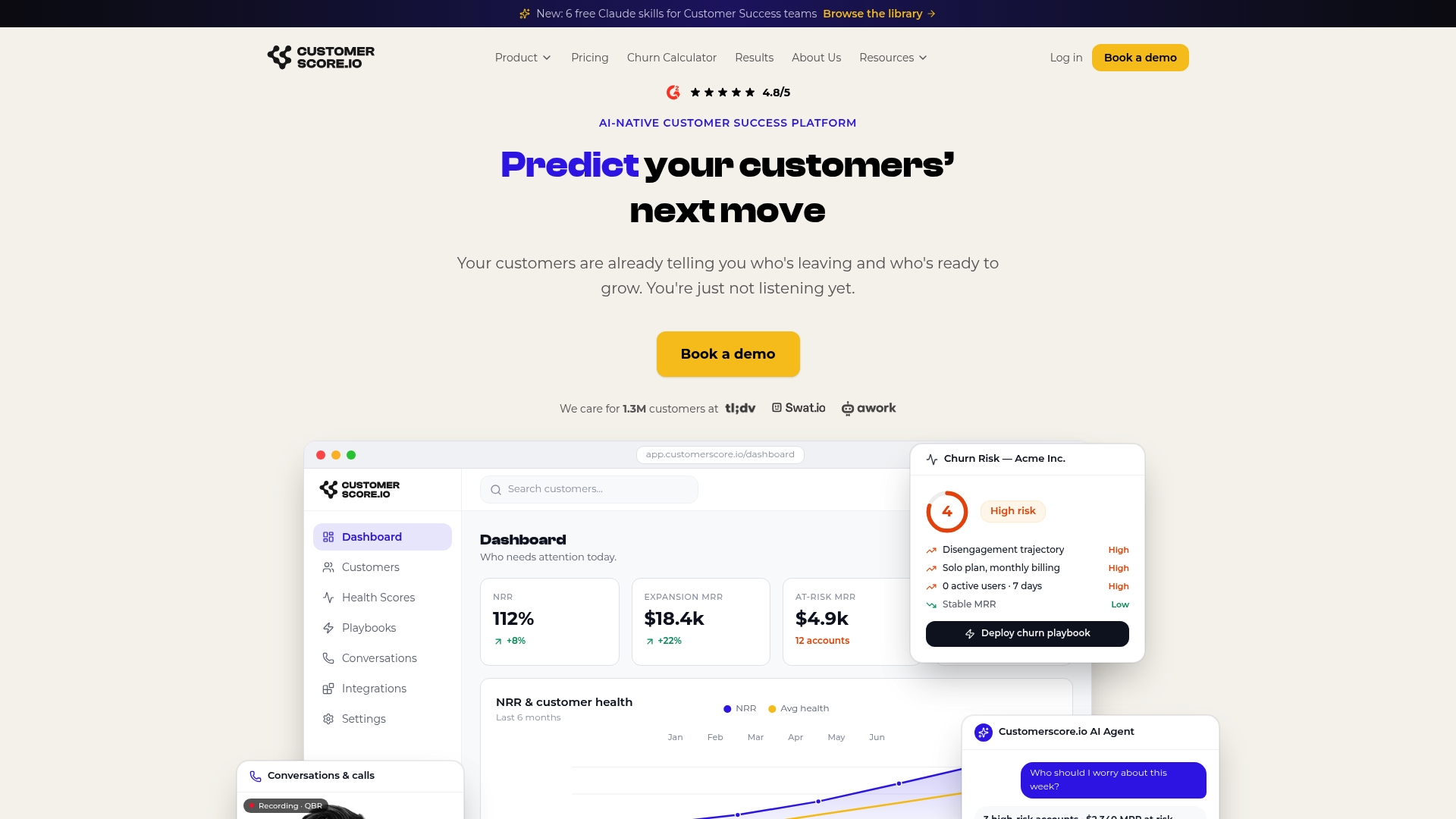
If you're building a procurement case right now, start with churn prediction and customer health scoring, then see how pricing works. When you're ready for a tailored offer for your ARR, book a demo and bring your data-source list. It'll make the conversation faster.
Sources
- Customer Success Platform Pricing 2026: Gainsight vs ChurnZero vs Totango vs Catalyst vs Vitally | StackScored
- Vendr: Planhat pricing benchmarks
- Vendr: Gainsight pricing benchmarks
- Vendr: ChurnZero pricing benchmarks
- Vendr: Vitally pricing benchmarks
- Vendr: Custify pricing benchmarks
- Customer Success Software for SaaS: Why You Don't Need a $40K Platform
Recommended
Related articles
Five Fields to Fix Playbook Trigger Design for B2B SaaS CS & RevOps
Five Fields to Fix Playbook Trigger Design for B2B SaaS CS & RevOps ! Isometric trigger routing system illustration The most reliable approach to playbook trigger design is to sort every alert into
BlogStop SaaS Downgrades: Save 31% of At Risk Accounts for CS & RevOps
Stop SaaS Downgrades: Save 31% of At Risk Accounts for CS & RevOps ! Isometric account protection title card The fastest way to prevent SaaS downgrades is to stop treating every at-risk account the
Blog24–48 Hour Handoffs: B2B SaaS Support to CS Checklist, Six Fields
24–48 Hour Handoffs: B2B SaaS Support to CS Checklist, Six Fields ! Isometric handoff cards crossing between platforms A reliable support to CS handoff transfers ownership and context so the new owner
Blog90–120 Day Explainable AI Playbook to Reduce Renewal Risk for SaaS CS
90–120 Day Explainable AI Playbook to Reduce Renewal Risk for SaaS CS ! Isometric illustration of explainable renewal risk decisions To reduce renewal risk, you prioritize accounts daily using