
Fix Data First: Prioritize CS Integrations With a 90 Day Pilot


Prioritize integrations that sharpen predictive signals and close the loop for CSMs, not the ones that just look impressive on an architecture diagram. That means fixing data quality and identity resolution before you connect anything new, then adding sources in order of how much they improve churn prediction, health scoring, or renewal automation. In practice, that usually puts CRM, billing, and product event data ahead of everything else. One AI-native platform is built around that exact sequencing.
TL;DR:
- Prioritize integrations that significantly enhance churn prediction, health scoring, or renewal automation, focusing on CRM, billing, and product usage data first.
- Score integrations based on impact, effort, and confidence, and choose those with high impact and reliability to pilot within 90 days.
- Ensure data quality and effective identity resolution before connecting new sources, as poor data can undermine model accuracy more than missing integrations.
- Conduct quick, structured workshops with key stakeholders to develop a ranked shortlist of integrations, rather than relying on ad hoc or lengthy processes.
- Use native, two-way sync integrations where possible, and build in ongoing monitoring, security, and rollback plans to avoid long-term data degradation.
Table of Contents
- ## What Framework Should You Use to Rank Integrations?
- How Do You Run a Workshop to Get a Ranked Shortlist?
- What Technical Checks Decide If an Integration Is Worth Building?
- Which Integration Feeds Which CS Outcome?
- How Do You Pilot, Validate, and Scale an Integration?
- An Author's View on Why Fewer, Cleaner Signals Win
- What Can Go Wrong, and How Do You Contain It?
- How Should You Budget for Integration Projects?
- The Real Lesson Buried in the Data-Quality Numbers
- Let Customerscore.io Run Your Prioritized Integrations
- Primary Sources and Further Reading
- Sources
- FAQ
## What Framework Should You Use to Rank Integrations?
Before scoring anything, name the outcomes you actually care about. Most CS teams land on three: reduce churn, predict expansion, and automate renewals. Every candidate integration gets judged against those, not against how many logos a vendor claims to support.
From there, score each candidate on three axes:
- Impact — how much does this source improve a predictive signal, cut manual lookups for CSMs, or unlock a new playbook trigger? A billing feed that reveals downgrade patterns scores high. A social media integration that tells you nothing about account health scores low, regardless of how easy it is to connect.
- Effort — engineering hours, mapping complexity, and how cooperative the vendor's API and support team actually are. Some integrations look simple until you discover the data lives three levels deep in a nested object with no documentation.
- Confidence — do you have enough clean, available data to trust the output? This is where identity resolution matters most. If you cannot reliably match a CRM account to a product usage account, the integration adds noise instead of insight, a point TSIA makes directly when it warns that data quality and lack of integration are the top barriers to getting value from CS platforms.
Here's how that shakes out with a generic scoring pass:
| Data source | Impact (1-5) | Effort (1-5, lower is easier) | Confidence (1-5) | Priority |
|---|---|---|---|---|
| CRM | 5 | 2 | 5 | Top priority |
| Billing/payments | 5 | 3 | 4 | Top priority |
| Product usage events | 5 | 4 | 3 | Top priority (pilot after data cleanup) |
| Support tickets | 3 | 2 | 4 | Backlog |
| NPS/survey | 3 | 2 | 3 | Backlog |
High scores on impact and confidence metrics suggest immediate piloting, while sources with substantial long-term value may require further identity resolution before prioritization.
How Do You Run a Workshop to Get a Ranked Shortlist?
You don't need a quarter-long committee to prioritize integrations. A focused 30 to 60 minute session with the right people in the room produces a ranked, defensible list. Structured evaluation processes beat ad hoc decisions made by whoever shouts loudest in Slack.
Invite these roles, and no more:
- The CS leader who owns the churn and expansion numbers
- A RevOps lead who understands the current data stack
- One engineer who can sanity check effort estimates in real time
- A product or analytics stakeholder who knows what event data actually looks like
- Finance, if billing or ARR data is on the table
Before the meeting, collect data owners for each candidate system, a sample export where possible, any SLA commitments from vendors, and the two or three business metrics you're trying to move.
Run the session in this order:
- Confirm the outcome list (churn, expansion, renewals) so scoring stays anchored.
- Score each candidate independently first, then reveal and discuss outliers.
- Apply a simple tie-break rule: when two items score the same, the one with higher confidence wins.
- Weight impact slightly higher than effort if your team is resourced to build.
Walk out with three pilot candidates, one long-lead backlog item, and a named owner for each.
What Technical Checks Decide If an Integration Is Worth Building?
An integration that connects cleanly but feeds bad data is worse than no integration at all. Run every candidate through these checks before committing engineering time.
- Data quality: required fields present, event granularity fine enough for the use case, missing-value rates below a threshold you can tolerate, and a schema that doesn't shift without warning.
- Identity resolution: a canonical account or contact ID that maps cleanly across systems, a defined strategy for account hierarchies (parent accounts, multiple subsidiaries, multiple product instances).
- Sync characteristics: does the use case tolerate batch updates, or does it need near real-time data? Decide upfront whether you need two-way sync or one-way ingestion is enough, and define a conflict policy for when two systems disagree.
- Security and compliance: authentication method, encryption in transit and at rest, the scope of data access the integration actually needs (not the scope it's offered by default), and what the vendor contract says about data ownership.
- Operational cost: who monitors this connector when it breaks, what the rate limits are, and how much ongoing transformation logic it requires to keep working.
Pro Tip: Favor integrations with two-way sync over ingestion-only feeds where the workflow calls for it. A CSM who resolves a risk flag inside your CS platform should be able to push that update back into the source system, not maintain two versions of the truth by hand.
Watch for data drift, too. Expert teams reconcile ARR against the billing system directly and treat the CS platform as an operational view for CSMs, not the system of financial record.
Which Integration Feeds Which CS Outcome?
Not every data source earns its place the same way. Matching the source to the outcome it actually improves keeps you from connecting things because they're available rather than because they're useful.
- CRM data anchors contract dates, expansion signals, and commercial health indicators like seat count changes or contract renegotiations.
- Billing and payments systems reveal true ARR, dunning failures, and downgrade risk long before a CSM would notice it manually.
- Product event streams surface feature adoption trends and anomalous usage drops, often the earliest leading indicator of churn.
- Support tickets expose friction points, recurring product themes, and sentiment flags that feed directly into playbook triggers.
- Survey and NPS data provide the supervised labels needed to train and validate predictive models against real outcomes.
- Warehouse and analytics platforms enable cohort enrichment and retrospective analysis once you need to explain why a model made a call.
TSIA's research backs this sequencing directly: rather than building one overloaded health score that tries to capture everything, focus AI on a handful of high-value, predictive sources. A model fed five clean signals usually outperforms one drowning in twenty noisy ones.
How Do You Pilot, Validate, and Scale an Integration?
Pick a 90-day pilot with KPIs you can actually measure: predictive precision on churn flags, reduction in manual account lookups, and time-to-action after a risk signal fires. TSIA's guidance is to start with one AI-driven use case, like automated risk analysis on a single segment, rather than rebuilding every score simultaneously.
Before you flip anything on, set a baseline: current churn rate, current manual research time per account, current time between signal and CSM action. Assign a cohort for comparison and define your retraining cadence upfront, monthly is a reasonable starting point for most B2B SaaS churn models.
- Ingest the pilot data source and map fields to your canonical schema.
- Validate against known outcomes (accounts that already churned or expanded).
- Retrain or calibrate your model with the new signal included.
- Run the resulting playbooks with a small group of CSMs and track adoption.
- Compare pilot cohort outcomes against baseline at the 90-day mark.
Set go/no-go criteria before you start, not after you see results you like. If precision improves and manual lookup time drops, document the runbook and scale. If it doesn't move the needle after one full cycle, the integration goes back to the backlog regardless of how much effort already went in.
An Author's View on Why Fewer, Cleaner Signals Win
Patrik has spent years watching customer success teams evaluate revenue technology and has written extensively on churn prediction and health scoring for the Customerscore.
Customerscore.io was built around the same premise TSIA's research supports: connect fewer sources, but demand more from each one. Its health scoring engine pulls from billing, product usage, CRM, and support data specifically to produce explainable scores, not a black-box number nobody trusts. When a support ticket volume spikes for a specific account, that signal feeds directly into churn prediction and triggers a playbook, rather than sitting in a separate tool a CSM has to check manually.
The pattern holds across the accounts Customerscore.io works with: fixing identity resolution and data quality before adding a fifth or sixth connector consistently produces better model precision than adding more sources on top of a shaky foundation.
What Can Go Wrong, and How Do You Contain It?
The biggest risk in any integration project isn't the connector breaking. It's shipping a model on bad data and not finding out until a churn prediction misses a real risk account. Treat every new integration as a hypothesis you're testing, not a fact you're accepting.
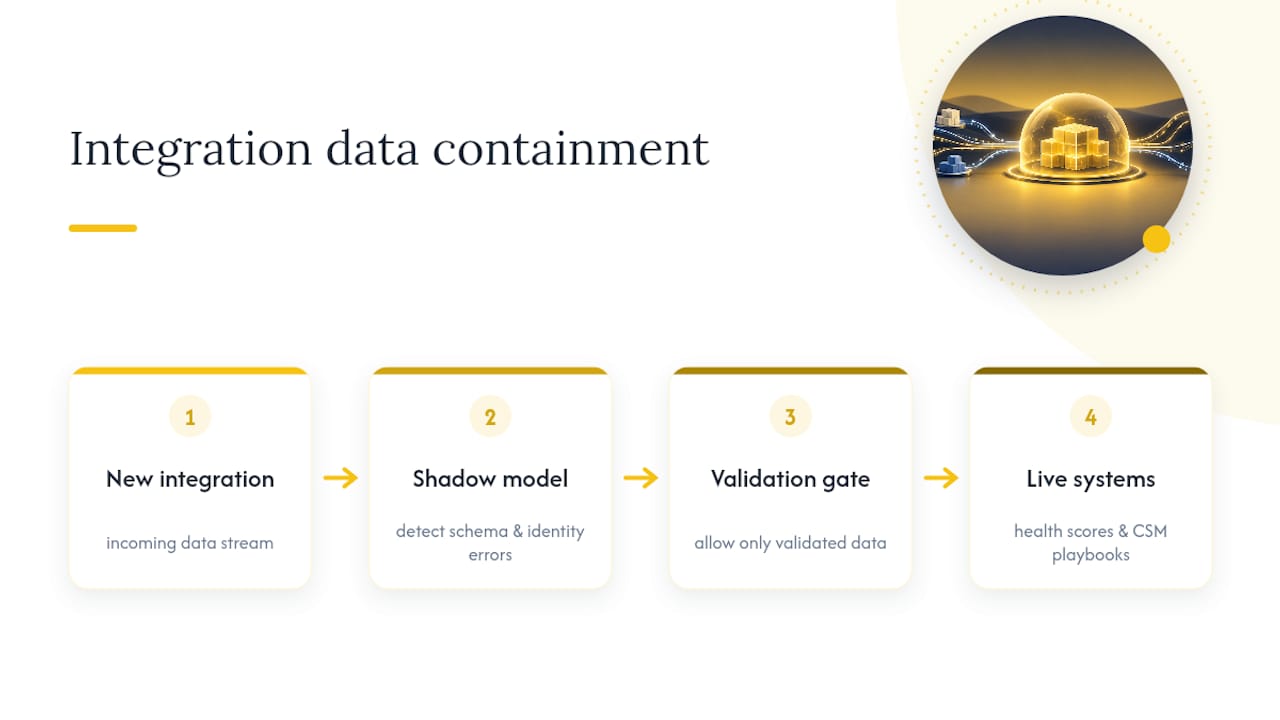
Start by isolating blast radius. Run new data through a shadow model or a staging environment before it touches live health scores or triggers CSM playbooks. This catches schema mismatches and identity resolution errors before they influence a renewal conversation.
Vendor risk deserves its own line item. An API that changes without notice, a rate limit that throttles your sync during a busy renewal season, or a support team that takes two weeks to respond to a broken webhook can quietly degrade your data pipeline for months. Ask about API versioning policy and support SLAs before signing, not after something breaks.
Access scope is another common failure point. Grant integrations the minimum data access the use case requires, and audit that scope quarterly, because permissions tend to accumulate and rarely get revoked. Pair this with a documented conflict policy for two-way syncs: when the CRM and the CS platform disagree on a field, decide in advance which system wins.
Finally, build a rollback plan before launch, not during an incident. Know how to disconnect a source and revert to the prior model state without losing the ability to serve CSMs their existing playbooks.
How Should You Budget for Integration Projects?
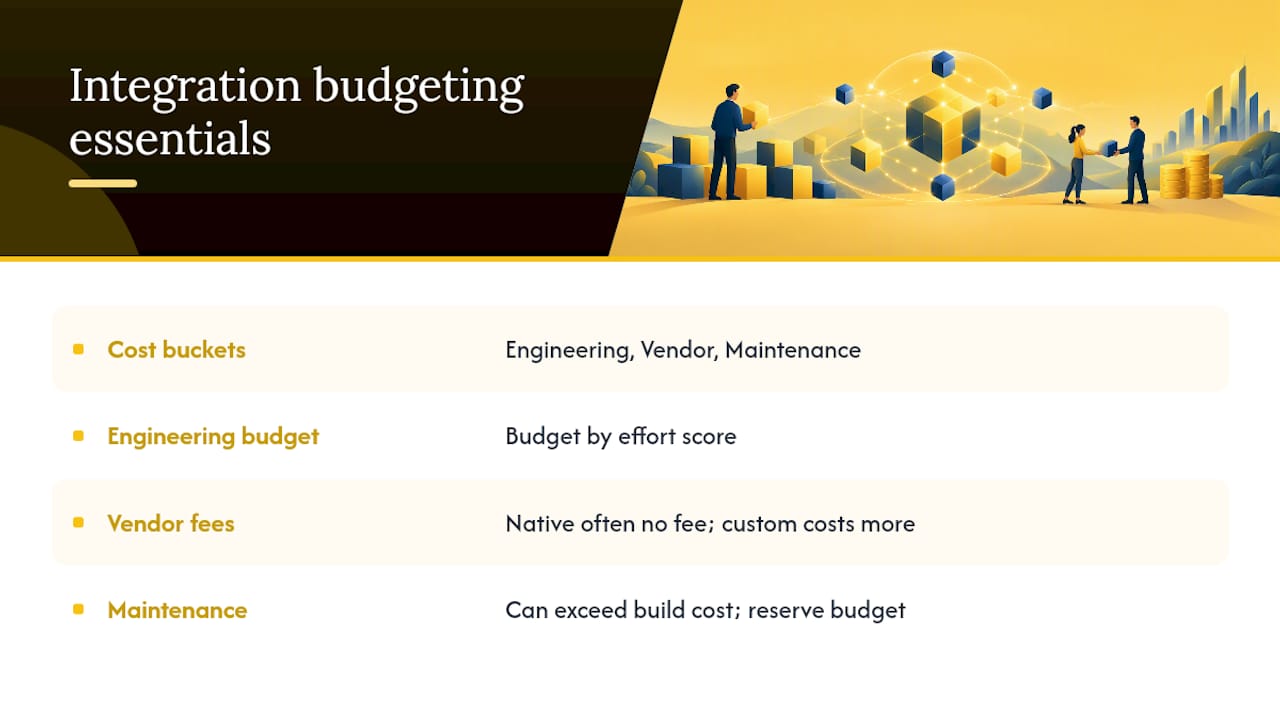
Integration costs split into three buckets: engineering time, vendor fees, and ongoing maintenance. Most teams budget generously for the first and barely account for the third, which is backward. A connector that took forty hours to build can easily cost more than that annually in monitoring, schema updates, and support tickets when something breaks.
Budget engineering time based on the effort score from your prioritization framework, not a flat estimate per integration. A CRM sync with clean documentation and a mature API might take a few days. A homegrown product analytics database with no API at all might need a data engineer for weeks.
Vendor costs vary by whether the integration is native, built through a middleware layer, or custom. Native integrations, the kind Customerscore.io offers for tools like HubSpot, Salesforce, Stripe, and Segment, typically carry no separate connector fee since they're part of the platform. Custom builds against a vendor's raw API often require ongoing developer hours to maintain as that API evolves.
Reserve a maintenance line in your budget from day one: monitoring dashboards, alerting for sync failures, and a named owner responsible for keeping mappings current when either system changes its schema. Skipping this line is the single most common reason integrations degrade quietly over a year until nobody trusts the data anymore.
The Real Lesson Buried in the Data-Quality Numbers
The conventional advice on integrations still treats connector count as a proxy for platform maturity. More logos, more credibility. That thinking is backward, and TSIA's own numbers make the case: over 70% of organizations cite data quality as their biggest obstacle, not the absence of integrations.
What the research actually supports is narrower and less flashy: fix identity resolution, reconcile your systems of record, and only then add sources that move a specific predictive metric. Teams that skip straight to broad connector sprawl end up with dashboards full of numbers nobody trusts, which is worse than having fewer numbers you can defend in a renewal conversation.
If you take one thing from this, prioritize the unglamorous work first. A clean CRM-to-billing identity match will do more for your churn model than your sixth integration ever will. Build the foundation, pilot one predictive use case, and let the results earn the next connector's place in line.
— Patrik
Let Customerscore.io Run Your Prioritized Integrations
Once you've ranked your integrations, someone still has to build, maintain, and act on them, and that's where most CS teams lose momentum. Some platforms connect CRM, billing, product usage, and support data natively, then turn that into explainable health scores and automated churn prediction without months of custom engineering work.
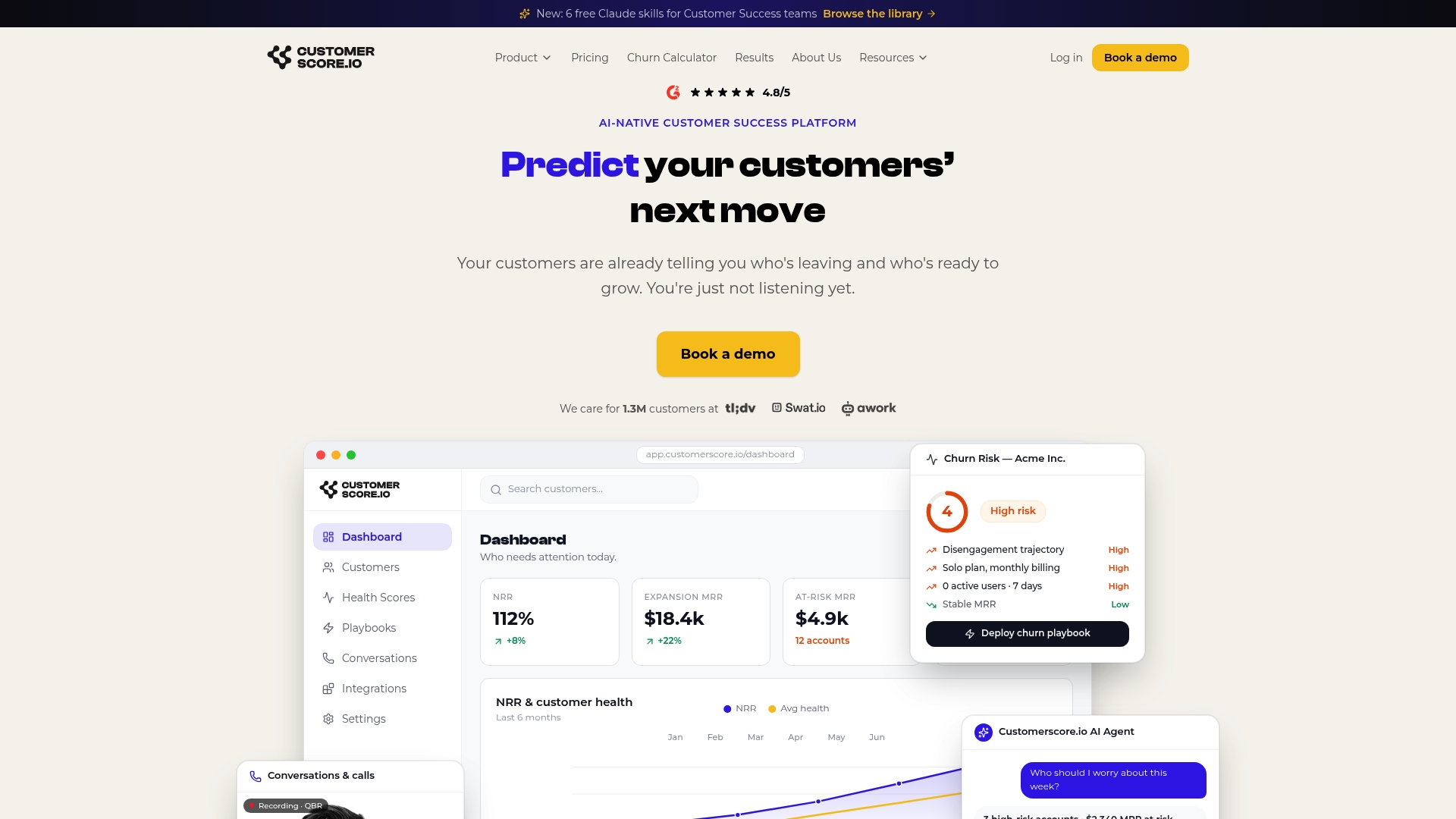
Instead of stitching together a homegrown pipeline and hoping identity resolution holds up, you can get native syncs with common customer success tools, plus playbooks that trigger automatically when a risk signal fires. That means your CSMs act on the same 90-day pilot plan outlined above without building the retraining infrastructure themselves.
Check the pricing page for a quote tiered by your client ARR, or book a demo to see how the platform scores accounts once your prioritized sources are connected.
Primary Sources and Further Reading
- Customer Success Tech Platforms Struggle | TSIA
- Customer Health Scoring: The Shift Toward Predictive Models | TSIA
- Customer Success Platforms: A Complete Guide to Choosing the Right Customer Success Tool | TSIA
- The State of Customer Success 2026: Proving Value in the Age of AI Economics™ | TSIA
- Customerscore
- How to Use Data for Insights to Drive Growth
Sources
- Customer Success Tech Platforms Struggle | TSIA
- Customer Health Scoring: The Shift Toward Predictive Models | TSIA
- Customer Success Platforms: A Complete Guide to Choosing the Right Customer Success Tool | TSIA
- The State of Customer Success 2026: Proving Value in the Age of AI Economics™ | TSIA
FAQ
What Is the Best Way to Prioritize CS Integrations?
Score each candidate on impact to predictive signals, engineering effort, and data confidence, then start with whichever combination scores highest on impact and confidence together. Fixing data quality and identity resolution first matters more than connector count, since poor data quality is the top barrier to getting value from CS platforms.
Should CRM or Product Usage Data Come First?
CRM data usually comes first because it's cleaner, easier to map, and directly supports commercial health indicators like contract dates and expansion signals. Product usage data often carries higher long-term impact but needs more identity resolution work before it's trustworthy enough to feed a churn model.
How Long Should a CS Integration Pilot Run?
A 90-day pilot gives you enough time to establish a baseline, ingest and validate a new data source, retrain a model, and measure whether predictive precision or manual lookup time actually improved. TSIA recommends starting with one focused use case rather than rebuilding every score at once.
Does Customerscore.io Support Two-Way Sync With CRM and Billing Tools?
Some platforms connect natively with popular tools such as CRM and billing systems to feed churn prediction and health scoring models. Specific sync behavior and setup details for each integration are available on the product page.
What Does Customerscore.io Cost?
Customerscore.io pricing is a flat platform fee tiered by your client ARR, never per seat. Every customer gets the full platform, and you get a tailored quote in one call.
Recommended
Related articles
Cut CSM Intervention 18%: Predictive Playbooks for CS & RevOps
Cut CSM Intervention 18%: Predictive Playbooks for CS & RevOps ! Predictive playbook geometric title card Predictive playbooks link a churn prediction to a specific, repeatable action so customer
BlogPinpoint B2B SaaS Adoption Gaps and the Fix That Lifts Renewal
Pinpoint B2B SaaS Adoption Gaps and the Fix That Lifts Renewal ! Analysts reviewing SaaS adoption gaps Adoption gap analysis identifies the funnel stage where eligible users or accounts fail to reach
BlogAnalysts: 6–12 Month Cohort Forecasts for Net Dollar Retention
Analysts: 6–12 Month Cohort Forecasts for Net Dollar Retention ! Analyst reviewing cohort retention forecast The most reliable way to forecast net dollar retention is cohort-based modeling that
BlogStop Surprise Churn: 5 Phase Data Mapping for RevOps and CS
Stop Surprise Churn: 5 Phase Data Mapping for RevOps and CS ! Analyst mapping customer data fields Data mapping for CS means connecting product usage, billing, CRM, and support data to the fields your