
Land and Expand SaaS: The B2B Playbook That Scales ARR


Land and expand is a staged go-to-market motion: win a small, scoped contract, prove value fast, then grow the account using behavioral signals, pricing levers, and a designated expansion owner. The one-line plan is this — land small, document value early, and expand on signals before the next renewal cycle.
Before reading further, run these three checks:
- Do you have usage or seat variability? If your product has no natural growth dimension, expansion requires a pricing redesign before anything else.
- Can a single team or department adopt your product without a company-wide rollout? If yes, you have a viable land target.
- Do you know who owns expansion quota today? If the answer is "CS and Sales both kind of do," you have an ownership gap that will kill NRR.
Key Takeaways
Land and expand works when pricing allows frictionless growth, signals route automatically to a named expansion owner, and each new department is treated as a fresh discovery cycle rather than an assumed upsell.
| Point | Details |
|---|---|
| Price for expansion from day one | Modular or usage-based pricing removes legal friction and lets expansions close in days, not months. |
| TTFV drives everything downstream | Accounts that reach first value in under 60–90 days expand at materially higher rates than those that take longer. |
| Signals beat calendars | Behavioral triggers (usage at tier limit, feature adoption breadth) outperform quarterly QBR-based outreach for expansion timing. |
| Assign a named expansion owner | Expansion with quota and comp on net-new expansion ARR produces shorter cycles and higher win rates than shared CS/Sales ownership. |
| Customerscore operationalizes the motion | Expansion scoring, health scoring, and automated playbooks turn the four-stage playbook into a measurable, repeatable system. |
Table of Contents
- What does land and expand actually mean for SaaS teams?
- Why land and expand beats traditional SaaS growth models
- How to run the land and expand playbook step by step
- How should you price to make expansion frictionless?
- Who owns expansion, and how does CS Ops make it repeatable?
- Which metrics tell you if your expansion motion is working?
- What goes wrong with land and expand, and how do you fix it?
- How a SaaS team turned stalled accounts into predictable expansion revenue
- The part most teams get backwards
- Customerscore gives your expansion motion a measurable starting point
- Useful sources
What does land and expand actually mean for SaaS teams?
The phrase gets used loosely, so a sharper definition matters. The land phase is a deliberately small, scoped first contract — one team, one use case, one budget owner who can sign without a committee. The goal is not to maximize ACV on day one. It is to minimize adoption friction so the customer reaches their first meaningful outcome fast.
The expand phase is everything that happens after that first value moment: adding seats, unlocking usage tiers, bringing in adjacent teams, or cross-selling product modules. Expansion is not the same as renewal. Renewal is keeping what you have. Expansion is growing the footprint, and it requires its own discovery, its own stakeholder map, and its own success criteria.
According to the B2B SaaS land and expand playbook, a real land-and-expand motion needs four things working in parallel: pricing that allows growth without renegotiation, a small first contract, an expansion owner with quota and comp, and a signal system that tells you when an account is ready to grow.
Three canonical play shapes exist in practice. The PLG wedge uses a free or low-friction self-serve entry to let end users adopt the product bottom-up, then converts team or company-wide. The pilot-to-departmental shape starts with a paid proof-of-concept scoped to one department, then expands to adjacent teams once the pilot hits its success criteria. The usage-first shape starts with a low seat count or consumption floor and grows as usage naturally increases. Each shape has a different TTFV target and a different expansion trigger, but all three share the same underlying logic: earn the right to expand before asking for it.
Why land and expand beats traditional SaaS growth models
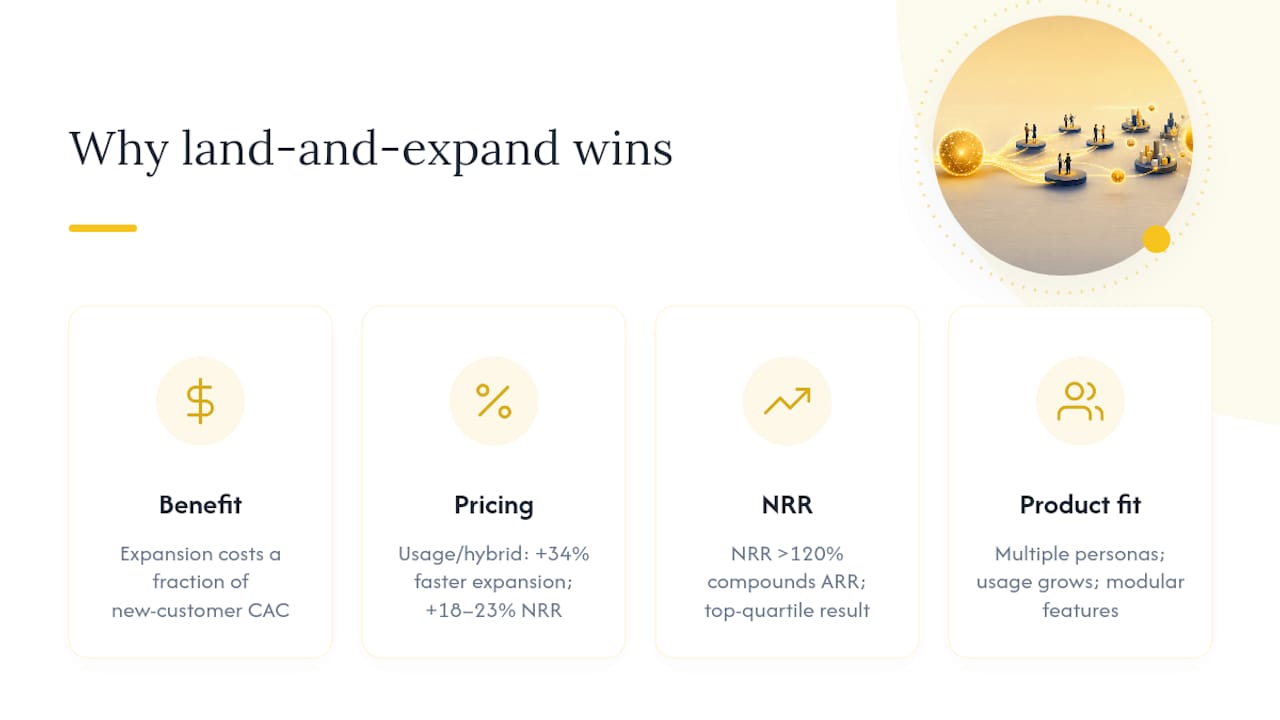
The business case is straightforward once you look at the unit economics. Expansion revenue from existing accounts costs a fraction of acquiring a new customer, because you skip the awareness, evaluation, and procurement stages that dominate new-logo CAC. The sales cycle for an expansion into a second team at an existing account is typically weeks, not quarters.
The primary financial metric is Net Revenue Retention (NRR). An NRR above 120% means your revenue base grows even with zero new logos — every percentage point above 100% is compounding ARR from accounts you already own. Top-quartile B2B SaaS companies consistently run NRR above 120%, and land-and-expand is the primary engine behind that number.
Companies running usage-based or hybrid pricing models report 34% faster expansion cycles and 18–23% higher NRR than those on flat-rate pricing — a gap that compounds significantly as ARR scales.
The motion fits best when three product conditions are present: multiple personas or departments who could benefit from the product, a usage or seat variable that grows naturally with adoption, and a modular feature set where value can be unlocked incrementally. Mid-market and enterprise accounts are the natural home for this motion because budget authority is distributed across departments, making a small first deal politically easier to close.
Counter-indicators are worth naming. Single-person workflows with no usage variability — think a solo practitioner tool — have no natural expansion surface. Products with a long time to first value (more than 60–90 days) struggle because the account goes cold before expansion signals appear. Monolithic bundled pricing, where everything is in one SKU at one price, creates legal and procurement friction every time you try to grow the contract.
How to run the land and expand playbook step by step
This is a four-stage sequence. Each stage has a clear owner, a success metric, and a handoff trigger.
-
Land small. Scope the first contract to a single team or use case. For mid-market accounts, a typical first deal runs $25K–$50K ACV; for SMB, $5K–$15K. The deal size should align with the signer's approval authority — if it requires a VP signature, you have already added procurement friction. Sales owns this stage. The success metric is a signed contract with a defined pilot scope and a documented TTFV target.
-
Activate. Get the customer to their first meaningful outcome as fast as possible. Define TTFV concretely: not "onboarding complete" but "first report generated" or "first integration live." Build onboarding checkpoints at day 7, day 14, and day 30. Partner-assisted implementations consistently reach first value faster than solo ones, so consider a structured kickoff call and a shared success plan document. CS owns this stage. The handoff from Sales to CS should happen at contract signature, not at renewal.
-
Signal. Before you can expand, you need to know when an account is ready. The signals that matter are behavioral: feature adoption breadth (are they using three modules or one?), usage velocity (is consumption growing week over week?), org signals (did a new department head just join the Slack channel?), and support patterns (are they asking questions about features they don't yet have?). Route these signals to the expansion owner automatically — manual QBR-only discovery misses the window. CS Ops owns signal design and routing.
-
Expand. Five plays cover most expansion scenarios. Seat expansion adds users within the same team. Usage expansion grows consumption against a metered tier. Team expansion brings in an adjacent department, which requires its own discovery cycle with its own stakeholder map and success criteria. Product expansion cross-sells a module the customer doesn't yet use. Renewal uplift uses the renewal conversation to negotiate a higher base tier. Expected close windows: seat and usage plays close in days to two weeks; team and product plays run four to eight weeks because they involve new stakeholders. Expansion AE or CS owns this stage, depending on ARR.
Handoff rules: Sales hands to CS at contract signature. The expansion owner engages when a signal score crosses a defined threshold, not on a fixed calendar cadence. Expansion AEs should carry quota on net-new expansion ARR — when expansion is on quota, it gets prioritized.
How should you price to make expansion frictionless?
Flat-rate, monolithic pricing is the single biggest structural barrier to land-and-expand. When every expansion requires a contract amendment, a legal review, and a procurement cycle, your expansion win rate drops and your cycle time balloons. The Bessemer Venture Partners case study on pricing redesign shows exactly this: a B2B SaaS company that moved from a monolithic ACV model to a lower entry price with usage tiers saw NRR move from sub-100% to top-quartile performance within months.
The pricing shapes that enable expansion are:
- Feature modules as separate SKUs. Building modules from day one — even if you only sell one initially — means expansions can be purchased via admin UI or a simple order form rather than a full contract renegotiation.
A rollout checklist for teams redesigning pricing: experiment with a usage tier on new logos before rolling it to existing accounts; document the internal amendment process so CS knows exactly what paperwork a $10K expansion requires; set and communicate internal discount rules so expansion AEs don't undercut the base price to close fast.
Pro Tip: Price the first deal with room to expand. If your standard seat price is $200/seat and you discount to $120 to close the land deal, you have created a pricing anchor that makes every future expansion conversation start from the wrong number. Instead, keep the seat price firm and reduce scope — fewer seats, shorter term, or a narrower feature set — so the expansion path is at full price.
Who owns expansion, and how does CS Ops make it repeatable?
Ownership of expansion shifts as ARR grows, and getting this wrong is one of the most common organizational mistakes in SaaS.
CS Ops is what converts land-and-expand from a gut motion into a repeatable system. The required capabilities are:
- Expansion scoring: — a composite score that ranks accounts by expansion readiness, drawing from product usage, billing data, CRM activity, and support history.
- Onboarding templates: standardized SaaS onboarding workflows that reduce TTFV variance across CSMs.
The integration checklist for CS Ops: connect billing and subscription data (Stripe, Chargebee) for usage and tier signals; sync CRM (HubSpot, Salesforce) for org changes and stakeholder mapping; pull product analytics (Mixpanel, PostHog, Segment) for feature adoption; and route support data (Intercom) for intent signals. Each source adds a different layer to the expansion score. Missing even one of them creates blind spots.
Which metrics tell you if your expansion motion is working?
Define these before you build a dashboard, because teams that track the wrong metrics optimize for the wrong behaviors.
| Metric | Definition | SMB Target | Mid-Market Target | Enterprise Target |
|---|---|---|---|---|
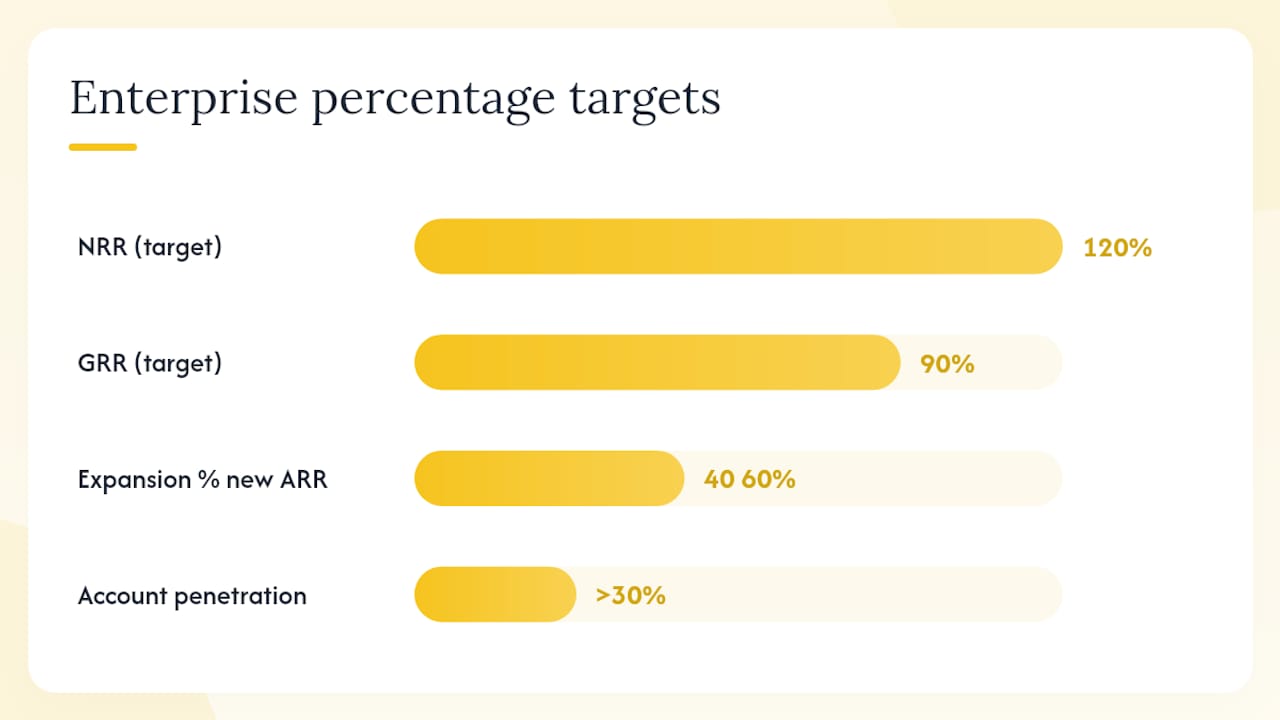
| NRR | (Starting ARR + expansion – contraction – churn) / starting ARR | 100% | 110–120% | 120% |
| GRR | (Starting ARR – contraction – churn) / starting ARR | 90% | — | 90% |
| Expansion % of new ARR | Expansion ARR / (new logo ARR + expansion ARR) | — | 30–45% | 40–60% |
| TTFV | Days from contract signature to first documented value milestone | <14 days | faster than three weeks | <30 days |
| Time to first expansion | Days from TTFV to first expansion event | 60–90 days | 90–120 days | 60–90 days |
| Expansion win rate | Expansion opportunities closed / expansion opportunities opened | — | 45–55% | — |
| Account penetration | Seats or usage deployed / total addressable seats or usage in account | Track trend | Track trend | >30% by year 2 |
The diagnostic thresholds for "motion is broken": NRR below 100% means contraction and churn are outpacing expansion — fix GRR first. Expansion win rate below 30% usually signals either wrong timing (engaging before the account has hit TTFV) or wrong play (running a product expansion before the customer has fully adopted the core). TTFV above 45 days in SMB is a red flag; accounts that take that long to reach first value rarely expand in year one.
A single expansion dashboard should pull NRR and GRR from your billing system, TTFV from your CS platform, expansion pipeline from your CRM, and feature adoption from product analytics. Customerscore's expansion scoring aggregates these sources into a single ranked list, so the expansion owner starts each week knowing exactly which accounts to contact and why.
For a deeper look at retention metrics beyond NRR, including product-qualified account signals and usage-based health indicators, the Customerscore blog covers the full stack.
What goes wrong with land and expand, and how do you fix it?
Most land-and-expand failures trace back to four root causes. Each has a specific symptom and a short mitigation path.
-
Overselling / shelfware. Symptom: the customer bought seats or modules they never activated. Expansion conversations stall because the champion can't justify more spend when existing licenses sit unused. Mitigation: run a license utilization audit at day 60. If adoption is below 50%, pause expansion outreach and run a re-onboarding play before any upsell motion.
-
Pricing friction. Symptom: expansion deals take 60+ days to close because every increment requires a legal amendment. Mitigation: redesign the contract structure so incremental seat or usage additions can be approved by the customer's admin without a new SOW. Even a simple order form process cuts cycle time significantly.
-
Wrong segment or product shape. Symptom: TTFV is consistently above 45 days, or the product has no natural expansion surface (no seat variability, no usage dimension, no adjacent modules). Mitigation: run a product-market fit audit for the land-and-expand motion specifically. If the product is monolithic, modular architecture is a prerequisite — you cannot bolt expansion onto a product not designed for it.
-
Operational gaps. Symptom: expansion happens only when a CSM remembers to check in, or when the customer asks. No signals, no owner, no comp alignment. Mitigation: assign a named expansion owner with quota this quarter. Build one signal alert — usage within 15% of tier limit — and route it to that owner. That single change produces measurable results faster than any process redesign.
How a SaaS team turned stalled accounts into predictable expansion revenue
Consider a mid-market B2B SaaS company running a project management tool. At $8M ARR, NRR was sitting at 97% — expansion was happening, but churn and contraction were outpacing it. The CS team was running QBRs quarterly, but expansion conversations were ad hoc and often came too late.
The intervention had three parts. First, pricing was restructured: the monolithic per-seat annual contract was replaced with a seat-based core plus a usage tier for API integrations. Entry ACV dropped by 30%, but the usage layer created an automatic expansion path. Second, a CS Ops function was stood up with a single signal: when an account's API usage crossed 80% of its included tier, an alert fired to the expansion owner. Third, each expansion into a new department was treated as a separate discovery cycle — new stakeholder map, new success criteria, new pilot scope.
Within two quarters, NRR moved above 110%. The expansion win rate on usage-triggered plays was above 55%, compared to roughly 25% on calendar-driven outreach.
Customerscore maps directly to this playbook. Its AI churn prediction flags accounts at risk before they contract, while health scoring ingests billing, product usage, CRM, and support data to build the expansion score. Automated CS playbooks trigger the right outreach at the right signal threshold, so expansion owners get a prioritized task list rather than a raw data dump. The platform integrates with HubSpot, Salesforce, Stripe, Chargebee, Mixpanel, PostHog, Segment, and Intercom — covering every data source in the integration checklist above.
The part most teams get backwards
There's a pattern worth naming directly, because it shows up repeatedly in how SaaS teams approach this motion.
Most teams treat land and expand as a sales strategy. They optimize the land — tighter ICP, better discovery, sharper proposals — and then wait for CS to "find expansion opportunities" during QBRs. When NRR stalls, they hire more CSMs or push for more frequent check-ins.
That is the wrong lever. Expansion is not a relationship outcome. It is an instrumentation outcome. The teams that consistently run NRR above 120% are not the ones with the most attentive CSMs. They are the ones who know, at any given moment, which accounts are at 80% of their usage tier, which departments just added three new users, and which champions just got promoted. They know this because they built the signal system, not because they asked the right questions at the right QBR.
The counterintuitive rule most teams miss: expansion needs its own discovery cycle for every new department, every time. The assumption that a happy champion in engineering will automatically sell the product into marketing is wrong more often than it is right. The problems are different, the stakeholders are different, and the success criteria are different. Treating expansion like a renewal — just bigger — is how you get a 40% expansion win rate when 60% is achievable.
The practical implication: build the signal system before you hire the expansion AE. Signals tell you when to engage and who to engage. Without them, even a great expansion AE is flying blind.
Customerscore gives your expansion motion a measurable starting point
If your NRR is below 110% and you can't name the three accounts most likely to expand this month, the gap is instrumentation, not effort. Customerscore connects your billing, product, CRM, and support data into a single expansion score that ranks every account by readiness, flags churn risk before it becomes contraction, and triggers the right playbook automatically.
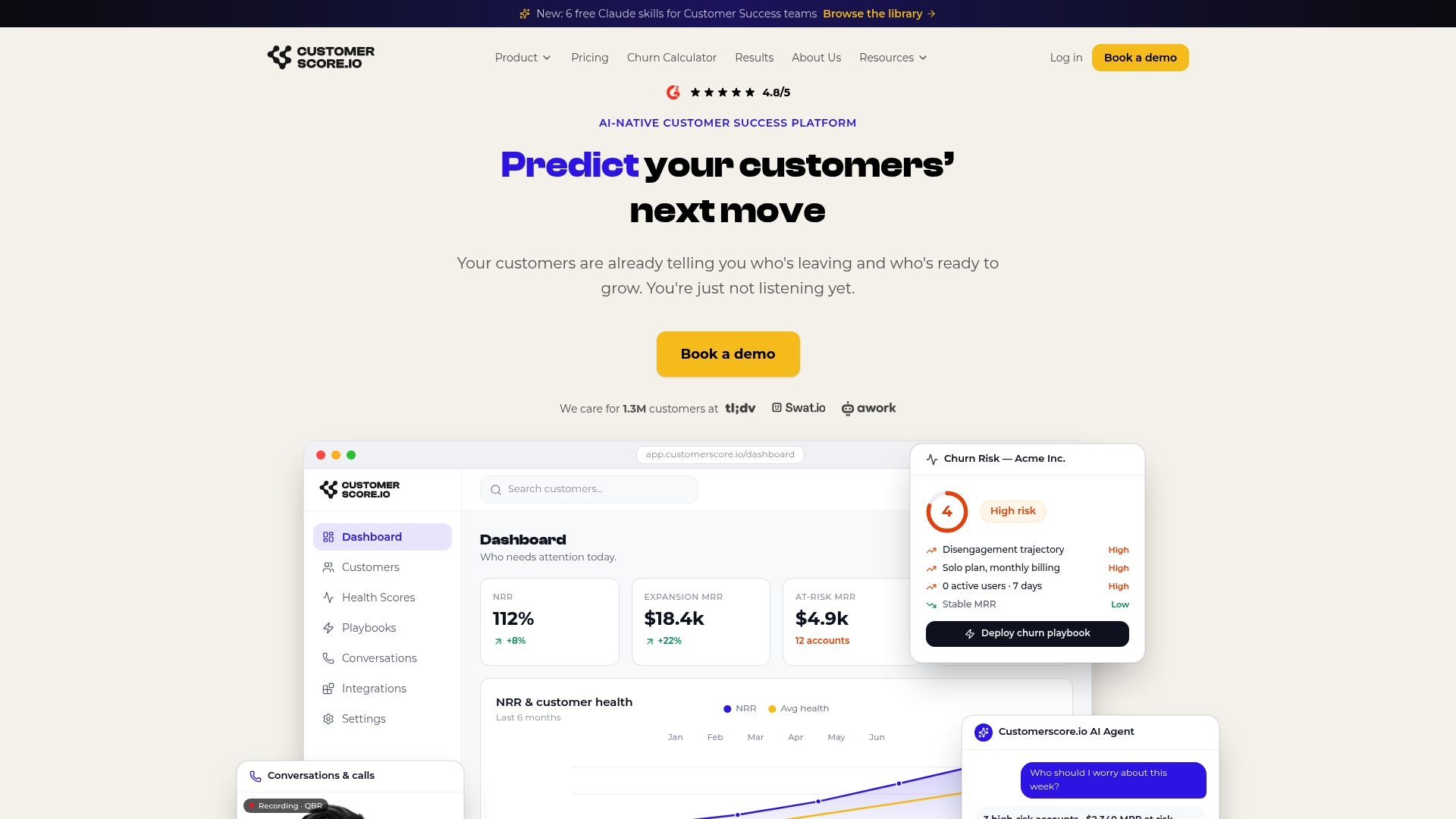
The pilot path is straightforward: connect your data sources in a guided setup (Stripe or Chargebee, HubSpot or Salesforce, and one product analytics source), and Customerscore surfaces your first expansion opportunities within 30 days. By day 90, you have a live NRR dashboard, automated signal alerts, and a ranked expansion pipeline your team can work from every week.
Teams evaluating where to start can use the free Expansion Finder skill to identify upsell opportunities before committing to a full platform setup. When you're ready to go deeper, book a demo and walk through the expansion scoring and playbook automation features with the Customerscore team.
Useful sources
- Land and Expand Methodology: A Complete Guide for SaaS Leaders
- Land and expand strategy: the B2B SaaS playbook
- How one B2B SaaS company revamped pricing for an ultra-successful land-and-expand play - Bessemer Venture Partners
- Building product modularity to enable land-and-expand - Alder VC
- Land and Expand Strategy: Stop Overselling the First Deal and Start Earning the Second One
- The Land & Expand Sales Strategy: Close now, win later
- Land and Expand: How to Turn a Small Deal into Big Results
Recommended
Related articles
Benchmarked Save Playbooks: Two Churn Survey Questions for SaaS Teams
Benchmarked Save Playbooks: Two Churn Survey Questions for SaaS Teams ! Customer success manager reviewing churn survey The most effective churn survey for SaaS is a two-question in-flow cancel
Blog90–120 Day Renewal System for CSMs: SaaS Renewal Playbook
90–120 Day Renewal System for CSMs: SaaS Renewal Playbook ! Team planning a structured SaaS renewal Run renewals as a 90 to 120 day managed pipeline, not a calendar reminder.
BlogCut Response Time 60% with This Slack for Customer Success Playbook
Cut Response Time 60% with This Slack for Customer Success Playbook ! Customer success team routing a Slack conversation Slack works best for customer success when it functions as the conversation
BlogProduct Led Customer Success in 90 to 180 Days Without a Data Team
Product Led Customer Success in 90 to 180 Days Without a Data Team ! Customer success operator reviewing product signals Product-led customer success uses product usage data and in-product