
Fixing CSAT: A B2B SaaS Playbook That Works in 30 Days


Shorten your survey, trigger it right after the moment that matters, and route every low score to an owner within 24 hours. That single sequence, repeated weekly, moves CSAT faster than any redesign, incentive program, or agent headcount increase. Quick wins show up in 2 to 4 weeks; durable gains, the kind tied to fixed root causes instead of patched symptoms, take 60 to 90 days.
B2B SaaS teams that hit a healthy CSAT range (75 to 85 percent, per RevOS) don't get there by sending longer surveys. They get there with a closed-loop process and a clear view of which unhappy accounts are also at real risk.
Before you touch anything else, do these four things:
- Cut your survey to one question plus an optional comment field.
- Trigger it immediately after ticket resolution, onboarding completion, or a key feature interaction.
- Auto-flag any score of 3 or below for follow-up within 24 hours.
- Tag the root cause of every detractor response so fixes outlast the apology email.
TL;DR:
- Automate immediate post-interaction surveys with a single question and route scores of three or below for follow-up within 24 hours to catch issues early.
- Focus on fixing root causes by tagging detractor responses, updating knowledge bases, or addressing product defects instead of solely reducing survey frequency or incentivizing responses.
- Segregate CSAT benchmarks by user role, plan tier, and decision-maker status, aiming for a score range of 75 to 85 percent to reflect healthy customer satisfaction levels.
- Use a combined approach of short surveys, timely triggers, and a closed-loop follow-up process to significantly improve response rates and reduce silent churn signals.
- Employ platforms like Customerscore to connect CSAT data with usage, billing, and support patterns, enabling proactive churn prediction and targeted account health management.
Table of Contents
- What Is CSAT and How Do You Measure It in SaaS?
- What Is a Good B2B SaaS CSAT Benchmark?
- Which Tactics Actually Raise CSAT Scores?
- How Do You Turn CSAT Scores Into Product Fixes?
- What Does a 30-Day CSAT Action Plan Look Like?
- Why This Playbook Reflects Real Operational Practice
- Key Takeaways
- What the Data Actually Says About Fixing CSAT
- Get a Clearer Picture of Why CSAT Moves
- Sources
What Is CSAT and How Do You Measure It in SaaS?
Customer satisfaction score, or CSAT, measures how satisfied a customer felt about one specific interaction, not your product overall. Respondents typically rate that interaction on a 1 to 5 scale, and the standard formula is straightforward: divide the number of positive responses (a 4 or 5) by total responses, then multiply by 100, according to RevOS's benchmark guide. Some teams use a 1 to 3 or 1 to 7 scale, but the 1 to 5 version dominates B2B SaaS because it balances enough resolution with a low completion burden.
Where you place the survey matters as much as how you word it. The strongest touchpoints in a SaaS product are:
- Immediately after a support ticket closes, while the interaction is still fresh.
- Right after onboarding completion, to catch friction before it becomes churn.
- Following a customer's first meaningful "aha" moment inside the product.
- After a new feature launch, especially for users who touched it in the first week.
- Ahead of renewal conversations, so you catch dissatisfaction before the contract decision, not after.
Three pitfalls quietly wreck CSAT programs. Sample bias skews results when only your angriest or happiest users respond. Response bias creeps in when survey wording nudges people toward a rating. And over-surveying, hitting the same account with five requests in a month, tanks response rates across the board. Cap survey frequency per user (once every 14 to 30 days is common), and segment your triggers so a support survey and an onboarding survey never land in the same inbox the same week.
What Is a Good B2B SaaS CSAT Benchmark?
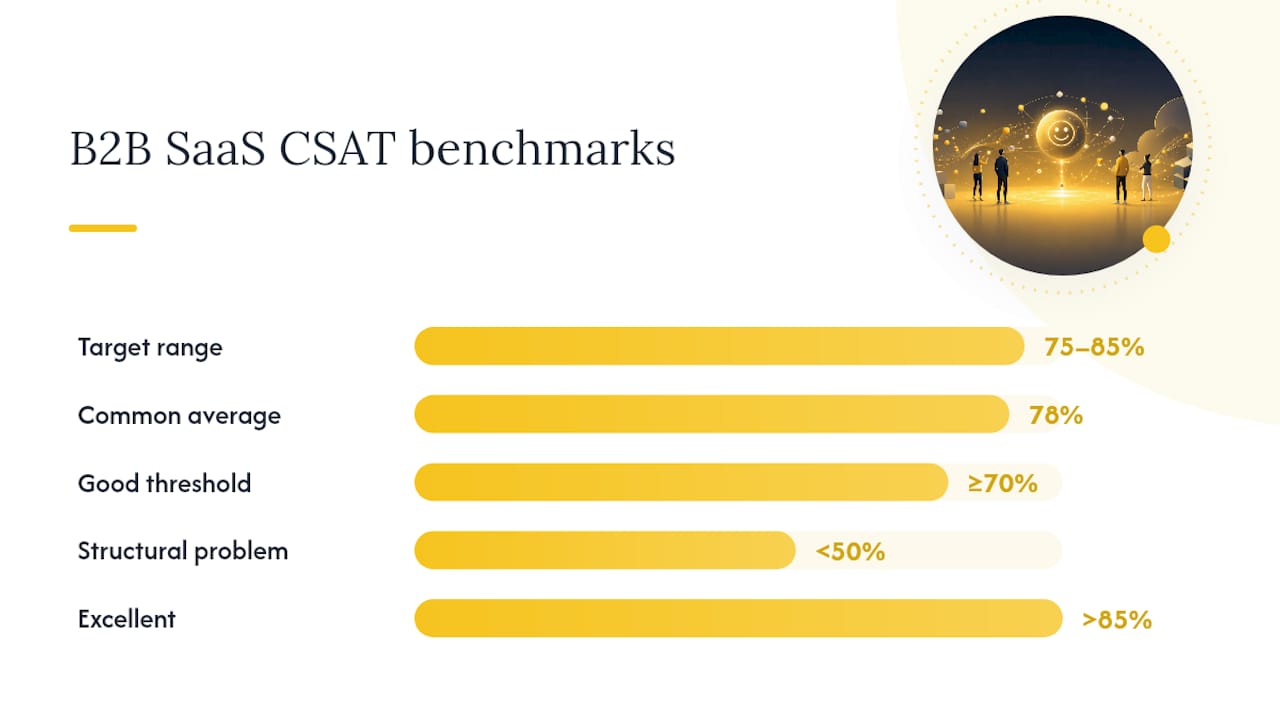
A CSAT score between 75 and 85 percent is healthy for most B2B SaaS products, and anything at or above 70 percent is generally considered good. Scores under 50 percent signal a structural problem, not a bad week, according to RevOS's benchmark data. Excellent performers push past 85 percent, usually on the back of tight support workflows and proactive success management rather than luck.
Raw benchmarks only tell part of the story. Build internal benchmarks by role, plan tier, and touchpoint before you compare yourself to an industry number:
- Segment CSAT by admin versus end-user, since admins often judge the product more harshly.
- Track score separately for enterprise versus self-service tiers; expectations differ wildly.
- Watch decision-maker CSAT specifically. It carries outsized weight for churn forecasting compared to a junior user's rating.
Statistic callout: A 78 percent average CSAT is common across industries broadly, but B2B SaaS teams should treat the 75 to 85 percent range, not a generic cross-industry figure, as their real target, since B2B buying committees and renewal cycles behave differently than consumer transactions.
Response rate and distribution shape whether a number means anything. A 90 percent score built on 15 responses out of 2,000 eligible users tells you almost nothing. A 75 percent score with a healthy spread of 4s and 5s, and only a few isolated 1s, is more trustworthy than a higher score padded entirely with 4s and no 5s at all.
Which Tactics Actually Raise CSAT Scores?
Fixing root causes and lowering customer effort moves CSAT faster than hiring more support staff, based on findings from customer feedback drives revenue growth strategies. Here's the prioritized order that works:
- Redesign the survey first. One question, an optional comment, sent immediately after the interaction, with a hard frequency cap per account.
- Close the loop on every detractor. Build an automation rule that assigns an owner the moment a score drops to 3 or below, with a 24-hour response deadline and a follow-up template ready to go.
- Cut customer effort. Give support agents unified context (billing, product usage, and prior tickets in one view) so customers stop repeating themselves, and set a first-contact resolution (FCR) target as a core team metric.
- Automate low-value intents. Password resets, plan questions, and basic how-to requests can go to AI deflection, freeing agents for the complex cases that actually move satisfaction.
- Invest in the knowledge base. Tie KB updates directly to recurring ticket tags so the content addresses what customers are actually asking, not what someone assumed they'd ask.
- Score every interaction with auto-QA. Scoring 100 percent of interactions instead of a sample surfaces coaching gaps and systemic issues weeks before a manual sample would catch them.
- Tag root causes and route them. Some problems need a product fix; others need a hire. Root-cause tagging tells you which is which before you spend budget on the wrong lever.
- Add segmented SLAs for high-value accounts. A response time that's fine for a small self-service customer can quietly erode trust with an enterprise account nearing renewal.
- Watch CSAT right after a feature launch. A dip in the first two weeks post-release is an early warning system, not noise.
- Coach with recovery playbooks. Give agents a script for turning a bad interaction around, and recognize the ones who do it well.
Pro Tip: Don't automate your way past a bad root cause. AI deflection handles volume, but if the same complaint keeps surfacing, that's a signal for your product feedback loop, not another macro.
How Do You Turn CSAT Scores Into Product Fixes?
A closed-loop workflow is what separates teams that read CSAT data from teams that act on it. The mechanics are simple: flag any score of 3 or below, auto-create a review task, and assign an owner within 24 hours, a sequence documented in detail by XAZA Tech. From there, every detractor ticket should follow the same documentation path: ticket comes in, gets a root-cause tag, and either triggers a knowledge-base update, gets logged as a product bug, or lands in the experimentation backlog.
Teams that make this loop visible to customers, showing them what changed because of their feedback, see response rates roughly triple compared to teams that collect scores silently.
Your weekly dashboard should track:
- CSAT broken out by customer segment and plan tier.
- Response rate, since a shrinking rate often precedes a shrinking score.
- First-contact resolution rate alongside customer effort score (CES) correlation.
- Detractor follow-up rate: what percentage actually got contacted within your 24-hour window.
| Cadence | Focus |
|---|---|
| Weekly | Triage urgent detractor trends and confirm follow-up completion. |
| Monthly | Review trend lines by segment and feed findings into product prioritization. |
| Quarterly | Use accumulated root-cause data as direct input into the roadmap. |
What Does a 30-Day CSAT Action Plan Look Like?
You don't need new headcount to move CSAT in a month. You need sequencing.
- Week 1: Audit your current CSAT baseline, shorten the survey to one question, identify your top three recurring ticket intents, and stand up a basic dashboard.
- Week 2: Turn on automation for low-score flagging, deploy AI deflection for your one or two highest-volume intents, and update the knowledge base to match.
- Week 3: Enable auto-QA across all interactions, coach agents on the top issues it surfaces, and start enforcing the 24-hour detractor follow-up rule.
- Week 4: Analyze what moved and what didn't, document root causes for anything unresolved, prioritize the fixes that need 90 days of structural work, and share the wins with your team.
Why This Playbook Reflects Real Operational Practice
Customerscore builds the infrastructure this playbook depends on: churn prediction, explainable health scoring, and multi-source data integration across billing, product usage, and support systems. That combination lets teams see a CSAT dip alongside usage drop-off before renewal conversations happen, not after.
- Health scoring connects CSAT trends to broader account risk signals, not just isolated survey responses.
- Native integrations with tools like HubSpot, Intercom, and Chargebee mean CSAT data doesn't sit in a separate silo from billing or CRM context.
- Patrik's work on Customerscore.io focuses on translating customer success operations into workflows teams can actually run.
Key Takeaways
CSAT improves fastest when short surveys, right-timed triggers, and a 24-hour closed-loop follow-up work together, not as isolated tactics.
| Point | Details |
|---|---|
| Formula and scale | CSAT equals positive responses divided by total responses, times 100, on a 1 to 5 scale. |
| Target range | Aim for 75 to 85 percent in B2B SaaS; treat sub-50 percent as a structural warning sign. |
| Close the loop fast | Flag scores of 3 or below and assign an owner within 24 hours to prevent silent churn signals. |
| Fix root causes, not symptoms | Root-cause tagging directs fixes toward product changes or hiring, instead of guesswork. |
| Operationalize with the right platform | A Customer Success platform like Customerscore.io shows account risk from usage, billing and support history, so you know which unhappy customers to call first. |
What the Data Actually Says About Fixing CSAT
Most CSAT advice treats symptoms. Teams chase response rates with incentives, redesign surveys for the fifth time, or roll out a canned apology script for detractors, and wonder why the score barely moves. The research behind this playbook points somewhere less flattering: the score usually reflects a process problem, not a tone problem.
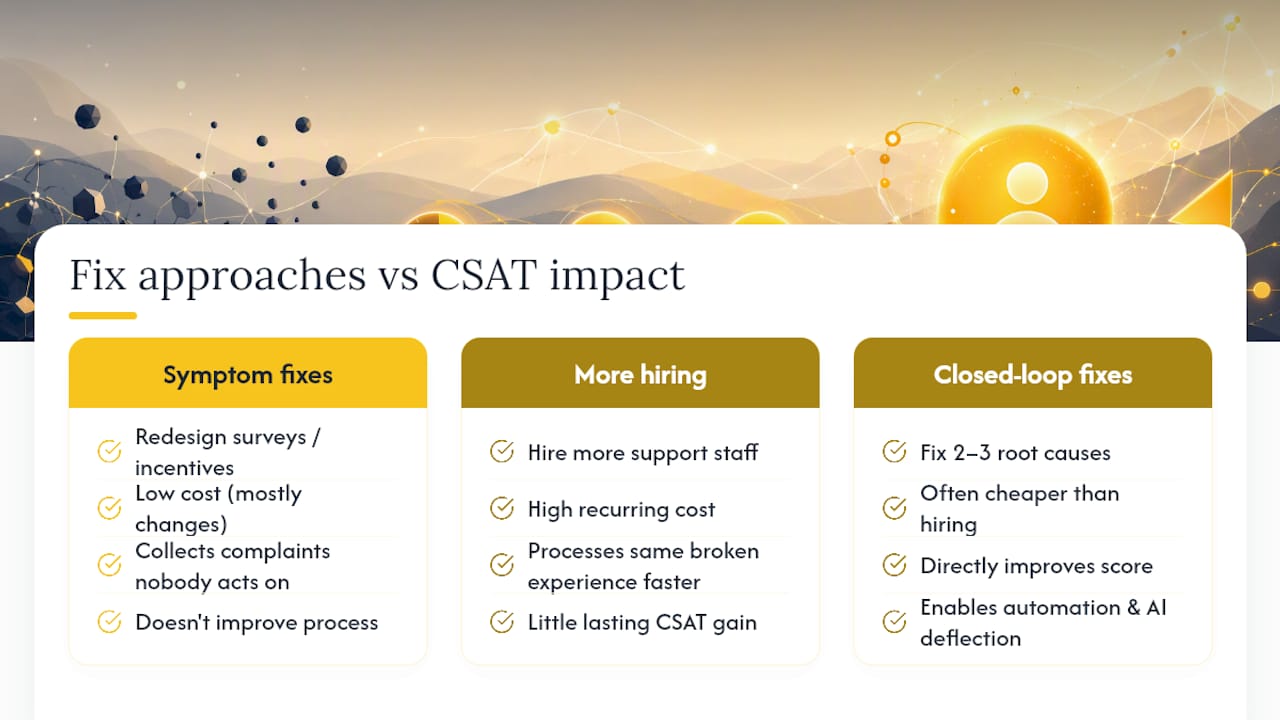
Conventional wisdom says hire more support staff when CSAT dips. That's often the expensive way to solve a cheap problem. Fixing the two or three root causes behind your worst tickets does more for your score than doubling your team, because a bigger team just processes the same broken experience faster.
If you take one thing from this, prioritize the closed loop before you touch anything else. A survey redesign without a follow-up mechanism is just a nicer way to collect complaints nobody acts on. Once that loop exists, automation and AI deflection become genuinely useful, because they free your best people to work the cases that actually move the number. Skip the loop, and you're just automating neglect faster.
Patrik
Get a Clearer Picture of Why CSAT Moves
Surveys tell you customers were unhappy. They rarely tell you why, and they almost never tell you which unhappy account was about to churn anyway. That's the gap Customerscore.io closes: it reads usage patterns, billing events, and support history so you can see which accounts are at real risk, not just which ones answered a survey badly.
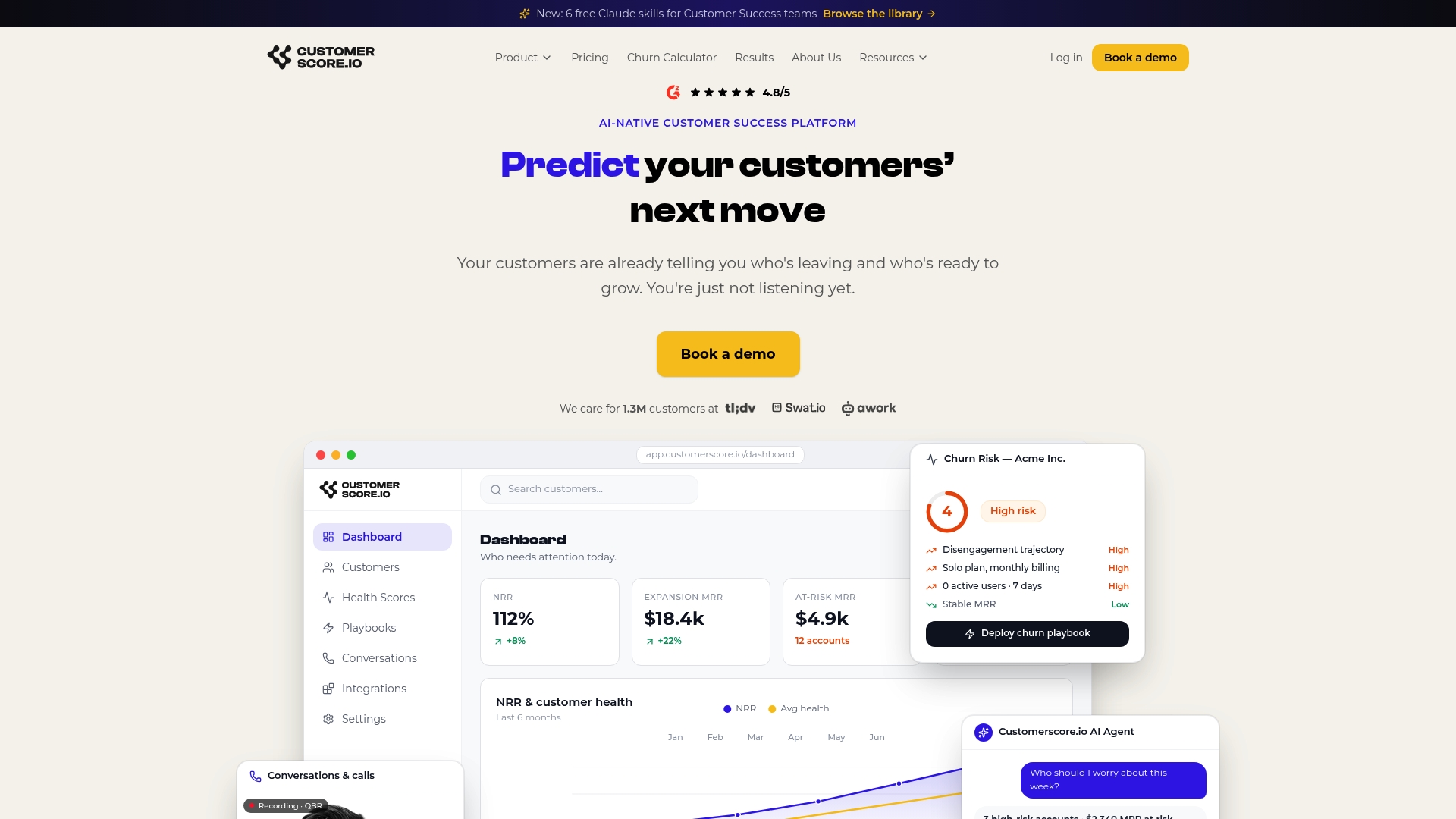
Instead of manually cross-referencing a detractor ticket against renewal dates, Customerscore.io's health scoring surfaces the accounts where support friction lines up with declining product usage, the combination that actually predicts churn. Pair that with churn prediction and your team stops treating every low score the same way; you triage based on real account risk instead of survey volume alone.
If your CSAT process currently lives in spreadsheets and disconnected support tickets, book a demo and see how the closed-loop workflow described in this guide runs when the data is already connected for you.
Sources
- CSAT: Formula, B2B SaaS Benchmarks & Guide (2026) | RevOS
- 8 Ways To Increase CSAT Score (and Make Customers Happier) | Gorgias
- CSAT Strategy: Turn Customer Satisfaction Into Growth | VWO
- Turn CSAT Data into Action: The Closed-Loop Method | XAZA Tech
Recommended
Related articles
Five Fields to Fix Playbook Trigger Design for B2B SaaS CS & RevOps
Five Fields to Fix Playbook Trigger Design for B2B SaaS CS & RevOps ! Isometric trigger routing system illustration The most reliable approach to playbook trigger design is to sort every alert into
BlogStop SaaS Downgrades: Save 31% of At Risk Accounts for CS & RevOps
Stop SaaS Downgrades: Save 31% of At Risk Accounts for CS & RevOps ! Isometric account protection title card The fastest way to prevent SaaS downgrades is to stop treating every at-risk account the
Blog24–48 Hour Handoffs: B2B SaaS Support to CS Checklist, Six Fields
24–48 Hour Handoffs: B2B SaaS Support to CS Checklist, Six Fields ! Isometric handoff cards crossing between platforms A reliable support to CS handoff transfers ownership and context so the new owner
Blog90–120 Day Explainable AI Playbook to Reduce Renewal Risk for SaaS CS
90–120 Day Explainable AI Playbook to Reduce Renewal Risk for SaaS CS ! Isometric illustration of explainable renewal risk decisions To reduce renewal risk, you prioritize accounts daily using