
Limit Each Executive Sponsor to 4–5 Accounts: Ops Rules for CS Leaders


An executive sponsor program pairs a named executive with a strategic account to build peer-level relationships and unlock advocacy that a customer success manager can't get alone. It works because a CCO trusts another CCO faster than a vendor rep. Reserve it for a portion of your highest-value accounts by annual recurring revenue, accounts running significantly above your average contract value, or a strategic logo showing real churn risk.
TL;DR:
- Prioritize sponsorship for high-value, strategic accounts facing renewal risk, multi-year deals, or early churn signals to maximize impact.
- Limit sponsors to four or five accounts each to maintain meaningful engagement and avoid superficial relationships.
- Track retention, expansion revenue, and direct relationship scores quarterly, comparing sponsored accounts against control groups for accurate attribution.
- Conduct regular audits and keep a documented sponsor roster to ensure consistent touchpoints and prevent program drift.
- Use automated tools to trigger renewal and risk alerts, ensuring timely sponsor involvement before critical renewal deadlines.
Table of Contents
- What is the goal of an executive sponsor program?
- Which accounts actually need an executive sponsor?
- Who selects accounts and pairs sponsors?
- What does the executive sponsor actually do versus the CSM?
- How often should sponsors meet with accounts?
- How do you brief an executive before a strategic call?
- How do you measure whether the program is working?
- What goes wrong with executive sponsor programs?
- How Customerscore thinks about executive sponsorship
- See sponsor triggers before the renewal clock runs out
- Sources
What is the goal of an executive sponsor program?
The core purpose is relationship multi-threading. When one CSM is the sole point of contact, a single departure or reorg can sink the account overnight. A sponsor creates a second, senior line of connection that survives staff turnover on both sides.
GitLab's executive sponsorship framework ties the program to measurable relationship strength, adoption, and NPS, not just goodwill. That distinction matters for how you set targets. Vague goals like "build relationships" don't survive a budget review; specific ones do.
Set goals around outcomes you can track quarter over quarter:
- Retention rate on sponsored accounts versus non-sponsored accounts of similar size
- Expansion ARR generated within sponsored relationships
- Relationship or NPS score collected directly from the customer executive
- References and case studies produced from sponsored accounts
A reasonable first-year target: retention on sponsored accounts running 5 to 10 points above your baseline, with at least one reference generated per sponsor annually.
Which accounts actually need an executive sponsor?
Not every account benefits from executive time, and treating sponsorship as a reward rather than a risk tool wastes your most expensive resource. The clearest case for a sponsor is an account facing a renewal decision where the buying committee has grown past the CSM's usual contacts.
Sponsors deliver value in a few concrete ways: faster resolution when an enterprise account hits a legal or procurement wall, a credible voice when a champion needs air cover internally, and a second relationship thread that survives a reorg. HubSpot Research found that companies with growing revenue rate customer success as very important more often than companies with stagnating revenue. That gap tracks closely with which companies bother to formalize sponsorship at all.
Start a sponsor relationship when you see:
- Renewal risk on an account above your ACV threshold
- A multi-year or multi-product deal entering negotiation
- A procurement or RFP process requiring peer-level sign-off
- A strategic logo showing early churn signals in usage data
Who selects accounts and pairs sponsors?
Someone has to own this or it drifts. Most programs assign ownership to the VP or head of customer success, with final sign-off from the CS or revenue leadership team. Build the selection process as a repeatable cycle, not a one-time exercise.
- Shortlist candidates using ARR, ACV multiple, and risk scores pulled from your account health data.
- Review the shortlist with CS and sales leadership to confirm strategic fit and catch accounts the data missed.
- Match sponsor to account based on title parity, industry familiarity, and available time.
- Confirm the pairing with the CSM and document it in your CRM or program roster.
- Reassess annually, rotating sponsors that have stagnated or accounts that no longer qualify.
Matching quality drives adoption more than most programs realize. GitLab's own framework treats seniority parity and relationship style as selection criteria, not afterthoughts. Pairing a CFO with an ops-focused sponsor produces flat conversations even when the account is strategically sound.
What does the executive sponsor actually do versus the CSM?
Confusing these roles is the fastest way to break a program. The sponsor exists for strategic altitude; the CSM owns everything tactical.
Executive sponsor responsibilities:
- Attend strategic QBRs, typically one or two per year, not every quarterly check-in
- Advocate internally when the account needs cross-functional support
- Step into escalations rarely, and only after the standard path is exhausted
- Cultivate references and case studies once trust is established
CSM responsibilities:
- Run day-to-day account management, adoption tracking, and support coordination
- Prepare the sponsor before every strategic touchpoint
- Handle tactical issues without looping in the executive
- Document every interaction so the sponsor never walks in blind
Escalation should follow a fixed path: CSM attempts resolution first, then CS leadership reviews, and only then does the executive sponsor step in. Direct customer-to-executive contact outside that path should loop back to the CSM immediately, or you'll train customers to skip your team entirely.
Pro Tip: Give every sponsor a one-page "if a customer emails you directly" script. Most awkward escalations happen because the executive didn't know the CSM was already three steps into resolving it.
How often should sponsors meet with accounts?
Cadence needs to be light enough that executives don't resent the program and frequent enough that the relationship stays real. A workable template looks like this:
- One informal touchpoint per quarter: a short call, an email check-in, or a conference run-in
- Two formal strategic QBRs per year where the sponsor discusses roadmap and business outcomes
- Ad hoc involvement triggered by renewal risk or contract size
HubSpot's renewal workflow guidance recommends triggering executive involvement at 120, 90, and 60 days before renewal for large or at-risk contracts, giving the sponsor time to build context before the account is in crisis mode.
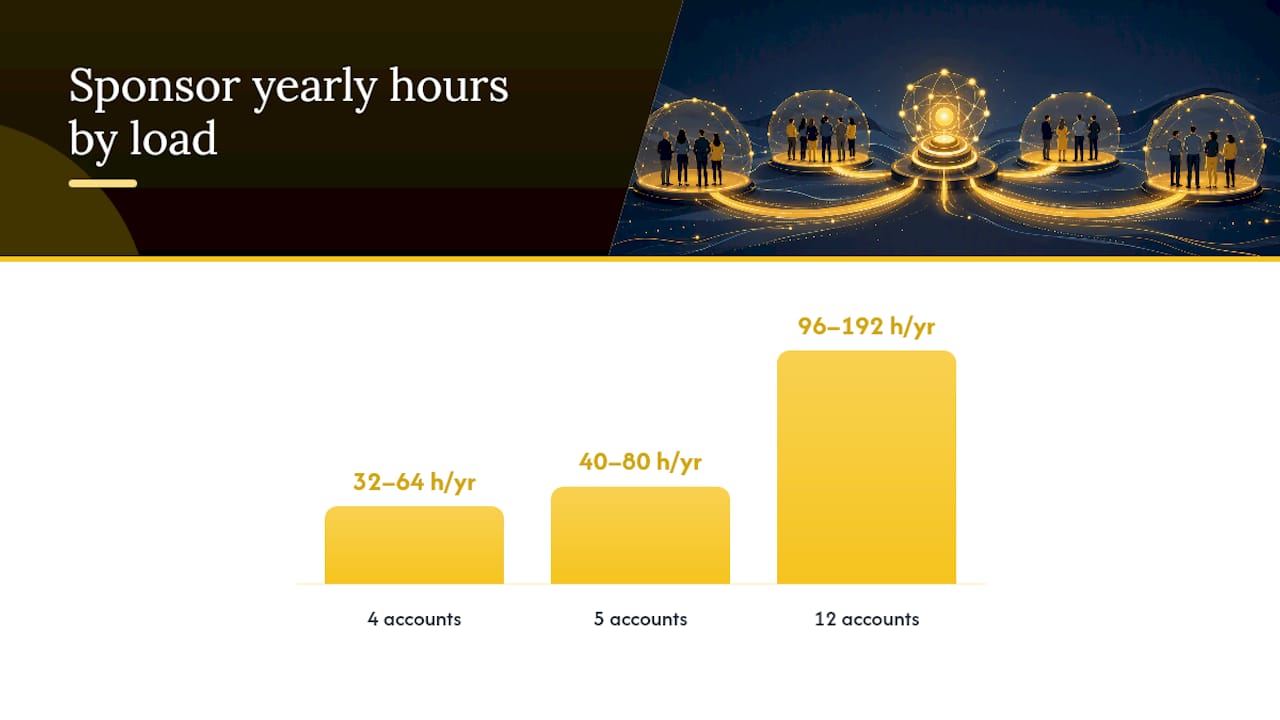
Time budget matters more than most programs admit. Plan for 8 to 16 hours per account per year, and cap each executive at 4 to 5 accounts. Beyond that, engagement quality drops fast, and a sponsor spread across a dozen accounts is a sponsor in name only.
How do you brief an executive before a strategic call?
Executives don't have time to read a full account history, so hand them a distilled version. A one-page brief works better than a slide deck: context in two sentences, the specific ask, three data points that matter, and the outcome you want from the call.
Build in a short pre-brief ritual, 15 to 30 minutes with the CSM before any strategic touchpoint. This is where the CSM flags political dynamics, recent friction, and what "success" looks like for this particular conversation.
- Context: why this account, why now
- Objectives: what the call needs to accomplish
- Key data points: usage trends, expansion signals, renewal date
- The ask: what you want the customer executive to agree to or commit to
- Desired outcome: the one sentence that defines a good call
Coach sponsors to keep it peer-to-peer. Startup Fundraising's sponsor program playbook is blunt about this: the moment a sponsor call turns into a status update, you've wasted a scarce resource on something a CSM could have handled by email.
Pro Tip: If your sponsor's talking points read like a QBR deck, rewrite them. Strategic conversations open with a question about the customer's business, not a recap of your product roadmap.
How do you measure whether the program is working?
Track a small set of numbers consistently rather than a large set sporadically. Retention rate, expansion ARR, and a relationship or NPS score collected directly from the sponsored executive form the core of most dashboards. Layer in reference generation as a lagging indicator of real trust.
Report monthly on leading indicators, quarterly on the numbers leadership actually cares about:
- Retention rate on sponsored accounts, tracked against a non-sponsored control group
- Expansion ARR attributed to accounts with an active sponsor
- Relationship score from direct executive feedback, not proxy metrics
- Reference and case study count per sponsor per year
Attribution is the trap here. An account renewing after a sponsor engagement doesn't prove the sponsor caused the renewal. Compare sponsored accounts against a similar cohort without sponsorship, and be honest when the numbers show the program helped at the margin rather than saved the deal outright.
What goes wrong with executive sponsor programs?
The most common failure is overloading executives with accounts until every relationship feels thin. Cap meaningful sponsorships around 4 to 5 accounts per executive and resist the pressure to add "just one more" strategic logo.
The second failure is using sponsors to patch a struggling CSM. If an account is unhappy because of poor onboarding or slow support response, an executive call won't fix the underlying onboarding or staffing problem, it just delays the reckoning.
Run a lightweight audit every 6 to 12 months:
- Are sponsors actually holding their scheduled touchpoints?
- Is there a documented rotation policy, ideally every 2 to 3 years?
- Are briefing checklists being used, or skipped under time pressure?
- Does the program roster exist somewhere CSMs can actually find it?
Pro Tip: Publish the sponsor roster internally. Programs quietly die when only one person in the company knows who's assigned to what.
How Customerscore thinks about executive sponsorship
Most sponsor programs fail on logistics, not strategy. Someone forgets to trigger the 90-day renewal touchpoint. A briefing doc lives in someone's inbox instead of the account record. Nobody notices an executive has quietly stopped showing up to QBRs.
Customerscore builds around that gap: automated triggers for renewal milestones, health scores that flag when an account needs sponsor attention, and a single record where briefing notes and touchpoint history actually persist. The tooling doesn't replace judgment. It just stops good programs from dying to spreadsheet drift.
Patrik
See sponsor triggers before the renewal clock runs out
Most of what breaks an executive sponsor program isn't strategy, it's timing. A 90-day renewal trigger gets missed because nobody was watching the account health score, or a briefing document gets buried in someone's inbox the week the QBR actually happens.
Customerscore's account health scoring flags at-risk strategic accounts automatically, so your sponsor program pulls from real risk data instead of gut instinct. Pair that with expansion scoring to catch accounts ready for a sponsor-led upsell conversation, not just a save. If your CS stack already runs through HubSpot, the HubSpot-native customer success app keeps sponsor triggers, briefing templates, and touchpoint history inside the same workflow your CSMs already use.
Book a demo to see how the dashboards and renewal triggers work before your next 120-day window opens.
Sources
- Executive Sponsorship Program | The GitLab Handbook
- The Beginner's Guide to Building a Successful Customer Success Program | HubSpot
- Executive Sponsor Programs for B2B Startups: 2026 Playbook
Recommended
Related articles
Five Fields to Fix Playbook Trigger Design for B2B SaaS CS & RevOps
Five Fields to Fix Playbook Trigger Design for B2B SaaS CS & RevOps ! Isometric trigger routing system illustration The most reliable approach to playbook trigger design is to sort every alert into
BlogStop SaaS Downgrades: Save 31% of At Risk Accounts for CS & RevOps
Stop SaaS Downgrades: Save 31% of At Risk Accounts for CS & RevOps ! Isometric account protection title card The fastest way to prevent SaaS downgrades is to stop treating every at-risk account the
Blog24–48 Hour Handoffs: B2B SaaS Support to CS Checklist, Six Fields
24–48 Hour Handoffs: B2B SaaS Support to CS Checklist, Six Fields ! Isometric handoff cards crossing between platforms A reliable support to CS handoff transfers ownership and context so the new owner
Blog90–120 Day Explainable AI Playbook to Reduce Renewal Risk for SaaS CS
90–120 Day Explainable AI Playbook to Reduce Renewal Risk for SaaS CS ! Isometric illustration of explainable renewal risk decisions To reduce renewal risk, you prioritize accounts daily using